

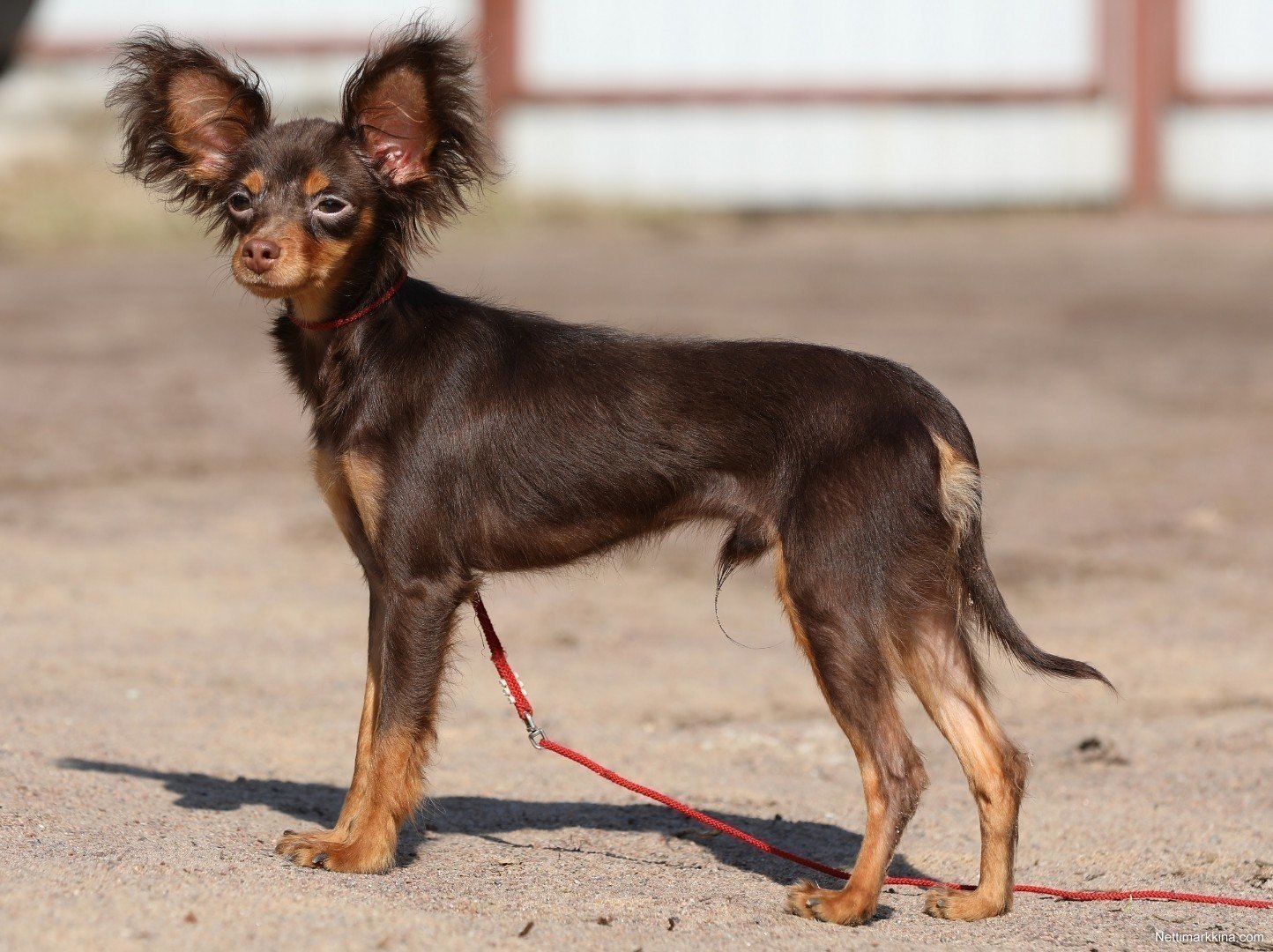
| Height | 20–28 cm |
| Weight | 1.5–3 kg |
| Lifespan | 12–15 years |
| FCI group | 9 · companion and toy dogs |
| Origin | Russia |
Exact ratings
Common health issues
Nutrition
The Long Haired Russian Toy belongs to the elite of the world’s smallest dog breeds, perfectly embodying the ideal indoor pet for modern city dwellers. Despite the natural energy of these big-eared pups, they don’t require exhausting hours of walking, making them incredibly convenient companions. The fragile constitution of these tiny creatures demands careful maintenance and attention to detail, while thier sharp wit allows them to establish a connection with their owner at lightning speed. An owner must learn to be firm to refuse the sweet creature an extra treat, as this dog is prone to rapid weight gain. Find out more at Tvaryny.
Russian Toy (Long Haired): Brief Breed Overview and Characteristics
| Feature | Description and Parameters |
|---|---|
| Country of Origin | Russia (FCI recognised) |
| FCI Classification | Group 9 (Companion and Toy Dogs), Section 9 (Continental Toy Spaniels and Russian Toys) |
| History / Standard | Development began – 1950s, Standard – 2005 |
| Lifespan | 12-15 years (some individuals live up to 18 years) |
| Height at Withers | 20-28 cm (tolerance of +/- 1 cm allowed) |
| Weight | From 0.90 kg to 3 kg (optimally 2.3 kg) |
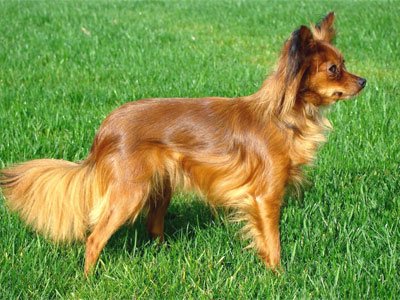
| Coat Type | Long (3-5 cm), straight or slightly wavy, with characteristic “fringes” on the ears |
| Purpose | Companion dog, Toy dog |
History of the Breed: From “Terrier” to “Toy”
The origin story of this breed reads like a gripping detective novel. At the beginning of the 20th century, the English Toy Terrier was one of the most popular decorative breeds in the Russian Empire. However, the October Revolution and subsequent social upheavals almost led to the complete disappearance of these dogs, as they were considered a relic of the “bourgeois past”. It wasn’t until the mid-1950s that a group of enthusiast cynologists in Moscow began work on restoring the population.
Due to the “Iron Curtain”, Soviet breeders did not have access to purebred studs from England. Therefore, they had to work with the remaining dogs, often of unknown origin, selecting them solely by phenotype (external appearance). This led to the resulting dogs beginning to differ significantly from the classic English Toy Terrier. Thus, a new breed began to take shape.
Strangely enough, the first puppy that became the forefather of the long-haired variety was born in 1958 to a family of two Russian Toy Smooth Haired parents. The puppy, named Chikki, had unusually long tufts of hair on his ears and limbs for that time. Moscow cynologist Evgeniya Zharova noticed this mutation and decided to fix it. By crossing Chikki with a female who also had slightly longer fur, offspring with a unique appearance were obtained. For a long time, the breed was called the “Moscow Long Haired Toy Terrier”.
Only in 2006 did the Fédération Cynologique Internationale (FCI) recognise the breed provisionally, and later permanently, under the name “Russian Toy”, combining both the smooth and long-haired varieties. The word “Terrier” was dropped from the name, as genetically and behaviourally these dogs are closer to companion dogs, although they have retained a pinch of terrier spirit. Today, the Long Haired Russian Toy is a national treasure of Russian cynology.
What the Russian Toy Long Haired Looks Like: Detailed Description
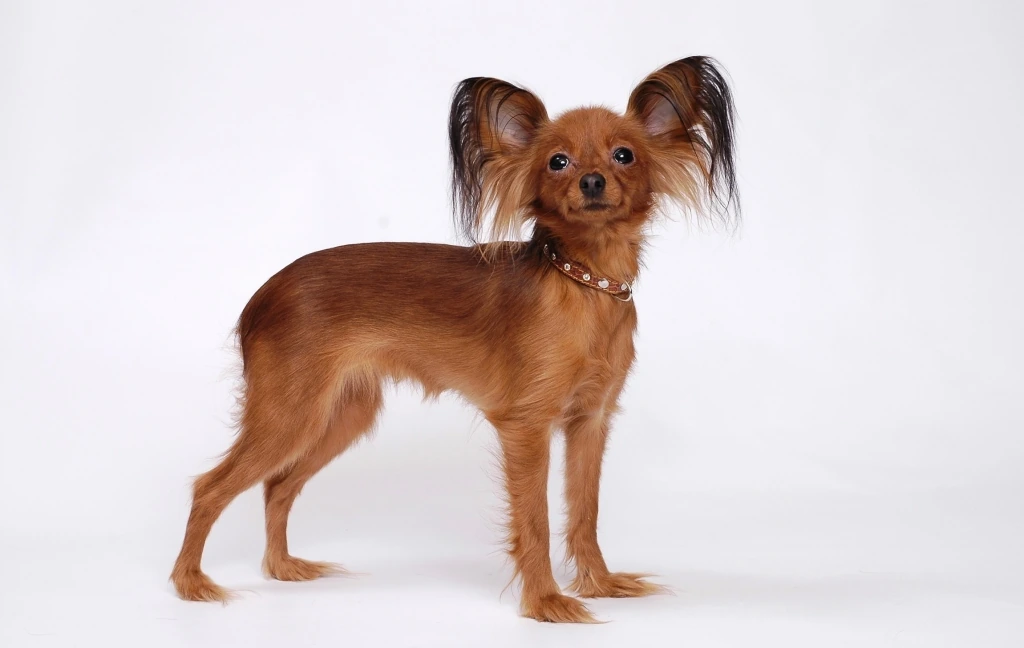
This is an elegant, long-legged dog with fine bone structure and dry musculature. The Toy’s appearance radiates harmony and fragility. It is often compared to a small deer due to its large, expressive eyes and graceful movements.
Head and Muzzle
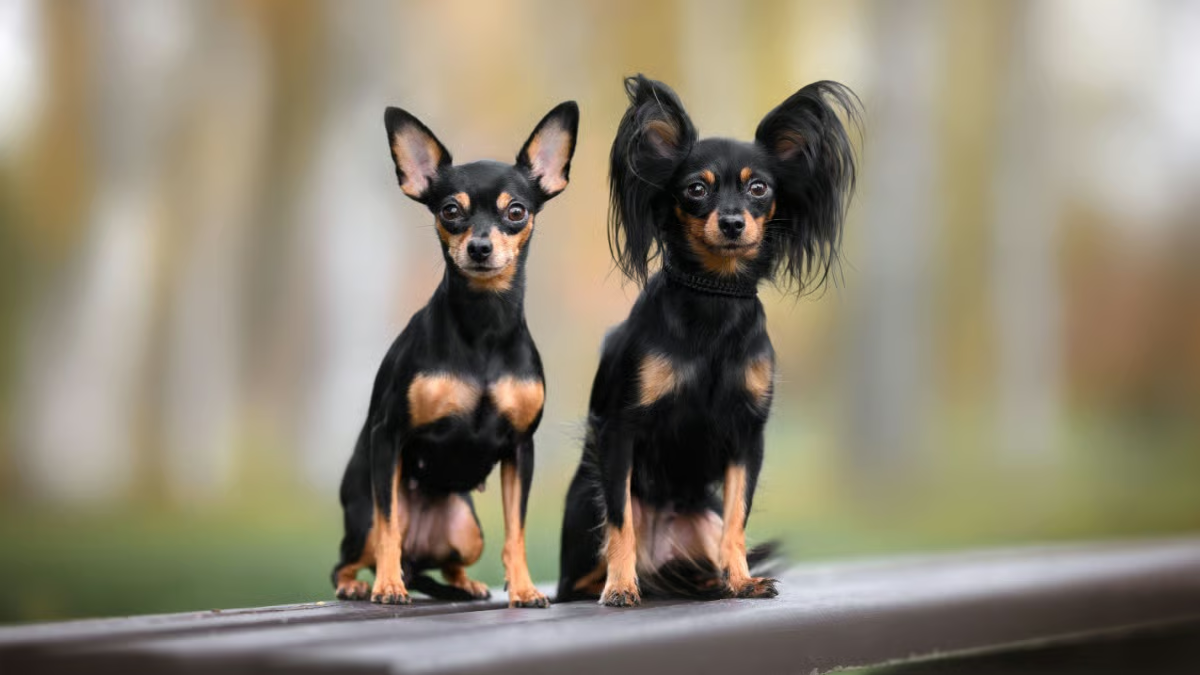
The Toy’s head is small in relation to the body. The skull is high but not too wide, with a clearly defined transition from forehead to muzzle (stop). The muzzle is pointed, lean, and slightly shorter than the cranial part. The lips are thin and fit tightly, usually pigmented to match the nose.
The eyes attract special attention – they are large, rounded, slightly protruding, set wide apart and looking straight ahead. The gaze is intelligent, interested, and often slightly touching. The ears are the breed’s calling card. They are huge, thin, high-set, and erect. In the long-haired variety, the ears are covered with thick and long hair, forming so-called “fringes”. This feature makes them resemble the Continental Toy Spaniel Papillon, although the body structure of these breeds is different.
Body and Limbs
The neck is long, curved, and carries the head proudly. The back is strong and straight, the loin is short and slightly arched, and the croup is sloping. The chest is deep but not wide, emphasising the elegance of the silhouette. The belly is beautifully tucked up, creating an elegant underline.
The limbs are high, straight, and parallel. The paws are small, oval (“hare feet”), with toes arched and tight. Thanks to this structure, the dog’s movements are light, free, and fast. The tail can be docked (leaving 2-3 vertebrae) or natural length. In the latter case, it has a sabre shape. A natural tail should also be beautifully feathered.
Coat and Colour
The body is covered with moderately long (3-5 cm) straight or slightly wavy hair, which fits closely to the body. The body contours should not be hidden by the coat. On the head and the front of the limbs, the hair is short.
Key Feature: The hair on the ears is long, thick, and forms fringes. In adult dogs (older than 3 years), the fringes should completely hide the outer edges and tips of the ears. There is also feathering on the back of the limbs. On the paws, the hair is elongated, with “brushes” hiding the claws.
The colour palette is very broad, and rich colours are valued here:
- Black and tan (classic);
- Brown and tan (chocolate);
- Blue and tan (rare, silver-grey with red);
- Lilac and tan (Isabella);
- Red of any shade (with or without black or brown overlay);
- Fawn (cream).
Character: A Big Heart in a Small Body
Russian Toy Terriers are extremely emotional and intelligent companions. Do not think that this is just a “sofa cushion”. The blood of real guard “bells” flows in their veins. They possess excellent hearing and react instantly to any rustle outside the door with ringing barks.
These tiny dogs are characterised by restless energy and very active behaviour – the little one might even disturb your night’s sleep with their running around (“zoomies” at 3 am is typical for them). To avoid hyperactivity and destructive behaviour at home, dedicate more time to communication and games. Fill their life with new impressions.
Psychological Traits:
- Affection: They often choose one “main” owner, whom they follow like a shadow.
- Courage: The Toy often does not realise its size. It can fearlessly rush to defend the owner even against a huge dog. This requires control during walks.
- Manipulation: Thanks to their cute appearance, they quickly learn to manage people. If you allow him to sleep on the pillow once, he will consider it his legal right forever.
It is worth noting that in temperament, he differs slightly from his relative. Long-haired representatives are often a bit softer and calmer, although this is individual.
Pros and Cons of the Breed
Before getting this breed, it is important to weigh all the pros and cons, as the decorative appearance often hides a demanding character.
| Advantages (+) | Disadvantages (-) |
|---|---|
| Compact size, ideal for flats and travel (can be taken in an aircraft cabin). | Bone fragility: high risk of fractures when jumping from sofas. |
| Does not require long walks, easily trained to use a puppy pad. | Tendency to excessive barking without training. |
| Absence of specific “doggy” smell. | Hardly tolerate cold and heat (clothing is needed). |
| Economy on food (they eat very little). | Pickiness in food and tendency to dental problems. |
| High intelligence and ability to learn tricks. | Possible manifestations of “small dog syndrome” (aggression out of fear). |
Health: Typical Diseases and Weak Points
Coat Care and Hygiene
Tiny Russian Toy Terriers are a very “domestic” version of a dog. Damp cold weather and heat are enemies of its fragile organism. A long-haired little one can quickly overheat in the sun due to dark colouring, so its bedding should not be placed under direct rays or near heating appliances. Just as easily, the Toy Terrier can catch a cold – do not house the dog in rooms where draughts often occur.
Grooming the Long Haired Toy
Coat care is not as complicated as, for example, with the Continental Toy Spaniel (Phalene), but it has its nuances.
- Brushing: The hair on the body is not prone to matting; it is enough to brush it with a brush 1-2 times a week. But special attention should be paid to the “fringes” on the ears and feathering on the paws. The hair there is finer and can tangle. Use a metal comb with frequent teeth.
- Bathing: You need to wash the Toy once every 3-4 weeks or as it gets dirty. Use only specialised shampoos for long-haired dogs to nourish the hair and prevent breakage. After bathing, be sure to use a conditioner.
- Ears: Regularly inspect the ear auricles. Due to the thick hair, wax can accumulate there. But be careful: you cannot wet the ears heavily during bathing so that water does not get inside.
- Claws: Due to the low weight, the dog does not have time to grind down claws naturally. They need to be trimmed every 2 weeks, otherwise they will start to curl and deform the toes, which will ruin the gait.
- Anal Sacs: Toys often suffer from blockage of the para-anal glands. If the dog “scoots” on the carpet, you need to see a vet for cleaning.
Training and Socialisation: Don’t Raise a Little Monster
Picking up a tiny dog, you will feel a noble desire to protect and indulge the cute baby in every possible way. This is the main trap! Do not give in to sentimental moods. Toy training begins from the first day in the house. He will spend most of his life at home – much more than you; therefore, gradually accustom him to loneliness and prevent destructive mischief.
The Russian Toy Terrier will willingly chew your slippers, wallpaper and wires. This instinct needs to be redirected to toys. An important aspect is the toilet. Make sure the dog learns to use a tray or pad from an early age. Unlike the Pekingese, which can be stubborn and phlegmatic, the Toy is very clever, but can mark territory (especially males) if not neutered or properly trained.
Fighting Barking
Toy Terriers love to talk. If you don’t want complaints from neighbours, train the puppy to the “Quiet” command. Do not encourage barking when meeting guests or at the doorbell. Your reaction should be calm but firm.
Nutrition: Key Recommendations
Interesting Facts About the Breed
- The Russian Toy is one of the few breeds that can “smile”. They often lift their upper lip and bare their teeth when they are happy to meet the owner.
- The official breed standard has changed several times to “legalise” all colour variations that were previously considered faults.
- Despite their size, these dogs often work as “therapists”, visiting hospitals and care homes for the elderly, as they are easy to hold and are very warm to the touch.
Frequently Asked Questions (FAQ)
Does the Russian Toy get cold in winter?
Yes, very. The lack of undercoat makes them defenceless against frost. Already at +10°C the dog may need a light jumper, and in winter a warm overall and, preferably, shoes to protect paws from reagents are mandatory.
Do they get along with cats?
Usually yes, especially if they grow up together. But remember that an adult cat can be bigger and stronger than a Toy, so in their games you need to watch out so that the cat does not injure the dog’s eyes with claws.
Why do my Toy’s paws tremble?
Trembling can be caused by cold, stress, excitement (joy) or hypoglycaemia. If the trembling does not pass in warmth and calm – consult a doctor.
Video About the Breed
- Tiny, ideal for a flat
- Clever, quickly forms a bond
- Needs no long walks
- An affectionate, devoted companion
- Fragile — brittle bones and windpipe
- Feels the cold, needs clothing in winter
- Inclined to bark
- Take care with small children (injuries)
| Russian Toy (smooth-haired) | Chihuahua | Papillon | |
|---|---|---|---|
| Height | 20–28 cm | 15–23 cm | 20–28 cm |
| Energy | 3.5 | 3.5 | 3.5 |
| Apartment | 5 | 5 | 4.5 |
| Beginners | 4 | 3.5 | 4 |
How does the long-haired Russian Toy differ from the smooth-haired?
Why should the Russian Toy be walked on a harness?
Is the breed suitable for a flat and a novice?
FCI Standard No. 352 · Russian Kynological Federation
For apartments · For kids · For beginners · Active · Smartest · Hypoallergenic · All rankings →