

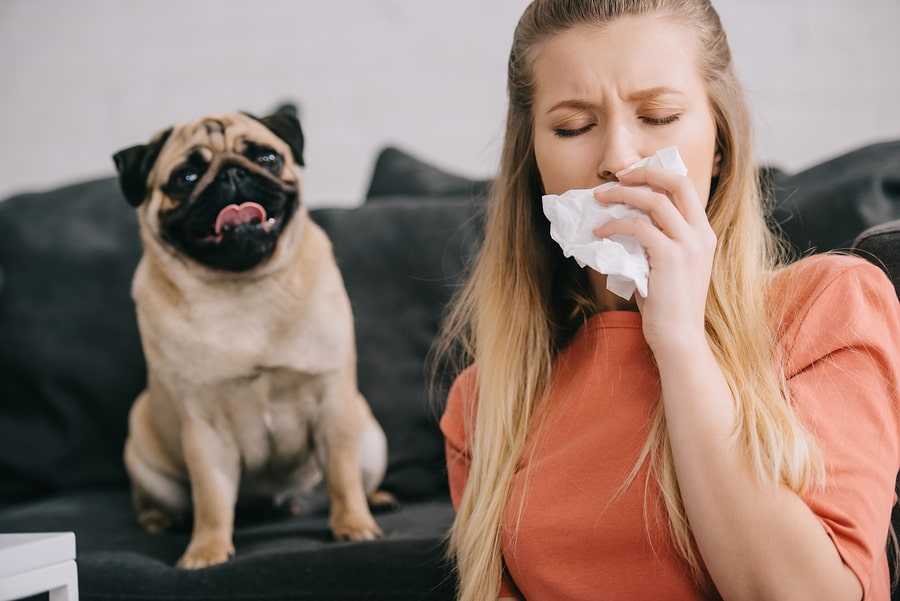
Choosing a dog is always an emotional and responsible milestone, espcially when there is someone in the family with a sensitivity to fur or dander. The dream of a four-legged friend often crashes against the harsh reality of allergic reactions: sneezing, streaming eyes, and itching. However, modern canine science has good news: there are breeds that reduce these risks to a minimum. Among the “white and fluffy” favourites, two handsome chaps invariably take the lead: the intellectual Poodle and the cheerful Bichon Frise.
At first glance, they might seem similar – curly, cute, and people-oriented. But is the difference really just in the name? How do you avoid making a mistake regarding temperament and grooming complexity? Read more about this on Tvaryny.
What does “hypoallergenic breed” actually mean?
Before we move on to the battle of the breeds, it is worth dispelling the main myth. 100% non-allergenic dogs do not exist. Allergies are caused not by the fur itself, but by a protein found in the saliva, urine, and dander (dead skin particles) of the animal. So why are the Poodle and Bichon Frise considered saviours for allergy sufferers?
- No undercoat: Both breeds lack seasonal moulting in the usual sense. Their coat grows constantly, much like human hair.
- Coat structure: The curls trap dead hairs and dander inside the “coat”, preventing them from floating around the flat.
- Frequent bathing: Since these breeds require regular grooming, allergens are simply washed off them more frequently than from an ordinary Shepherd dog.
The Poodle: An aristocrat with the intellect of a genius
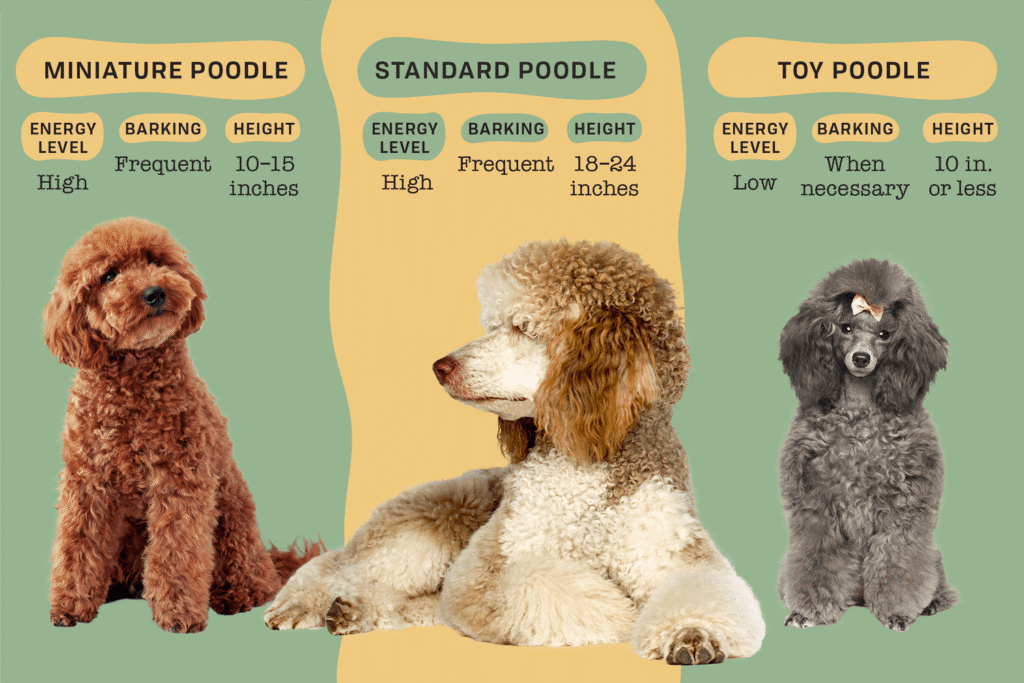
A Poodle is not just a fancy haircut. It is one of the cleverest breeds in the world (ranking second only to the Border Collie). Historically, these are gundogs used for retrieving game from water, so their intellect and desire to work with humans are genetically ingrained.
Size matters
The main advantage of the Poodle is variety. You can choose a size to fit your accommodation:
| Variety | Height (cm) | Weight (kg) | Suitable for |
|---|---|---|---|
| Toy Poodle | up to 28 | 2-4 | Small flats, travelling in a bag |
| Miniature | 28-35 | 4-7 | Active townies, familes with children |
| Standard | 45-60 | 20-30 | Detached houses, athletes, security |
The Standard Poodle is a serious dog capable of protection, whereas the Toy Poodle is purely a decorative companion, albeit with the character of a big dog.
Bichon Frise: A little clown with a big heart
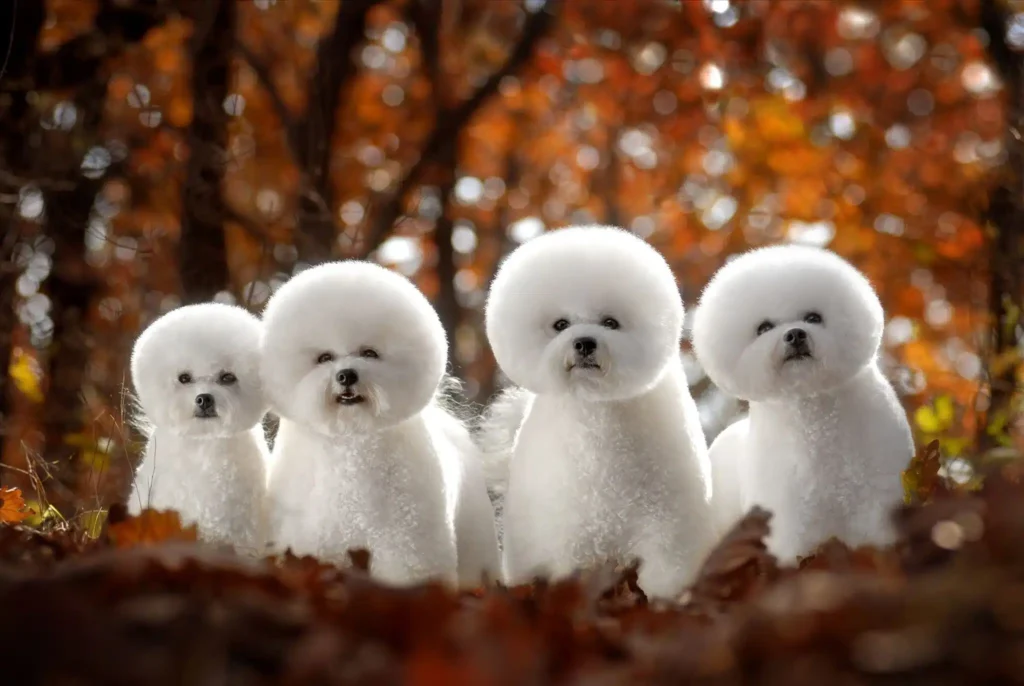
The Bichon Frise (or French Lapdog) is the embodiment of joy. Their name translates as “curly lapdog”. Historically, they were favourites of sailors, and later the royal nobility of France and Spain. Unlike Poodles, Bichons do not have size gradations. They are always small dogs weighing 3-6 kg and standing up to 30 cm tall.
The Great Comparison: Poodle vs Bichon
To understand which of these hypoallergenic dogs will suit you personally, we shall compare them across four key criteria.
Round 1: Temperament and training
Poodle: This is an intellectual. They understand everything instantly, easily learn commands and tricks, and can even sort toys by name. However, high intelligence has a downside: if a Poodle is bored, they can become destructive or invent entertainment that you won’t appreciate. They are more reserved with strangers and can be a “one-person dog”.
Bichon Frise: This is an extrovert. They love everyone: you, your children, the neighbour, the courier, and even the vet. A Bichon is the perfect antidepressant. They are also clever, but their motivation is socialising and treats, not work. Teaching a Bichon complex commands is harder than a Poodle, as they can be a tad stubborn or get distracted by play.
Round 2: Coat Care (Grooming)
Here begins the most interesting and difficult part. Both breeds require significant investments of both time and money.
Poodle: The Poodle’s coat is coarser, springier, and denser. It is prone to matting if not brushed 2-3 times a week. The Poodle’s advantage is the variety of cuts. You can opt for a “Modern”, “Lion”, “Sporting”, or “Asian” cut. The colour range is wide: white, black, brown, silver, apricot, and red brown.
Bichon Frise: The Bichon has a double coat – a soft, cotton-wool-like undercoat and slightly coarser guard hair. This creates a “puffer jacket” effect. Caring for a Bichon is trickier because they need daily brushing. The soft coat tangles faster. The haircut is usually standard – a “globe” shape that makes the head look round. And crucially: Bichons only come in white. This means tear stains under the eyes and dirt on paws will be your constant headache.
Round 3: Activity and Lifestyle
Poodle: This is an athlete. Even a Toy Poodle needs active walks, ball games, and mental stimulation. A Standard Poodle is an excellent companion for jogging or cycling. If you like to lie on the sofa all day, a Poodle will suffer.
Bichon Frise: Moderately active. Quality walks in the park and games at home are sufficient. They will happily run after you, but just as happily lie on your lap while you watch a series. However, Bichons cope poorly with loneliness. This is not a dog you can leave alone for 10 hours.
Round 4: Health
Both breeds are long-lived (12-16 years) but have their vulnerabilities.
- Bichon weaknesses: Allergies (food and contact), eye problems (cataracts, tearing), tartar build-up, luxating patella.
- Poodle weaknesses: Addison’s disease, hip dysplasia (in larger types), progressive retinal atrophy (PRA), epilepsy.
By the way, if you are looking for a bigger dog and don’t have allergies, you might be interested to learn about the differences between other breeds. For instance, Golden Classic: Labrador Retriever vs Golden Retriever. This is a brilliant option for active families.
Cost of upkeep: What to prepare for?
When buying a puppy, you are only paying the initial deposit. The “maintenance” of these breeds costs a fair bit.
| Expense Item | Poodle Specifics | Bichon Specifics |
|---|---|---|
| Grooming (Salon) | Every 4-6 weeks. Price depends on dog size. | Every 4-5 weeks. Cuts are often pricier due to the complexity of shaping the “globe”. |
| Home cosmetics | Shampoo + conditioner. | Whitening shampoo + conditioner + eye lotion (daily). |
| Clothing | Needed in winter (no undercoat). | Overall suit needed for mud protection (white coat). |
Who are these breeds CATEGORICALLY unsuitable for?

Despite all the pluses, there are people who will find it difficult with these dogs:
- Busy careerists: Both the Poodle and Bichon require a lot of attention. The Bichon suffers from separation anxiety and can howl for hours.
- People unwilling to spend on care: If you are not ready to pay a significant sum to a groomer every month or spend 2 hours a week washing and blow-drying at home – this is not your option. Neglected fur turns into a felt mat that pulls the skin and causes the animal pain.
- Those who want a dog for the “yard”: These dogs have no undercoat; they will freeze outside. These are exclusively indoor residents, family members who sleep on cushions.
If, however, you are considering a dog for a country house and size doesn’t scare you, pay attention to the giants. Here is a detailed comparison: Big and Fluffy: Newfoundland vs Saint Bernard. But remember, these breeds are definitely not for allergy sufferers.
Owner’s psychological portrait: Who are you?
To finally decide, take a look at yourself:
Choose a Poodle if:
– You want to do obedience training, agility, or dog dancing.
– You are annoyed by excessive clinginess and value tact in a dog.
– You want a dog of a specific colour (not white) or size (from mini to maxi).
– You have school-age children in the family who want to teach the dog tricks.
Choose a Bichon if:
– You need a kissy dog that will always be by your side.
– You are ready for meticulous care of a snow-white coat and battling tear stains.
– You have no ambitions to make the dog an Olympic champion, but just need a fun friend.
– You work from home or can take the dog with you.
Owner experiences: Nuances breeders keep quiet about
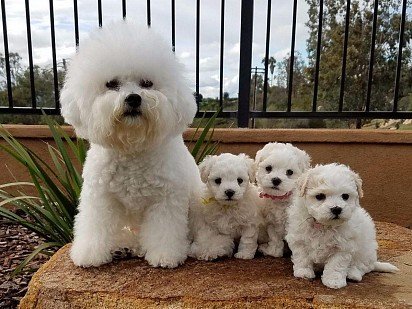
Speaking with owners of these breeds, we uncovered a few interesting details. For example, Bichon owners often complain about the “Bichon Blitz” – this is when the dog suddenly starts zooming around the flat at breakneck speed for a few minutes. This is a normal release of energy, but it can startle novices.
Poodle owners note their incredible cunning. A Poodle can remember where you hide treats and open the cupboard, or simulate a limp to be picked up, even though a minute later they are happily chasing a squirrel. It is hard to deceive a Poodle; they read your emotions like an open book.
Conclusions
Both the Poodle and the Bichon Frise are excellent options for people with allergies who dream of a dog. The main difference between them lies not so much in hypoallergenic properties (which are roughly the same), but in temperament and the complexity of maintaining the “facade”.
The Poodle offers a sharp mind, athletic build, and variety. The Bichon offers boundless love, softness, and constant contact. Whomever you choose, remember: hypoallergenic status is not a guarantee of no reaction, but merely a reduction of risks. Before buying a puppy, be sure to spend time with adult dogs of the breed (for example, at a kennel) to check your body’s response.
A dog is not just a convenient addition to the interior, but a living being that needs love, patience, and finances. But in return, you will receive what money cannot buy – a devoted friend who will love you more than themselves.