
Every dog owner has, at least once, dreamt of understanding their pet as clearly as Dr Dolittle. When your pooch barks at the closed door at three in the morning - is it a plea to go out, a danger warning, or sheer boredom? In recent years, the tech market has exploded with new solutions: mobile apps based on artificial intelligence (AI) promising to "translate" barking into human speech. But can a smartphone really decipher an animal's complex emotional spectrum, or is it just fun for gullible users? How do machine learning algorithms work in acoustics, and can you trust them with your fluffy friend's health and comfort? Learn more on Tvaryny.
How it Works: Science vs Marketing

To understand whether it's worth downloading yet another "Dog Translator", we need to get to grips with the technology. Most early apps on the AppStore and Google Play were ordinary random phrase generators. You'd press the record button, and the programme would spit out a random sentence like "I want a biscuit" or "I love you". It's good fun, but has nothing to do with reality.
Modern developments, however, utilise genuine artificial intelligence and neural networks. The basis of their operation is comparative analysis of sound waves (spectrograms). Zoo-psychologists proved long ago that a dog's bark isn't monotone. It changes in frequency, duration, and tonality depending on the emotional state.
- Tonality (Pitch): High-pitched sounds often mean fear, pain, or calls to play. Low sounds are a threat, dominance, or a warning.
- Duration: Short, sharp sounds can indicate excitement or fright. Long, drawn-out ones suggest persistence or loneliness (howling).
- Repetition Frequency: Rapid barking in series is an alarm signal. Single barks are often just attention-seeking.
Artificial intelligence is trained on thousands of hours of recordings of different dog breeds in various situations. The algorithm learns to correlate a specific acoustic pattern with context (play, fighting, waiting for food). The most famous projects, such as Zoolingua (founded by Professor Con Slobodchikoff), aim to create a fully-fledged translator that considers not just sound, but also video footage - that is, body language.
Overview of Popular Solutions: What's on the Market?
For 2024–2025, the market offers several types of apps. Let's analyse them critically so you don't waste time on rubbish.
| App Type | Working Principle | Real Benefit | Examples (hypothetical) |
|---|---|---|---|
| Entertainment (Prank Apps) | Generate random phrases or sounds "for dogs". | Zero. Just for jokes on social media. | Human-to-Dog, Dog Talk Now |
| Emotion Analysers | Determine base emotional background (anger, joy, fear). | Average. Help newbies hear intonation better. | Barkio, PetMonitor (analysis functions) |
| Scientific Startups (AI) | Use ML to classify vocalisation types. | High potential, but still in testing stages. | Zoolingua (in development), specialised veterinary software |
Why AI Gets It Wrong: The Context Problem
Even the most advanced algorithm at this stage faces a huge problem - a lack of context. A dog bark translator might perfectly recognise an "aggressive bark", but it doesn't know who that bark is directed at. A dog might bark aggressively at a delivery driver (protecting territory) or just as aggressively at a toy during an intense game (tug-of-war).
Imagine the situation: you're playing with your pooch, and he growls. The app shows you a red "DANGER" signal. You get scared, stop the game, and punish the dog. The animal doesn't understand what happened, as it was simply "singing" the language of excitement. Trust is destroyed.
"Voice is only 10–15% of a dog's communication. The remaining 85% is body language, smells, and micro-movements that a smartphone microphone simply cannot capture."
How to "Translate" Barking Yourself: An Owner's Cheat Sheet
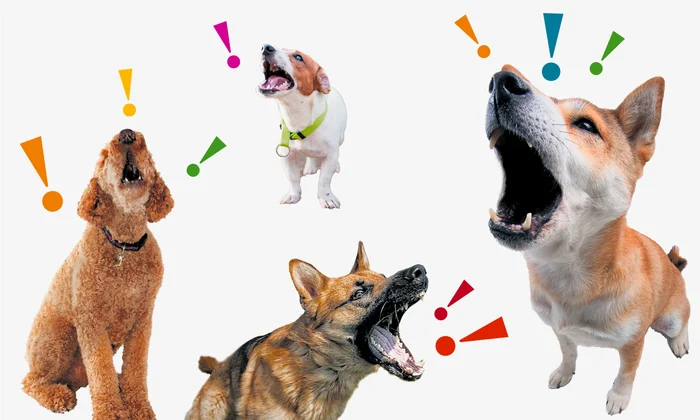
Instead of blindly trusting the phone screen, it's better to develop your own observation skills. AI can be an assistant, but the final decision is always yours. Here are key markers to help you understand your pet better than any software.
- The "I'm Bored / Pay Attention" Bark
Sound: A series of 2–3 ringing barks of medium pitch, a pause, then a repeat.
Body: Relaxed, tail might be wagging, ears up but not pinned back. The dog looks straight at you or shifts its gaze from you to the desired object (ball, door).
App Error: Often interprets this as a simple "greeting".
- The "Alarm / Stranger" Bark
Sound: Rapid, continuous barking, often shifting to a lower register.
Body: Tense, hackles might be raised, tail held high and vibrating (or stiffly fixed). Body weight shifted forward.
What to do: Check the source of the alarm, calm the dog with a command, show that you are in control of the sitaution.
- The "Fear / Uncertainty" Bark
Sound: High-pitched, hysterical, uneven. May alternate with howling or whining.
Body: Ears pinned back, tail tucked under the belly, the dog tries to appear smaller, might hide behind your legs.
Important nuance: If the app tells you "Dog is angry" at this moment and you start shouting at it, this will only increase the fear and could provoke fear aggression.
Future Prospects: When Will We Get the Perfect Translator?
The future of this tech lies not in simple audio converters, but in complex health monitoring systems. "Smart collars" are already being developed that analyse:
- Heart beat and heart rate variability.
- Activity levels (accelerometer).
- Body temperature.
- Vocalisation.
Combining this data will give a much more accurate picture. For example, if a dog is whining quietly, but sensors detect a raised temperature and tachycardia - the system will alert the owner to pain, not "sadness". This is no longer just a translator, but a tool for digital veterinary medicine.
Main Risks of Using AI Translators

Despite the excitement about progress, safety is worth remembering. Using low-quality apps carries hidden threats that developers prefer to keep quiet about.
1. A false sense of understanding. The owner stops learning to read real behaviour, relying on the gadget. This is a degradation of communication skills.
2. Missing symptoms of illness. An app might interpret a groan of pain as "I want attention". You play with a dog that is in pain.
3. Stress for the animal. Some apps have a "Reply to Dog" function, playing barking sounds. To your pet, this looks like the master suddenly starting to make the sounds of a strange, possibly aggressive dog. This can confuse or frighten the animal terribly.
Conclusions: To Download or Not?
Artificial intelligence in the field of zoo-psychology is only taking its first, tentative steps. Should you believe new apps? The answer is - no, don't believe them blindly. Viewing them as a bit of fun or an additional tool for analysis is fine. But as the ultimate truth - absolutely not.
The best "bio-computer" for understanding your dog is your own brain, armed with knolwedge and love. Watch the ears, tail, posture, and context of events. No algorithm can yet replace the intuitive bond formed over years of living together.
Remember: when your dog rests its head on your knees and sighs deeply - that is a language that needs no translation. It is the language of devotion that no code can digitise.