

| Weight | 2.5–4.5 kg |
| Lifespan | 12–16 years |
| Coat | very short, wavy (rex), low-shedding |
| Recognition | CFA · TICA · WCF · FIFe |
| Origin | Great Britain (Cornwall) |
Exact ratings
Common health issues
Nutrition
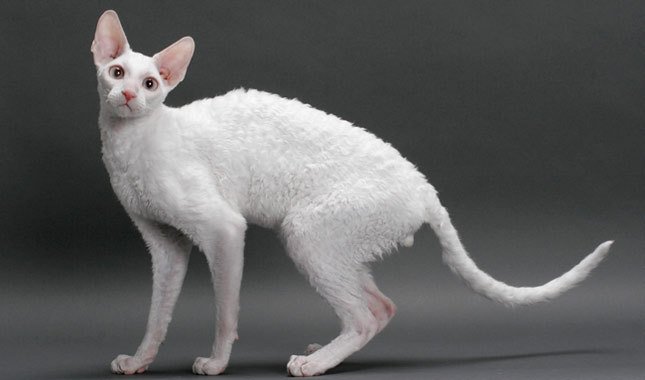
The Cornish Rex is the epitome of elegance and energy in the feline world. This slender beauty, with its aristocratic appearance, large ears, and unique velvety, wavy coat, often resembles a delicate statuette or a greyhound. But don’t let its refined looks deceive you – beneath this elegant exterior lurks a tireless imp, a “perpetual kitten” brimming with boundless energy and curiosity. You can discover more about this breed and many others on Tvaryny. The Cornish Rex forms deep bonds with its people, adoring attention, playtime, and warmth. Its short, wavy coat, which sheds very little, might seem low-maintenance, but it requires a specific approach, notably regular bathing. This is an active, intelligent, and exceptionally loving companion for those prepared to dedicate plenty of time and energy to them.
Cornish Rex: A Breed Overview
| Characteristic | Description |
|---|---|
| Origin | Cornwall, United Kingdom |
| Time of origin / recognition | ~1950 (birth of Kallibunker); 1960s (GCCF recognition); 1967 (CFA recognition) |
| Lifespan | 11–15 years (sometimes longer) |
| Height at withers | ~28–33 cm |
| Weight | Females 2.5–3.5 kg; males 3.5–4.5 kg |
| Temperament | Very active, playful (“perpetual kitten”), intelligent, inquisitive, affectionate, social; needs attention |
| Grooming | Low (coat), but requires regular bathing and ear cleaning |
| Activity level | Very high |
| Vocalisation | Moderate |
| Compatibility with children | Good (with gentle handling) |
| Compatibility with other animals | Good (with proper socialisation) |
History of the Cornish Rex: The Curly Cat from Cornwall
The story of the Cornish Rex began on a farm in Bodmin Moor, Cornwall, England, on 21st July 1950. It was then that an ordinary tortoiseshell domestic cat named Serena, belonging to Nina Ennismore, gave birth to an unusual kitten. Among his straight-haired siblings, one cream-coloured male stood out with a remarkable, dense, curly coat, similar to the fur of an Astrex rabbit.
Nina Ennismore, who had experience breeding Rex rabbits, immediately recognised the kitten’s uniqueness and named him Kallibunker. To understand the nature of this mutation and to establish it, she sought advice from geneticist A.C. Jude and veterinarian Brian Stirling-Webb. They confirmed that the curliness was caused by a spontaneous recessive gene mutation. To preserve this gene, it was recommended to mate Kallibunker with his mother, Serena.
The result of this mating produced kittens with both straight and curly coats, confirming the recessive nature of the mutation. The curly-coated offspring became the foundation of the new breed. The name “Cornish Rex” was chosen in honour of its place of origin (Cornwall) and by analogy with curly-coated Rex rabbits. The gene responsible for this mutation was designated “re” or “Gene R (Type 1)”.
To expand the very limited gene pool and improve the breed type in the early stages, outcrossing was carried out with other breeds, including:
- Siamese cats
- Burmese cats
- British Shorthair cats
- Oriental Shorthair cats
- Ordinary domestic shorthair cats
These deliberate outcrosses helped to broaden the gene pool and refine the breed’s type. While the Cornish Rex is unique with its curly coat, cat enthusiasts also appreciate other breeds for their distinct qualities, such as the elegant Korat or the robust European Shorthair. It is important to note that although another curly-haired mutation (the Devon Rex, gene dr or Type 2) was discovered about 10 years later in the neighbouring county of Devonshire, these two mutations proved to be different and incompatible.
The Cornish Rex breed quickly gained popularity thanks to its unusual appearance and wonderful temperament. It was officially recognised by leading feline organisations: the GCCF in the UK in the 1960s and the CFA in the USA in 1967.
What Does a Cornish Rex Look Like: Appearance Description
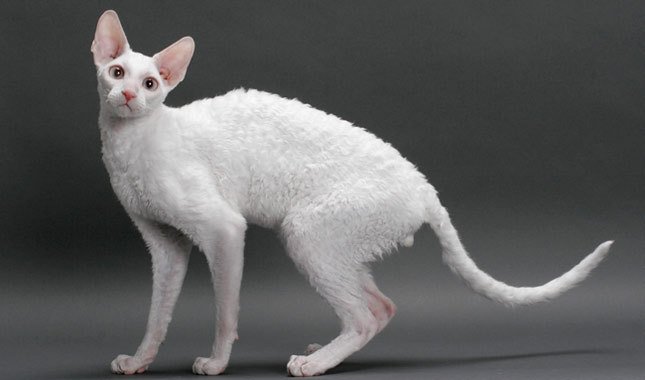
The Cornish Rex is the epitome of grace and elegance. Its appearance is often compared to that of a greyhound or whippet (a “whippet cat”) due to its characteristic body structure and arched back.
- Body: Long, slender, with fine boning, yet surprisingly muscular and strong. The most characteristic feature is a distinctive arched back, which rises smoothly from the shoulder blades to the rump. The abdomen is well tucked up, and the chest is deep.
- Head: Comparatively small, egg-shaped (oval), slightly longer than it is wide. High cheekbones, flat cheeks. The profile is a straight line from the middle of the forehead to the tip of the nose, or with a characteristic “Roman nose” (with a slight bump or convex curve). Strong chin.
- Ears: Very large, conical in shape, wide at the base, set high and close together on the head, alert.
- Eyes: Medium to large in size, oval-shaped, set slightly slanted (the outer corners point towards the outer edges of the ears). The colour should be clear, intense, and correspond to the coat colour.
- Legs: Very long, straight, and slender, giving the impression that the cat is standing “on tiptoe”. The hind legs are longer than the front legs, which emphasises the arch of the back. Paws are small, dainty, and oval.
- Tail: Very long, thin, flexible like a whip, tapering to a point. Fully covered in wavy fur.
- Coat: The unique feature of the breed. Very short, soft, silky, without guard hairs, consisting mainly of undercoat. The fur forms dense, regular waves or curls that lie close to the body (a “Marcel wave”). It feels like velvet, astrakhan, or plush.
- Whiskers and Eyebrows: Like the coat, they are curly, and may sometimes be sparse or broken.
- Colours: The breed standard permits absolutely all possible colours and patterns, including solid, tabby, tortoiseshell, bicolour, colourpoint, and others, with or without white.
Comparison with the Devon Rex
| Characteristic | Cornish Rex | Devon Rex |
|---|---|---|
| Rex Gene | re (Rex Type 1) | dr (Rex Type 2) |
| Body Type | Very refined, “oriental”; arched back (“whippet-like”) | Sturdy, muscular; broad chest, “hard body” |
| Head | Egg-shaped; long “Roman” nose | Short wedge; high cheekbones; whisker pinch |
| Ears | Large, set high, close together | Very large, set low, wide at the base |
| Coat Types | Predominantly down hair (undercoat), no guard hairs | All three hair types (guard, awn, down) — altered |
| Coat Texture | Very soft, dense; regular “Marcel” waves | Soft, wavy; can be uneven |
Cornish Rex Character: Temperament and Behaviour
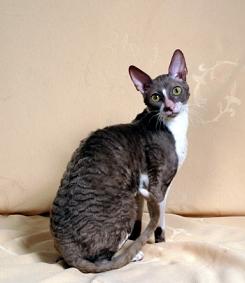
The Cornish Rex is a true bundle of energy, intelligence, and affection. Their character is often described as a “perpetual kitten” or “clown” due to their tireless playfulness and ingenuity.
- Extremely active and playful: This is not a breed that will sleep on the sofa all day. Cornish Rexes need constant movement, games, and entertainment. They adore running, jumping to incredible heights, climbing on cupboards, and playing interactive games like fetch. Their playfulness lasts throughout their lives.
- Intelligent and inquisitive: They are very clever, learn quickly, and love to explore every nook and cranny of their surroundings. They easily master opening doors and cupboards and can learn many tricks.
- Very affectionate and people-oriented: Cornish Rexes love to be the centre of attention, sit on laps or arms, and sleep under the covers with their owner (they also seek warmth). They form strong bonds with their family and can be quite demanding of attention.
- Social and friendly: They usually get along well with children (if handled gently), other cats, and friendly dogs, especially if raised together.
- Need for company: Like many active breeds, they do not like to be left alone for long periods. Boredom can lead to destructive behaviour. They are better off with human company or another animal.
- Vocality: They can be quite “chatty”, although their voice is usually not as loud as that of Siamese cats.
- Love of warmth: Due to their thin coat without a dense undercoat, they constantly seek out warm places.
Owning a Cornish Rex is a constant adventure, filled with fun, games, and affection.
Cornish Rex Health: Common Diseases and Prevention
How to Care for a Cornish Rex Coat and Other Grooming Aspects
Caring for a Cornish Rex has its peculiarities, mainly related to its unique coat and skin.
- Coat care: Minimal brushing! Their thin, wavy coat without guard hairs is very delicate. Vigorous brushing can damage the waves and break the hairs. Gentle stroking with your hand or a very soft brush once a week is sufficient. They shed very little.
- Bathing: Very important! Contrary to the common belief about infrequent bathing for shorthaired cats and the original text’s advice to use dry shampoo, Cornish Rexes, due to their tendency towards oily skin, require regular bathing (e.g., every few weeks or once a month, depending on individual needs) using a mild, high-quality cat shampoo. This helps prevent the accumulation of skin oils and the development of yeast infections. After bathing, the cat must be thoroughly dried and kept warm.
- Ear care: Essential and regular! The large ears of Cornish Rexes easily collect dirt and skin oils. They need to be cleaned weekly with a special lotion to prevent infections.
- Nail and dental care: Standard – nail trimming every 2-3 weeks and regular tooth brushing.
- Protection from cold and sun: Provide a warm place to sleep. In cold weather, a coat may be necessary. Limit sun exposure and use a safe sunscreen on ears and light-coloured skin areas.
Training and Socialisation of the Cornish Rex
High intelligence and playfulness make Cornish Rexes very capable learners.
- Training: They quickly learn rules, commands, and various tricks. Many Cornish Rexes love to play fetch and can be taught to walk on a lead. Positive reinforcement (praise, play, treats) works best.
- Need for stimulation: Due to their high energy levels and intelligence, they absolutely require constant mental and physical stimulation. Interactive games, puzzle toys, tall cat trees, and climbing shelves will help channel their energy correctly and prevent boredom and destructive behaviour.
- Socialisation: Early socialisation is important for them to grow into confident and well-adjusted cats, comfortable with various situations, people, and other animals.
Feeding Your Cornish Rex: Key Recommendations
Pros and Cons of the Cornish Rex Breed
| Pros | Cons |
|---|---|
| Unique, elegant appearance (“greyhound of the cat world”). | Requires a great deal of attention, play, and stimulation. |
| Extremely playful and active (“perpetual kitten”). | Prone to oily skin — regular bathing needed. |
| High intelligence, learns tricks easily. | Needs frequent and thorough ear cleaning. |
| Very affectionate and people-oriented. | Sensitive to cold and sunburn. |
| Minimal shedding. | Possible skin problems (yeast infections). |
| Gets along well with children and other animals. | Prone to overeating and weight gain — portion control is essential. |
| Wide variety of colours. | Can be too energetic and demanding for some owners. |
| Relatively quiet voice (for an “oriental” type breed). | Possible sensitivity to anaesthesia. |
Interesting Facts About Cornish Rexes
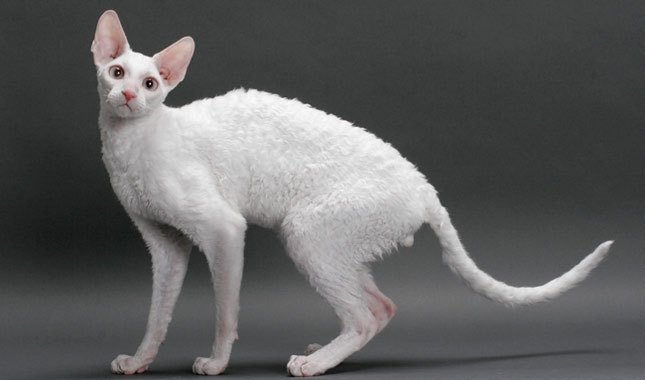
- Kallibunker – The Forefather of All Cornish Rexes: All purebred Cornish Rexes are descendants of that very first curly kitten found in 1950.
- “The Greyhound of the Cat World”: They are often called this due to their slender body, long legs, and arched back.
- Marcel Waves: The characteristic even waves in a Cornish Rex’s coat are sometimes compared to the “Marcel wave” hairstyle, popular in the early 20th century.
- Absence of Guard Hairs: Their coat consists mainly of soft undercoat, making it exceptionally soft to the touch.
- Acrobatic Cat: Cornish Rexes are known for their agility, ability to jump high, and climb into the most unexpected places.
- Different Rexes – Different Genes: The Cornish Rex’s curly gene (Type 1) differs from the Devon Rex’s gene (Type 2) and the Selkirk Rex’s dominant gene.
Frequently Asked Questions (FAQ) About the Breed
Is the Cornish Rex hypoallergenic? No. Although they shed significantly less than other breeds, they still produce the allergen Fel d 1. Reactions in allergic individuals vary.
How does the Cornish Rex differ from the Devon Rex and Selkirk Rex?
- From the Devon Rex: Different gene, different body type (Cornish – slender/elegant; Devon – sturdier, pixie-like), different head and ear shape (Cornish – egg-shaped/high-set, large ears; Devon – broad wedge/very large, low-set ears), different coat structure (Cornish – almost entirely undercoat, very soft and wavy; Devon – all three hair types present but altered, resulting in a loose, soft, sometimes sparse coat).
- From the Selkirk Rex: The Selkirk Rex has a completely different, much heavier, more cobby body type (“teddy bear” look), a round head, its curls are caused by a dominant gene (meaning even heterozygous individuals are curly), and its coat is significantly thicker, plusher, and forms looser, more random curls and waves, not the tight, regular waves of the Cornish Rex.
Does the Cornish Rex require frequent bathing? Yes. Due to their tendency towards oily skin, regular bathing (every few weeks to once a month) is usually necessary to maintain skin and coat health.
How active are they? Very active. This is one of the most energetic cat breeds, requiring plenty of exercise, play, and mental stimulation.
Is the Cornish Rex suitable for first-time owners? They can be, but only if the prospective owner is prepared for their high energy levels, need for attention, and specific grooming requirements (bathing, ear cleaning). They demand a significant investment of time and energy.
- Athletic, lively, playful into old age
- The wavy coat hardly sheds
- Affectionate, “dog-like”, people-oriented
- Ideal for a flat
- Cannot bear solitude at all
- Feels the cold — seeks warmth, needs warmth and clothing
- A tendency to heart disease (HCM)
- Needs plenty of space for running and play
| Devon Rex | Sphynx | Oriental Shorthair | |
|---|---|---|---|
| Weight | 2.5–4.5 kg | 3–5 kg | 3–5 kg |
| Energy | 4.5 | 4.5 | 4.5 |
| Apartment | 5 | 5 | 5 |
| Beginners | 4 | 3.5 | 3 |
How does the Cornish Rex differ from the Devon Rex?
Why is the Cornish Rex constantly on the move?
Does the Cornish Rex feel the cold?
CFA / TICA / WCF / FIFe standards (Cornish Rex)
For apartments · For kids · For beginners · Most affectionate · Quietest · Hypoallergenic · All rankings →