

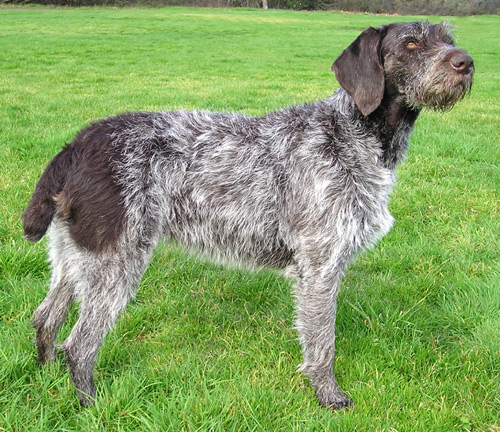
| Height | 58–70 cm |
| Weight | 25–34 kg |
| Lifespan | 12–14 years |
| FCI group | 7 · pointing dogs |
| Origin | Germany |
Exact ratings
Common health issues
Nutrition
The German Stichelhaar (Deutsch Stichelhaar), also known as the German Wirehaired Pointer (Deutsch Drahthaar), is a rare and one of the oldest breeds of German rough-haired pointing dogs. This canine is a true all-round hunting dog with a complex, yet loyal, character. Its name accurately describes its unique coat structure: “Stichel” means “bristle” or “needle”, and “Haar” means “hair”. This is a dog for an experienced owner who can appreciate its exceptional working qualities and become its sole authority. Find out more about this unique breed, its history, character, and care specifics right here on Tvaryny.
The Stichelhaar is not just a dog, but a serious working partner that demands respect, proper upbringing, and, most importantly, the opportunity to fulfil its hunting potential. Its loyalty to its owner knows no bounds, but it treats strangers with great suspicion, making it an excellent guard dog.
German Stichelhaar: Key Characteristics
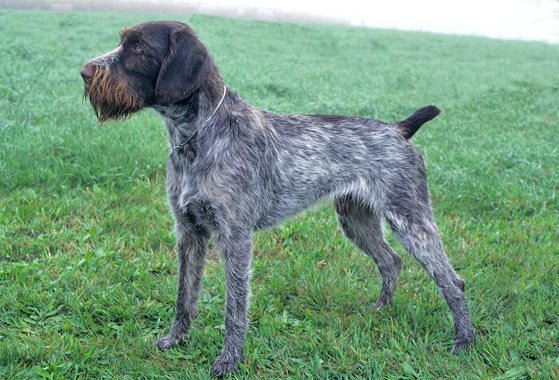
| Characteristic | Description |
| Origin | Germany |
| FCI Classification | Group 7 (Pointing Dogs), Section 1.1 (Continental Pointing Dogs, ‘Bracke’ type) |
| Year of Recognition | 1892 (club foundation), official recognition later |
| Life Expectancy | 12-14 years |
| Height at Withers | Males: 60-70 cm, Females: 58-68 cm |
| Weight | 25-35 kg |
| Temperament | Loyal, brave, stubborn, distrustful of strangers, energetic |
| Use | Versatile hunting dog (work in field, forest, and water) |
| Activity Level | Very high |
| Grooming Needs | Low |
History of the German Stichelhaar Breed
The history of the German Stichelhaar stretches back centuries and is closely intertwined with the history of European hunting dogs. It is believed that its ancestors were old German rough-haired pointers, which in turn descended from the so-called “bird dogs” (Vogelhunde). These were versatile dogs used for hunting feathered game long before the advent of firearms.
Targeted breeding work began in the second half of the 19th century. Frankfurt am Main became the main breeding centre. Breeders aimed to create the ideal hunting dog – resilient, intelligent, with an excellent sense of smell and a harsh coat that would protect it from bad weather and thorny bushes. Local rough-haired and short-haired pointers were used as a basis. To give the coat its characteristic “needle-like” structure and improve working qualities, blood from other breeds was added. It is believed that the Korthals Griffon played a part in the formation of the Stichelhaar. Some sources also indicate a possible infusion of German Shepherd blood, which may have influenced the development of a narrower muzzle and a more serious disposition.
A key date in the breed’s history was 1892, when the “Stichelhaar-Klub” was founded, which was later renamed “Verein Deutsch-Stichelhaar”. This club took on the responsibility for maintaining the studbook and preserving the purity of the breed.
What the German Stichelhaar Looks Like: Standard and Appearance Description
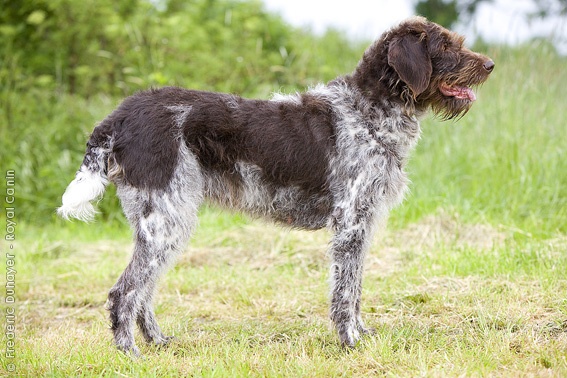
The German Stichelhaar is a dog of robust, somewhat coarse build, of medium to large size. It appears powerful, but without excessive massiveness. Every one of its movements testifies to strength, endurance, and readiness for work.
- Head: Medium length, proportional to the body. Skull moderately wide. The stop is not too sharply defined. Dense hair on the head forms distinctive eyebrows, whiskers, and a beard, giving the dog a serious, even slightly gruff appearance.
- Eyes: Oval in shape, medium size. Colour – from light to dark brown, darker preferred. The gaze is intelligent, calm, but attentive. Thick eyebrows reliably protect the eyes from branches and grass.
- Ears: Medium length, pendent, set high. Lie flat against the cheeks, should not be twisted.
- Body: Robust, with well-developed musculature. Neck strong, without dewlap. Back straight and strong. Chest deep and wide, providing ample room for lungs and heart. Abdomen moderately tucked up.
- Tail: Is a continuation of the topline. Usually docked for hunting purposes (in countries where permitted) to approximately half its length. An undocked tail is straight or slightly sabre-shaped.
- Coat: The most characteristic feature of the breed. It is harsh, wiry, protruding, resembling needles. The length of the outer coat is about 4 cm. In winter, a thick, dense undercoat develops, which reliably protects the dog from cold and damp.
- Colour: The main colour variations are brown roan, light roan, with or without large brown patches. Solid brown also occurs.
Character: Temperament and Behaviour of the Stichelhaar
The character of the German Stichelhaar is a fusion of hunting passion, boundless loyalty to one owner, and an innate distrust of strangers. This is not a breed that will joyfully greet every guest. The Stichelhaar is a one-person dog, and it chooses this person itself, bestowing upon them all its love and respect. Towards other family members, it may be benevolent, but it will only obey its leader.
Its high working qualities, such as perseverance, courage, and hunting ardour, make it not the best companion for inexperienced dog owners. It is prone to dominance and stubbornness, so upbringing will require patience, consistency, and a firm hand. At the same time, harshness and physical punishment are absolutely unacceptable – they can permanently destroy trust and provoke aggression in response.
Towards strangers, the Stichelhaar behaves very reservedly and warily, making it an excellent guard dog. It will always warn of a stranger’s arrival with a loud bark. Unprovoked aggression is not characteristic of this breed, but it will unhesitatingly defend its territory and owner if it senses a real threat. Early and proper socialisation is critically important for the dog to react appropriately to new situations and people.
During hunting, the wirehaired pointing dogs behave actively, demonstrating incredible stamina and enthusiasm. They show a high ability to perform a variety of tasks: from working with birds with a point to tracking and retrieving injured game, including from water. It is a true all-rounder that fears neither dense thickets nor cold water.
Comparison with the German Shorthaired Pointer
| Criterion | German Stichelhaar (German Wirehaired Pointer) | German Shorthaired Pointer |
|---|---|---|
| Origin | Old German pointers, no infusion of English Pointer blood. | German pointers with infusion of Spanish and English Pointer blood. |
| Coat | Harsh, wiry, protruding, about 4 cm long. “Needle-like”. | Short, dense, harsh to the touch. |
| Character | One-owner dog, very distrustful of strangers. More independent. | Friendly, people-oriented, usually gets on well with everyone. |
Health of the German Stichelhaar: Typical Diseases and Prevention
How to Care for a German Stichelhaar?
Caring for a Stichelhaar cannot be described as complicated, but it has its specificities related to its active lifestyle and coat characteristics.
Grooming: The harsh coat does not require frequent brushing or trimming. It is sufficient to brush the dog with a metal comb or brush 1-2 times a week to remove dead hairs and dirt. After every hunt or walk in the woods, the coat should be thoroughly inspected for ticks, burrs, and other foreign objects. The dog should be bathed rarely, only when absolutely necessary, as frequent washing can damage the protective layer on the skin and coat. Special attention should be paid to the beard, which needs to be cleaned of food residues.
Living Conditions: The German Stichelhaar is a dog categorically not suited for life in a city flat. It needs space, freedom, and daily intense physical exercise. The ideal place for it is a country house with a large, securely fenced area. This dog should live in close contact with its owner, so keeping it on a chain or in an isolated kennel is unacceptable and can lead to the development of behavioural problems.
Physical Activity: This is the most crucial aspect of keeping a Stichelhaar. Ordinary lead walks will be catastrophically insufficient for it. The dog needs at least 2 hours of active engagement per day: running off-lead in a safe place, swimming, retrieving, and, of course, hunting. Insufficient physical activity will inevitably lead to health problems and destructive behaviour at home.
Training and Socialisation
The stubborn, independent, and dominant nature of the Stichelhaar demands experience, patience, and consistency from the owner. Training should begin from the first days a puppy arrives in the home. The key to success is establishing clear rules and a hierarchy. The owner must become the dog’s undisputed leader, whose decisions are not open to discussion.
Training sessions should be short, engaging, and based on positive reinforcement. Stichelhaars are very intelligent and learn quickly, but monotonous repetitions quickly bore them. It’s important to work on the “come” command from an early age, as a strong hunting instinct can make the dog ignore commands if it spots game.
Early socialisation is absolutely essential. The puppy needs to be introduced to different people, sounds, places, and other animals (under strict supervision). This will help to raise a well-balanced dog that will not display excessive aggression or timidity in unfamiliar situations. However, even a well-socialised Stichelhaar will most likely remain wary of strangers for good.
Feeding the German Stichelhaar: Key Recommendations
Pros and Cons of the Breed
| Advantages (Pros) | Disadvantages (Cons) |
|---|---|
| Exceptional hunting qualities: A versatile dog for any type of hunting. | Not suitable for novices: Requires a very experienced owner. |
| Boundless loyalty to the owner: Becomes the most reliable friend and partner. | Prone to dominance and stubbornness: Needs a firm, but fair, hand. |
| Excellent guard dog: Will always warn of danger and protect its family. | Distrust of strangers: Can be a problem with frequent guests. |
| Robust health and low maintenance: Doesn’t require complex care. | Requires immense physical exercise: Not suitable for flat living. |
| Unique appearance: A rare and distinctive breed that attracts attention. | High hunting instinct: May chase cats and other small animals. |
| Low grooming requirements: Coat doesn’t need professional care. | High price and low prevalence: Difficult to find a good puppy. |
Interesting Facts about the German Stichelhaar
- “Father” of all wirehaired breeds: The Stichelhaar is considered to be one of the oldest and “purest” German wirehaired breeds.
- Ideal protection: Its “needle-like” coat not only protects against bad weather but also serves as excellent camouflage and armour against thorny branches and even the teeth of small predators.
- Deceptive appearance: Despite their stern appearance, Stichelhaars can be very amusing and playful, especially when young.
Frequently Asked Questions about the Breed (FAQ)
Is the German Stichelhaar suitable for a family with children?
This is a complex question. If the dog has grown up with children and considers them part of its “pack”, it can be a good protector for them. However, it does not have limitless patience, and it should not be left alone with very young children. It is important to teach children to respect the dog’s personal space. Generally, it is not the best breed for the role of a family “nanny”.
Does the German Stichelhaar shed a lot?
Shedding is moderate and seasonal. Regular brushing helps to keep it under control. Its coat is not prone to matting, but it can collect a lot of dirt and burrs during walks.
Can a Stichelhaar be kept with other animals?
With other dogs, especially of the opposite sex, it can get along if it grew up with them. However, a tendency towards dominance can lead to conflicts with other males. Due to its strong hunting instinct, it is highly unadvised to keep it with cats, rodents, or birds.
Are they really as aggressive as people say?
The Stichelhaar is not aggressive without reason. Its behaviour is a mixture of innate distrust of strangers and a strong protective instinct. With proper training and socialisation, it is a balanced, albeit very serious, dog. Aggression is usually the result of training mistakes or provocation from people.
Video about the Breed
- A versatile, hardy pointer
- Clever and devoted to one master
- An excellent watchdog (distrustful of strangers)
- The rough coat protects from weather and thorns
- A very high energy level — not for a flat
- A difficult character — only for the experienced
- Distrustful and wary of strangers
- A strong hunting instinct (dangerous to cats)
| German Wirehaired Pointer | Pudelpointer | Český fousek | |
|---|---|---|---|
| Height | 57–68 cm | 55–68 cm | 58–66 cm |
| Energy | 4.5 | 4.5 | 4.5 |
| Apartment | 2 | 2 | 2 |
| Beginners | 2.5 | 3 | 3 |
Is the Stichelhaar the same as the Wirehaired?
Where does the name "Stichelhaar" come from?
Is the Stichelhaar suitable for a novice?
FCI Standard No. 232 · Verein Deutsch-Stichelhaar
For apartments · For kids · For beginners · Active · Smartest · Hypoallergenic · All rankings →