A German all-round hybrid of field and water — a clever worker with a cheerful temper: hardy, obedient, keen and devoted. The Pudelpointer is a happy blend of the poodle's intelligence and love of water with the pointer's nose, stamina and hunting instinct; a first-class all-round pointer and at the same time an affectionate companion for active, experienced owners.
Apartment · not suitableKidsCats · with caveatsOther dogsBeginners · with caveats
The Pudelpointer is a truly unique hunting breed, a prime example of a successful blend of the best qualities from two distinguished breeds. Originating in Germany, this hybrid inherited high intelligence and a love for water from the Poodle, alongside the incredible hunting instinct, stamina, and superb scenting ability of the Pointer. The result is a versatile gundog, capable of working in any conditions: in the field, in the forest, and in water. Its lively, open temperament, natural obedience, and robust health make it not only a first-class hunter but also a wonderful companion for active individuals. Discover more about this amazing breed on Tvaryny.
This dog is a genuine worker, who absolutely adores being useful to its owner. It's tireless on the job, but at home transforms into a calm and affectionate family member. The Pudelpointer requires significant physical exertion and mental stimulation, making it best suited for experienced owners who lead an active lifestyle and can dedicate sufficient time to their pet.
Versatile hunting dog (retrieving, water work, pointing)
Coat Colour
Brown, dead leaf, black
Coat Care
Moderate, requires regular brushing
Activity Level
Very high
Interesting Facts About the Pudelpointer
The Name Says It All: Unlike many other breeds, the name "Pudelpointer" is a direct and honest combination of the two founding breeds: the German hunting Poodle (Pudel) and the English Pointer.
Rigorous Selection: In the first 30 years of the breed's existence, fewer than 15 individuals (Poodles and Pointers) were used for its creation. The main emphasis was not on quantity, but on quality and working characteristics.
German Precision: Pudelpointer breed clubs in Germany and North America maintain very strict studbooks and breeding rules. To be approved for breeding, a dog must pass a series of tests for working qualities and health.
Not for the Show Ring: This breed was created exclusively as a working gundog. While they can participate in shows, the primary priority in breeding is always given to hunting talents, rather than external beauty.
A Quiet Breed: Pudelpointers are not prone to causeless barking. They typically only voice a warning about something unusual, making them good, but not overly noisy, watchdogs.
History of the Pudelpointer Breed
The history of the Pudelpointer is a story of dedicated and meticulously documented work by German dog breeders in the late 19th century. The visionary behind the breed's creation was the German writer and dog enthusiast Baron von Zedlitz, who wrote under the pseudonym "Hegewald". His goal was to develop an ideal all-purpose hunting dog that would combine the best traits of its parent breeds and be perfectly suited for working in the diverse conditions of German hunting grounds.
The Baron envisioned a dog that possessed the love for water, intelligence, and retrieving ability of the Poodle, while also having the excellent scenting capabilities, speed, stamina, and pointing instinct characteristic of the Pointer. He desired a dog with a harsh, protective coat that would be impervious to thorny undergrowth and cold water. Work on the breed commenced in 1881. To achieve this vision, specific individuals were carefully selected. On the Poodle side, it was not a decorative salon Poodle, but the older type of hunting or water Poodle. One of the key foundation bitches was a Standard Poodle named Molly. From the Pointer side, an outstanding working English Pointer named Tell was chosen.
The breed's development process spanned approximately 30 years. During this time, only 11 crossbreedings between Poodles and Pointers were conducted. The primary work was carried out "in itself", meaning puppies from these pairings were meticulously selected based on their working qualities and conformation, and then bred together. The aim was to solidify the desired traits and establish a stable gene pool. All stages of selection were rigorously documented. The first breed club was founded in Germany in 1897. Thanks to such scrupulous work, they succeeded in creating a dog that fully matched the original concept - an intelligent, resilient, and versatile hunter with a balanced temperament.
What the Pudelpointer Looks Like: Standard and Appearance
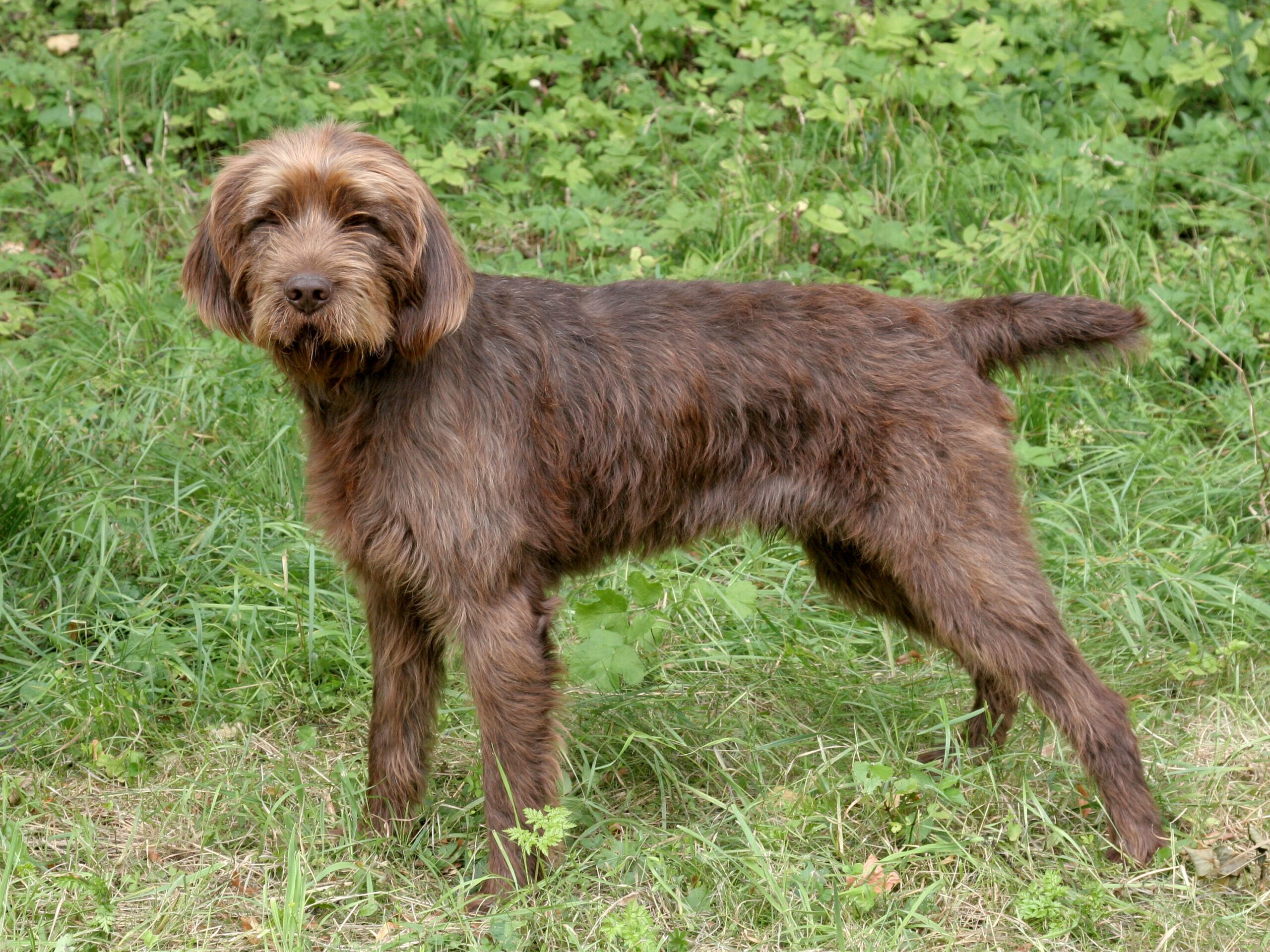
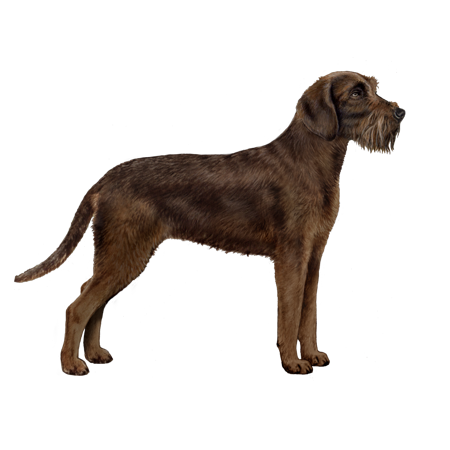
The Pudelpointer is a dog of ideal proportions, combining strength and elegance. It should be neither too heavy nor too light. Its appearance speaks of endurance, speed, and the capacity for prolonged work. This is a dog with strong bones and well-developed musculature.
Head, Eyes, and Ears
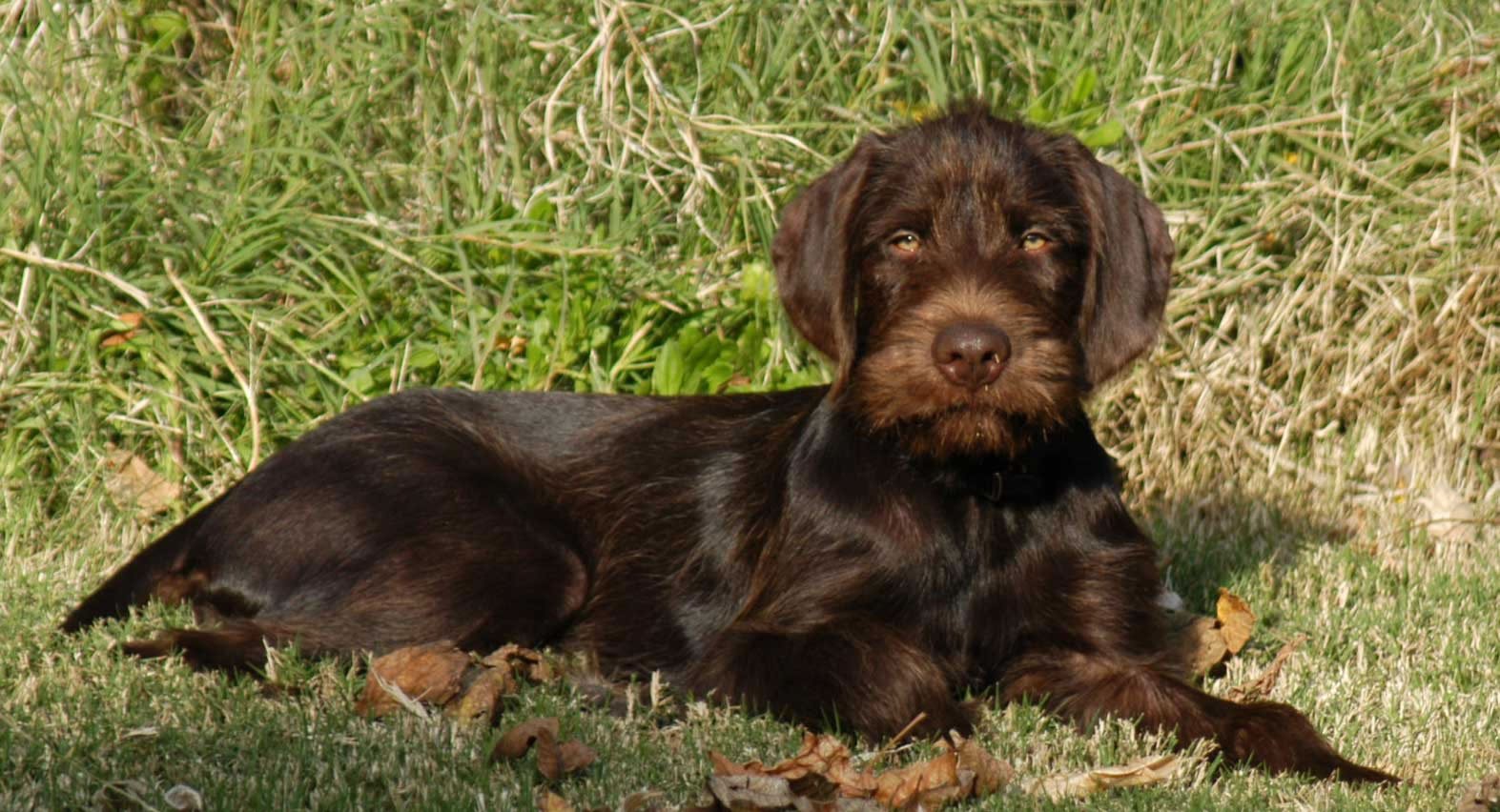
The Pudelpointer's head is of medium length, dry, with a not overly pronounced stop (transition from forehead to muzzle). The muzzle is long and broad, proportionate to the skull. An important feature is the presence of small "moustaches," "beard," and "eyebrows," which give it a characteristic expression but do not obscure the contours of the head. The eyes are large, round, predominantly amber in colour, with an intelligent and lively expression. The ears are medium-sized, pendant, lying close to the head, with rounded tips.
Coat and Colour
The coat is one of the breed's key features. It should be harsh, dense, medium in length (about 4–6 cm), lying close to the body, and possessing a well-developed undercoat. Such a coat structure excellently protects the dog from adverse weather, cold water, and damage in dense undergrowth. The coat should not be curly or soft. The ideal coat type is "wiry" (Drahthaar-like).
The breed standard permits three main colours:
Brown (liver): The most common and desirable colour.
Dead leaf: A shade reminiscent of autumn foliage.
Black: Permitted, but less frequently seen. The prevalence of Pointer genes in some breed representatives leads to this black coat.
Small white markings on the chest and paws are permissible.
Tail and Limbs
The tail is a continuation of the backline. In a relaxed state, it is carried horizontally or slightly raised. Historically, tails were docked to approximately two-thirds of their length to prevent injuries during hunting. However, docking is now prohibited in many countries. The tail should not have a dense plume but be covered with harsh fur. The limbs are straight, parallel, with well-developed musculature, ensuring a powerful drive and endurance in movement. The paws are compact, with firm pads.
Temperament and Character of the Pudelpointer
The character of the Pudelpointer is a harmonious blend of a hunter's energy and a companion's calmness. It is a very intelligent and clever dog, which learns quickly and always strives to please its owner. In the field, it demonstrates incredible passion, determination, and tireless energy. Its instincts are honed to perfection: it holds an excellent point, confidently follows a trail, and fearlessly retrieves game from water of any temperature.
At home, however, the Pudelpointer transforms into a calm, balanced, and very affectionate family member. It forms strong bonds with its people and copes poorly with solitude. It requires close contact with its owner. With proper socialisation, it gets along wonderfully with children, becoming a patient and cheerful playmate for them. With other dogs, it is generally non-confrontational. However, due to its strong hunting instinct, it may perceive small animals (cats, rodents, birds) as prey, therefore requiring early acclimatisation to living together.
Pros and Cons of the Pudelpointer Breed
Like any breed, the Pudelpointer has its advantages and disadvantages. It's important to objectively assess them before deciding to acquire such a dog.
Pros
Cons
✅ High intelligence and trainability: One of the smartest gundogs, easily learns commands.
❌ High need for physical exercise: Not suitable for inactive people or apartment living without daily, long walks.
✅ Versatility: Works excellently on land, in water, and in the forest. Suitable for hunting various types of game.
❌ Strong hunting instinct: May chase small animals, requires a reliable lead in unfenced areas.
✅ Loyalty and people-oriented: Forms strong bonds with its family, makes an excellent companion.
❌ Doesn't tolerate loneliness: May develop destructive behaviour if left alone for too long.
✅ Robust health: the absence of described hereditary disease is not the absence of risk — breeding animals are screened all the same.
❌ Requires an experienced owner: An intelligent dog can be stubborn if the owner isn't a consistent leader.
✅ Low shedding: The harsh coat sheds minimally, but requires regular grooming.
❌ Coat needs care: Regular brushing and periodic stripping are necessary to maintain skin and coat health.
Training and Education of the Pudelpointer
Thanks to the keen intelligence inherited from the Poodle and their desire to please, Pudelpointers are very capable learners. They are easy to train, but the process requires consistency and patience. They respond best to positive reinforcement methods - praise, treats, and games. Harsh or unfair methods can lead to the dog becoming stubborn and withdrawn.
Early socialisation is key for this breed. A puppy needs to be introduced to various people, sounds, places, and other animals so that it grows into a confident and well-balanced dog. Basic obedience, such as commands like "sit," "lie down," and "come," should begin as early as possible. As it is a hunting breed, particular attention should be paid to teaching the "come" command and steadying, to control the dog in environments with strong distractions. For hunters, the Pudelpointer is a true gem; it easily learns all stages of field work. In many ways, its approach to work resembles other continental gundogs, such as the Portuguese Pointer or the Burgos Pointer.
Care and Upkeep of the Pudelpointer
The Pudelpointer is a hardy and undemanding dog, but its upkeep has its own peculiarities, related to its origin and purpose.
Grooming and Coat Care
Despite Pudelpointers shedding minimally, their harsh coat requires regular care. It is recommended to brush the dog 1–2 times a week with a special brush or furminator to remove dead hairs and undercoat. This helps maintain skin health and prevents matting. Bathe the dog only when necessary, using shampoos for harsh-coated breeds. Frequent washing can damage the protective properties of the coat. It is very important not to clip the Pudelpointer with clippers, as this ruins the coat's texture, making it soft and unable to protect against bad weather. Instead, professional hand-stripping is recommended 2–3 times a year. You should also regularly inspect and trim the hair between the paw pads.
Living Conditions and Physical Activity
This is an extremely energetic breed. The Pudelpointer is absolutely not suited for life on a chain or in an outdoor kennel without human contact. The ideal conditions for it are a private house with a large, securely fenced garden where it can run freely. However, even with a garden, it requires daily, full-fledged walks. An adult dog needs a minimum of 1.5–2 hours of intense physical activity per day. This could include:
Long walks or runs;
Swimming (most Pudelpointers adore water);
Retrieving games;
Dog sports activities: agility, flyball, coursing.
Insufficient exercise can lead to behavioural problems: the dog may become restless, bark excessively, or destroy things in the house. For them, not only physical but also mental stimulation is important. Other versatile gundogs, such as the German Wirehaired Pointer, have similar exercise needs.
Nutrition
Nutrition: What to Feed a Pudelpointer?
Health and risks
Health and Typical Breed Illnesses
Frequently Asked Questions About the Breed (FAQ) · 4
Is the Pudelpointer suitable for apartment living?
Generally, no. This is a very energetic breed that needs space. Theoretically, it can be kept in an apartment, but only if the owner is prepared to provide 2–3 hours of intense daily walks, training, and games in an open area. The ideal option is a private house with a large garden.
Does the Pudelpointer shed a lot, and is it hypoallergenic?
The Pudelpointer sheds very little, especially compared to smooth-coated breeds. Its harsh coat reliably holds onto dead hairs. However, it is not hypoallergenic. Allergies are caused not only by hair but also by skin particles (dander) and saliva, so people with allergies should exercise caution.
How does the Pudelpointer get along with children and other animals?
With proper socialisation, Pudelpointers are wonderful family dogs. They are patient and friendly with children. They usually get along well with other dogs. However, their strong hunting instinct can pose a threat to small household pets (cats, rabbits, hamsters), so they need to be introduced from a young age and under strict supervision.
Are they difficult to train for a novice?
For an absolute novice who has never owned a dog, the Pudelpointer can be a challenging choice due to its high energy level and intelligence. It requires a consistent, confident leader. If the owner cannot provide proper discipline and exercise, the dog may become unmanageable. This breed is best suited for individuals with experience in handling active dogs.
Video about the Breed
FAQ
What breeds make up the Pudelpointer?
It is a German hybrid of poodle and pointer: from the poodle come intelligence and a love of water, from the pointer the nose, stamina and hunting instinct; the result is a versatile pointer.
Is the breed suitable for a flat?
Poorly — it is an energetic working pointer that needs space, scent work and water; at home, though, it is calm and affectionate.
Is the Pudelpointer healthy?
Generally yes — the country of origin pays special attention to the breed's health, breeding against hip dysplasia (HD) and epilepsy.