


| Height | 58–69 cm |
| Weight | 20–34 kg |
| Lifespan | 12–14 years |
| FCI group | 7 · pointing dogs |
| Origin | United Kingdom |
Exact ratings
Common health issues
Nutrition
The English Pointer is not merely a dog; it is a living sculpture, crafted for speed and the aesthetics of the hunt. This dog is elegant, graceful, and possesses a balanced temperament; he is friendly and peace-loving, yet the moment he steps into the field, he transforms into a tireless machine for locating game. Dogs of this breed are a perfect match for active people who believe that “movement is life” and are not prepared to sit still. They will become indispensable assistants on the hunt, where they demonstrate their signature “Pointer gallop”. They will accompany you wherever you wish – from a morning jog to a long hike in the hills. Pointers quickly get along with other animals, provided they are not the object of the hunt. They will become protectors and guardians for small children, and for adults – devoted and loyal friends. Read more about this on Tvaryny.
English Pointer: a brief breed overview

| Characteristic | Description / Indicator |
|---|---|
| Country of Origin | Great Britain |
| Purpose | Gun dog (Pointing dog), companion |
| FCI Classification | Group 7 (Pointing Dogs), Section 2 (British and Irish Pointers and Setters) |
| Life Expectancy | 12-14 years |
| Height at Withers (Dogs) | 63-69 cm |
| Height at Withers (Bitches) | 61-66 cm |
| Weight | 20-30 kg (depending on sex and condition) |
| Coat Type | Short, smooth, dense |
| Grooming Difficulty | Low (requires minimal grooming) |
| Activity Level | Very High (requires lengthy daily exercise) |
History of the breed
English Pointers are amongst the most popular hunting dogs worldwide, and their history spans several centuries of selective breeding. The name “Pointer” signifies one who indicates or directs. This is no coincidence. Indeed, the famous dogs of this breed gained renown precisely because of their signature stance, freezing like a statue to indicate the direction of the bird’s location during a hunt.
Targeted breeding and the polishing of these dogs’ working qualities began as early as the 18th century in England. However, canine historians suspect that similar dogs appeared much earlier on the continent. It is probaly that the ancestors of modern English Pointers were the Old Spanish Pointers, or “Perro de Punta” (“dog in the point”), which were brought to England by officers following the War of the Spanish Succession (1701–1714). The involvement of Portuguese pointing dogs is also considered a possibility.
Pointers acquired their modern appearance thanks to the painstaking work of English breeders, who strove for ideal proportions, speed, and stamina. To lighten the bone structure and give the dog a “sporting form”, breeders resorted to crossing with breeds such as:
- Foxhounds – to improve stamina and leg structure;
- Greyhounds – to impart speed, elegance, and improve eyesight;
- Bloodhounds – to refine the sense of smell;
- Old French and Italian Pointing Dogs – to consolidate hunting instincts.
These dogs are extremely popular today, especially amongst professional hunters. Their superb nose and phenomenal speed have made them indispensable assistants in bird hunting. The Pointer standard was adopted in 1897 by the Breed Club. In 1900, the breed was officially recognised by the Kennel Club, becoming the benchmark amongst smooth-haired pointing dogs.
What the English Pointer looks like: appearance description
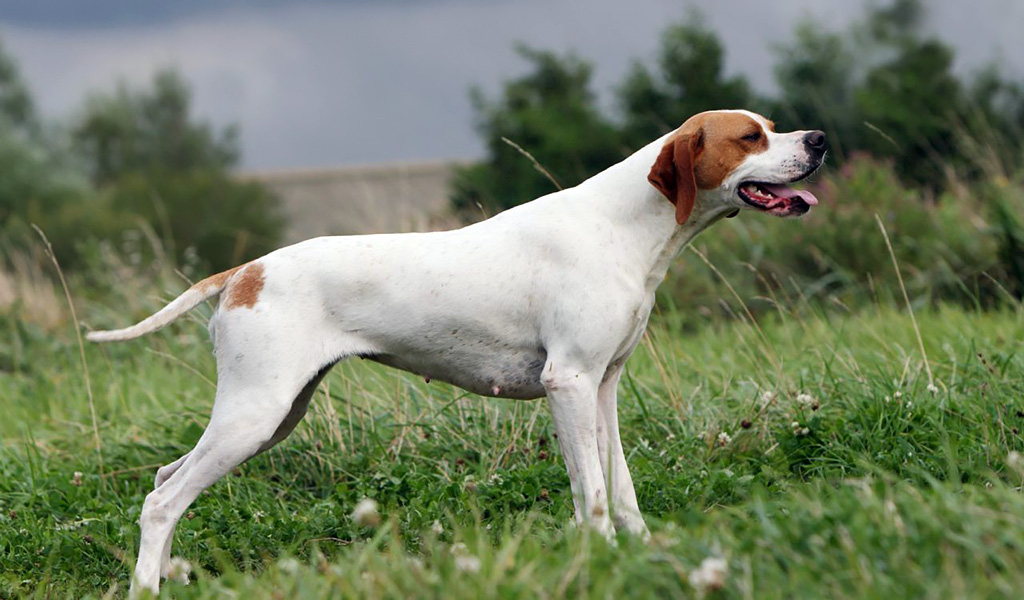
The Pointer’s appearance is the embodiment of aerodynamics. Every line of his body speaks of readiness for a rapid dash. This is a dog of noble lines, without the slightest sign of coarseness. Let us examine the exterior in more detail according to international standards.
Head and Muzzle
The English Pointer is a reasonably large dog with a strong bone structure and well-developed dry muscle. His head is proportional to the body with a long, moderately wide skull. A characteristic feature is the clearly defined stop (transition from forehead to muzzle) and specific profile lines: the lines of the muzzle and skull converge (convergence), giving the muzzle a slightly dish-faced look. This allows the dog to catch the scent with a “high nose”, holding his head high whilst running.
The muzzle is long and rectangular in cross-section. The nose is large, soft, and moist; the colour can be dark (black) or light (matching the coat spots), depending on the dog’s general colouration. The nostrils are wide, which is critical for intensive breathing and scenting. The ears are pendant, set fairly high at eye level, thin, silky, triangular in shape with rounded tips, and lie close to the head. The eyes are large, round, with an intelligent and lively expression; the colour varies from hazel to dark brown; light eyes are undesirable. The neck is long, muscular, elegantly arched, and free from dewlap (loose skin).
Body and Limbs
The back is strong, short, and taut, sloping slightly from withers to croup. The loin is strong, muscular, and slightly arched. The chest is deep, reaching down to the elbows, providing ample volume for the lungs and heart during a prolonged gallop. The tail is of medium length, thick at the root, tapering smoothly to the tip. In motion, the dog carries it level with the back, and it acts as a rudder. Interestingly, during the search, the Pointer’s tail moves from side to side with a characteristic “lashing” sound.
The limbs are long, straight, parallel to each other, with well-developed, defined muscles. The hind limbs have well-marked angulation, ensuring a powerful drive. The paws are oval or rounded with long, closely knit arched toes (“cat feet” are not characteristic; “hare feet” are more common).
Coat and Colour
The coat is short, straight, dense, and glossy; it may feel slightly hard to the touch but lies close to the body. It does not hide the muscle definition. The colouration of the English Pointer is varied and classified as follows:
- Solid colour: Black, Fawn, Coffee (rarely encountered);
- Bicolour (most popular): Lemon and White, Orange and White, Liver and White (Brown and White), and Black and White;
- Tricolour: A combination of white, black/brown, and tan markings.
White patches on the muzzle, chest, and tips of the paws are permitted. Each colour has its charm, but the colour of the spots has absolutely no bearing on working qualities.
Character: temperament and behaviour
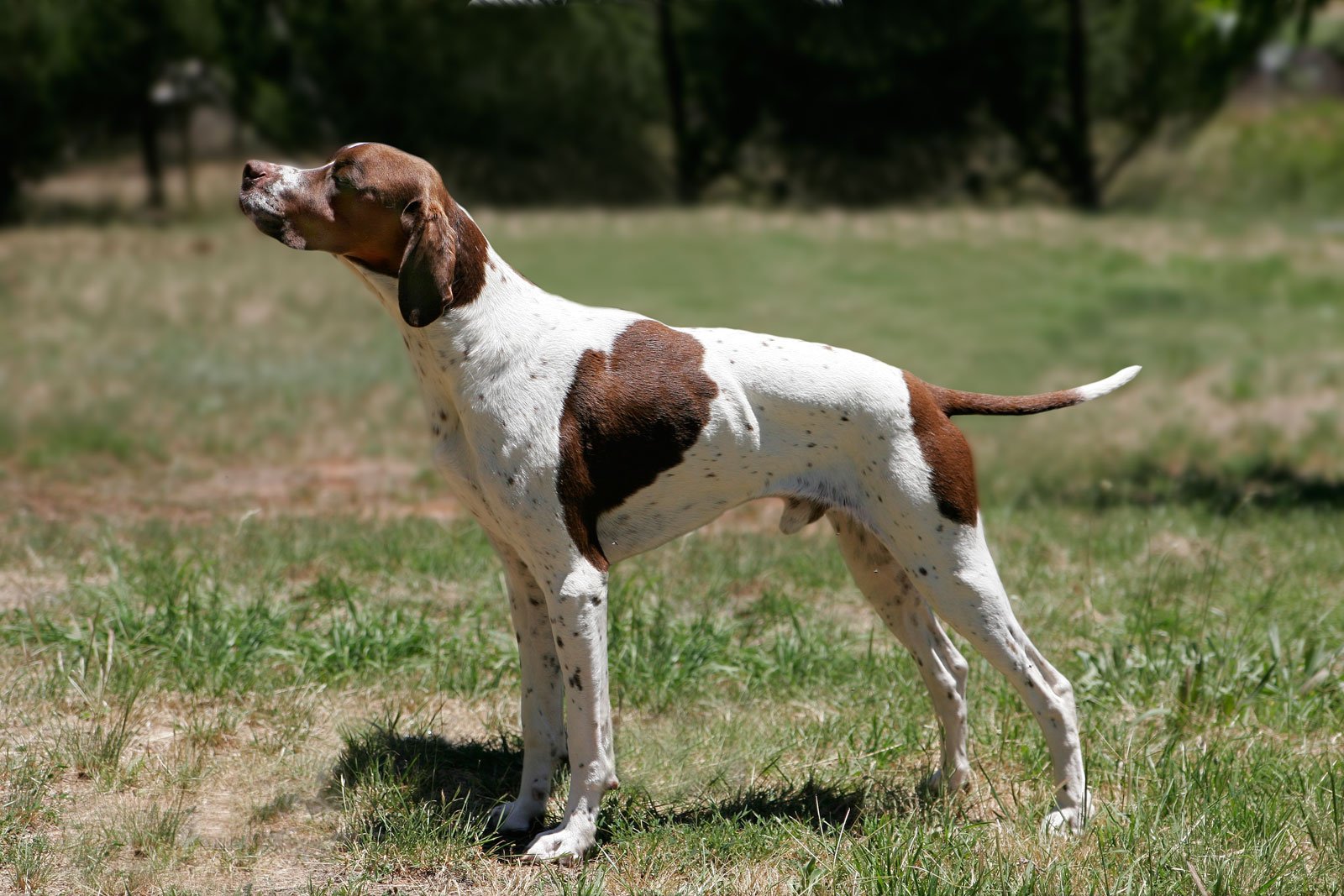
The character of dogs of this breed essentially has no flaws if viewed through the prism of their purpose. They know exactly where and how they need to behave. These are the intellectuals of the canine world with a high level of adaptability.
At home, these dogs are quite calm, sometimes even phlegmatic. Towards close people, they are affectionate, tactile, and friendly. The English Pointer is a dog that loves comfort; do not be surprised if you find him under the duvet in your bed. On the hunt, however, a metamorphosis occurs – the dog becomes attentive, passionate, and tireless. They get along excellently with other pets, especially dogs, as Pointers are accustomed to working in a pack (or brace). However, small rodents or birds may arouse their interest, although the Pointer is not prone to aggression or killing the prey (his task is to find and point).
Pointers clearly understand the context: home is for rest, the field is for work. Nevertheless, it is better not to keep birds in close proximity with free access. Do not tempt your pet, so you do not have to punish him later; after all, if you hunt with him regularly, you cannot punish the dog for showing instinct, lest he develops dissonance due to two contradictory instructions.
Also, remember that in many ways, the character of your four-legged friend depends on your upbringing, as it is shaped thanks to you. By nature, Pointers are fast, agile, clever, good-natured, and cheerful. They are completely devoid of aggression towards humans. To ensure the puppy manifests all the best sides of his character in the future, make sure that from childhood he feels safe and confident.
Pros and Cons of the breed
Like any breed, the English Pointer has its strengths and weaknesses. What is an advantage for a hunter can become a problem for an ordinary city dweller.
| Pros (Advantages) | Cons (Disadvantages) |
|---|---|
| High intelligence and trainability | Excessive energy, requires a lot of movement |
| Lack of aggression towards people and other dogs | Tolerates loneliness poorly, may howl |
| Easy care for short coat | Not suitable for outdoor kennel living (gets cold) |
| Ideal partner for running and sports | Strong hunting instinct (may run off after a bird) |
| Affectionate and devoted to the family | Quite “talkative” at home if bored |
| Resilient and healthy by nature | Tendency to scavenge “rubbish” on the street |
Health: typical diseases and prevention
How to care for the coat?
The English Pointer must live in warmth. These dogs have short hair without a thick undercoat, which will not protect them from severe cold, especially in winter. In an outdoor kennel in winter, this dog would simply perish or contract pneumonia. Therefore, it is best to keep Pointers in a flat or a private house with free access to a garden, but sleeping in the warmth. Of course, the second option is the most successful, as these dogs need to move a lot and spend time in the fresh air.
English Pointers behave very calmly in the house, provided they get the neccessary physical exercise. These dogs are primarily hunters by nature, so you need to spend a lot of time with them walking in the woods. If there is no opportunity to hunt, provide your pet with sporting activities that simulate this action so exciting for dogs of this breed – for example, coursing or agility.
Looking after Pointers is a pure pleasure. They do not require daily brushing or frequent bathing. It is enough to go over the coat once a week with a special rubber mitt or a natural bristle brush to remove dead hairs and massage the skin. Although, if possible, brushing dogs even with short hair should be done as often as possible, as this procedure improves blood circulation and also has a positive effect on the appearance of the animal’s coat.
Do not forget to monitor the cleanliness of your pet’s eyes and ears. The Pointer’s hanging ears are poorly ventilated, creating a favourable environment for bacteria. It is best to wash the eyes regularly with a chamomile decoction or a special lotion. Inspect the paw pads, which can crack after running on rough terrain; lubricate them with special wax or ordinary vegetable oil. Accustom the puppy to all hygiene procedures from childhood. Treat him with goodies and praise so that the dog allows you to examine him.
Training and Socialisation
Upbringing and training are very important moments in your life and the life of your pet. English Pointers are smart and quick-witted dogs with an innate hunting instinct, but if raised incorrectly, they can become skittish and disobedient, or conversely, ignore the owner on a walk.
To prevent this from happening, under no circumstances should you physically offend the dog. Pointers are very sensitive to the owner’s intonation and mood. You must be patient and persistent, yet gentle. Harsh training methods will lead to the dog withdrawing into himself.
Early socialisation is very important – you must introduce the puppy to the world around him and its inhabitants. Walk in parks, introduce him to other dogs, people in hats, cyclists. A hunting dog, above all, must be self-confident. If the puppy is scared of something, do not pity him excessively, otherwise, your gesture will be interpreted as praise for the “correct” (fearful) behaviour. It is better to distract him with a game.
Serious training is best started when your Pointer is a little older (after 6-8 months), but until then, learn basic commands with him such as: “Come!”, “Sit”, “No”, “Heel”. The command “Stand” (or “Whoa”) is natural for a Pointer, but it needs to be consolidated. However, the puppy should be taken into the woods from an early age so that he gets used to the forest, its sounds, and the surroundings.
Pointers are dogs that specialise in feathered game (partridge, pheasant, quail). They even have their own strategy, which the puppy does not need to be taught – it is in the blood. Scenting a bird, Pointers make a characteristic point, lifting a front paw and stretching out like a string, indicating the direction of the game; after this, they wait for the master’s command to flush the bird (command “Flush” or “Get on”). Ideally, the Pointer should not chase the bird after it takes wing. Then the Pointer can bring the prey to the master’s hand, although retrieving is not a mandatory profile discipline for island pointing dogs, unlike continental ones. The main thing for you is to accustom him to obedience and unquestioning subordination, and this is not difficult at all if your pet feels love and trust towards you.
If you are interested in other breeds for active hunting, it is worth looking at close relatives of the Pointer. For example, the German Shorthaired Pointer (Deutsch Kurzhaar) is a more versatile soldier that works both on game and in water. And for connoisseurs of French charm, the Saint Germain Pointer (Braque Saint-Germain), which also possesses excellent working qualities, would be suitable. Often people choose a Pointer just for the pretty picture, without understanding the amount of activity required. If you are looking for a companion dog but are not interested in hunting, perhaps you should consider other options. For instance, if you like fluffy friends, pay attention to the German Spitz (Wolfspitz/Keeshond), which will make a wonderful family pet. And for those keen not on hunting, but say, tourism in northern latitudes or herding work, an interesting choice would be the Lapponian Herder (Lapinporokoira).
Nutrition: key recommendations
Interesting facts about the English Pointer
- Dog on a coin. The image of a Pointer can be found not only in paintings by classic artists but also on commemorative coins of some countries, highlighting its status as a cultural heritage.
- The “Stone” dog. A Pointer can hold a point for hours if he senses the scent of a bird. There are known cases where dogs were found in thick undergrowth only thanks to the fact that they did not move at all, waiting for the owner.
- Innate pointing. Pointer puppies begin to point instinctively as early as 2 months of age. They can freeze before a butterfly, a toy, or a pigeon in the park.
- Show record holder. The legendary dog Judy, an English Pointer, became the first animal prisoner of war during World War II and received the PDSA Dickin Medal for bravery.
Frequently Asked Questions (FAQ)
Is a Pointer suitable for a flat?
Yes, but only on the condition that you dedicate at least 2-3 hours a day to active walks. Without this, the dog may start ruining furniture out of boredom.
Does the Pointer shed a lot?
Shedding is moderate and seasonal. Since the coat is short, it does not mat, but tiny “needles” can get stuck in textiles.
Do these dogs bark?
Pointers are not “yappers”. They may bark to warn of a stranger’s arrival, but they will not do so without reason. As guards, they are not very effective due to their kindness towards people.
Is it hard to train a Pointer?
They are very smart but can be stubborn if they are bored. They need motivation and a game-based approach. Drilling does not work for them.
Video about the breed
- Athletic and hardy
- Friendly and gentle
- Low-maintenance coat
- An excellent working hunter
- Needs plenty of exercise
- Sensitive to cold
- Risk of gastric torsion
- Not a flat dog
| German Shorthaired Pointer | English Setter | Brittany | |
|---|---|---|---|
| Height | 53–64 cm | 61–69 cm | 46–52 cm |
| Energy | 5 | 4.5 | 5 |
| Apartment | 2 | 2 | 2.5 |
| Beginners | 3 | 3 | 3 |
How much walking does the Pointer need?
Is the Pointer good with children?
Is the Pointer suitable for a flat?
FCI Standard No. 1 · The Kennel Club
For apartments · For kids · For beginners · Active · Smartest · Hypoallergenic · All rankings →