Brittany

By tvaryny
25 Min Read
In short A compact orange-and-white whirlwind of the French fields: energetic, clever, affectionate and tireless. The Brittany (Épagneul Breton) is the smallest of the pointers, a "gundog in pocket format"; it works brilliantly in the field and adores its family, so it needs plenty of exercise and attention.
Apartment ⚠KidsCatsOther dogsBeginners
Parameters
Height46–52 cm
Weight14–18 kg
Lifespan12–15 years
FCI group7 · pointing dogs
OriginFrance
Size
Height at withers 46–52 cmWeight 14–18 kg
Ratings · 12 · Dataset
FamilyKidsBeginnersTrainingEnergyHealthSheddingDroolingBarkingApartmentWeatherPrey dri.
Exact ratings
Family4.5
Kids4.5
Beginners3.5
Training4.5
Energy5.0
Health3.5
Shedding3.0
Drooling1.5
Barking3.0
Apartment2.5
Weather3.5
Prey drive4.0
Common health issues
  • Hip dysplasia (a mild tendency)
  • Epilepsy (above average, 3–7 years)
  • Skin disease
  • Eye disease
  • Ear infections (drop ears)
Nutrition

A quality food for an active breed, with weight control. Plenty of exercise is a must; train only by gentle methods (the breed is sensitive).

Cheerful, energetic and exceptionally smart – that’s the Brittany (Epagneul Breton). This active dog is highly obedient and deeply attached to its human family. It won’t make a stern guard, as it’s friendly even towards strangers, but the Brittany is a real find for a sporty family that loves the outdoors, perhaps with children. This sensitive “Frenchman” reacts keenly to how it’s treated and strives to be a full-fledged member of the family. Representatives of this breed are exceptionally easy to train and require straightforward, regular grooming. We’ll talk more about all the details of keeping, personality, and health of this unique breed more on this on Tvaryny.

The Brittany: A Brief Breed Overview
The Brittany
OriginFrance (Brittany region)
Original NameEpagneul Breton (Brittany)
FCI ClassificationGroup 7 (Pointing Dogs), Section 1.2 (Continental Pointing Dogs, ‘Spaniel’ type). With working trial.
Lifespan12-14 years (sometimes up to 15-16)
Height at withers (males)48-51 cm
Height at withers (females)47-50 cm
Weight13-18 kg (depending on sex and build)
TemperamentEnergetic, intelligent, alert, friendly, ‘happy-go-lucky’
Grooming NeedsMedium (2-3 times a week)
Activity NeedsVery High
Role in FamilyNeeds an owner who can set rules; very human-oriented
History and Origin of the Brittany

The history of the Brittany is deeply rooted in the fields and forests of its homeland – the province of Brittany in north-western France. It is one of the oldest ‘spaniel’ type breeds in France. The first mentions of dogs similar to modern Brittanys date back to the 17th century. They can be seen in paintings and tapestries of the time, notably by the Dutch painter Jan Steen. These spaniel-like, short-tailed dogs with long coats were favourite companions for local hunters and peasants thanks to their versatility, compact size, and excellent sense of smell.

It is believed the modern breed emerged in the mid-19th century from crosses between local French spaniels (possibly ancestors of the modern French Spaniel) and English Setters and Pointers. British hunters, who came to Brittany to hunt woodcock, brought their dogs with them. These crossings likely led to the appearance of the short tail (natural bobtail) in the Brittany, one of its characteristic features, and also improved its hunting abilities.

By the end of the 19th century, the breed was already quite recognisable. A key figure in the standardisation and popularisation of the breed in the early 20th century was Arthur Enaud, who presented the first Brittany at a show in Paris in 1896. The first official breed standard was written in 1907. After the Second World War, the breed, like many others, was under threat, but thanks to the efforts of enthusiasts, it was restored and spread throughout the world. Today, the Brittany is one of the most popular gundogs in France and the USA, prized for its exceptional working qualities and wonderful character.

What Does the Brittany Look Like: A Detailed Description
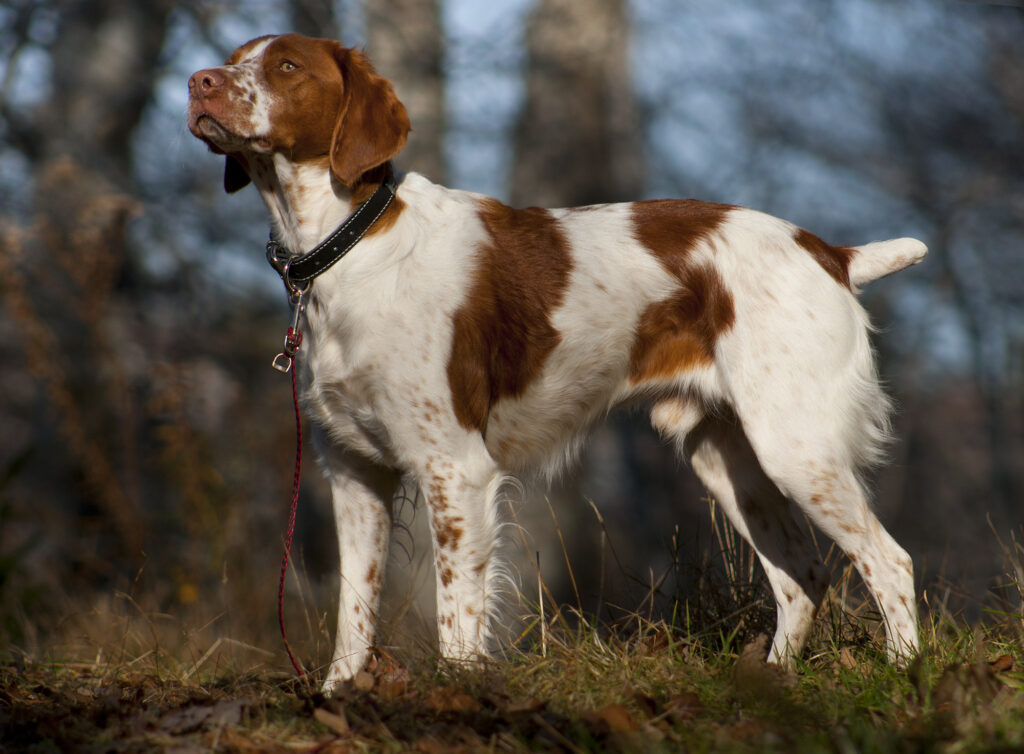
Brittany — photo 2

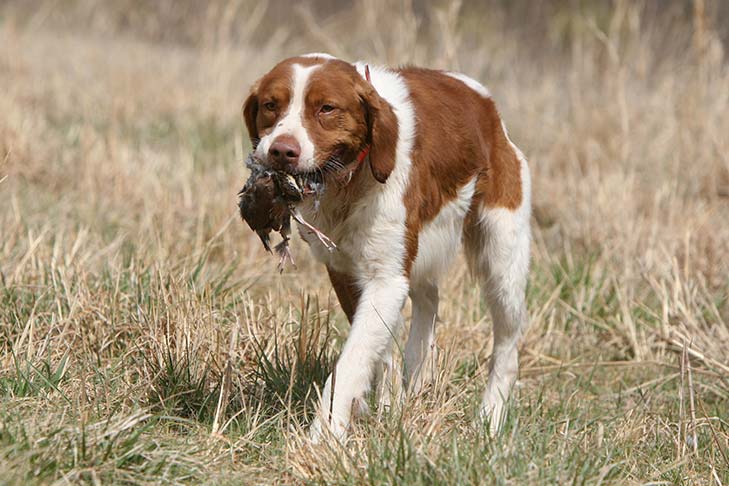
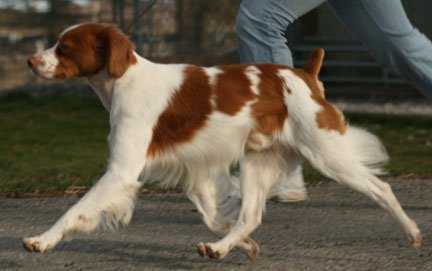
The Brittany is an elegant, compatc, and sturdy dog, without any heaviness. It gives the impression of maximum athleticism and energy in a small body. It is the smallest of the French long-haired pointing dogs. Its expression is intelligent, alert, and cheerful, perfectly matching its temperament.

Head, Eyes, and Ears

The head has a slightly rounded skull with a moderate stop (the transition from forehead to muzzle). The muzzle is medium-length, straight, and not too narrow. The nose should be dark (black or brown, depending on the coat colour), with well-opened nostrils, indicating an excellent sense of smell. The eyes are very expressive, slightly almond-shaped, amber or hazel, harmonising with the coat colour. The gaze is lively and intelligent. The ears are set high, quite short (shorter than other spaniels, like the English Springer Spaniel), triangular, slightly rounded, and covered with wavy hair. They frame the face and give the dog its characteristic alert look.

Body and Tail of the Brittany

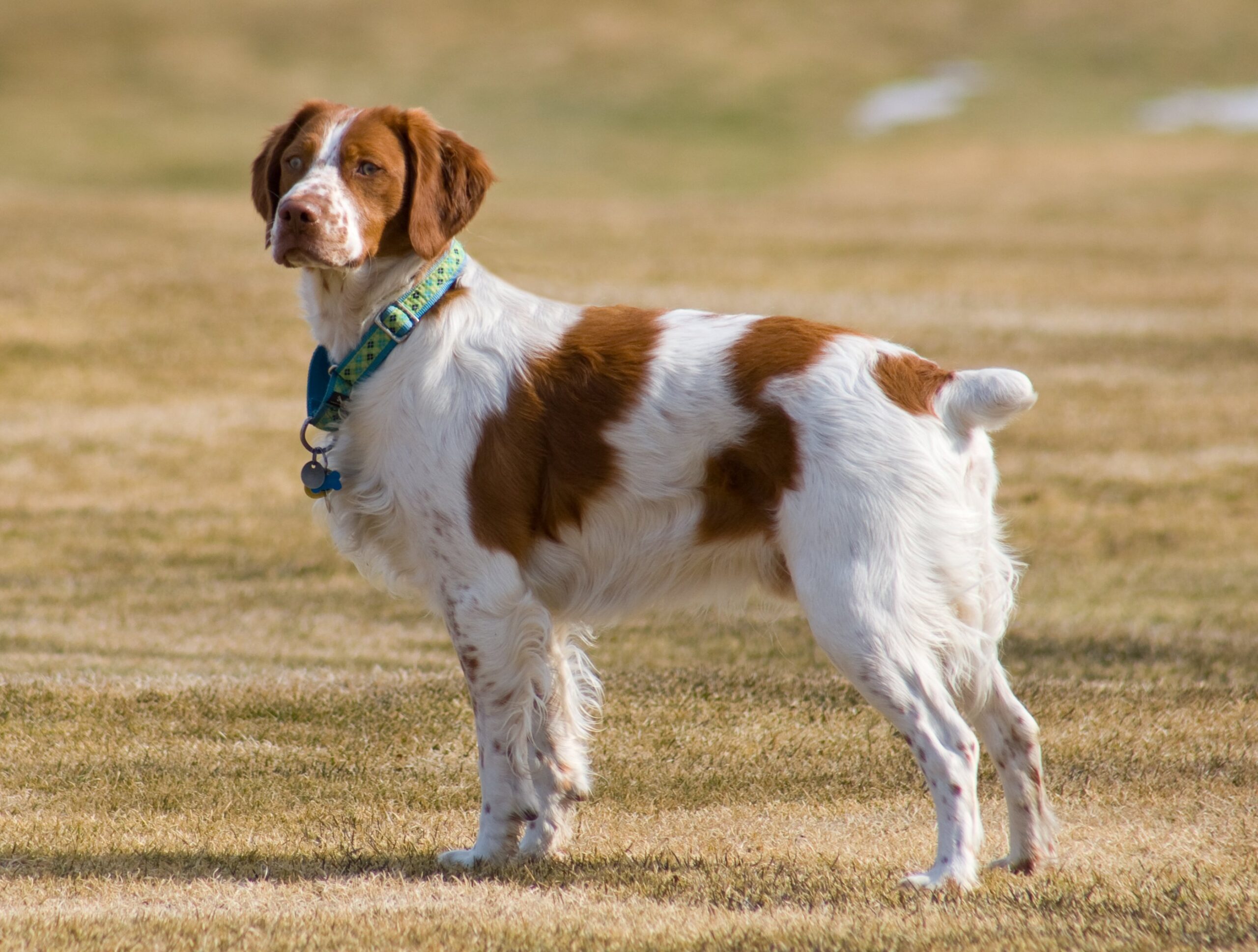
The body is cobby but not massive, with a deep chest reaching the elbows and a short, straight back. The loin is short and strong. This gives the dog endurance and agility. The tail is one of the breed’s most interesting features. Brittanys can be born with a naturally short tail (bobtail) or without one at all (anury). If a dog is born with a long tail, it was traditionally docked in countries where this was permitted (in the UK and many European countries, cosmetic docking is banned). A natural bobtail is a desirable trait.

Coat and Colour

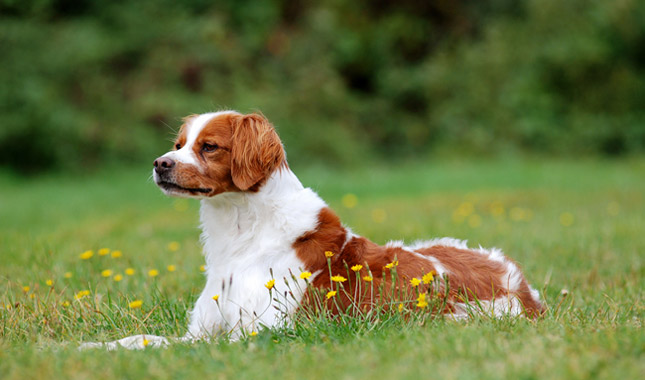
The Brittany’s coat is fine but not silky, and can be straight or slightly wavy. There is almost no undercoat. On the ears, as well as the back of the front and-hind legs, there is longer ‘feathering’, but it should not be excessive so as not to hinder the dog when working in thick cover. This makes grooming easier and prevents burrs from getting tangled.

Traditional colours are a combination of white with other colours:

  • Orange & White: The most common colour.
  • Liver & White: Also very common.
  • Black & White: Quite rare, but recognised by the standard.
  • Tricolour: Black & white with tan markings or liver & white with tan markings (usually above the eyes, on the muzzle, and legs).
  • Roan: Heavy roaning (a mix of coloured hairs on a white background) is permitted, creating a beautiful ‘speckled’ effect (e.g., orange roan or liver roan).
Character: Temperament and Behaviour
Brittany — photo 3

Brittanys are ‘generators of positivity’ on four legs. They combine high emotional sensitivity with natural obedience, although they are often considered free-spirited dogs. This is not a dog that will lie quietly in a corner. It wants to be in the centre of the action, take part in all family affairs, and follow its owner like a shadow. Their ‘motor’ is almost never off when they are awake.

The Brittany in the Family and with Children

This is an ideal family companion for active people. This lively and hyperactive pet finds separation from its owner difficult and longs to always be in human company. They do not cope well with loneliness and can develop anxiety or destructive behaviour (barking, chewing furniture) if left alone for long periods.

The Brittany is friendly towards strangers, so you shouldn’t expect guard dog qualities. It’s more likely to ‘lick an intruder to death’ than scare them away. They get along wonderfully with children, seeing them as equally tireless playmates. However, due to their high energy, they might accidentally knock over a very small child, so play should always be supervised by adults.

Relationship with Other Animals

Other animals shouldn’t be wary of the Brittany either – it will happily cooperate with other dogs. They are non-confrontational and usually happy to have a canine friend. Of course, their energy might be too much for calm, phlegmatic breeds. Unlike some hunting breeds that can be dominant, such as the Rhodesian Ridgeback, the Brittany is usually geared towards cooperation.

As for smaller pets (cats, rodents, birds), the situation is more complex. The Brittany is a gundog with a strong innate instinct. Although it can live peacefully with a cat it grew up with, it will most likely chase new or unfamiliar cats relentlessly, not to mention birds or squirrels in the garden.

The Brittany as a Gundog
Brittany — photo 4

It shouldn’t be forgotten that the Brittany is first and foremost a working gundog. It’s a versatile helper, classified in France as a “pointer” (un chien d’arrêt) and in the US as a “spaniel” (retriever). In reality, it combines the best of both worlds and is an outstanding ‘all-in-one’ hunter.

  1. Work in the Field (Pointing): The Brittany has an exceptional nose and a wide, fast search. Unlike spaniels, which work ‘under the gun’ (close to the hunter), the Brittany scans the field far ahead, finds game (usually birds like woodcock, pheasant, quail), and freezes in a classic ‘point’, indicating the direction to the hunter.
  2. Work After the Shot (Retrieving): After the shot, on command, the Brittany finds and retrieves the wounded or dead game. They have a ‘soft mouth’, meaning they bring back the bird without damaging it.
  3. Versatility: They work brilliantly not only in the field but also in marshes and water, eagerly retrieving ducks. Their coat, while not thick, provides good protection from cold water.

Their energy and intelligence make them similar to other European pointers, such as the Small Munsterlander, but Brittanys usually have a wider search range. Their passion for work is innate, and even if you are not a hunter, you must provide an outlet for this energy through sport or intensive games.

Health of the Brittany: Typical Diseases and Prevention
Brittany — photo 5

Brittanys are generally a healthy and hardy breed, especially working lines where selection is based on working ability and health. However, like many purebred dogs, they have a predisposition to certain genetic conditions. It’s important to choose a puppy from a responsible breeder who tests the parents for common diseases.

  • Hip Dysplasia: This is a common problem for many medium and large-sized dogs. It’s a genetic condition where the joint develops improperly, leading to arthritis and pain. Weight control, moderate exercise at a young age, and proper nutrition can reduce the risks.
  • Epilepsy: Brittanys, being sensitive to stressful situations, can suffer from idiopathic epilepsy. This is a neurological disorder that causes seizures. It’s usually well-controlled with medication.
  • Ear Infections (Otitis): Their hanging, feathered ears create a warm, moist environment, perfect for bacteria and yeast to thrive. This leads to a high tendency for inflammation in the ear canal. Regular ear cleaning is critically important.
  • Eye Problems: The breed can be prone to cataracts and Progressive Retinal Atrophy (PRA), which can lead to blindness. It’s important to check the dog’s vision and not ignore cloudiness of the lens or changes in behaviour (e.g., the dog bumping into objects in the dark).
  • Hypothyroidism: An underactive thyroid gland, which can lead to weight gain, lethargy, and skin and coat problems.
  • Discoid Lupus Erythematosus (DLE): This is an autoimmune disease that affects the skin, most often the nose. It causes loss of pigmentation, scaling, and ulcers. Dogs with DLE need protection from the sun.

Regular visits to the vet, timely vaccinations, parasite treatment, and close observation of the dog’s condition are key to a long and happy life. If you notice any changes in behaviour, appetite, or activity level, don’t hesitat to visit the clinic. You need to see the changes firsthand to react in time.

Grooming the Brittany: Coat Care and Hygiene
Brittany photo outdoors

Grooming a Brittany is relatively simple compared to other spaniels, as their coat isn’t as thick or long and lacks a heavy undercoat. However, it does require regularity, especially if the dog spends a lot of time outdoors.

Coat Care

The main tool is a comb or a slicker brush. Brush the coat 2-3 times a week to prevent mats, especially in the ‘feathering’ (ears, legs, belly). This will also help remove dirt, burrs, dead hair, and distribute natural oils through the skin. You’ll need to bathe this long-haired dog about once a month or when it’s noticeably dirty (e.g., after hunting in a marsh). Use only special dog shampoo to avoid drying out the skin. This will not only keep the Brittany clean but also rid your home of that characteristic ‘doggy’ smell.

Ears, Nails, and Teeth:

  • Ears: This is the most crucial aspect of grooming a Brittany. Due to their drop shape, they are poorly ventilated. Check the ears WEEKLY. After every bath or swim, be sure to dry them thoroughly. Use a special ear cleaning solution to remove dirt and wax. Redness, an unpleasant smell, or if the dog is shaking its head, are signs of infection.
  • Nails: Trim the nails regularly (about every 3-4 weeks). If the dog runs a lot on tarmac, they might wear down naturally, but the dewclaw (fifth toe) doesn’t touch the ground and must be clipped. The ‘click-clack’ of nails on the floor is a sure sign it’s time for a pedicure.
  • Teeth: If necessary, you should brush the dog’s teeth with a special toothpaste 2-3 times a week to prevent tartar build-up and gum disease.
Training and Socialisation of the Brittany
Brittany puppy

Natural obedience, high intelligence, and a desire to please their owner make training a Brittany an easy and enjoyable process. They literally ‘live’ to work as a team with a human. Brittanys are the ‘A+’ students of the dog world. They grasp new commands quickly and love to perform tasks.

The breed’s extraordinary emotional sensitivity demands a gentle attitude and a soft approach. They are very sensitive to criticism. Harsh training methods, shouting, physical punishment, or ‘lead-jerking’ can ‘break’ this dog, making it fearful, insecure, and anxious. They respond best to positive reinforcement: praise, treats, games, and the owner’s enthusiasm. Your joy is their motivation.

The sensitive nature of the long-haired Brittany requires early and intensive socialisation. From a young age (after the necessary quarantines), introduce the puppy to different people, sounds, places, surfaces, and other calm, vaccinated animals. Without this, this dog with a delicate psyche can become fearful or overly excitable. Physical training will give it an outlet for its boundless energy, but variety is key here. A Brittany can quickly become bored without adventure and mental challenges.

Activity and Physical Exercise
Brittany — photo 8

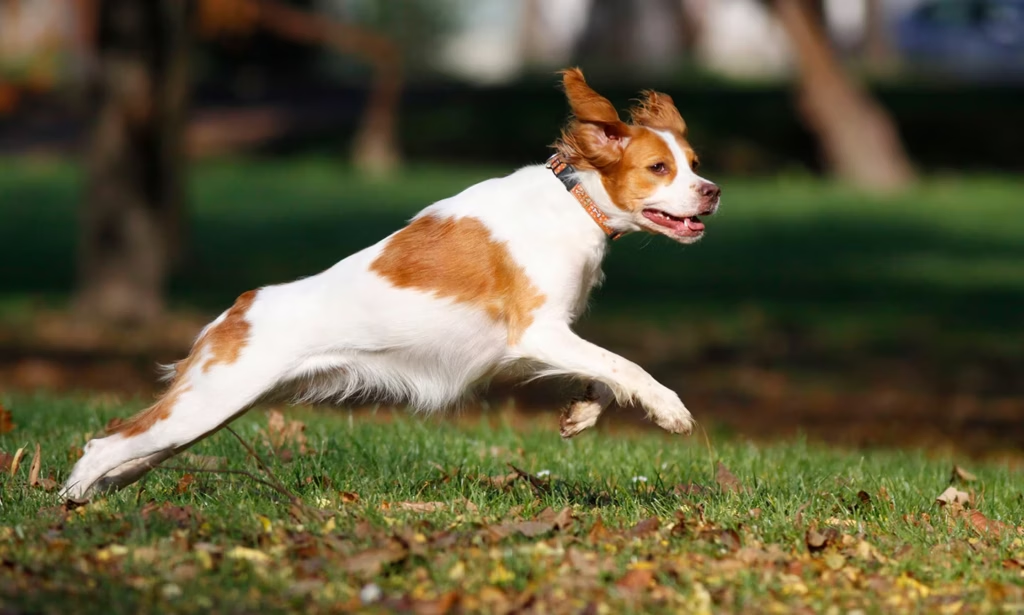
This is not a breed that will be happy with a 15-minute walk around the block. The Brittany is a high-energy ‘perpetual motion machine’. It needs a minimum of 1-2 hours of intense physical exercise daily. And that’s not just a walk on the lead; it needs to be running, playing frisbee, or working in its field (hunting, sport).

Important: A Brittany that doesn’t get enough exercise becomes destructive, anxious, and unmanageable. They might start chewing furniture, barking incessantly, or trying to escape the garden in search of adventure. This breed is ideal for people with an active lifestyle. They, just like Dalmatians, are excellent partners for:

  • Running and jogging
  • Cycling (with the dog running alongside)
  • Hiking and trekking
  • Canine sports: agility (where they are often champions), flyball, dock diving, nosework.

They are ready to work in any weather, be it heat or raib. Their stamina is legendary. Also, don’t forget about mental stimulation. 15 minutes of command training, scent games (e.g., hiding treats in a room), or working on tricks can tire them out just as much as an hour-long run.

Feeding the Brittany: Key Recommendations
Brittany on a hunt

As an active, athletic dog, the Brittany needs a high-quality diet rich in protein and fat to maintain its energy levels. The main rule is not to overfeed. Brittanys can be prone to weight gain if their diet doesn’t match their activity level, and this puts extra strain on their joints, which is especially dangerous given their predisposition to dysplasia.

Dry Food vs. Natural Diet

The choice of diet depends on the owner, their time, and budget. High-quality dry food (premium or super-premium) for active medium-sized dogs is an excellent, balanced option. It already contains all the necessary vitamins and minerals. Choose formulas high in protein (25-30%) and fat (15-20%), especially if the dog is a working or very active.

If you prefer a home-cooked (natural) diet, the menu must be carefully planned and balanced by a veterinary nutritionist. It should include:

  • Protein sources (the base): lean meat (beef, turkey, chicken), offal (heart, liver – in moderation), sea fish (boneless).
  • Fats: A moderate amount of animal fats and vegetable oils (flaxseed, olive) as a source of Omega-3 and Omega-6.
  • Carbohydrates: Grains (buckwheat, rice, oats), but they shouldn’t form the bulk of the diet.
  • Fibre: Vegetables (carrots, pumpkin, courgette, broccoli), fruits (apples), and greens.
  • Fermented dairy products: Kefir, low-fat cottage cheese (not milk!) can be given as a separate meal.

Important: A natural diet definitely requires additional vitamin and mineral supplements. Mixing dry food and a natural diet in the same meal is not recommended.

AgeFeeds per dayDiet Type
2-4 months4-5 timesSpecialised puppy food for medium breeds
4-7 months3 timesGradually increase portion, move to 3 feeds
7-12 months2-3 timesTransition to adult food (depending on size and activity)
1+ year (Adult)2 timesHigh-quality food for active dogs (morning and evening)
Pros and Cons of the Brittany Breed

No breed is perfect for everyone. The Brittany is a wonderful dog, but it’s not the right fit for every family. Here’s an honest look at the advantages and disadvantages to help you make an informed decision.

Pros (+)Cons (-)
High intelligence and ease of training. They love to learn and please.Extremely high energy needs. They need a job, not just walks.
Compatc size. ‘A lot of dog’ in a small package, convenient for travel.Does not tolerate being alone. Prone to separation anxiety.
Friendly and affectionate nature. Great with children and other dogs.Sensitive nature. Responds poorly to shouting, harsh methods, and negativity.
Relatively simple coat care (compared to other spaniels).Strong hunting instinct. May chase cats, birds, and squirrels.
Good health and stamina.Prone to ear infections. Requires constant monitoring and cleaning.
Versatile (work and companionship). An excellent hunter and a wonderful companion.Not a guard dog. Too friendly towards strangers.
Interesting Facts About the Brittany
  • ‘French’, but not a ‘Spaniel’ (in the US): Although its name is ‘Epagneul Breton’ (French Spaniel of Brittany), the American Kennel Club (AKC) classifies it in the ‘Sporting’ group and simply calls it the ‘Brittany’. They believe its working style (pointing) is closer to pointers than to spaniels (which flush game without pointing).
  • Natural Bobtail: The Brittany is one of the few gundog breeds where a naturally short tail (from birth) is the norm and even a desirable trait in the standard.
  • Escape Artists: Thanks to their intelligence and athleticism, Brittanys are known as escape artists. They can jump a high fence or figure out how to open a latch if they are bored. They need a securely fenced garden.
  • Two Types: There is a slight division into ‘American’ and ‘French’ (European) types. American Brittanys tend to be slightly taller, faster, and bred for a wider search in the field, while the French type (the original) is more compact and works closer to the hunter.
Frequently Asked Questions (FAQ) About the Breed

Does the Brittany shed a lot?

They shed moderately, with two distinct seasonal peaks in spring and autumn when they drop their light undercoat. They don’t shed as heavily as a Labrador, for example, but there will be hair in the house. Regular brushing (2-3 times a week) helps to keep the shedding under control.

Can a Brittany live in a flat?

Theoretically – yes, but it is difficult and not recommended. They can adapt to flat life only if the owner provides them with 2+ hours of intense physical and mental activity every day. A private house with a securely fenced garden where they can run is much better for them. But even in a house, they need daily walks and training outside the garden.

Is this breed suitable for a first-time owner?

It’s a ‘yes, but…’. On the one hand, they are very intelligent and learn easily, which is a plus for a novice. On the other hand, their hyper-energy, sensitivity, and need for a constant ‘job’ can be too much for a person who has no prior experience with active working breeds. A novice owner must be prepared to dedicate a lot of time to training and activity and be very consistent.

Do they bark a lot?

They aren’t considered a ‘barky’ breed, but they are alert and will let you know when someone is at the door (although they’ll probably just lick the guest). They may also bark out of boredom or anxiety if their needs for activity and companionship are not met.

Video About the Breed
Pros
  • Very clever, learns easily
  • Affectionate, good with children
  • A compact working hunter
  • Hardy, athletic
Cons
  • A huge need for exercise
  • Sensitive — does not tolerate harshness
  • Dislikes solitude
  • A strong hunting instinct
Compared with similar breeds
German Shorthaired PointerSpringer SpanielCocker Spaniel
Height53–64 cm46–56 cm38–43 cm
Energy554
Apartment22.53
Beginners2.533.5
FAQ
Is the Brittany suitable for a novice?
Yes — it is one of the easiest pointers to train, affectionate and obedient; the key is to provide plenty of exercise and gentle training.
How much exercise does the Brittany need?
A great deal — it is a hardy field hunter; without long daily exertion it grows bored.
What does the Brittany suffer from?
The breed is generally healthy, but epilepsy occurs above average (usually at 3–7 years); there is also a mild tendency to dysplasia and skin problems.
Sources

FCI Standard No. 95 · The Kennel Club

Share This Article