

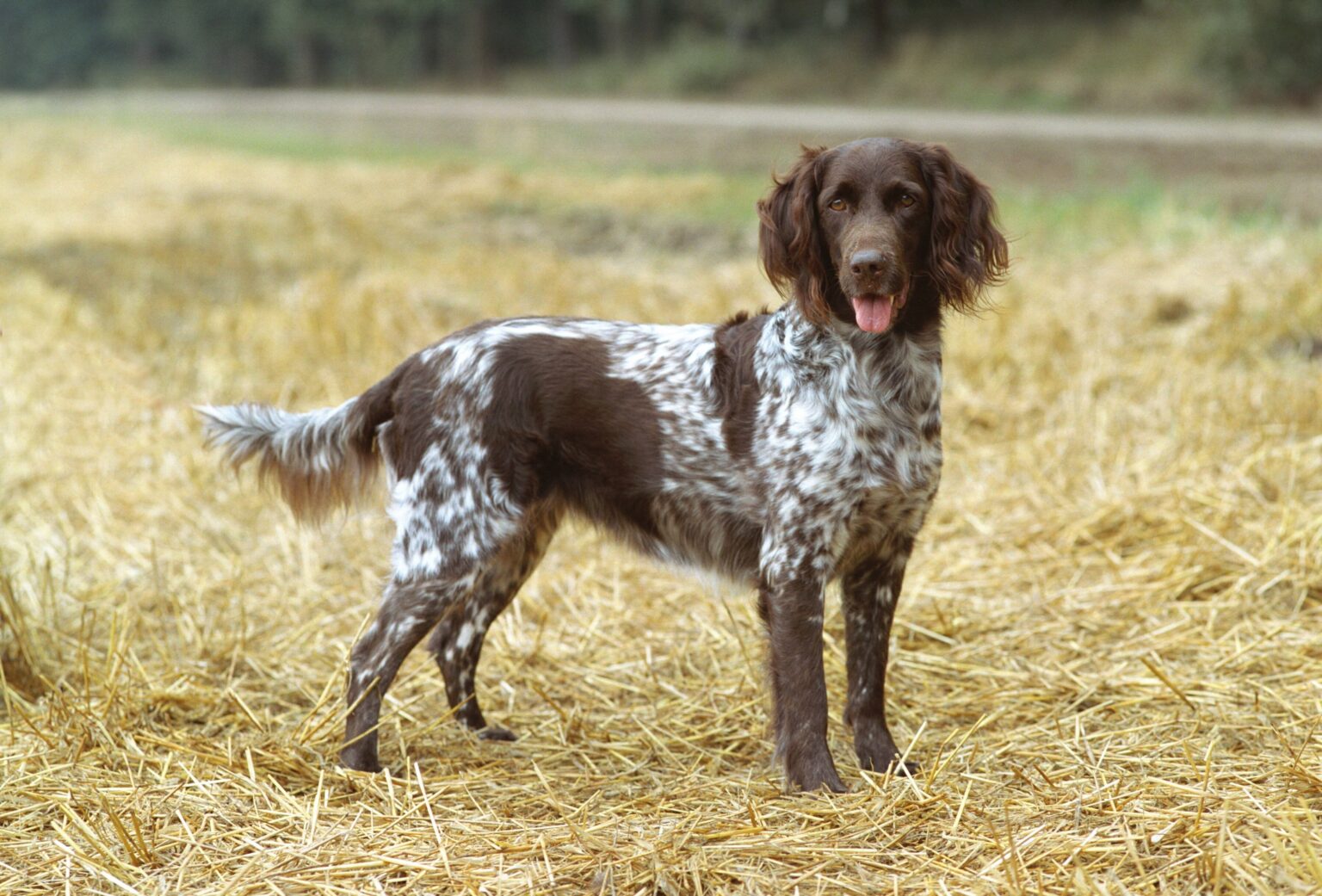
| Height | 50–56 cm |
| Weight | 15–27 kg |
| Lifespan | 12–14 years |
| FCI group | 7 · pointing dogs |
| Origin | Germany (Münsterland) |
Exact ratings
Common health issues
Nutrition
The Small Münsterländer (Kleiner Münsterländer) isn’t just a dog; it’s an energetic bundle of hunting passion, intelligence, and loyalty, all wrapped up in a compact and elegant form. As one of the smallest pointer breeds, this dog is a versatile assistant for hunting both on land and in water. Tireless and resilient, with an exceptional sense of smell, it works in close cooperation with the hunter – earning it the affectionate German nickname “Spürhund” (tracker). Yet, its talents extend far beyond the field; the Small Münsterländer also makes a wonderful companion, getting along famously with children and becoming a well-behaved, loving family member. You can read more about all aspects of this remarkable breed right here on Tvaryny.
Despite its name and some superficial resemblance, it’s crucial not to confuse it with the Large Münsterländer. These are two distinctly different breeds with separate ancestors and developmental histories, although both originate from the Münsterland region. The Small Münsterländer has captured the hearts of hunters and dog enthusiasts worldwide thanks to its versatility, sharp intelligence, and cheerful disposition.
Small Münsterländer: Key Breed Information
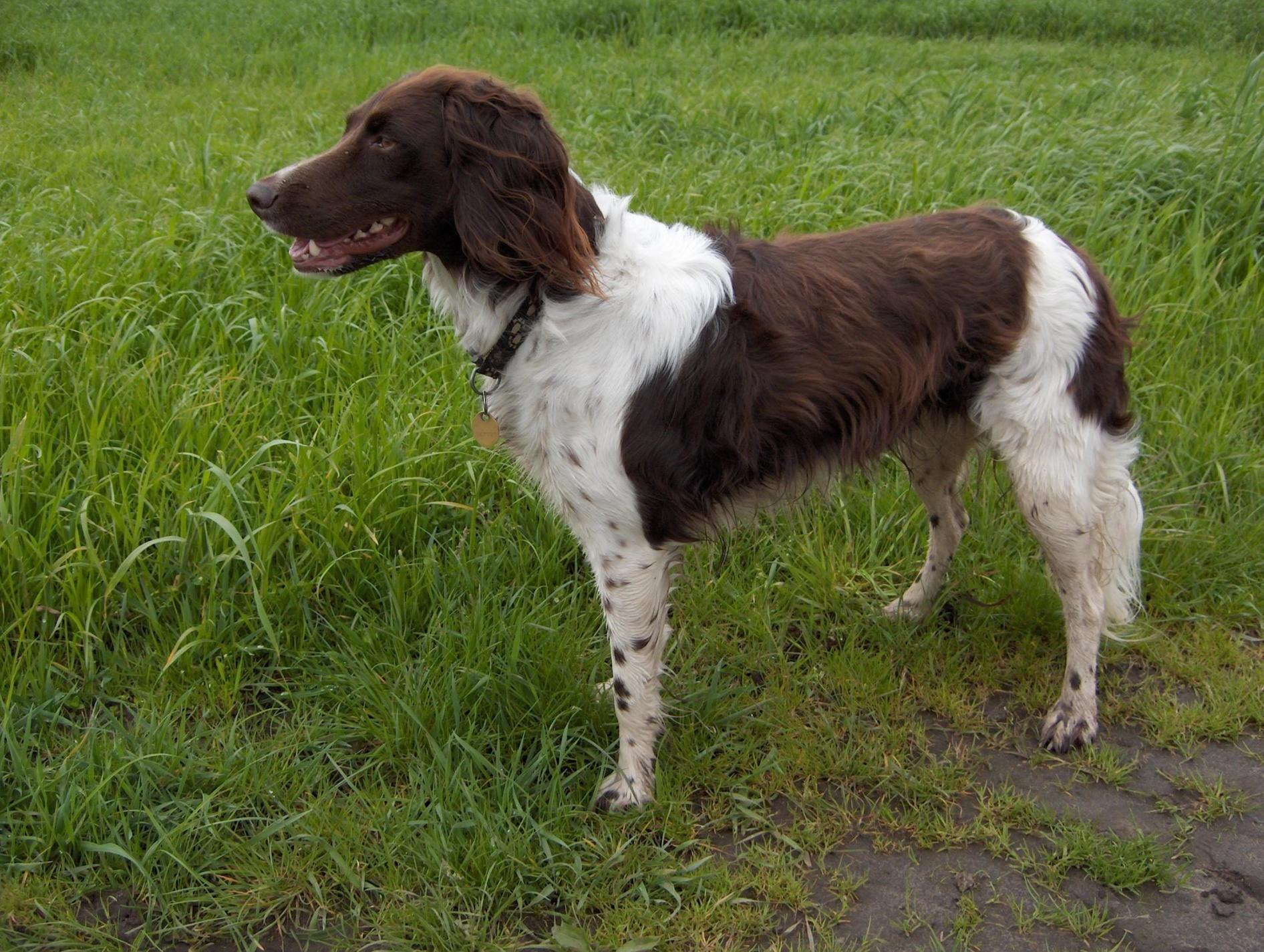
| Breed Name | Small Münsterländer (Kleiner Münsterländer) |
| Country of Origin | Germany |
| FCI Classification | Group 7 (Pointing Dogs), Section 1.2 (Continental Pointing Dogs, Spaniel type) |
| Time of Origin | Late 19th – Early 20th Century |
| Lifespan | 12-14 years |
| Height (at withers) | Dogs: 52-56 cm, Bitches: 50-54 cm |
| Weight | 18-25 kg (approximately 40-55 lbs) |
| Usage | Versatile gun dog, companion dog |
History of the Small Münsterländer’s Origin
The history of the Small Münsterländer is deeply intertwined with Germany’s hunting traditions, particularly in the Münsterland region of Westphalia. For centuries, so-called “bird dogs” (Vogelhunde) were used here for hunting feathered game. These dogs were known by various names, including “Heidewachtel” (heath quail dog), indicating their specialisation. They were small, long-haired, intelligent, and adept at working in dense undergrowth.
In the late 19th century, with changes in German hunting laws and the increasing popularity of English breeds, local varieties faced extinction. However, enthusiasts worked diligently to preserve these unique dogs. A key figure in the breed’s revival and establishment was Edmund Léns, a schoolteacher from Burgsteinfurt. Alongside his brothers, he began a targeted breeding programme, gathering surviving representatives of the old “bird dog” lines.
They discovered these dogs were incredibly versatile: not only did they excel at pointing birds, but they also retrieved from water and worked a blood trail. Unlike the Large Münsterländer, which descends from German Longhaired Pointers (Deutsch-Langhaar), the Small Münsterländer has the blood of ancient Spanish and French spaniels in its veins, making it a relative of breeds such as the Kooikerhondje and the Brittany Spaniel. This explains its somewhat different working style and appearance. In 1912, the “Association for Small Münsterländer Pointing Dogs” was founded, and in 1921, the breed standard was officially approved.
Breed Standard and Appearance of the Small Münsterländer
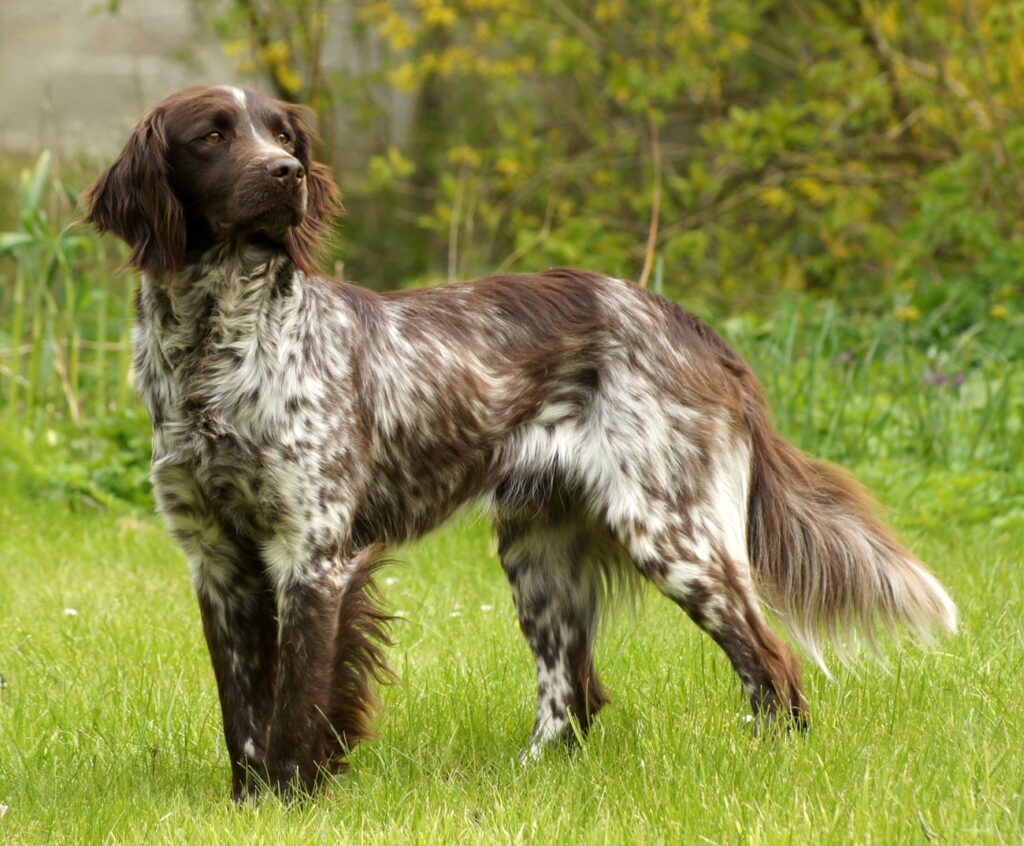
The Small Münsterländer is a medium-sized dog of robust and harmonious build, combining nobility and strength without any trace of coarseness. Its appearance speaks of intelligence, liveliness, and readiness for work. The overall impression is that of an elegant and athletic hunter.
- Head: Dry, noble, slightly domed. The muzzle is long and strong, with a straight bridge of the nose. The stop (forehead to muzzle transition) is not abrupt but discernible.
- Eyes: Medium-sized, preferably as dark brown as possible. The expression is intelligent, lively, and friendly. Eyelids are tight-fitting.
- Ears: Set high, broad at the base, tapering to rounded tips. They lie close to the head and are covered with long hair.
- Body: Slightly longer than tall, with a strong, straight back and a muscular loin. The chest is deep but not overly wide, ensuring endurance.
- Tail: Set high, of medium length. It is a continuation of the backline. Carried horizontally when moving, and dropped in repose. Covered with long hair forming a beautiful “plume”.
- Coat: Dense, smooth, or slightly wavy, of medium length. It offers good protection against harsh weather and brambles. On the ears, hindquarters, and tail, it forms fringes and feathering.
- Colouring: The primary colours are brown and white or brown roan (speckled). Large brown patches, ticking, or a combination thereof are permissible. The head is predominantly brown, possibly with a white blaze.
Character and Temperament of the Small Münsterländer
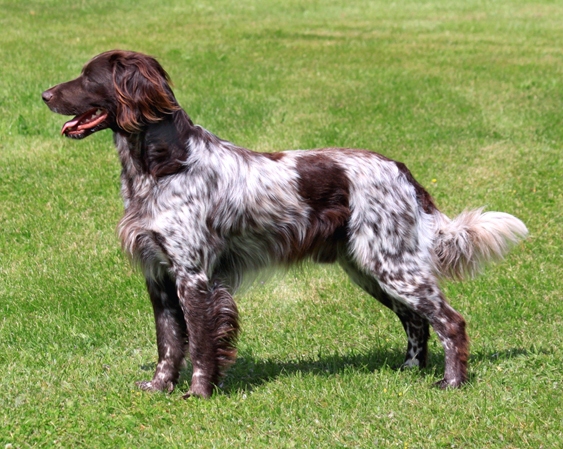
The Small Münsterländer’s character is its “golden ticket” not only to the hunting world but also to the hearts of everyday families. It’s a lively, spirited, yet balanced and obedient dog. It develops a strong attachment to its family and especially to its owner. This dog is not designed for life on a chain or in a kennel; it needs constant human contact.
They are highly intelligent and astute, making the training process enjoyable, but also requiring consistency from the owner. The Small Münsterländer always strives to please, but its hunting instincts can sometimes take over. They get along well with children, seeing them as playmates. Their playfulness and energy make them excellent companions for active families. They may be somewhat reserved with strangers, but without aggression, making them decent watchdogs who will always alert to guests with a bark. They generally get on well with other dogs, especially with proper socialisation from a young age. However, due to their strong hunting instinct, small domestic animals (cats, rodents, birds) may be perceived as prey.
Pros and Cons of the Breed
| Pros | Cons |
|---|---|
| High intelligence and trainability: Quickly grasps commands and tricks. | High need for physical exercise: Not suitable for inactive individuals. |
| Versatile hunting qualities: Effective on land and in water. | Strong hunting instict: May chase small animals, requires a reliable lead. |
| Loyalty and human-oriented: Becomes a true family member. | Prone to barking: Can be noisy if bored or left alone for too long. |
| Friendly disposition towards children: Patient and playful companion. | Requires early and consistent socialisation. |
| Relatively low-maintenance coat care. | May suffer from separation anxiety if left alone for extended periods. |
| Good health and stamina. | Susceptible to ear infections due to their pendulous ear shape. |
Care and Upkeep of the Small Münsterländer
While the Small Münsterländer can adapt to living in a spacious flat, an ideal home for it would be a detached house with a well-fenced garden. The main condition for its happiness is a sufficient level of physical and mental activity.
Grooming and Coat Care
The Small Münsterländer’s coat doesn’t demand complicated care. Brushing it once or twice a week is enough to prevent mats and remove dead hairs. During shedding periods (spring and autumn), this procedure should be done more frequently. Bathe the dog only when necessary, using special dog shampoos to avoid damaging the skin’s protective layer. Particular attention should be paid to the ears. Their pendulous shape creates a favourable environment for the development of bacteria and fungi. Regularly inspect the ear canals, cleaning them of dirt and wax with special lotions. After every bath or swim, always dry the ears thoroughly inside. Also, don’t forget regular nail trimming and dental care.
Physical Exercise and Activity
This is a key aspect of owning the breed. A Small Münsterländer needs at least 1.5-2 hours of active exercise per day. These cannot be slow walks on a lead around the block. The dog needs the opportunity to run freely, explore territory, and swim. Ideal activities for it include:
- Long walks in the woods or park;
- Retrieving objects (balls, frisbees);
- Swimming;
- Dog sports: agility, flyball, obedience;
- For hunters – regular training and hunting.
Without sufficient exercise, a Münsterländer’s energy will find an outlet in destructive behaviour: chewing things, incessant barking, or attempts to escape. This is a dog that constantly needs a task. Its energy requirements can be compared to those of working breeds like the Greenland Dog, although the nature of the activities is, of course, different.
Training and Socialisation
Thanks to their high intelligence and desire to cooperate with humans, Small Münsterländers are highly trainable. However, it’s important to remember that this is a sensitive dog. Positive reinforcement methods work best: praise, treats, toys. Harshness, shouting, and physical punishment can lead to a loss of trust and stubbornness. Training should start from an early age. It’s crucial to establish clear rules and boundaries from day one, and to be consistent in your demands.
Early socialisation is critically important. Introduce your puppy to various people, sounds, places, and other animals (under supervision). This will help raise a confident and well-adjusted dog. Special attention should be paid to perfecting the “Come!” command, as their hunting instinct might compel the dog to chase a bird or a squirrel, ignoring everything else. Training sessions should be varied and engaging to prevent the dog from getting bored. Intellectual games, scent work, and learning tricks – all help satisfy its need for mental stimulation.
Health of the Small Münsterländer: Typical Ailments and Prevention
Nutrition: Key Recommendations
Interesting Facts About the Breed
- In its native land, the breed is often called “Heidewachtel”, which translates to “heath quail dog”, indicating its historical purpose.
- Despite the name “Small”, it is not a miniature version of the Large Münsterländer. It’s an entirely independent breed with different ancestors.
- Small Münsterländers are known for their ability to “find lost game” (Verlorenbringen), meaning they can locate and retrieve injured game long after a shot, following the trail.
- It is one of the three most popular pointing breeds in Germany, alongside the German Shorthaired Pointer and the German Wirehaired Pointer.
- Small Münsterländers are very “talkative”. They use a wide range of sounds – from whining and growling to barking – to communicate with their owner.
Frequently Asked Questions About the Breed (FAQ)
Is the Small Münsterländer suitable for apartment living?
Yes, but only if the dog receives daily, long, and intense physical exercise (1.5-2 hours minimum). If you’re not prepared to provide this level of activity, it’s better to choose another breed. Otherwise, the dog will suffer and may start destroying the apartment.
Does the Small Münsterländer shed a lot?
Shedding is moderate, increasing seasonally in spring and autumn. Regular brushing once or twice a week will help keep the amount of hair in the house under control.
Can a Small Münsterländer live with a cat?
This is possible if they grow up together from a young age. An adult Münsterländer is highly likely to perceive a cat as prey. Even if they live together, they shouldn’t be left unsupervised, especially outdoors, where instincts can take over.
Is this breed difficult to train?
No, they are very intelligent and eager to please. However, they require a consistent, patient, but firm approach. Novices might find it challenging to manage their energy and hunting instincts, so the breed is more recommended for people with experience owning dogs, especially active and working breeds.
Can a Small Münsterländer not be used for hunting?
Yes, it can. But in that case, you must provide it with an adequate substitute in the form of intense sports (agility, canicross), long hikes, scent games, and swimming. This dog vitally needs to expend its energy and intellect.
Video About the Breed
- A versatile pointer: land and water
- An extraordinary nose, works in contact with its person
- Clever and easy to train
- Cheerful, good with children
- A very high energy level — not for a flat
- Needs scent work or hunting
- Bored and destructive without a workload
- Drop ears are prone to infections
| Large Munsterlander | Brittany | Drentse Patrijshond | |
|---|---|---|---|
| Height | 58–65 cm | 47–52 cm | 55–63 cm |
| Energy | 4.5 | 5 | 4 |
| Apartment | 2 | 2.5 | 2 |
| Beginners | 3 | 3.5 | 3.5 |
How does the Small Munsterlander differ from the Large?
Why is it called a "sleuth"?
Is the breed suitable for a flat?
FCI Standard No. 102 · Verband für Kleine Münsterländer
For apartments · For kids · For beginners · Active · Smartest · Hypoallergenic · All rankings →