The “grey ghost” — an elegant silver hunter with hypnotic eyes: athletic, intelligent, boundlessly devoted. Inexhaustible energy and strong attachment mean separation anxiety; this is a breed for very active people, not for a flat without a workload.
Apartment · not suitableKidsCats · not suitableOther dogs · with caveatsBeginners · not suitable
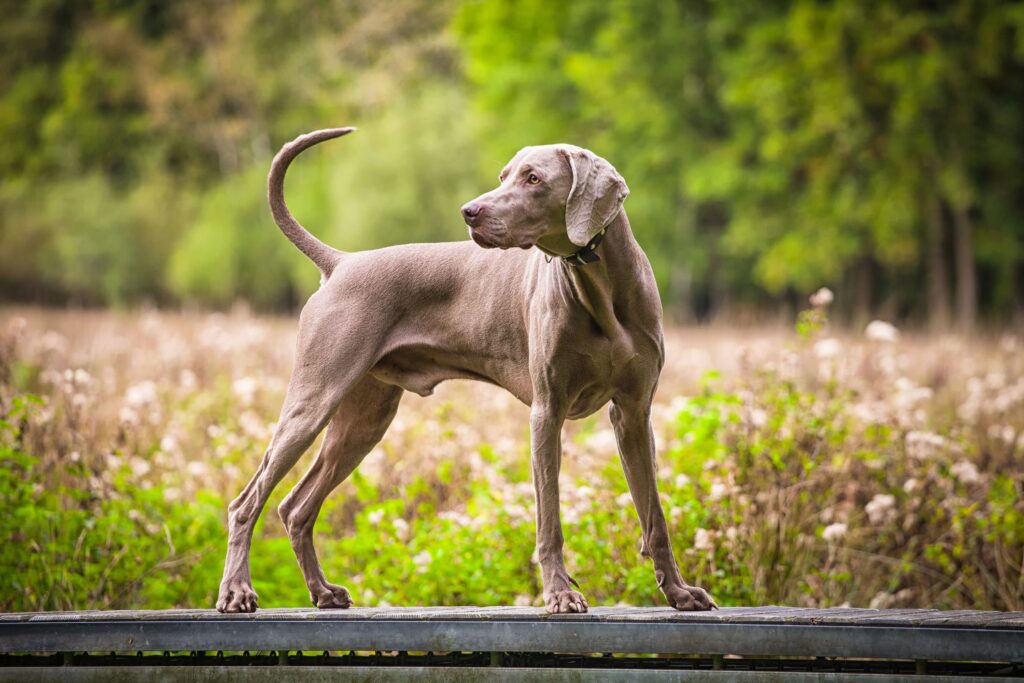
The Shorthaired Weimaraner is not just a dog; it's a truly aristocratic personality with a silvery coat and piercing amber eyes. It's often called the "Grey Ghost" due to its unique colouration and silent, graceful movements. This elegant German hunting dog, a descendant of breeds like the Bloodhound and English Pointer, embodies strength, stamina, and intelligence. It makes an ideal companion for an active family, a courageous partner in the hunt, and a loyal friend. However, its strong hunting instinct and high need for attention place certain demands on owners, about which you can read more on Tvaryny.
This breed combines a noble appearance with a multifaceted character, making it equally successful as a family pet and a working dog. Weimaraners are known for their deep attachment to their owners; they are literally ready to follow them everywhere, earning them the nickname "shadow dog." At the same time, this trait can lead to separation anxiety if proper training is not given from an early age.
The Weimaraner as a hunting dog
Despite its popularity as a family pet, the Weimaraner remains a first-class hunting dog. It belongs to the group of versatile pointing dogs (continental pointers), capable of performing a wide range of tasks. Its hunting qualities include:
Fieldwork: An excellent nose and systematic search allow it to effectively find feathered game. Upon finding a bird, it adopts the classic "pointer" stance.
Retrieving: They are natural retrievers and happily bring back game from both land and water.
Tracking: Thanks to their Bloodhound heritage, Weimaraners have an exceptional ability to work on a blood trail to find wounded game.
This hunting drive requires the owner to provide the dog with an outlet for its energy. If a Weimaraner is not used for hunting, it needs alternative activities such as long runs, swimming, agility, or coursing. There are many breeds worldwide that specialise in hunting, for example, the similarly purposed German Shorthaired Pointer (Deutsch Kurzhaar), or less well-known but equally talented French breeds such as the Braque du Bourbonnais or the Braque de l'Ariège.
Interesting facts about the "Grey Ghost"
Star owners: US President Dwight D. Eisenhower kept a Weimaraner named Heidi right in the White House. Actress Grace Kelly was also a fan of this breed.
Photogenicity: The breed became world-famous thanks to photographer William Wegman, who created celebrated surreal portraits of his Weimaraners, dressing them in human clothes.
Tiger stripes: Weimaraner puppies are born with faint dark stripes on their bodies, which disappear within the first few weeks of life.
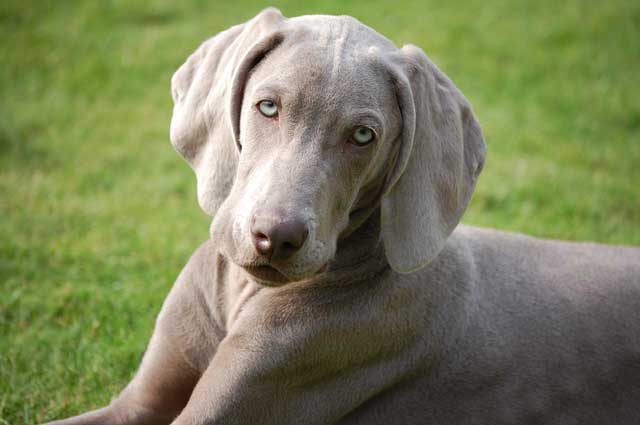
Chameleon eyes: The blue eyes of puppies gradually change colour to amber, finally settling at around 6–8 months of age.
History of the Weimaraner breed: From ducal forests to global recognition
The history of the Shorthaired Weimaraner is relatively young, yet rich and exclusive. The breed was developed in the early 19th century at the court of Grand Duke Carl August of Saxe-Weimar-Eisenach in the city of Weimar, modern-day Germany. The Duke was a passionate hunter and aimed to create an ideal all-around hunting dog — brave, intelligent, resilient, and with an excellent sense of smell. For the creation of this new breed, European pointing dogs were used, particularly descendants of St. Hubert Hounds (Bloodhounds) and Spanish Pointers. Initially, these dogs were called "Weimar Pointers" (Weimarer Vorstehhund) and were used for hunting large game: bears, deer, and wolves.
Over time, as large forest areas in Germany began to disappear and big game became rare, Weimaraners were reoriented towards hunting smaller animals and birds. Their versatility allowed them to easily adapt to new tasks such as searching, retrieving, and tracking wounded game. Only members of the nobility could own these dogs, and in 1897, an elite club was established in Germany that strictly controlled the breeding and sale of puppies. The club's policy was so rigid that exporting a dog outside Germany was practically impossible. They sought to preserve the purity and exclusivity of the breed, preventing its widespread dissemination.
The journey of the "Grey Ghosts" to America was long and arduous. It was only thanks to the persistence of American enthusiast Howard Knight, who made incredible efforts, that he managed to obtain permission to export a pair of Weimaraners to the USA in 1929. Interestingly, the German club initially sent him sterilised dogs, and only on the second attempt did he receive breeding stock. It was thanks to Knight that a strong Weimaraner population was established in the USA in the mid-20th century, from where the breed spread worldwide and gained immense popularity.
What a Shorthaired Weimaraner looks like: Standard and appearance description
The Weimaraner is a medium to large-sized dog with an athletic, harmonious, and proportionate build. Its appearance exudes strength, speed, and endurance. Every movement of the dog is refined and graceful, perfectly matching its aristocratic origins.
Head: The skull is proportionate to body size, wider in males than in females. The stop (transition from forehead to muzzle) is smooth. The muzzle is long and powerful.
Eyes: Perhaps the most expressive feature of the breed. In puppies, they are bright blue, but with age, they change colour to light or dark amber. The gaze is intelligent, watchful, and slightly wary.
Ears: Broad, long, set high, with rounded tips. When at rest, they hang along the cheeks.
Body: Strong, with well-developed musculature. The back is firm, with a slightly sloping topline. The chest is deep and powerful.
Tail: Traditionally docked to approximately 15 cm in length (in countries where permitted). An undocked tail is strong at the base, tapering towards the tip, and hangs down at rest.
Coat: In the shorthaired variation, as the name suggests, the coat is short, dense, smooth, and glossy. The undercoat is either absent or very sparse. There is also a rare variety, known as the Longhaired Weimaraner, whose coat is soft and wavy.
Colour: Unique to the breed. The standard allows shades from silver-grey to mouse-grey or roe-grey. The head and ears are usually slightly lighter. Small white markings on the chest and toes are permissible.
Parameter · 7
Parameter
Description
Height at withers (males)
62–70 cm
Height at withers (females)
59–65 cm
Weight (males)
30–40 kg
Weight (females)
25–35 kg
Lifespan
10–14 years
Coat type
Short, smooth, no undercoat
Colour
Silver-grey, mouse-grey, roe-grey
Weimaraner character: Intelligence, energy, and boundless devotion
The character of the Weimar Pointer is a complex blend of hunting instincts, high intelligence, and deep emotional attachment to its family. These are incredibly intelligent dogs who learn quickly, but their intelligence can also be a challenge for an inexperienced owner. They tend to make independent decisions and can be quite stubborn if they don't perceive their owner as a strong and consistent leader.
They are known as "Velcro dogs" or "shadow dogs" because they strive to be close to their owner 24/7. This trait makes them excellent companions but also prone to separation anxiety. Left alone for long periods, a Weimaraner can become destructive: chewing furniture, scratching doors, or barking incessantly. Therefore, this breed is definitely not suitable for people who spend a lot of time away from home.
Weimaraners generally get along well and patiently with children, especially if they grow up together. However, due to their large size and high energy levels, they should not be left unsupervised with very young children, whom they might accidentally knock over during play. They are wary of strangers, which makes them good watchdogs. They will always alert to guests' arrival with a loud bark. Their hunting instinct is very strong, so small household pets (cats, rodents, birds) might be perceived as prey. Early and proper socialisation is absolutely essential.
Training and socialisation of the Weimaraner
The upbringing of a stubborn and independent Weimaraner should begin from the first day the puppy arrives home. Early socialisation is key to forming a balanced character. Introduce the puppy to various people, sounds, places, and other animals (under supervision). This will help prevent the development of fears and aggression.
Representatives of this breed will constantly strive to take a leadership position, so you will have to tirelessly assert your authority. Training must be consistent, persistent, but fair. Weimaraners are very sensitive to their owner's mood and react poorly to harshness, shouting, or physical punishment. Positive reinforcement methods—praise, treats, games—work best. Training sessions should be varied and interesting, as monotonous activities quickly bore this intelligent dog. Provide it with not only physical but also intellectual stimulation: teach new commands, use puzzle toys, engage in search games.
Pros and cons of the Weimaraner breed
Before getting such a serious breed, it's worth weighing all the "pros" and "cons."
Pros and cons of the Weimaraner breed · 6
Pros ( ✅ )
Cons ( ❌ )
Incredible loyalty and affection
Prone to separation anxiety
High intelligence, easy to train
Can be stubborn and manipulative
Elegant and impressive appearance
Very high need for physical exercise
Minimal coat grooming
Strong hunting instinct (danger to small animals)
Good watchdog
Requires an experienced and confident owner
Versatile partner for sport and hunting
Not suitable for apartment living without sufficient exercise
Care and maintenance: What an owner needs to know
Caring for a Shorthaired Weimaraner is not difficult, but it requires regularity and attention to detail.
Grooming: The short coat does not require frequent brushing. Once a week is enough to go over it with a rubber brush or glove to remove dead hairs and maintain its shine. Shedding is moderate.
Bathing: Bathe the dog only when necessary, using specialised dog shampoos to avoid drying out the skin.
Ear care: This is a very important aspect. Pendulous ears create a favourable environment for the development of bacteria and fungi. It is necessary to regularly inspect and clean the ear canal with special lotions.
Claws: Trim the claws 1–2 times a month if they don't naturally wear down during walks.
Teeth: Regular teeth cleaning will help prevent tartar buildup and gum disease.
The most important requirement for keeping them is ensuring a sufficient level of physical activity. This breed needs a minimum of 1.5–2 hours of intense exercise daily. This is not a dog that will be satisfied with a short walk on a lead. An ideal place for keeping them would be a private house with a large, securely fenced garden. In an apartment, a Weimaraner can only live if the owner is willing to dedicate a lot of time to active and long walks.
Weimaraner health: Typical illnesses and prevention
Frequently asked questions about the breed (FAQ) · 5
Is the Weimaraner suitable for an inexperienced owner?
No, it's generally not recommended. Their high intelligence, stubbornness, and need for a leader require experience, patience, and consistency in training. A novice might not cope with their dominant character traits.
Does the Shorthaired Weimaraner shed much?
Their shedding is moderate. Regular brushing once a week will help keep the amount of hair in the home under control.
Can they live in an apartment?
Theoretically, yes, but only if the owner is prepared to provide 2–3 hours of active walks daily (running, games, swimming). Without sufficient physical and mental stimulation, the dog will become unhappy and destructive. A private house is the ideal option.
Do Weimaraners get along with cats and other animals?
It's challenging. Due to their strong hunting instinct, they may chase cats and other small animals. Chances of peaceful coexistence are higher if the dog and cat grow up together from a young age, but even then, constant supervision is needed.
How much does a Weimaraner puppy cost?
The price for a Weimaraner puppy from a responsible breeder with documentation and vaccinations can vary significantly, but it is typically an expensive breed. One should be wary of excessively low prices, as this might indicate health problems or a lack of papers. Expect to wait: established breeders have their litters spoken for well in advance.
Video about the breed
FAQ
Why is the Weimaraner called the “grey ghost”?
Because of its unique silver-grey colour and graceful movement. Puppies’ eyes are blue and turn amber with age.
Can a Weimaraner be left alone?
Not for long — strong separation anxiety leads to howling and destruction. It is a “companion dog” that needs company.
Is the Weimaraner suitable for a beginner?
Rather not — its energy, strength and sensitivity demand experience, exercise and consistency.