

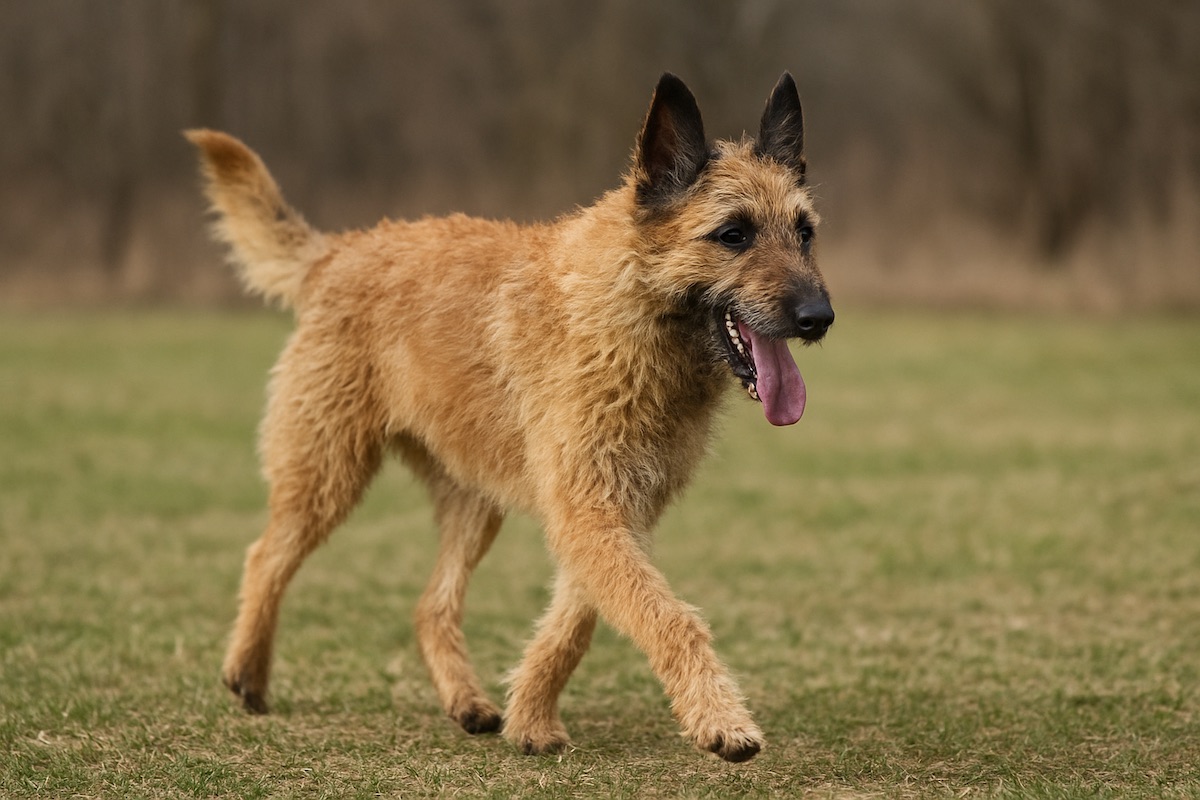
| Height | 56–66 cm |
| Weight | 20–30 kg |
| Lifespan | 10–12 years |
| FCI group | 1 · sheepdogs and cattle dogs |
| Origin | Belgium |
Exact ratings
Common health issues
Nutrition
The Laekenois, the rarest of the four Belgian Shepherd varieties, is a truly unique dog with a distinctive harsh, ‘wired’ coat. This gives them a somewhat dishevelled, yet incredibly appealing appearance. More than just a pretty face, the Laekenois is an exceptionally athletic, robust, and resilient companion. Historically bred for guarding and herding livestock, this breed has retained its working qualities to this day. Unlike its Belgian ‘cousins’ such as the Groenendael, Tervuren, or Malinois, the Laekenois stands out for its particular strength of character, making it an ideal protector. These dogs do not tolerate loneliness well and form deep bonds with their families, often recognising only one owner as their undisputed leader. To strangers, the Laekenois can appear stern and serious, always ready to defend its territory and loved ones. Discover more on Tvaryny.
Laekenois: A Brief Overview of Key Breed Characteristics
| Origin | Belgium |
| FCI Classification | Group 1. Sheepdogs and Cattle Dogs (except Swiss Cattle Dogs). Section 1. Sheepdogs. With working trial. |
| Year of Breed Recognition (approx.) | Late 19th century (standard approved in 1897) |
| Life Expectancy | 10–14 years |
| Height at Withers (according to FCI) | Males: 62 cm; Females: 58 cm; Permitted deviations: −2 cm, +4 cm |
| Weight (according to FCI) | Males: approx. 25–30 kg; Females: approx. 20–25 kg |
History of the Laekenois Breed
The history of the Laekenois breed is intricately intertwined with the history of Belgian sheep farming and the Belgian royal family. This variety of Belgian Shepherd was definitively established at the end of the 19th century, although dogs of a similar type had existed in the region much earlier. The name “Laekenois” originates from the Royal Castle of Laeken (Château de Laeken), located near Brussels. It was here that these dogs were the favourites of Queen Henriette of Belgium, wife of King Leopold II. The Queen highly valued their harsh, tousled coat, which provided excellent protection against the elements while guarding sheep and flax fields bleached in the sun.
The Laekenois is considered the oldest and rarest of the four Belgian Shepherd types. Initially, these dogs were primarily used as herding and guard dogs. Their vigilance, courage, and stamina made them indispensable helpers for farmers. Thanks to their unique coat, which provided excellent camouflage and protection, Laekenois were particularly popular in the Antwerp and Brussels regions.
At the end of the 19th century, Professor Adolphe Reul, a veterinarian and one of the founders of the Belgian Canine Club, played a key role in the classification and standardisation of Belgian Shepherds. In 1891, the first inspection was held in Cureghem (Brussels), where 117 dogs were gathered. It was then that the division into types based on coat structure and colour began. The first standard for three varieties (long-haired, short-haired, and rough-haired) was developed in 1892. The Laekenois, as the rough-haired type, was officially recognised as one of the first.
Unfortunately, two World Wars caused significant damage to the Laekenois population. Dogs were used on the front lines as messengers, medics, and guards, and many perished. After World War II, the breed was on the brink of extinction. Thanks to the efforts of enthusiasts and breeders, the population was gradually restored, but the Laekenois has remained the least numerous among Belgian Shepherds. Even today, this breed is rare outside Belgium and certain European countries. The American Kennel Club (AKC) only recognised the Laekenois in 2020, which attests to the breed’s long journey to worldwide recognition. Despite its scarcity, the Laekenois is in no way inferior to its ‘relatives’ – the Tervuren, Malinois, or Groenendael – and in some qualities, such as strength of character and protective instincts, it even surpasses them.
What a Laekenois Looks Like: Detailed Description of Appearance and Breed Standard

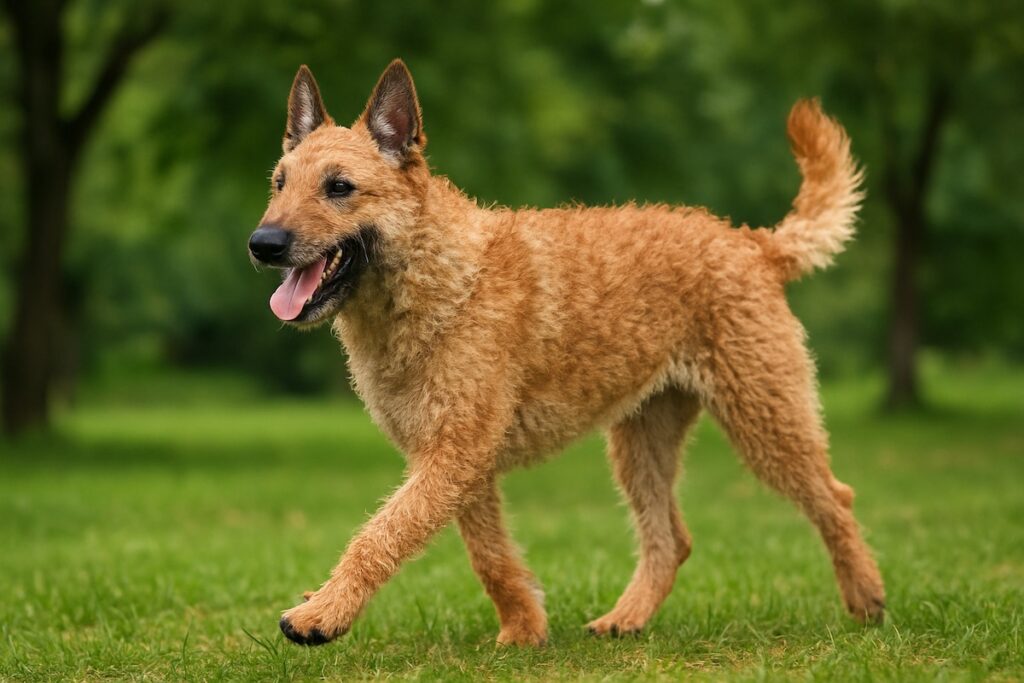
The Laekenois is a harmoniously built, proportionate medium-sized dog that combines elegance and strength. Its appearance exudes alertness and readiness for action. The most distinctive feature of the Laekenois is its coat – harsh, dry, coarse to the touch, creating an impression of slight dishevelment, but without curls.
The head of the Laekenois has clean lines, is dry, of medium length, and proportionate to the body. The forehead is flat, and the stop (transition from forehead to muzzle) is moderate. The muzzle gradually tapers towards the nose leather, which must be black. The lips are thin, tightly fitting, with black pigmentation.
The eyes are medium-sized, almond-shaped, and predominantly dark brown. The gaze is lively, intelligent, and inquisitive. The eye rims are black.
The ears are set high, triangular in shape, erect, and firm. Their size is proportionate to the head. They should not be too large or floppy.
The body is strong but not heavy. The topline is straight. The withers are pronounced. The back is short, strong, and muscular. The loin is short, broad, and muscular. The croup is slightly sloping. The chest is moderately broad, deep, reaching the level of the elbows. The ribs are well sprung.
The tail is of medium length, set at a medium height. When at rest, it is carried low, with the tip slightly curved at hock level. In action, it is raised higher but should not curl or be carried over the back.
The limbs are strong, with well-developed musculature. The forelegs are straight and parallel. The shoulder blades are long and obliquely set. The upper arms are muscular. The elbows fit closely to the body. The hind legs are powerful but not heavy, with well-defined angulations. The thighs are broad and muscular. The hocks are set low. The paws are round, ‘cat-like’, with tightly clenched toes and hard, dark pads. The claws are strong and dark in colour.
The coat is the Laekenois’s hallmark. It should be harsh, coarse, dry, and tousled all over the body. The coat length is approximately 6 cm over most areas of the body, but shorter on the muzzle (with the exception of characteristic ‘whiskers’ and ‘beard’), ears, and lower parts of the limbs. The presence of an undercoat is essential for protection against the elements. The coat on the muzzle forms characteristic eyebrows, whiskers, and a beard, which gives the dog a special expression. The coat should not be curly, silky, or excessively long.
The colouring of the Laekenois is predominantly fawn or reddish with a characteristic ‘overlay’ (darkening of the hair tips), especially on the muzzle and tail. Small white markings on the chest and toes are permissible but undesirable. The main colour is a warm hue, reminiscent of rye bread. Excessive darkening, making the dog almost black, is considered a fault.
Laekenois Character: Temperament, Behaviour, and Interaction
The Laekenois is a dog with a strong, determined, and resolute character. They are known for their exceptional vigilance, bravery, and inherent guarding instinct. This makes them excellent protectors for home and family. A Laekenois is always on alert, ready to warn of approaching strangers with a loud bark and, if necessary, to defend their loved ones and territory. However, a properly trained Laekenois should not display unwarranted aggression; its reaction is always appropriate to the situation.
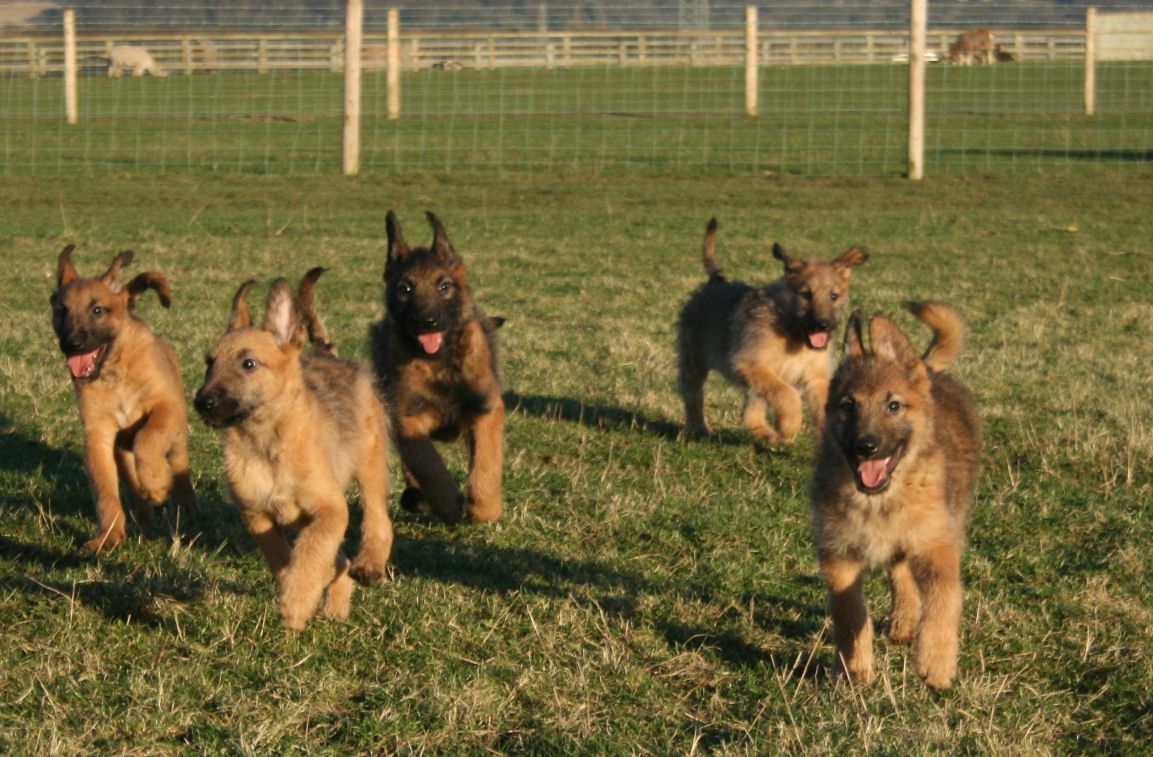
These dogs are extremely loyal to their family and form deep attachments to their owner. They crave human companionship and do not tolerate prolonged solitude well. A Laekenois needs close contact with people and active participation in family life. If left alone for too long, they may become bored, leading to destructive behaviour or excessive barking. They generally get along well with children, especially if raised together, showing patience and playfulness. However, due to their herding instinct, young children should be taught proper behaviour around dogs, and interactions should always be supervised by adults.
Laekenois are very intelligent and astute dogs; they learn quickly but can display stubbornness and independence. They require a consistent, patient, yet firm and confident owner who can establish clear rules and boundaries. Early socialisation and training are critically important for developing a well-balanced and obedient dog. Their energy and intelligence make them excellent candidates for various dog sports, such as agility, obedience, and protection work. In many ways, their trainability and energy are similar to such recognised canine intellectuals as the Border Collie, though the Laekenois may be more independent in decision-making.
Regarding other animals, a Laekenois can cohabit with them if properly socialised from a young age. However, their strong chase instinct can pose a problem for smaller pets, such as cats or rodents, if the dog is not taught appropriate behaviour. Towards unfamiliar dogs, a Laekenois may be suspicious or dominant, so it’s important to supervise their interactions.
It is important to remember that the Laekenois, like other Belgian Shepherds, is a high-energy breed. They require regular and intense physical exercise, as well as mental stimulation. Long walks, running, games, and training will help keep them in good shape and prevent the development of behavioural problems. This is not a dog that will be content with short lead walks; it needs space to move and an outlet for its energy.
Laekenois Health: Typical Ailments, Genetic Predispositions, and Prevention
How to Care for a Laekenois: Specifics of Upkeep and Hygiene
Caring for a Laekenois has its peculiarities, mainly related to its unique coat and high energy level. Ensuring proper living conditions and regular hygienic procedures is key to your beloved pet’s health and happiness.
Laekenois Coat Care
The Laekenois’s coat – harsh, coarse, and tousled – does not require frequent washing or complex grooming, unlike some other breeds. On the contrary, excessive washing can disrupt the skin’s natural oily layer and make the coat softer, which is undesirable for the breed standard. Bathing the dog is recommended only when absolutely necessary, using special shampoos for harsh coats.
The primary coat care involves regular brushing (1-2 times a week) using a brush with widely spaced metal teeth or a special comb for harsh coats. This will help remove dead hairs, dirt, and prevent matting. Particular attention should be paid to areas with denser fur, such as the neck and thighs.
Twice a year, the Laekenois requires stripping (manual plucking of dead hair). This procedure is best entrusted to a professional groomer familiar with the breed’s specific needs, or you can learn to do it yourself. Correct stripping helps maintain the proper texture and appearance of the coat. Clipper cutting is not recommended, as it can spoil the coat’s structure, making it soft and dull.
General Hygiene
- Ears: Regularly inspect the ears for dirt, redness, or unpleasant odour. Clean the ears as needed with a special ear cleaning lotion and cotton pads. In healthy dogs, ears are usually clean.
- Eyes: Periodically examine the eyes. Small discharges in the corners of the eyes can be gently removed with a clean, damp cloth or wipe. If the discharges are abundant, yellowish or greenish, or the eyes are red, consult a vet. Wiping with chamomile infusion can be helpful for minor irritations but does not replace a vet visit for serious symptoms.
- Teeth: To prevent the formation of plaque and tartar, it is recommended to regularly brush your Laekenois’s teeth with a special dog toothbrush and toothpaste. Special chew treats and toys will also be beneficial.
- Claws: Trim claws as they grow, usually every 3-4 weeks. If the dog moves a lot on hard surfaces, the claws may wear down naturally. Use special dog nail clippers of the appropriate size.
Living Conditions and Activity
The Laekenois is a very active and energetic breed that requires significant physical exercise. They are best suited to living in a private house with a large, securely fenced garden where they can run and play freely. Apartment living is possible, but only if daily long and intense walks (at least 2-3 hours a day) are provided, including running, active games, and training. If a Laekenois does not receive enough physical and mental stimulation, it can become restless, destructive, or excessively noisy.
These dogs tolerate heat poorly due to their dense coat, so in summer, they must be provided with access to shade and fresh water, and physical activities should be moved to the morning or evening hours. At the same time, their coat provides good protection against cold and moisture, so they can feel comfortable outdoors even in cool weather, provided they have an insulated kennel or enclosure.
Remember that a Laekenois puppy left unsupervised in an apartment or house can cause considerable damage due to its curiosity and energy. Provide it with safe toys and gradually accustomed it to being alone for short periods.
Laekenois Training and Socialisation: Raising an Intelligent Protector
Laekenois are highly intelligent dogs with excellent learning abilities. However, their strong character, independence, and inherent stubbornness require a special approach to training. Success in raising a Laekenois depends on the owner’s patience, consistency, and ability to establish themselves as a fair but unwavering leader.
Early socialisation is critically important for the Laekenois. From a very young age, the puppy should be introduced to different people, sounds, places, and other animals. This will help it grow into a confident, well-balanced, and well-adapted dog that will not display excessive suspicion or aggression towards strangers or in new situations. Attending puppy classes will be very beneficial.
Laekenois training should be based on positive reinforcement methods: praise, treats, and toys. Harshness, physical punishment, or yelling are not only ineffective but can also undermine the dog’s trust and trigger a defensive reaction. Laekenois respond well to fair and consistent training. They quickly understand what is expected of them but may ‘test’ their owner’s firmness, trying to establish their own rules. It is important to be persistent and not give in.
A key aspect of training is establishing contact and mutual understanding with the dog. The Laekenois must respect its owner and see them as the ‘pack leader’. This is achieved not through force, but through confident behaviour, clear commands, and fair treatment. Training sessions should be short, engaging, and varied to prevent the dog from getting bored. Laekenois excel in various canine sports, such as obedience, agility, frisbee, search and rescue, and protection trials. This not only provides them with the necessary physical and mental exercise but also strengthens the bond with their owner.
Given their strong guarding instinct, it’s important to teach the Laekenois to control its reaction to strangers and to bark only when necessary. Aggressive behaviour should not be encouraged. A properly trained Laekenois will be a reliable protector but not dangerous to others. Remember that raising a Laekenois is a long process that requires time, effort, and love. However, the result – a loyal, intelligent, and devoted friend – is worth all the effort expended.
Laekenois Nutrition: Key Recommendations for Health and Activity
Pros and Cons of the Laekenois Breed
Before getting a Laekenois, it’s important to weigh all the ‘pros’ and ‘cons’ to understand if this breed is right for you and your lifestyle. These are wonderful dogs, but they require specific living conditions, training, and attention.
| Pros of the Laekenois Breed | Cons of the Laekenois Breed |
|---|---|
| Exceptional Guard Dog: Natural guarding instinct, vigilance, bravery. | Requires an Experienced Owner: Can be stubborn and independent, requires a firm but fair hand. |
| Family Loyalty: Forms very strong bonds with its people, becomes a faithful companion. | High Energy Level: Requires daily long and intense physical exercise. |
| High Intelligence: Learns quickly, capable of complex tasks, successful in dog sports. | Needs Early and Long-term Socialisation: Without proper socialisation, can be excessively suspicious of strangers. |
| Low-Maintenance Coat: Harsh coat doesn’t require frequent washing, protects well from the elements. Needs periodic stripping. | Can Be Noisy: Prone to barking, especially if bored or not trained to control it. |
| Robust Health: Generally a healthy and resilient breed with proper care. | Not for All Families: May not be suitable for inactive people or families with very young children without proper supervision. |
| Unique Appearance: The original ‘wired’ coat gives it a distinctive charm. | Rare Breed: Can be difficult to find a puppy from responsible breeders. |
| Tolerates Temperate Climate Well: The coat provides protection from both cold and (to some extent) heat. | Prey Drive: May chase small animals if not trained from puppyhood. |
Interesting Facts About the Laekenois Breed
- Royal Favourites: Laekenois were the favourite breed of Belgian Queen Henriette Marie in the late 19th century, which gave the breed its name from the royal castle of Laeken.
- The Rarest ‘Belgian’: Of the four varieties of Belgian Shepherd (Groenendael, Malinois, Tervuren, and Laekenois), the Laekenois is the least numerous and rarest in the world.
- “Wired” Coat for Protection: Their characteristic harsh, tousled coat not only gives them a unique appearance but also wonderfully protected them from bad weather and bites from predators during their herding duties. It also served as camouflage.
- War Heroes: Like other Belgian Shepherds, Laekenois were used during the First and Second World Wars as messengers, medical dogs, and guards, demonstrating their bravery and loyalty.
- Flax Field Shepherds: Historically, Laekenois were used not only for herding sheep but also for guarding flax fields that were being bleached in the sun – their coat helped them blend into the landscape.
- Last AKC Recognition: The American Kennel Club (AKC) officially recognised the Laekenois breed only in July 2020, making it the 196th recognised breed. Other Belgian Shepherds were recognised much earlier.
- Natural Appearance: The breed standard emphasises the natural, somewhat ‘untrimmed’ look of the Laekenois’s coat. Excessive grooming that alters the coat’s texture is not welcomed in shows.
Frequently Asked Questions About the Laekenois Breed (FAQ)
Is the Laekenois suitable for apartment living?
The Laekenois can live in an apartment, but only if a very high level of physical activity is provided (long walks, running, games, training – at least 2-3 hours a day) and sufficient mental stimulation. Without this, the dog will get bored, which can lead to destructive behaviour. The ideal option for a Laekenois is a private house with a large, securely fenced garden.
Does the Laekenois shed a lot?
Laekenois shed moderately throughout the year. The main shedding occurs twice a year (spring and autumn), during which they lose their undercoat. Regular brushing and periodic stripping help to control shedding and keep the coat in good condition. They are not a hypoallergenic breed.
Do Laekenois get along well with children and other animals?
With proper socialisation from a young age, Laekenois can get along well with children, especially if they grow up together. They can be patient and playful. However, due to their size and energy, interaction with young children should always be supervised. They can cohabit with other dogs and cats if properly introduced and socialised. However, their strong herding and hunting instincts can pose a threat to small pets (rodents, birds).
Is the Laekenois easy to train?
Laekenois are very intelligent and capable of learning, but they can also be independent and stubborn. They need a consistent, patient, but firm owner who uses positive reinforcement methods. Early socialisation and starting training from puppyhood are crucial. They respond well to fair treatment and clear rules. This is not the best choice for a novice dog owner.
How much does a Laekenois puppy cost?
The Laekenois is a rare breed, so the cost of a puppy can be quite high. The price depends on the pedigree, the parents’ titles, the breeder’s reputation, and the region. It is important to choose a puppy from a responsible breeder who cares about the health and temperament of their dogs, conducts the necessary genetic tests, and provides all documentation.
What type of coat does the Laekenois have compared to other Belgian Shepherds?
The Laekenois has a harsh, ‘wired’ coat, which is coarse to the touch and appears tousled. This distinguishes them from the other three types of Belgian Shepherds: Groenendael (long black coat), Tervuren (long fawn or grey coat with a black mask and overlay), and Malinois (short fawn coat with a black mask).
Video about the Breed
- Athletic, hardy, hard-working
- Clever, easy to train, watchful
- Devoted, with a strong family bond
- A versatile working and guard dog
- A very high need for exercise and work
- Wary of strangers; territorial
- Not for a flat or a novice
- The wire coat needs hand-stripping
| Malinois (Belgian Shepherd) | Groenendael (Belgian Shepherd) | Dutch Shepherd | |
|---|---|---|---|
| Height | 56–66 cm | 56–66 cm | 55–63 cm |
| Energy | 5 | 5 | 4.5 |
| Apartment | 1.5 | 1.5 | 2 |
| Beginners | 1.5 | 2 | 2.5 |
How does the Laekenois differ from the other Belgian Shepherds?
Is the Laekenois suited to a novice?
Is the Laekenois good for a family?
FCI Standard No. 15 · Société Royale Saint-Hubert
For apartments · For kids · For beginners · Active · Smartest · Hypoallergenic · All rankings →