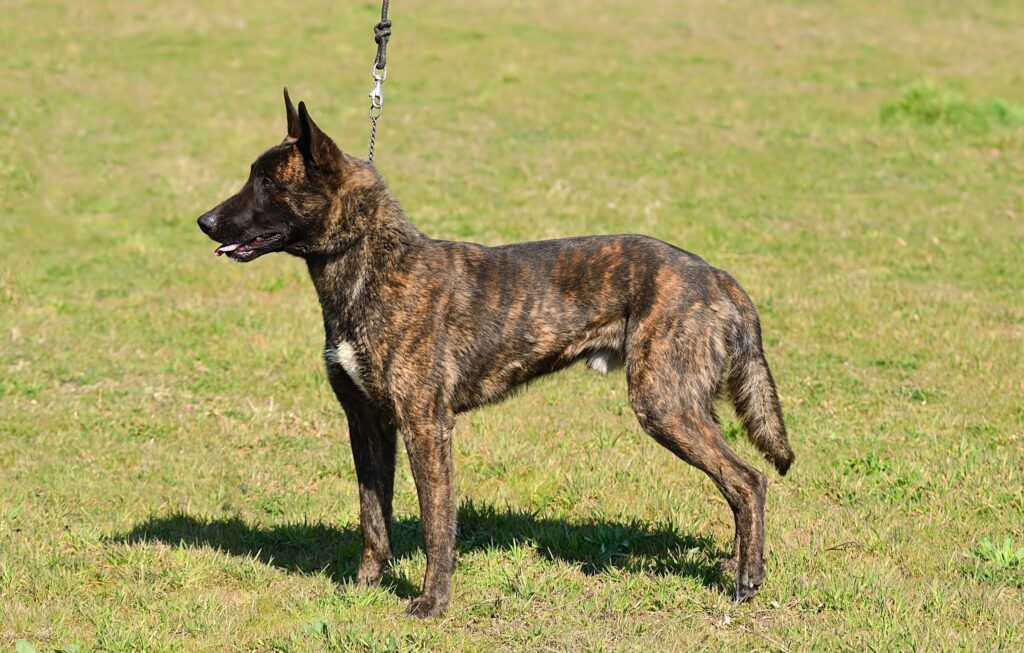
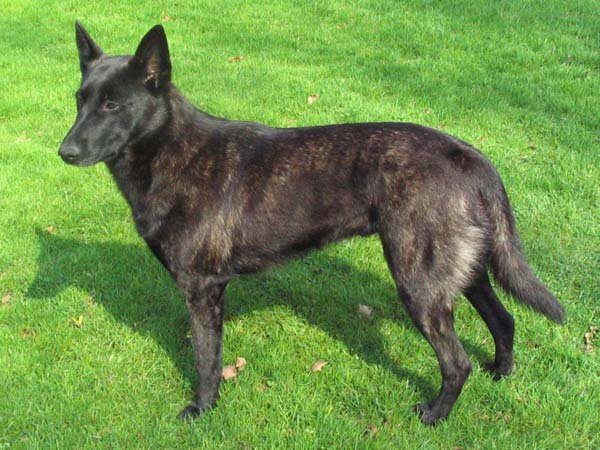
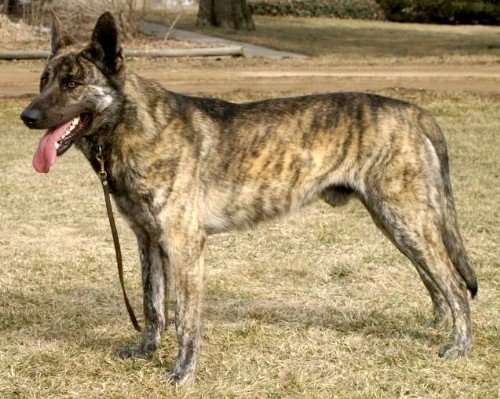
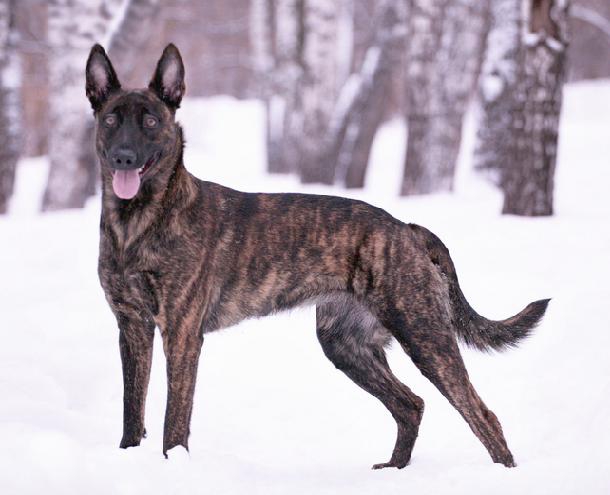
A brindle Dutch all-rounder with nerves of steel — clever and reliable: devoted, active, level-headed and hard-working. The Dutch Shepherd is a typical European herding breed with a striking brindle coat and three coat varieties; extremely clever, hardy and reliable, it is versatile in work and service, but needs activity and an active owner.
Apartment · not suitableKidsCats · with caveatsOther dogsBeginners · with caveats
The Dutch Shepherd (Hollandse Herdershond) is a typical representative of Europe’s shepherd breeds. For several centuries, shepherd dogs from the Netherlands, Belgium and France shared many traits and were barely distinguishable from one another. This unique herding breed from the Netherlands stands out for its striking brindle coat and the fact that it comes in three distinct varieties within a single breed. At first glance, the Dutch Shepherd can resemble a wolf or a mix of several medium-sized breeds. Long used primarily as a herding dog, today it succeeds in conformation shows, dog sports and as a reliable companion. Dutch Shepherds are exceptionally hardy and can work for long periods without tiring. While they bravely protect their owner’s property, they are rarely aggressive without cause. Learn more on Tvaryny.
Dutch Shepherd: A Brief Overview of the Breed's Characteristics
Before getting a dog, it's important to familiarise yourself with the main characteristics of the breed. Below is a table with key information about the Dutch Shepherd.
Dutch Shepherd: A Brief Overview of the Breed's Characteristics · 10
Characteristic
Description
Original Name
Hollandse Herdershond
Country of Origin
The Netherlands
Time of Origin
19th Century (officially recognised in 1860, FCI standard in 1960)
Lifespan
12–14 years (some sources suggest 9–13 or 11–15)
Height at the Withers (as per FCI Standard No. 223)
Dogs: 57–62 cm, Bitches: 55–60 cm
Weight
Dogs: approx. 23–32 kg, Bitches: approx. 23–32 kg (depends on height and type)
Loyal, reliable, vigilant, active, intelligent, trainable, not a nuisance barker.
Use
Herding, guarding, companion, sports, guide dog, search and rescue.
Interesting Facts About the Dutch Shepherd
Three in one: The Dutch Shepherd is one of the few breeds that has three officially recognised varieties based on coat type (short-haired, long-haired, wire-haired), which are all considered a single breed and can be interbred (although this is done rarely and with certain restrictions).
The all-rounder dog: Historically, Herders were not only shepherds but also farm guards, draught dogs (helping to pull small carts), and even companions to farming families.
Brindle is the trademark: The characteristic brindle colour is the breed's calling card. Other solid colours or patchiness are considered a fault or a disqualifying feature.
Relatives of the Belgians: Dutch Shepherds share common ancestors with Belgian Shepherds (Malinois, Tervueren, Groenendael, Laekenois). They were once considered a single group of pastoral dogs in the region. The division into separate breeds occurred later, mainly along national lines and due to some differences in the standards. For example, the Belgians did not recognise the brindle colouring that became characteristic of the Dutch.
A rare breed: Despite its excellent qualities, the Dutch Shepherd remains a relatively rare breed outside the Netherlands and a few other European countries, especially when compared to the German or Belgian Shepherd.
The "Dutch Wolf": Sometimes, due to the external resemblance of some individuals (especially those with a silver-brindle coat) to a wolf, they may be called this, although it is just a popular nickname.
Involvement in KNPV: In the Netherlands, Dutch Shepherds are often used in the Royal Dutch Police Dog Association (KNPV) programmes, demonstrating outstanding working qualities in protection, search, and apprehension. This attests to their high potential for service work. Some owners jokingly compare their working qualities to those of a Welsh Corgi Cardigan; while this is, of course, a jest given the difference in size and purpose, both breeds do share a strong herding history.
History of the Dutch Shepherd Breed
The Dutch Shepherd (Herder) was bred in the Netherlands in the 19th century, primarily as a herding dog. Its ancestors are considered to be the same dogs that gave rise to Belgian Shepherds, such as the Malinois, and German Shepherds. Initially, the main focus in breeding was on working abilities, not on appearance. Farmers needed a hardy, intelligent, and low-maintenance helper capable of herding flocks of sheep and guarding property. The coat colour and type were not of primary importance to them, which helped to preserve the genetic diversity of the breed. These dogs were common in the Dutch countryside, especially in the southern regions (Brabant, Drenthe) and along the coast.
The declining need for herding dogs in the late 19th and early 20th centuries, due to the reduction of pastures and flocks, put the breed at risk of extinction. However, breed enthusiasts made great efforts to preserve it. The first breed standard was drafted in 1898, the same year the Dutch Shepherd Dog Club (Nederlandse Herdershonden Club - NHC) was officially recognised. The Fédération Cynologique Internationale (FCI) adopted the modern standard for the Dutch Shepherd in 1960 (Standard No. 223). Today, the Dutch Shepherd is not as numerous as, for example, the shorthaired German Shepherd, but the breed has its devoted fans worldwide. It is increasingly used as a guard dog, companion, and in various sports, police, and rescue services. It excels as a guide dog for the visually impaired and in tracking.
What Does a Dutch Shepherd Look Like: A Detailed Description of Appearance
Before bringing any animal into your home, it is crucial to thoroughly research the breed's characteristics. In the case of the Dutch Shepherd, its appearance combines strength, proportion, and functionality. It is a medium-sized, medium-weight, muscular dog with a strong, well-balanced body, indicative of its stamina. The body length slightly exceeds the height at the withers (approximately a 10:9 ratio). The expression in its eyes is intelligent and alert.
Head: Proportional to the body, wedge-shaped, dry, and without wrinkles. The skull is flat, and the transition from the forehead to the muzzle (the stop) is gentle but noticeable. The muzzle is slightly longer than the skull. The lips are tight-fitting. The teeth are strong, with a scissor bite.
Eyes: Medium-sized, almond-shaped, set slightly obliquely, and dark in colour (dark brown is preferred).
Ears: Medium-sized, erect, and set high. When the dog is alert, they are directed forward.
Body: Strong. The back is short, straight, and powerful. The loin is strong, neither long nor narrow. The croup should not be short or overly sloped. The chest is deep but not too broad, with moderately sprung ribs.
Tail: At rest, it hangs straight down or is slightly curved, reaching the hock. In motion, it is carried higher, but never curls into a ring or lies on the back.
Limbs: Strong, with well-developed bone structure and powerful musculature. The forelegs are straight with strong pasterns. The shoulders are sloping, and the elbows fit closely to the chest. The hind legs are powerful with well-defined angles at the hocks. The paws are oval and compact, with firm, dark pads and claws.
The main distinguishing feature of the Dutch Shepherd is its coat, which comes in three types:
Short-haired: The coat is quite hard, close-fitting, with a dense undercoat.
Long-haired: The coat is long, straight (or slightly wavy), harsh to the touch, not curly, with a dense undercoat. The hair is shorter on the head, ears, paws, and the back of the forelegs. It forms a "mane" on the neck and chest, and "trousers" on the back of the hind legs. The tail is profusely feathered.
Wire-haired (Rough-coated): The entire body is covered with a thick, harsh, tousled coat with a dense undercoat. The coat should be dense. On the head, it forms characteristic "eyebrows," "whiskers," and a "beard." The tail is well-feathered. This coat type requires specific grooming, including hand-stripping.
Colour: For all three coat types, the colour is brindle. The base colour can be golden (from light sand to chestnut red) or silver-grey. The brindle stripes are clear, dark (preferably black), and distributed over the entire body, including the "ruff," "trousers," and tail. Too much black (a solid black mantle) is undesirable. A black mask on the muzzle is preferred.
A Herder's weight can reach 30–32 kg, which, combined with its considerable height, makes keeping one in a small flat somewhat problematic without sufficient physical exercise. The dog has a powerful frame that allows it to withstand significant physical exertion. The musculature is well-developed, so the animal needs regular training. The limbs can be called the strongest part of the body—they are quite tall and strong. This breed loves to run, as endurance and a desire to be useful are in its blood. As soon as dog shows and competitions became fashionable, the Dutch Shepherd became an indispensable participant in such events, often finding itself among the leaders.
The Dutch Shepherd's Character: Temperament and Behaviour
The Dutch Shepherd is more than just a dog; it is a loyal friend, a reliable protector, and a tireless helper. This breed has an incredibly balanced and sensible character. You will rarely hear it bark without reason. It is very devoted to its family and loves its members unconditionally. The Herder is known for its vigilance and guarding instincts, yet it is not prone to unprovoked aggression. It is an intelligent, observant, and responsible dog.
One of the key temperament traits is its high trainability. Dutch Shepherds are bright, quick to learn commands, and eager to work with their owner. They are not only physically but also mentally resilient, so they need regular activities that stimulate their intellect. Boredom and a lack of tasks can lead to undesirable behaviour. The Dutch Shepherd is not for those looking for a quiet "lap dog." It needs an active person or family who is prepared to devote time to games, training, and long walks.
Attitude towards children and other animals: With proper socialisation from an early age, the Dutch Shepherd gets along well with children, especially if it grows up with them. It can be patient and playful. However, as with any large and energetic dog, interactions with small children should be supervised. A Herder can get used to other pets, including cats, if they are introduced gradually and correctly. However, its herding instinct can sometimes manifest in attempts to "herd" family members or other animals. Compared to some other shepherd breeds, such as the active Bouvier des Flandres, the Dutch Shepherd can be somewhat more reserved with strangers, showing a natural wariness but not aggression.
This dog was created to serve people, but it strives to be first and foremost a friend and a partner. Its devotion knows no bounds. There is a charming story about a Dutch Shepherd named Vibe who was incredibly gentle with the fish in a pond. While out for a walk, Vibe would always pull her owner towards the pond to "say hello" to its inhabitants! This speaks to their sensitivity and capacity for deep affection.
Training and Socialisation of the Dutch Shepherd
Dogs of the Dutch Shepherd breed are exceptionally intelligent, resilient, and strong, so their training and socialisation must be taken seriously from an early age. Training a Dutch Shepherd can be a very rewarding experience for both owner and pet if approached correctly.
Key Aspects of Training:
Early Start: You can start teaching basic commands and house rules to a puppy as early as 2–3 months of age. More serious training, such as advanced obedience or specialised disciplines, can begin from 6–8 months.
Positive Reinforcement: Dutch Shepherds respond best to training methods based on positive reinforcement—praise, treats, and toys. Harshness, shouting, and physical punishment can lead to a loss of trust and stubbornness from the dog.
Consistency and Persistence: Be consistent with your demands and commands. The Dutch Shepherd breed requires persistence and patience from the owner. The dogs are very intelligent, but sometimes their natural independence or "pride" can lead them to test boundaries, especially during adolescence. It is important to remain calm but firm.
Variety and Stimulation: To keep the dog interested, training sessions should be varied and engaging. Monotonous lessons can quickly bore a Herder. Use game-based elements and change training locations.
Professional Help: If you have little experience in dog training or encounter difficulties, do not hesitate to seek help from a professional dog trainer. They can help you establish a connection with your dog and choose the right training methods.
Socialisation:
Socialisation is a critically important aspect of raising a Dutch Shepherd. It should begin as early as possible—from the moment the puppy arrives in your home. It's important to introduce the dog to different people (adults, children), other dogs and animals (under supervision), and various sounds, smells, places, and situations. A properly socialised Dutch Shepherd will grow into a confident, calm, and well-adjusted dog that will not show fear or aggression in unfamiliar circumstances. A lack of proper socialisation can lead to timidity, excessive suspicion of strangers, or even aggressive behaviour. Similar to the Beauceron, which is also a working pastoral breed, early socialisation helps to shape a reliable and manageable companion.
Over time, with proper upbringing and training, the Dutch Shepherd will become not just an obedient pet, but a true member of the family, a devoted friend, and a reliable protector.
Pros and Cons of the Dutch Shepherd Breed
Like any breed, the Dutch Shepherd has its advantages and disadvantages that prospective owners should consider.
Pros and Cons of the Dutch Shepherd Breed · 7
Pros
Cons
High intelligence and trainability: They learn commands quickly and are successful in various types of training and sports.
Requires significant physical exercise: Not suitable for inactive people or those not prepared for long walks and activities.
Loyalty and attachment to the family: Excellent companions and protectors.
Requires early and thorough socialisation: Without it, they can be overly suspicious of strangers or become timid.
Good guarding qualities: Alert and attentive, they instinctively protect their territory and family.
Can be stubborn: Especially if the owner is not an authority figure for them; they require consistent and patient training.
Stamina and robust health: the absence of described hereditary disease is not the absence of risk — breeding animals are screened all the same.
Can get bored and exhibit destructive behaviour: If they lack physical and mental stimulation.
Versatility: Suitable for various types of work (herding, guarding, search and rescue), sports, and as family dogs.
Coat care (especially long-haired and wire-haired types): Requires regularity and certain skills (e.g., hand-stripping for the wire-haired).
Three coat varieties: The option to choose a type that is more to one's liking and suits one's grooming capabilities.
Not for novices: The breed requires an experienced owner who understands the needs of active working dogs.
Not prone to nuisance barking.
May "herd" family members or other animals due to a strong pastoral instinct.
Specifics of Caring for a Dutch Shepherd
Caring for a Dutch Shepherd depends on its coat type, but overall the breed does not require overly complicated grooming. However, some aspects deserve special attention.
Coat Care
As mentioned, there are three coat types, and each has its own specifics:
Short-haired Dutch Shepherd: This coat type is the easiest to care for. Regular brushing (1–2 times a week) with a stiff bristle brush or a rubber grooming mitt is sufficient to remove dead hair and maintain its shine. Shedding occurs seasonally, usually in spring and autumn, and during this period the dog will need to be brushed more often.
Long-haired Dutch Shepherd: A long coat requires more thorough care to avoid mats and tangles. It is recommended to brush it several times a week, using a wide-toothed comb to detangle and a slicker brush for a final smooth-over. Pay special attention to areas with longer hair – the "mane," "trousers," and tail.
Wire-haired Dutch Shepherd: This coat type has a specific texture that needs to be maintained. Wire-haired Herders are not usually clipped with clippers, as this can ruin the coat's structure, making it softer. Instead, manual hand-stripping (plucking out the dead outer coat) is recommended 2–4 times a year. This helps to maintain the harshness of the coat and a healthy appearance. Daily care includes brushing with a special brush for coarse coats. You also need to regularly care for the "beard" and "whiskers," cleaning them of food debris.
Don't be afraid of causing your pet discomfort during brushing, but act gently, especially if there are mats. A Herder's skin is not as thick as that of some other shepherd dogs, but its coat, especially the undercoat, is quite dense. Proper care ensures your pet will look its best.
Bathing
Frequent bathing of a Dutch Shepherd is not recommended, as it can disrupt the natural balance of oils on the skin and coat. Bathe the dog as needed, using special dog shampoos appropriate for its coat type. During the autumn and spring, when the streets are muddy and wet, it's advisable to wash only the dirty areas (paws, belly) rather than the entire dog. After a walk in the rain or a bath, it is important to dry the dog well, especially if it is long-haired or wire-haired, to avoid getting chilled and developing skin problems.
Care of Teeth, Ears, and Claws
Teeth: Regularly inspect the mouth and brush the teeth with a special dog toothpaste and brush to prevent tartar build-up and gum disease.
Ears: Check the dog's ears weekly for dirt, redness, or an unpleasant odour. Clean them as needed with a cotton pad soaked in a special ear-cleaning solution. Do not use cotton buds, as they can damage the ear canal.
Claws: If the claws do not wear down naturally during walks on hard surfaces, they need to be trimmed regularly with special dog nail clippers. Nail trimming should not cause negative emotions in the animal, so accustom it to this procedure from a young age. If you are not sure how to do it correctly, consult a groomer or a vet.
Physical Exercise and Activity
The Dutch Shepherd is a very energetic breed that requires significant physical exercise. Daily long walks (a minimum of 1–2 hours a day), running, and playing with a ball or frisbee are essential. These dogs enjoy having a "job" or a task, which is why they excel in various canine sports such as agility, obedience, mondioring, and search and rescue. Insufficient physical activity can lead to boredom, destructive behaviour, and health problems, including obesity.
Nutrition
Feeding a Dutch Shepherd: Key Recommendations
Health and risks
Health of the Dutch Shepherd: Common Diseases and Their Prevention
Frequently Asked Questions About the Dutch Shepherd Breed (FAQ) · 7
Is the Dutch Shepherd suitable for living in a flat?
A Dutch Shepherd can live in a flat, provided it is given a sufficient level of daily physical activity (long walks, running, games) and mental stimulation. Without this, the dog can become bored and exhibit destructive behaviour. The ideal option for it would be a house with a fenced garden.
How does a Dutch Shepherd get along with children?
With proper socialisation from an early age, a Dutch Shepherd usually gets along well with children, especially if it grows up with them. It can be a patient and playful companion. However, due to its size and energy, interactions with small children should always be supervised by an adult.
Does the Dutch Shepherd shed a lot?
Yes, Dutch Shepherds do shed, especially seasonally (in spring and autumn). The short-haired type sheds moderately but consistently. The long-haired and wire-haired types also have a seasonal moult, and their coats require regular brushing to remove the dead undercoat. The wire-haired variety also needs periodic hand-stripping.
Is the Dutch Shepherd easy to train?
Dutch Shepherds are very intelligent and trainable, which makes the training process relatively easy for an experienced owner. They respond best to positive reinforcement, consistency, and patience. However, they can be somewhat independent and stubborn, so they require a firm but fair hand.
Are Dutch Shepherds aggressive?
Dutch Shepherds are not an aggressive breed by nature. They are vigilant and have a protective instinct, which makes them good guard dogs, but they are usually reserved with strangers and do not show aggression without cause. Early socialisation is very important for developing a balanced character.
How much does a Dutch Shepherd puppy cost?
The price of a Dutch Shepherd puppy can vary depending on its pedigree, the breeder's reputation, coat type, and region. It is important to choose a reputable breeder who prioritises the health and temperament of their dogs. Keeping the animal for its whole life always outweighs what you pay at the start, and that is the figure worth thinking about first.
Which Dutch Shepherd coat type is the easiest to care for?
The short-haired type is the easiest to care for, requiring only regular brushing. The long-haired type needs more frequent brushing to prevent mats, and the wire-haired type requires regular hand-stripping.
Video About the Dutch Shepherd
FAQ
How many varieties does the Dutch Shepherd have?
Three by coat type — short-haired, long-haired and wire-haired; all have the characteristic brindle coat that distinguishes the breed from the related Belgian and German shepherds.
Is the Dutch Shepherd good for a family?
Yes — a level-headed, reliable and devoted breed, good with children; but it needs activity and exercise, so it is best for an active family rather than a flat.
Is the Dutch Shepherd easy to train?
Very — one of the cleverest and most reliable working breeds, it shines in herding, service and sport; it learns fast and strives to cooperate.