

| Height | 40–48 cm |
| Weight | 16–24 kg |
| Lifespan | 10–13 years |
| FCI group | not FCI-recognised (Latvian national) |
| Origin | Latvia |
Exact ratings
Common health issues
Nutrition
The Latvian Hound is not merely a dog; it is a national treasure of Latvia and a living symbol of Baltic hunting traditions. This breed of small hunting dogs was specifically bred for collective driven hunts – the only type of hunting historically and legally permitted in the dense Latvian forests. Rlearn more on Tvaryny.
Latvian Hound: A brief breed overview
| Origin | Latvia |
| Year of standardisation | 1971 (first mentions earlier) |
| Purpose | Blood tracking, driven hunt |
| FCI Classification | Group 6 (Scenthounds and related breeds), recognised at national level |
| Coat type | Short, hard, dense |
| Colour | Black with clear tan markings |
| Life expectancy | 12-15 years |
| Height at withers | Males – 43-48 cm; Females – 40-46 cm |
| Weight | Ranges between 16-20 kg |
History of the breed: From Courland to the present day
The history of the Latvian Hound is a fascinating journey of selective breeding dictated by harsh natural conditions and changes in legislation. The breed was not formed in a single day. Its roots go back to the times of the Duchy of Courland (17th–18th centuries), where hunting with dogs was actively develloped. The ancestors of the modern “Latvian” are considered to be the now-extinct Courland Hounds, which were crossed with Beagles, Polish and Russian hounds.
The turning point came after the First World War and particularly during the Soviet period. In the 1920s, a ban was introduced in Latvia on the use of tall hounds (over 51 cm) for forest hunting. This was done to preserve the roe deer population, which perished in large numbers from fast, long-legged dogs, especially in winter deep snow. There was an acute need for a dog that was:
- Short-legged – so that the roe deer could escape if the dog caught up with it.
- Enduring – capable of working for hours.
- Vocal – so the hunter could hear the direction of the chase.
Breeders began painstaking work. Dogs for mating were selected exclusively for working parameters, without much regard for external gloss or “blue blood”. The main requirements were height and tenacity (persistence in pursuit). Thus, the new breed was formed, in part, based on mixed breeds. Its gene pool consisted of hunting dogs from various districts and farmsteads in Latvia. The official breed standard was approved in 1971. Interestingly, this developmental path partly resembles the history experienced by the Estonian Hound, although the results of selection produced dogs with different temperaments and exteriors.
Anatomy and exterior: What the ideal hunter looks like
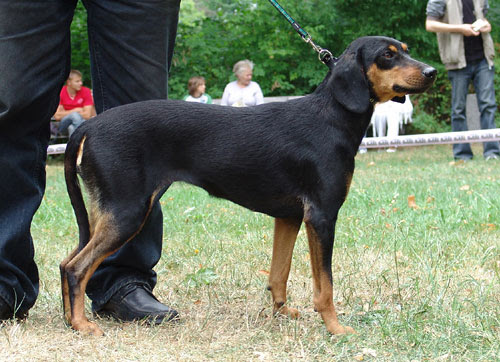
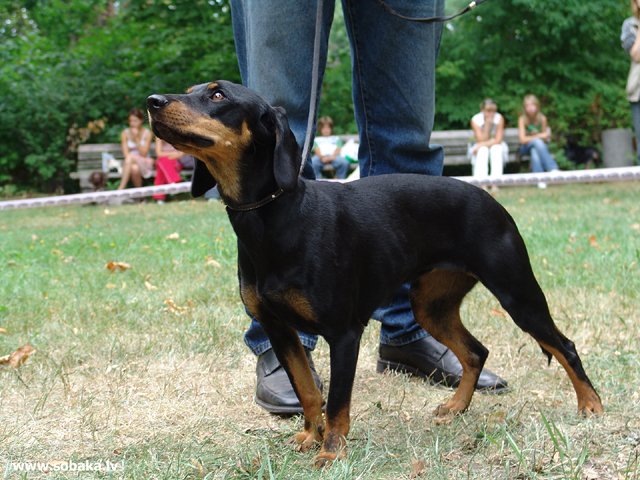
The Latvian Hound has the appearance of a strong, sturdy dog of a rectangular format (elongation index 102-106). This is not a decorative dog, like, for example, the currently popular Labradoodle, but a genuine working machine. The musculature is dry and defined, the bone structure is strong but not coarse.
Head and muzzle
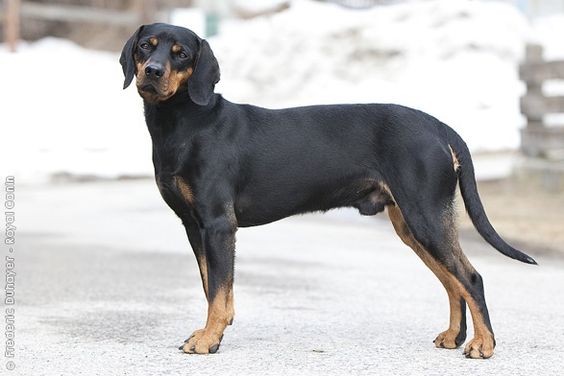
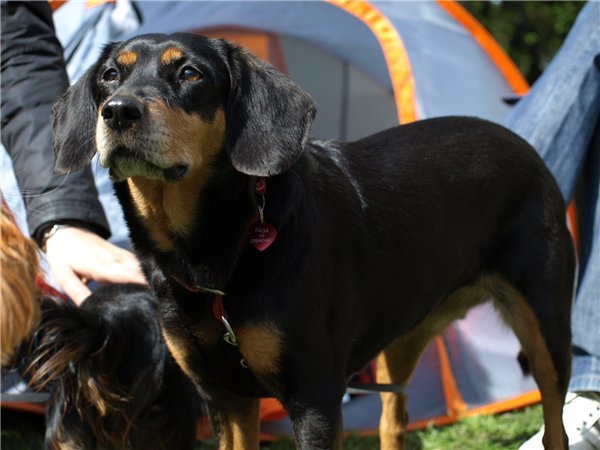
The head is wedge-shaped and dry. The transition from forehead to muzzle is smooth but noticeable. The muzzle is straight, parallel to the line of the skull. Lips are dry, fitting tightly without forming jowls – this is important so as not to get injured in the undergrowth. Teeth are large, white, with a scissor bite. Eyes are of medium size, round or slightly oval, usually dark brown, with an attentive and intelligent expression. Ears are an important breed marker: they are long, oval, set low (at eye level or lower) and fit tightly to the cheeks.
Body and limbs
The neck is muscular, without dewlap (loose skin). The chest is deep and wide, descending to the elbows, which ensures sufficient lung volume for prolonged running. The back is straight and wide, the loin is short and sprung. Limbs are bony, dry, with oval paws and tightly closed toes. This allows the dog to tire less on difficult terrain.
Coat and colour
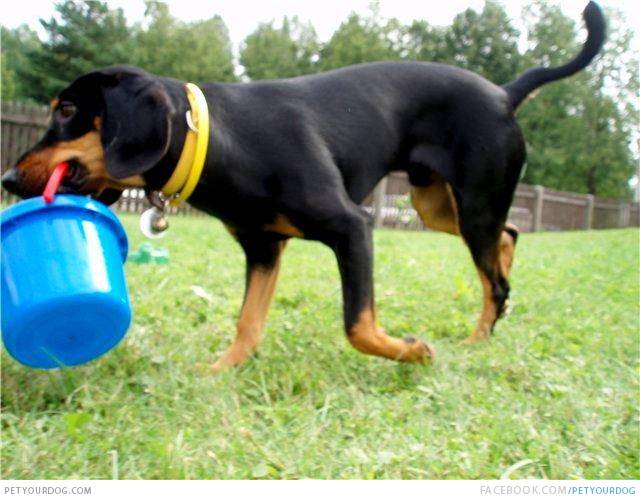
The coat is short (2-3 cm), straight, very dense and hard to the touch. The undercoat is well developed, but not excessive. Such a covering protects the dog from branches, thorns and moisture, as well as from insects. The colour is exclusively black with clearly defined tan markings (above the eyes, on the cheeks, chest and limbs). The black colour should be saturated, not brownish.
Working qualities and hunting style
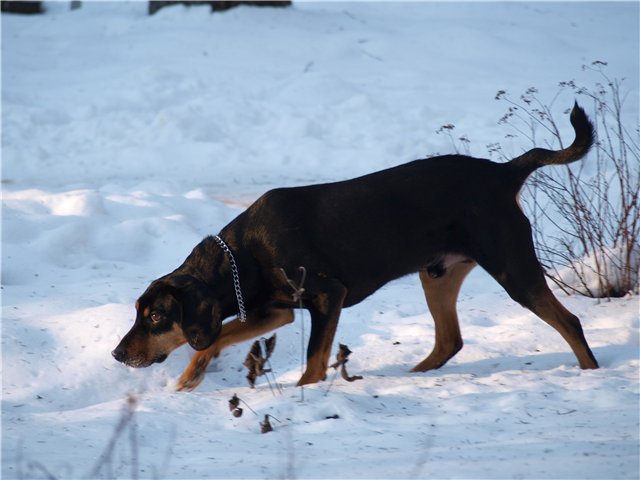
The Latvian Hound is a highly specialised professional. Its element is the driven hunt for ungulates (wild boar, roe deer, deer), as well as hare and fox. Unlike the Finnish Hound, which often works on snow over long distances, the Latvian Hound is adapted to work in dense thickets in the conditions of the Baltic maritime climate.
Features of work:
- Search: The dog goes into the search (quartering) not too widely, keeping contact with the hunter.
- Voice: This is one of the most important qualities. The hound gives voice only on a hot scent or upon visual contact with the beast. The voice is ringing and carrying; by its intonation, an experienced hunter understands exactly which animal the dog is driving.
- Tenacity: The Latvian Hound is persistent, but not to the point of self-oblivion. It rarely gets lost, as it periodically checks the owner’s location.
Character: Two sides of the same coin
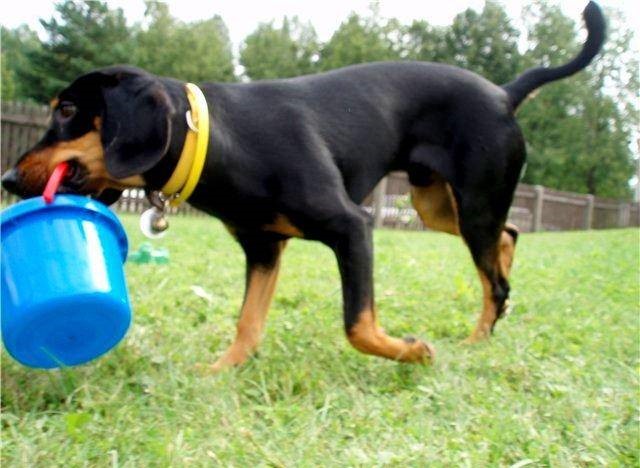
The psychological portrait of the Latvian Hound is interesting for its duality. In the forest, it is a tireless, spirited predator tough on the quarry. At home, it is a phlegmatic, calm intellectual. This switchability of the nervous system is the result of strict selection: overly aggressive or hysterical dogs were culled.
Relations with family: They are loyal to their owner, but not obtrusive. This is not a dog that will demand petting for hours. They behave patiently with children but do not perceive them as an authority. Games with children are possible, but under supervision, as the dog is strong and active.
Relations with other animals: Here things are complicated. Small animals (cats, rodents) are perceived exclusively as prey. The instinct to chase is in their blood. Latvian Hounds get along quite well with other dogs, as they are used to working in braces (pairs) or packs, but dominance over weaker ones is possible. This distinguishes them significantly from companion breeds, such as the rare Lucas Terrier, which, although having hunting roots, is much more loyal to its surroundings.
Care and maintenance: What an owner needs to know
The Latvian Hound is absolutely unsuitable for life “on a chain”. It is a social and active animal.
Flat or Kennel?
The ideal option is a spacious enclosure with an insulated kennel and a large territory for exercise. The dog’s coat protects well from bad weather, but in severe frosts (below -15°C), the dog should be taken into a warmer room. Keeping in a flat is possibe, provided there are 2-3 hours of active walking daily. Without exercise, the dog will start to “dismantle” the flat, howl, or suffer from obesity.
Hygiene
Care for the hard coat is minimal. It is enough to groom the dog with a rubber mitt once a week, and daily during shedding. Frequent bathing is not recommended so as not to wash off the protective lipid layer from the skin. Particular attention should be paid to:
- Ears: Due to their hanging shape, they are poorly ventilated, which creates a favourable environment for ear infections and fungi. Inspection and cleaning – weekly.
- Paws: After hunting, be sure to inspect the pads for cuts and splinters.
- Eyes: Rinse if necessary.
Training: Specifics of the approach
Latvian Hounds are clever, but their intellect is directed towards solving hunting tasks. They may seem stubborn if they do not see the sense in a command. The “drill” method does not work here. Only positive reinforcement and consistency.
- Field training: Begins at 4-5 months. The puppy is taught not to fear the forest, gunshots, or water.
- Recall command: This is the most important command for a hound. It is practiced to automatism, using a long lead and treats.
- Horn: Many hunters train dogs to return not to a voice, but to the sound of a hunting horn, which can be heard much further away.
Health and genetics
Nutrition: Fuel for the hunter
Pros and cons of the breed
| Pros (+) | Cons (-) |
|---|---|
| Outstanding hunting qualities | Requires serious physical exercise |
| Compact size, convenient for transport | Tendency to run off (follows scent) |
| Robust health and undemanding nature | Pronounced hunting instinct towards cats/birds |
| Balanced temperament in domestic life | Loud voice which may disturb neighbours |
| Easy coat care | Difficult to find a puppy outside Latvia/Baltics |
Interesting facts about the breed
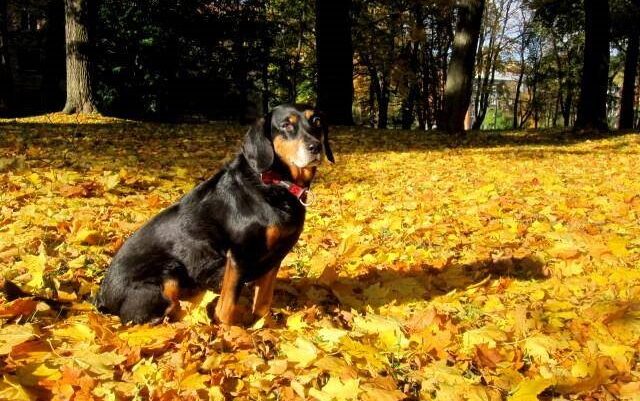
- National status: Latvia is so proud of this breed that it has released a postage stamp featuring the Latvian Hound.
- Flag colour: There is a legend that a true Latvian Hound should wear colours resembling dark amber, although the standard clearly prescribes black and tan.
- Long-livers: There are known cases where dogs of this breed actively hunted even at the age of 14, which is a phenomenal indicator.
- Versatility in food: Unlike fussy decorative breeds, the Latvian Hound can in extreme conditions feed on “foraged food” (for example, berries), although this is not the norm.
Frequently Asked Questions (FAQ)
Is the Latvian Hound suitable for a family with children?
Yes, but with a caveat. This is not a nanny. It will be tolerant of children, but it needs personal space. If the family is active and often spends time in nature, this is an excellent option.
How often do they bark?
At home, these are fairly silent dogs. Barking for them is a working tool. They may give voice to warn of a stranger, but they cannot be called “yappers”.
Where can I buy a puppy?
The main population is concentrated in Latvia. There are kennels in Lithuania, Estonia, and isolated examples in Ukraine and Russia. You should buy only through kennel clubs, checking the parents’ working diplomas.
- A hardy, hard-working tracker
- Gentle and patient with children
- Robust health overall
- Clever, learns the work early
- Loud — gives tongue on the trail
- Needs plenty of exercise and space
- A strong hunting instinct
- Not for a flat without exercise
| Estonian Hound | Beagle | Swiss Hound | |
|---|---|---|---|
| Height | 42–52 cm | 33–40 cm | 47–59 cm |
| Energy | 4 | 4 | 4 |
| Apartment | 2 | 3 | 2 |
| Beginners | 3 | 3.5 | 3 |
Is the Latvian Hound a rare breed?
Is the breed suitable for a flat?
Is the Latvian Hound good with children?
Latvian national breed · Latvijas Kinoloģiskā federācija
For apartments · For kids · For beginners · Active · Smartest · Hypoallergenic · All rankings →