


It’s raining again, snowing, or there is just that unbearable drizzle outside, and your four-legged friend is looking at you with eyes full of energy and a silent question: “Well, shall we play?” Familiar situation? Many dog owners believe that proper training is only possible outdoors or on specialised grounds with expensive equipment. But this is a huge mistake. Your living room or hallway can turn into a real amusement park if you use a little imagination. Home agility is not just a way to “tire out” a dog when you are too lazy to go for a long walk. It is a powerful tool for developing the animal’s intelligence, improving coordination and, most importantly, strengthening your emotional bond. Learn more on Tvaryny.
What is agility and why is it useful (even in a flat)
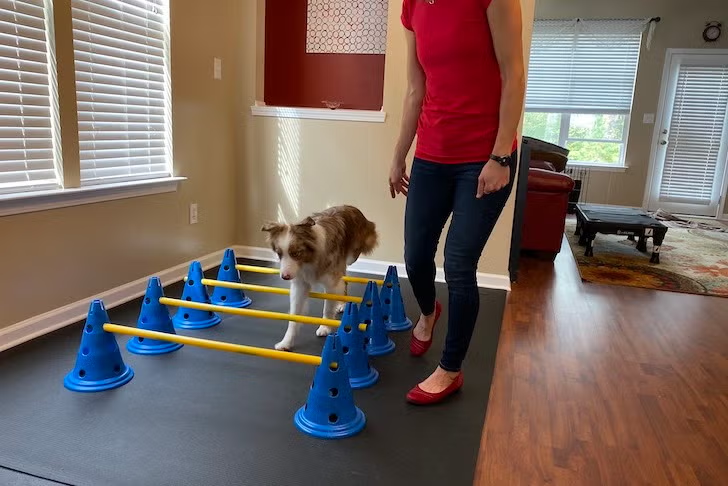
Agility is a sport in which a dog overcomes an obstacle course under the guidance of a handler. But don’t be scared by the word “sport”. At home, this turns into a fun game where the main goal is not speed and medals, but mutual understanding and mental stimulation.
Why you should try home agility:
- Mental stimulation. 15 minutes of actively learning new tricks and overcoming obstacles tires a dog just as much as an hour of running in the park. The dog needs to think about where to place its paw and how to squeeze through a tunnel.
- Developing confidence. For shy dogs, overcoming a “scary” tunnel made of chairs is a huge victory over themselves. It boosts your pet’s self-esteem.
- Improving physical fitness. Jumping, crawling, and balancing engage muscle groups that rarely work during a normal walk.
- Contact with the owner. The dog learns to hear you and follow your instructions even when excited.
Safety First: Rules of the Game No. 1
Before we start building barricades out of sofa cushions, let’s talk about safety. A flat is not a professional arena, and there are risks here. To ensure the game doesn’t end with a visit to the vet, follow these rules:
Flooring
This is the most important point. Never practise agility on slippery laminate, parquet or tiles! A dog can slip during a jump or a sharp turn, which threatens sprained ligaments, dislocations or even fractures. If you don’t have a carpet, use yoga mats, rubber runners or stick to exercises that don’t require speed and jumping (for example, slowly navigating a maze).
Height of obstacles
Do not force the dog to jump higher than its elbow level, espcially if you are beginners. For puppies under 1 year old (and for large breeds up to 1.5 years), jumping is generally contraindicated as their joints are still forming. Instead of jumps, use poles lying on the ground (cavaletti).
Stability of structures
Your obstacles must be lightweight and safe. If a dog catches a paw on a crossbar, it should fall down, not knock the dog off its feet. Use plastic bottles, cardboard boxes, lightweight plastic pipes. Avoid heavy planks or metal objects.
Inventory: What can be found in every flat
You don’t need to buy professional equipmnt. Everything neccessary is already in your wardrobe or cupboard. Let’s do an audit:
| Household item | Role in agility | Note |
|---|---|---|
| Chairs and stools | Base for tunnels, stands for hurdles | Must be stable |
| Mop, vacuum cleaner handle | Crossbar for jumping (hurdle) | Falls easily upon impact |
| Sofa cushions | Unstable surface for balance | Great for training micro-muscles |
| Throws and sheets | Creating a closed tunnel | Darkness inside adds difficulty |
| Plastic bottles (1.5-2L) | Stands for slalom (weave poles) | Can be filled with water for stability |
| Books | Supports for adjusting hurdle height | Use old magazines |
Building the obstacle course: Step-by-step guide
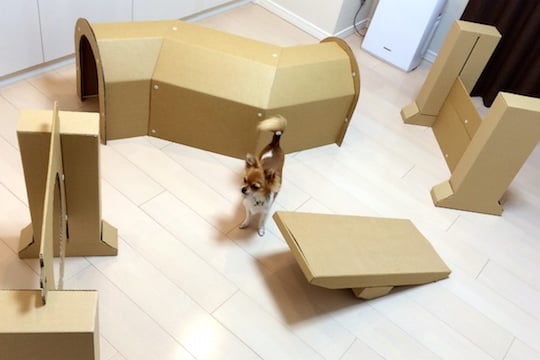
Now we move on to the most interesting part – constructing the course. We will break down 5 basic elements that can be combined.
1. The Mystery Tunnel
The tunnel is one of the favourite obstacles for many dogs, but some may fear it due to the enclosed space.
- Construction: Place 2-4 chairs in a row. Cover them with a large throw or sheet so that it hangs down the sides, forming a corridor.
- How to teach: Do not force the dog inside! Have a family member hold the dog at the entrance, while you sit at the exit with treats. Call your pet through the tunnel. At first, you can lift the edge of the blanket so the dog can see the light at the end. Praise enthusiastically when the dog comes out the other side.
2. Hurdle for Champions
Jumping is a classic. But remember the “elbow rule” (height no higher than the dog’s elbow).
- Construction: Take two stacks of books or two large pans. Place a mop handle, a rolled-up piece of card or a light plastic pipe on top.
- Important: The stick must not be fixed! It must fall freely if the dog touches it.
- How to teach: Start with the stick simply lying on the floor. Lead the dog over it for a treat, giving the command “Over” or “Jump”. Gradually raise the height.
3. Indoor Slalom (Weave Poles)
Slalom is the most difficult but also the most spectacular exercise. It requires flexibility and concentration from the dog.
- Construction: Arrange 4-6 plastic bottles with water (for weight) in a line at a distance of 50-60 cm from each other. You can use your own boots or flower pots (if you don’t mind risking them).
- How to teach: Take a treat in your hand and lead the dog’s nose with your hand, literally “drawing” a snake pattern between the obstacles. Do not rush. It is important that the dog does not miss “gates”.
4. Balance Mountain
Balance exercises strengthen the deep back muscles and improve proprioception (body awareness in space).
- Construction: Place sofa cushions, an air mattress or use a gym ball (if you have one) on the floor.
- How to teach: Lure the dog onto the wobbly surface. The task is simply to stand or sit, maintaining balance. To make it harder, you can ask for a paw while standing on the cushion.
5. The Hoop (Tyre)
Imitation of a jump through a tyre.
- Construction: Take a hula hoop.
- How to teach: First, place the hoop on the floor and guide the dog through it. Then lift it slightly. It is important that the dog jumps through the opening and does not run underneath it.
Training methodology: Secrets of success
Building a course is only half the battle. The main thing is to explain the rules correctly to the dog. Shouting and coercion do not work here. Agility is based entirely on positive reinforcement.
Markers and rewards
Use a clicker or a short marker word (e.g., “Yes!”), to mark the moment of correct action. The dog jumped – “Yes!” – hand over a treat. This speeds up learning significantly.
The “Simple to Complex” rule
Don’t try to complete the entire course at once. Break the learning into stages:
- Familiarisation with each obstacle separately.
- Combining two obstacles (hurdle + tunnel).
- Completing the full sequence.
To successfully navigate the obstacle course, your dog must know basic obedience commands. If there are problems with this, we recommend refreshing your knowledge and reading the top 5 commands every well-trained dog should know. This is the foundation, without which it will be difficult to manage your pet’s excitement in agility.
Course layouts for different skill levels
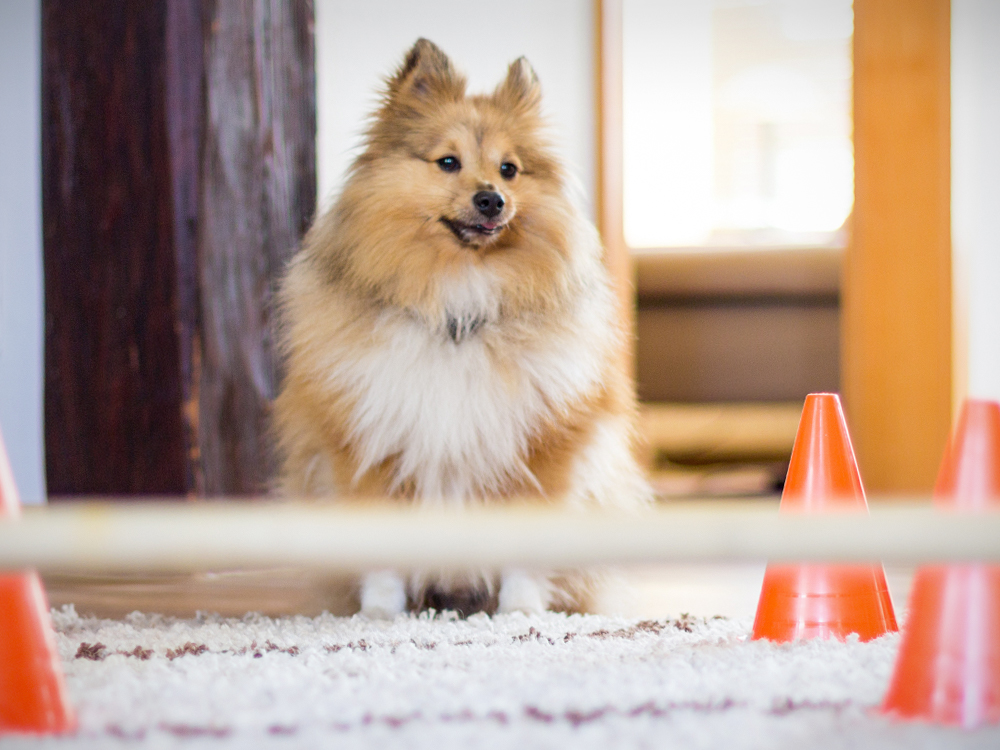
How do you arrange the obstacles in a room? Here are a few options.
“Novice” Level (Linear course)
Arrange the obstacles in a circle or a straight line (if your hallway allows).
Sequence: Hurdle (low) -> Tunnel -> Balance on a cushion.
“Pro” Level (Course with turns)
Arrange obstacles in a zigzag pattern so the dog has to change direction.
Sequence: Slalom -> Hurdle -> 180-degree turn -> Tunnel -> Jump through the hoop.
Expert tip: Always finish training on a positive note. Even if the dog didn’t do what you wanted, ask for the simplest command (e.g., “Sit”), praise, give a jackpot (lots of treats) and end the game. The dog should remember that sessions with you are a celebration.
Common mistakes to avoid
During home workouts, it is easy to get carried away and make slips that will dampen the dog’s motivation.
- Sessions that are too long. Dogs tire mentally very quickly. 10-15 minutes is quite enough. If you see the dog starting to get distracted, sniffing the floor or yawning – he is tired.
- Overly emotional owner. If the dog doesn’t understand how to do the slalom, don’t get annoyed. Your irritated tone will only scare the animal. Take a step back, simplify the task.
- Slippery floor. We remind you again: socks slip, claws slip. Lay down a runner!
- Overfeeding. Use tiny treats the size of a pea. Or use the evening meal portion for training.
What to do after training?
Agility, even at home, greatly excites the dog’s nervous system. After active jumping and running, it is difficult for the animal to calm down instantly. Do not end the game abruptly. Do a “cool-down”: walk slowly around the room, give the dog a light massage or give him something to chew (long-lasting chewing is calming).
If, after home entertainment, you decide to go out in public, it is important to remember etiquette in public places. Especially if you want to pop in for a bite to eat. By the way, we have an excellent article “Dog in a cafe: how to teach your pet to lie calmly under the table while you enjoy your coffee“. This skill will be a logical continuation of your endurance training.
Conclusion
Home agility is creativity. Today your living room is a training ground, tomorrow it is a relaxation zone. Do not be afraid to experiment with the configuration of obstacles. Using ordinary household items teaches the dog not to fear new objects and to trust you in any situation.
Remember that the best toy for a dog is you. Your attention, your voice and your joint activity are valued by your furry friend more than the most expensive ball. So grab the chairs, stock up on treats and build your perfect course. Have fun training!