

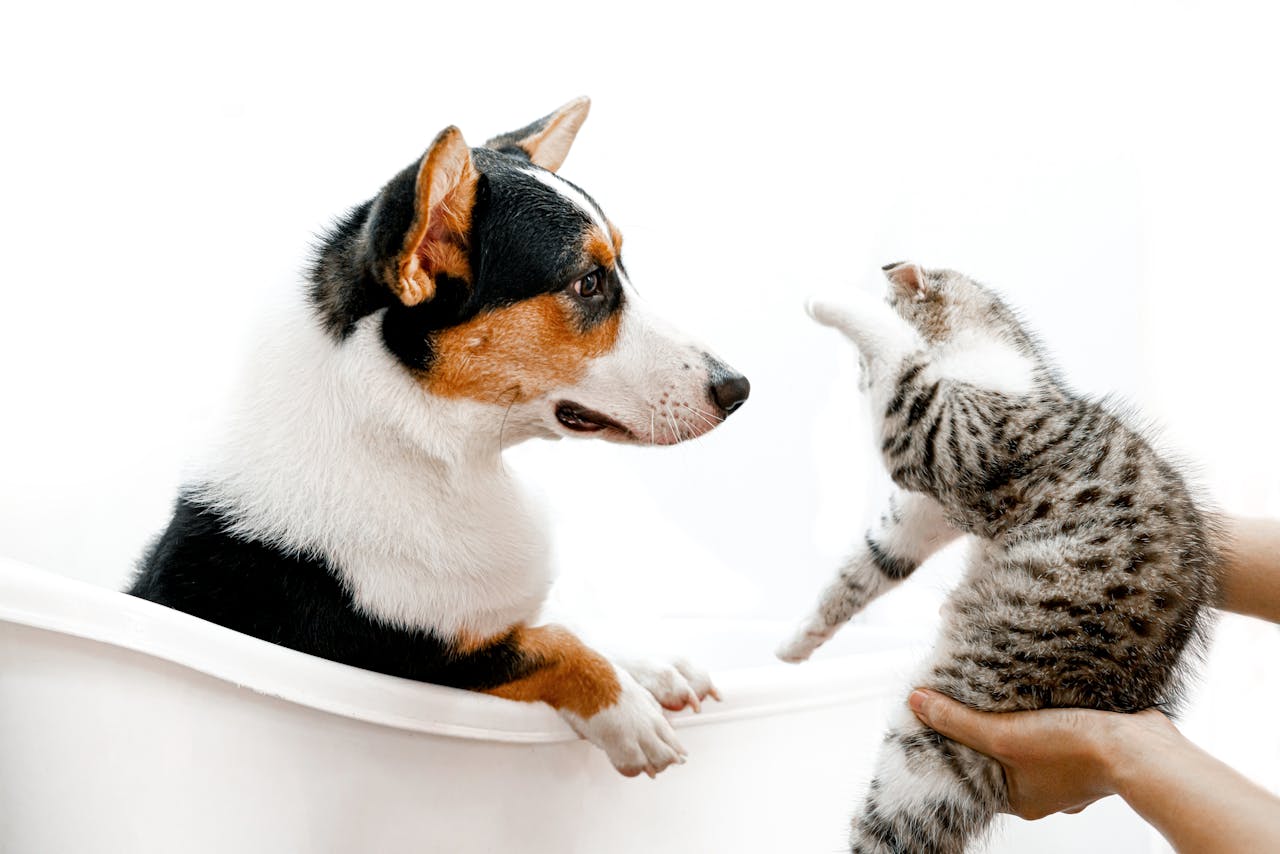
Bringing a new four-legged friend into the family is always a joy. But when a cat is set to join a home that already has a dog, or vice-versa, that joy can often be mixed with anxiety. Will they get along? Will they fight? How can you avoid stress and injuries? These are questions that worry every responsible pet owner. The saying “fighting like cats and dogs” is famous for a reason, symbolising animosity. However, thousands of families worldwide prove that friendship between these very different animals is indeed possible. The key is the right approach, patience, and an understanding of both pets’ psychology. We’ll delve into this in detail on Tvaryny, breaking down the entire process into simple, easy-to-follow steps.
A proper first introduction isn’t just a formality; it’s the foundation for your pets’ future relationship. How the initial meeting between a dog and a cat unfolds will determine whether they become friends or live for years in a state of “cold war”. Our guide will help you organise this process as safely and effectively as possible, ultimately leading to harmony in your home.
Why Is It So Difficult? Understanding Instincts

Before we get to the practical steps, it’s crucial to understand why potential conflict between a dog and a cat is inherently natural. They are representatives of different species with completely distinct behaviour patterns and communication styles.
- The Dog – A Predator and Pack Animal. For many dogs, especially hunting breeds, a small, fluffy, fast-moving animal is prey. Loud barking and the desire to chase aren’t always aggression; they’re often a manifestation of their hunting instinct. Furthermore, dogs are accustomed to a clear hierarchy within a pack and will try to figure out the cat’s place in that hierarchy.
- The Cat – A Solitary Hunter and Potential Prey. Cats are inherently more independent and territorial. A large, noisy, and energetic creature (a dog) is often perceived by them as a direct threat. Hissing, an arched back, attempts to flee and hide – these are all defensive reactions. A cat is protecting its territory and its life.
Different Body Language: The Main Source of Misunderstandings
What a dog perceives as friendliness, a cat might interpret as an attack. And vice-versa. This is one of the key reasons why their first meeting without preparation can end badly.
| Action/Signal | Meaning for a Dog | Meaning for a Cat |
|---|---|---|
| Tail wagging | Joy, excitement, friendliness (context-dependent) | Irritation, anger, warning of attack |
| Direct eye contact | Challenge, dominance, threat | Challenge, aggression |
| Raised paw | Invitation to play, uncertainty | Uncertainty, preparing to defend/strike |
| Exposed teeth | Aggression, warning (growling) | Aggression, fear (hissing) |
| Rolling onto back | Demonstration of trust, submission | Extreme defence, readiness to attack with all four paws |
Understanding these differences is the first step to success. As the owner, you must become the translator and mediator between your beloved pets.
Stage 1: Preparing the Space and Scents (Before the Meeting)
Never bring a new pet home and immediately let them loose with another animal. The introduction process begins long before the first visual contact. The main goal of this stage is to allow the animals to get used to each other’s scent.
1. Creating a Safe Zone
For the new arrival (whether it’s a cat or a dog), you’ll need to prepare a separate room. This room should be inaccessible to the “resident” pet. In this space, the newcomer should have everything they need for comfort:
- Food and water bowls
- Litter tray for a cat or puppy pads for a puppy
- A bed or a cosy hiding spot
- Toys
The new animal should spend a few days to a week in this “base”. This will allow them to adapt to the new sounds and smells of the house in a safe environment, and for the resident pet to get used to the idea that there’s someone else in the house.
2. Scent Exchange
Scent is a crucial channel of information for animals. Organise an “indirect” introduction:
- Swap bedding. Take a towel or a soft cloth, rub one animal with it (especially around their cheeks and flanks), then place this cloth in the other animal’s room, and vice-versa. Allow them to calmly sniff the new scent.
- Room swap. After a few days, once the initial reaction to the scent becomes calm, swap the animals’ rooms. Confine the dog to the cat’s room, and allow the cat to explore the rest of the house. Then swap them back. This allows them to leave their scent marks on each other’s territory and get to know their “neighbour” better.
- Your hands. Stroke one animal first, then, without washing your hands, stroke the other. This way, you transfer their scents and associate them with something pleasant – your affection.
Checklist: Preparing Your Home for the Introduction
- [ ] A separate room has been designated for the newcomer.
- [ ] The room has food, water, a litter tray/puppy pads, and a sleeping area.
- [ ] Scent exchange with towels/bedding has been carried out.
- [ ] Escape routes for the cat have been organised (high shelves, cat tree, access under furniture).
- [ ] Both animals’ claws have been trimmed to minimise injuries.
- [ ] Treats have been purchased for positive reinforcement.
Stage 2: The First Meeting of Dog and Cat: Control and Safety
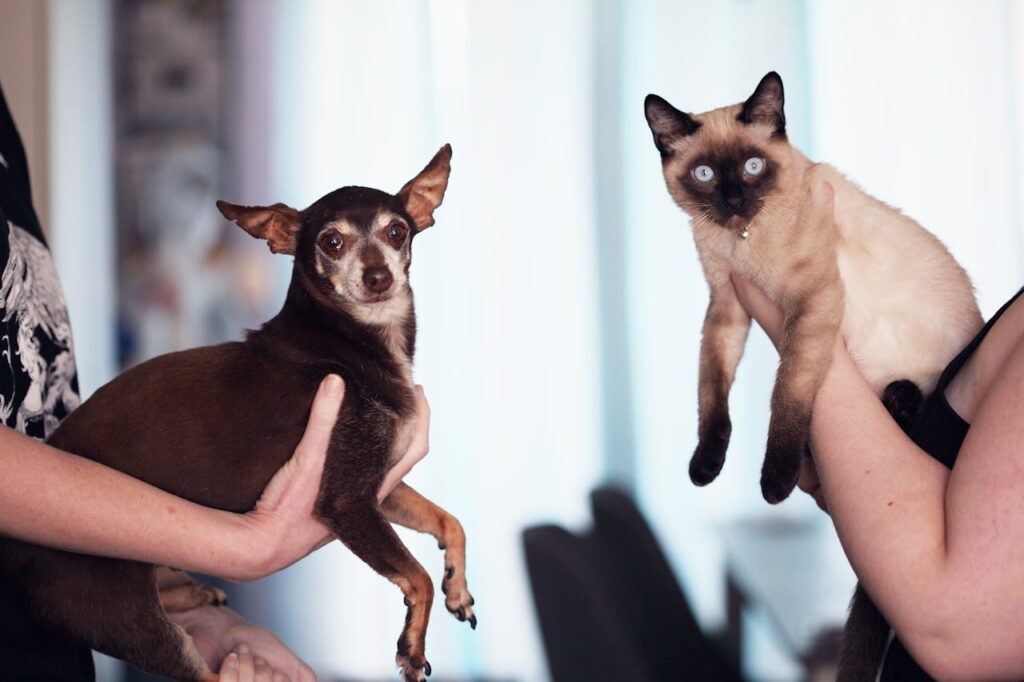
Once the animals are reacting calmly to each other’s scents and show no signs of significant stress (eating normally, using the litter tray/pads), you can move on to the first visual contact. This is the most crucial moment.
Rules for the First Visual Introduction:
- Neutral territory. If possible, conduct the first meeting in a room where neither animal spends a lot of time (e.g., the living room).
- Dog on a lead. The dog MUST be on a sturdy, but not taut, lead. This will allow you to control the situation and prevent them from lunging at the cat, even with playful intentions.
- Cat in safety. The cat should have complete freedom of movement and escape routes. Ideally, the cat is in a large carrier or behind a baby gate that the dog cannot get through. Or simply has access to high surfaces (wardrobe, cat tree).
- Short sessions. The first meeting should only last a few minutes (5-10).
- Positive reinforcement. Throughout the meeting, remain calm and speak in a gentle voice. Praise and give treats to both animals for calm behaviour and absence of aggression. They should associate each other’s presence with something pleasant.
- End on a positive note. Finish the meeting before either of them shows signs of fatigue or irritation.
Repeat these short, controlled meetings several times a day for a few days. The main indicator for moving to the next stage is when the animals can calmly be in the same room, ignoring each other or showing calm interest.
Stage 3: Gradual Bonding and Shared Time
Once the initial controlled meetings go well, you can move on to closer interaction. The goal of this stage is to create positive associations and teach the animals to coexist peacefully in the same space. This is the longest stage and requires patience.
Joint Feeding
Feeding is a powerful tool for creating positive associations. Start feeding the animals simultaneously, but at a good distance, for example, in opposite corners of the room. Gradually, day by day, move their bowls a few centimetres closer. If tension arises, take a step back. The ultimate goal is for them to be able to eat side-by-side, ignoring each other. Important: do not allow one animal to eat from the other’s bowl.
Controlled Off-Lead Time
The next step is to allow the dog to be in the room with the cat off-lead. However, your supervision is still essential. Stay in the room, go about your business, but closely observe their interaction. Encourage calm behaviour. If the dog tries to chase the cat, give a clear command (“Stop!” or “Leave it!”) and redirect their attention to a toy. If this behaviour repeats, go back to the lead stage.
Ideas for Positive Associations:
- Shared games. Play with both animals simultaneously (but with separate toys). For instance, you might throw a ball for the dog while another person plays with the cat using a laser pointer.
- Relaxation time. When you’re relaxing on the sofa, encourage both pets to be nearby, stroke them, and speak in a calm voice.
- Obedience training. Conduct short sessions of command training with the dog in the presence of the cat. This teaches the dog to focus on you, not the cat, and reinforces your role as leader.
Potential Problems and Their Solutions

Even with a perfect plan, something might go wrong. It’s important not to panic and to know how to react to common issues.
Dog Chasing the Cat: What to Do?
This is one of the most common problems, stemming from the dog’s hunting instinct. The cat’s flight only provokes the dog further.
- Never allow this. Even if the dog is doing it playfully, such behaviour causes immense stress for the cat and reinforces an undesirable behaviour pattern in the dog.
- Use a command. Immediately stop such behaviour with a command like “Stop!” or “Leave it!”.
- Redirect attention. Always have your dog’s favourite toy on hand. As soon as they start fixating on the cat, redirect their attention to playing with the toy.
- Provide escape routes for the cat. The cat must be able to quickly hide somewhere the dog can’t reach them (high shelves, a cat tree, narrow gaps behind furniture). This will reduce the cat’s stress levels.
Mistakes to Avoid
- Forcing things. Each pair of animals has its own pace. Don’t rush the process, even if it feels like it’s taking a long time.
- Punishing for hissing or growling. This is natural animal communication, their way of saying “I’m uncomfortable.” Punishment will only increase stress and negative associations. It’s better to simply increase the distance between them.
- Holding animals during the introduction. This restricts their freedom and can lead to injuries if one of them tries to break free.
- Leaving them alone unsupervised. Don’t do this until you are 100% confident in their peaceful interaction, which could take months.
How Long Does Adaptation Take?
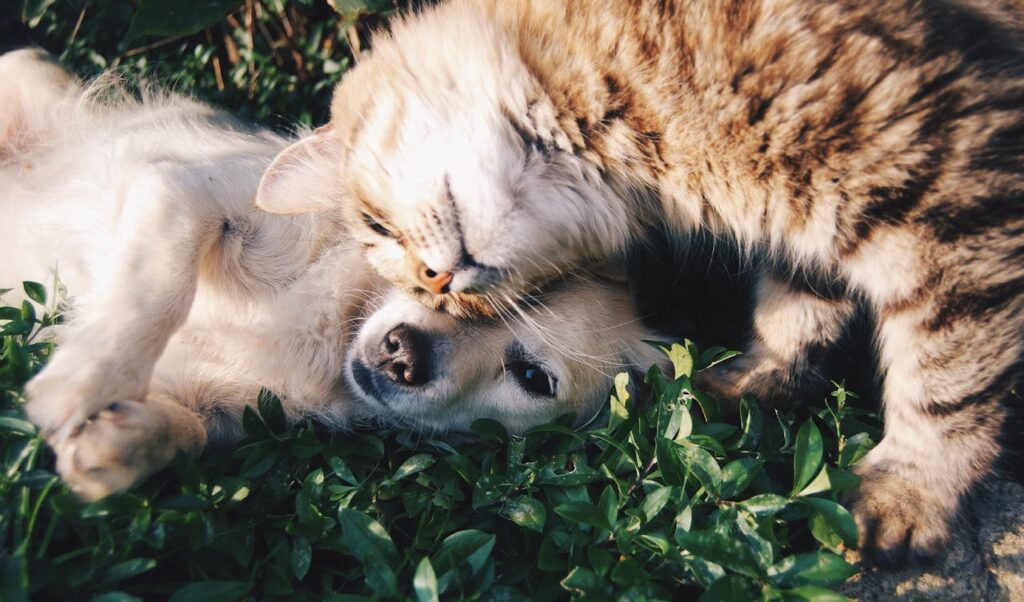
There’s no definitive answer to this question. The process of how to make a cat and dog friends in an apartment can take anywhere from a few weeks to several months, and sometimes even over a year. It depends on many factors:
- Age of the animals. Puppies and kittens usually find it easier to get used to each other.
- Temperament. A calm, phlegmatic dog will usually get along with a cat more quickly than an active, excitable one. The same applies to cats.
- Previous experience. If the dog has lived with cats before, or the cat has had positive experiences with dogs, the process will be smoother.
- Your consistency and patience. This is the most crucial factor.
Be prepared that they might never become best friends who snuggle up together. And that’s perfectly normal! The goal is to achieve peaceful coexistence, where the animals respect each other’s space and don’t feel stressed by the other’s presence. Neutrality is also a victory.
Conclusion: Love and Patience Work Wonders
Introducing a dog to a cat is a marathon, not a sprint. The key principles of this process are gradualness, control, safety, and positive reinforcement. Remember that you are the main peacemaker and the guarantor of safety in your home. Your confidence and calmness will be passed on to your beloved pets. By following our advice and listening to the individual needs of your animals, you have every chance of turning potential adversaries into good neighbours, and perhaps even true friends. And then, harmonious purring and happy tail wags will become the familiar music of your home.