

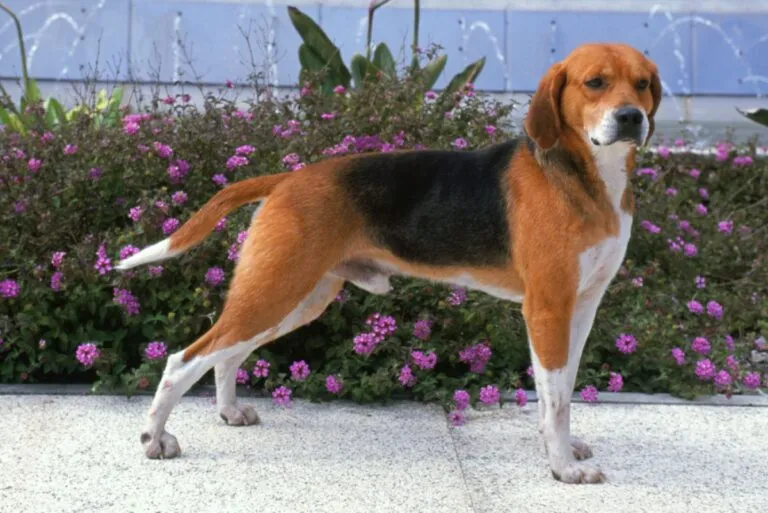
| Height | 45–50 cm |
| Weight | 19–21 kg |
| Lifespan | 12–13 years |
| FCI group | 6 · scenthounds |
| Origin | France |
Exact ratings
Common health issues
Nutrition
The Beagle-Harrier is an energetic and keen medium-sized hound, combining exceptional hunting qualities, a ringing voice, and considerable intelligence. Its primary purpose is to hunt small game such as hares or foxes, but the bravery and endurance of these dogs also allow them to be used for hunting larger animals, such as wild boar or deer. This four-legged hunter is a true all-rounder, capable of working effectively both independently and in a pack with other hounds, relying on its extraordinarily keen sense of smell and lightning-fast reactions. Find out more about this unique breed, its character, and specific care and keeping requirements further on Tvaryny.
History of the Beagle-Harrier Breed
The history of the Beagle-Harrier is inextricably linked with late 19th-century France and the name of Baron Gérard Grandin de l’Eprevier. A passionate hunter, he set out to create the ideal hound that would combine the best traits of two popular breeds of the time: the speed and power of the Harrier with the unparalleled scenting ability and hunting drive of the Beagle. The Baron aimed to produce a medium-sized dog that was hardy, fast, and capable of relentlessly pursuing prey, primarily hares.
His years of selective breeding, involving the careful crossing of representatives from these two breeds, were crowned with success. Although some cynologists suggest that other French hounds might have participated in the process to solidify desired qualities, the foundation of the breed is precisely the harmonious combination of Beagle and Harrier genes. Interestingly, the ancestral genes were distributed so evenly that it is difficult to distinguish a dominant original breed in the offspring, making the Beagle-Harrier a unique “hybrid” hunter.
The first breed standard was drawn up in France, with official recognition by the Fédération Cynologique Internationale (FCI) occurring much later, on 27 December 1974. Despite its outstanding working qualities, the Beagle-Harrier remains a rather rare breed even in its homeland and is little known beyond its borders, making each representative of the breed a true exclusive.
Breed Standard and Appearance
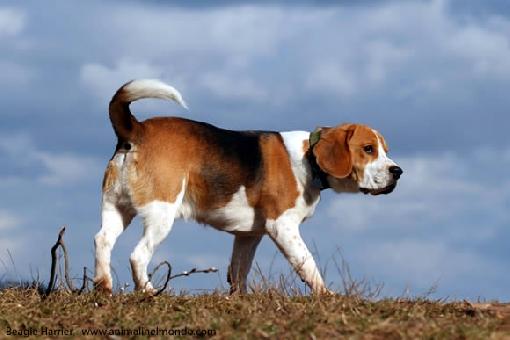
The Beagle-Harrier is a harmoniously built, robust, and muscular dog that gives an impression of both strength and elegance. It is compact but not stocky, with a well-developed bone structure and defined musculature.
| Characteristic | Description according to FCI Standard No. 290 |
| Height at Withers | 45–50 cm (deviation of +/- 1 cm allowed) |
| Weight | 19–21 kg |
| Life Expectancy | 12–14 years |
| Country of Origin | France |
| FCI Group | Group 6. Scent Hounds and Related Breeds. Section 1.2. Medium-sized Hounds. |
The head of the Beagle-Harrier is quite broad and proportionate to the body, with a distinct but not overly abrupt stop. The skull is slightly convex. The muzzle should not be square or pointed. The nose is large, black, with well-opened nostrils, indicating an excellent sense of smell.
The eyes are large, expressive, and dark brown. The gaze is lively, intelligent, and a little mischievous. The ears are set high, broad, of medium length, and slightly rounded at the tips. They hang along the cheeks, giving the head a soft expression.
The body has a strong, straight back and a muscular loin. The chest is deep and well-developed, providing ample space for the lungs and heart, which is critically important for an enduring hound. The tail is fairly thick at the base, of medium length, and well-covered with fur. The dog carries it high and gaily, scimitar-like, which is a sign of good spirits and confidence.
The coat of the Beagle-Harrier is short, dense, and smooth, lying close to the body, providing good protection from the elements. The breed standard allows for a classic tricolour pattern: a combination of fawn (reddish), black, and white. Most commonly seen is a “black saddle” (a large black patch on the back resembling a saddle) on a reddish-white background. The placement of patches can vary, but the tip of the tail is traditionally white — this serves as a “beacon” for the hunter to spot the dog in dense undergrowth.
Character and Temperament of the Beagle-Harrier
The Beagle-Harrier’s character is a fascinating blend of hunting ardour and a friendly family dog. This is a very energetic, brave, and determined breed. When hunting, it is relentless and capable of making independent decisions, which can sometimes manifest as stubbornness in daily life. Its independent nature and sharp mind require patience and consistency from the owner during training.
At home, the Beagle-Harrier transforms into an affectionate and playful companion. It forms strong bonds with its family and gets along well with children, especially if raised with them. However, due to its strong hunting instinct, it may perceive small household pets (cats, rodents, birds) as prey. Early and proper socialisation can help mitigate these traits, but leaving them unsupervised is not recommended.
One of the breed’s most distinctive traits is its propensity for vocalisation. Beagle-Harriers love to “talk” — they bark, howl, and emit characteristic hound sounds, especially when excited or left alone. This isn’t just barking; it’s a true “hound music” appreciated by hunters but which can become a nuisance for neighbours in urban environments. Also, be prepared for your beloved pet, following an interesting scent, to start digging holes in the garden or attempting to tunnel under fences.
Pros and Cons of the Breed
Before getting a Beagle-Harrier, it’s important to weigh all its advantages and potential challenges associated with its hunting origins.
| Advantages | Disadvantages |
|---|---|
| Cheerful and friendly nature: A wonderful companion for an active family. | Extremely high energy level: Requires daily intensive exercise. |
| High intelligence: Learns quickly if the right motivation is found. | Stubbornness and independence: May ignore commands if engrossed in something. |
| Robust health: no one has studied this breed systematically, so no list of hereditary diseases exists for it — that is a gap in the data, not evidence of health. | Very strong hunting instinct: Prone to escaping, pursues small animals. |
| Low maintenance grooming: Short coat does not require complex grooming. | Loud voice: Prone to frequent and loud barking and howling. |
| Works excellently in a pack: Gets along well with other dogs. | Requires secure fencing: Master of digging and escaping. |
Care and Keeping
Keeping a Beagle-Harrier has its peculiarities, related to its activity and instincts.
- Living Conditions: The ideal place for a Beagle-Harrier is a private house with a large, and most importantly, securely fenced garden. The fence height must be sufficient for the dog not to jump over it, and the foundation should be deep, as these dogs are known “diggers.” They can live in an outdoor kennel, but require daily close contact with the family.
- Physical Exercise: This is a key need for the breed. A Beagle-Harrier requires at least 1.5-2 hours of active walks per day. These can include long runs, hikes, or ball games. Without sufficient physical exertion, the dog’s energy will find an outlet in destructive behaviour: damaging items, incessant barking, digging holes.
- Coat Care: The Beagle-Harrier’s short coat sheds moderately throughout the year, with increased shedding during spring and autumn. It’s sufficient to brush it 1-2 times a week with a rubber brush or grooming mitt to remove dead hairs. Bathe the dog only when necessary.
- Ear and Eye Care: Drooping ears are a weak point of the breed. They need to be regularly inspected and cleaned (1-2 times a week) to prevent the development of ear infections and otitis. Eyes also require periodic inspection and cleaning of natural discharge.
- Claws: If the claws do not wear down naturally during walks on hard surfaces, they need to be trimmed every 3-4 weeks with a special dog nail clipper.
Training and Education of the Beagle-Harrier
Training a Beagle-Harrier is an exciting yet challenging process. Its keen mind allows it to quickly grasp commands, but its inherent stubbornness requires consistency and patience from the owner. Early socialisation and completing a general obedience course are mandatory. The puppy needs to be introduced to various people, sounds, places, and other animals to grow into a well-balanced and confident dog.
Positive reinforcement works best: use treats, praise, and games as rewards for correct command execution. Harshness and physical punishment are unacceptable — they can only exacerbate stubbornness and undermine trust in the owner. Training sessions should be short, dynamic, and varied to keep the dog from getting bored.
Particular attention should be paid to perfecting the “Come!” command. Due to its strong hunting instinct, a Beagle-Harrier, having caught an interesting scent, may completely ignore its owner. Therefore, on walks in unfenced areas, it should be kept on a long lead. This is not a dog that can be safely let off-leash near roads or in the woods without 100% certainty of its obedience.
Health and Typical Breed Diseases
Beagle-Harrier Feeding Recommendations
The Beagle-Harrier as a Hunting Dog
Although the Beagle-Harrier is increasingly adopted as a companion dog, its primary purpose should not be forgotten. It is a first-class hound. Its hunting style combines methodical work with keen enthusiasm. Thanks to its phenomenal sense of smell, it can unravel even the oldest and most complex trails. Its ringing, melodious voice allows the hunter to track the dog’s movements from a great distance. The Beagle-Harrier is fast enough to keep up with a hare and resilient enough to pursue it for hours. Due to its bravery and tenacity (persistence in pursuit), it is also successfully used for hunting foxes, roe deer, and even wild boar. Its working qualities are highly valued among European hunters, who often use similar types of breeds, such as the Bosnian Coarse-haired Hound or the Blue Gascony Griffon.
Interesting Facts about the Breed
- “Designer Breed” of the 19th Century: The Beagle-Harrier is one of the early examples of purposeful cross-breeding of two breeds to obtain specific working qualities, long before the term “designer breeds” became fashionable.
- Name-Formula: The breed’s name contains no geographical or historical references, but is a simple “formula” of its origin: Beagle + Harrier.
- Musical Voice: The Beagle-Harrier’s voice is described by hunters as “ringing” and “melodious.” Each dog has its unique timbre, by which an experienced owner can recognise their beloved pet.
- White Tail Tip: As with many hounds, the white tail tip of the Beagle-Harrier serves a practical purpose — it’s a kind of flag that helps the hunter spot the dog in tall grass or bushes.
Frequently Asked Questions about the Breed (FAQ)
Is the Beagle-Harrier suitable for apartment living?
Generally, no. This is a very energetic breed that requires space. Apartment living is only possible if the owner is prepared to dedicate 2-3 hours a day to intensive walks and training to provide the dog with the necessary level of physical and mental stimulation.
Does the Beagle-Harrier shed much?
Shedding is moderate throughout the year, but increases seasonally in spring and autumn. Regular brushing helps keep this process under control.
How do Beagle-Harriers get along with children and other animals?
They are wonderful companions for children, patient and playful. They usually get along well with other dogs, as they are used to working in a pack. However, their hunting instinct poses a threat to small household pets (cats, rabbits, hamsters), so their cohabitation requires caution and supervision.
Are they easy to train?
They are intelligent but stubborn. Training requires patience, consistency, and the use of positive reinforcement methods. Novice dog owners may find it challenging to handle their independent nature.
How much does a Beagle-Harrier puppy cost?
As the breed is rare, finding a puppy can be difficult, especially outside of France. The price will depend on the breeder, the parents’ lineage, and their working qualities. Budget for the running costs rather than the one-off sum: food, routine check-ups, parasite treatment, equipment and training classes.
Video about the Breed
- Friendly, good with children and dogs
- Hardy, athletic
- Generally robust health
- Affectionate, devoted at home
- Needs plenty of exercise
- Keen nose — follows a scent
- Prone to barking
- Dislikes being alone
| Beagle | Harrier | English Foxhound | |
|---|---|---|---|
| Height | 33–40 cm | 48–55 cm | 58–64 cm |
| Energy | 4 | 4.5 | 5 |
| Apartment | 3 | 2.5 | 1.5 |
| Beginners | 3 | 3 | 2.5 |
What is a Beagle-Harrier?
Is the Beagle-Harrier good for a family?
Is it easy to train?
FCI Standard No. 290 · The Kennel Club
For apartments · For kids · For beginners · Active · Smartest · Hypoallergenic · All rankings →