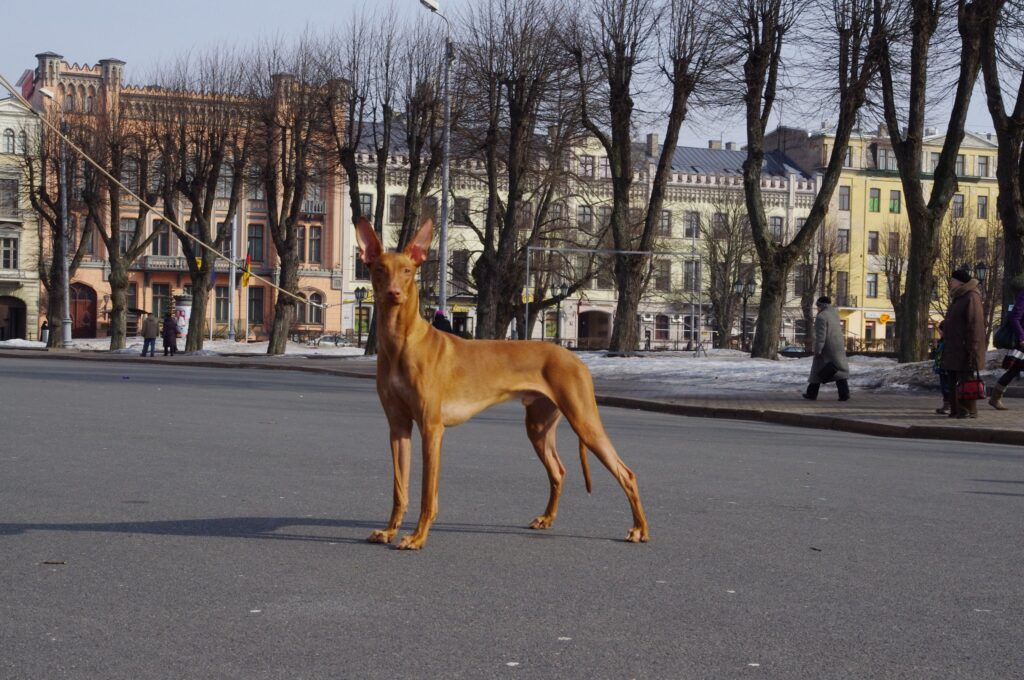
An ancient Egyptian sighthound that "blushes" with joy: elegant, athletic, playful and sensitive. The Pharaoh Hound combines a sighthound's speed with a gentle character; when it is happy, its nose and ears flush pink — a unique breed trait.
Apartment · with caveatsKidsCats · not suitableOther dogs · with caveatsBeginners · with caveats
The Pharaoh Hound is one of the most enigmatic and elegant breeds in the canine world. One look at their refined silhouette involuntarily transports you back to the time of the pyramids and ancient Egyptian deities. But did these dogs really accompany the Pharaohs, or is it merely a beautiful legend? They are incredibly cheerful, kind, and affectionate creatures who, despite their aristocratic appearance, remain playful puppies at heart. Learn more on Tvaryny.
The Pharaoh Hound: Brief Overview and Characteristics
The Pharaoh Hound: Brief Overview and Characteristics · 10
Characteristic
Description
Country of Origin
Malta (Patronage: Great Britain)
First Official Mention
1974 (as a breed), but roots go back millennia
Purpose
Hunter (by scent and sight), Companion
FCI Classification
Group 5 (Spitz and primitive types), Section 6 (Primitive type)
Life Expectancy
15–17 years (long-lived for a dog of this size)
Height at Withers (Males)
56–63 cm (ideal is 56 cm)
Height at Withers (Females)
53–61 cm (ideal is 53 cm)
Weight
18–27 kg
Coat Type
Short, glossy, no undercoat
Maintenance Level
Low (requires minimum grooming but maximum activity)
Unique Features: "Humans in Dog's Clothing"
The Pharaoh Hound possesses two unique physiological traits that make it incredibly human-like in an emotional sense. These are rarely mentioned in general standards, but every owner will attest to these facts.
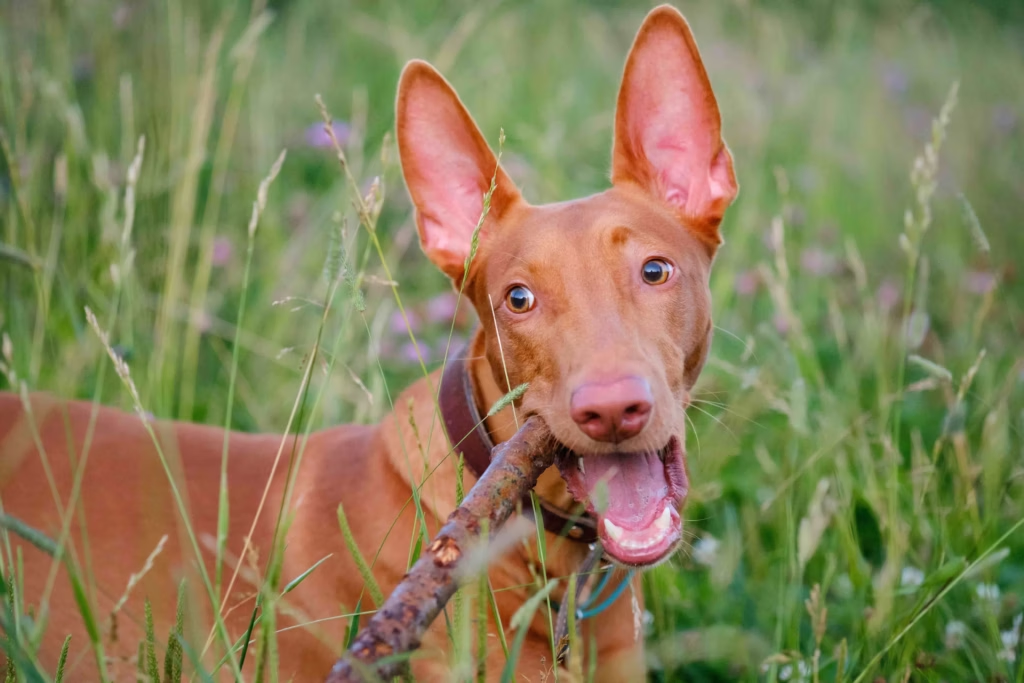
The Ability to Blush: This is the only breed of dog that blushes from excitement or joy. When a "Pharaoh" is happy or feeling an emotional high, his nose and the inside of his ears turn a bright pink. This occurs due to increased blood flow to the capillaries located close to the surface of their thin skin.
The Famous Smile: These dogs know how to smile, stretching their lips and baring their teeth in a broad grimace of joy. This is not a snarl of aggression, but rather an expression of genuine happiness when greeting their owner. It looks incredibly touching and amusing.
Interesting Facts about Pharaoh Hounds
The Pharaoh Hound is the only breed where the official standard specifies a requirement for nose colour: it must be flesh-coloured, "blending with the coat".
In their homeland of Malta, they are often used for hunting at night. It is believed that the light coat helps hunters see the dogs in the dark, and their large ears pick up the slightest rustle of a rabbit.
Despite the name, genetic studies in 2004 showed that modern Pharaoh Hounds do not have a direct DNA link to ancient Egyptian dogs but were "recreated" from local Maltese dogs. However, this doesn't stop them looking like living statues of Anubis.
They are very "talkative". The range of sounds a Pharaoh produces is impressive: from barking and howling to a peculiar "yodel" when they are very happy.
History of the Breed: Myths and Reality
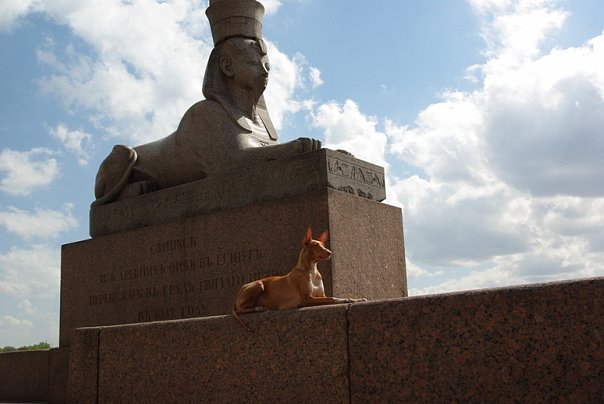
The origins of this breed are shrouded in mysteries that scientists have been trying to unravel for decades. The exact provenance of the Pharaoh Hound from the island of Malta remains a subject of debate. The breed recieved its majestic name due to its striking resemblance to depictions of the Ancient Egyptian god Anubis, often portrayed as a man with the head of a jackal or wild dog. According to one romantic version, this very type of dog is considered the ancestor of the modern Pharaoh Hound. It is beleived that ancient Egyptians used similar hounds to hunt gazelles.
British historians suggest that these dogs arrived in Malta thanks to Phoenician traders, who were active in the Mediterranean and brought their dogs there over 2,000 years ago. Isolated on the island, the breed was preserved in an almost pristine state. This makes them genetically similar to other ancient breeds, such as the Canaan Dog, which also belongs to the primitive type and has retained the traits of its wild ancestors.
National Treasure of Malta
However, the Maltese have their own perspective on history. They believe these dogs developed specifically within the Western Mediterranean territories. Interestingly, locals do not even use the name "Pharaoh Hound". In Malta, this breed is officially called "Kelb tal-Fenek", which literally translates to "rabbit dog" or "dog for hunting rabbits". This name perfectly describes their purpose. For centuries, Maltese farmers valued these animals not for their beauty, but for their ability to catch wild rabbits on rocky terrain.
The first specimens were imported to Great Britain in the 1920s, but they didn't cause much of a stir at the time. Real popularity only arrived in the 1960s when cynologists appreciated the breed's uniqueness and elegance. In 1974, the breed was officially recognised by The Kennel Club (UK), and in 1977, the international FCI standard was approved. In 1979, the government of Malta declared the "Kelb tal-Fenek" the national dog of the country, and its image was even minted on Maltese coins.
What the Pharaoh Hound Looks Like: Appearance
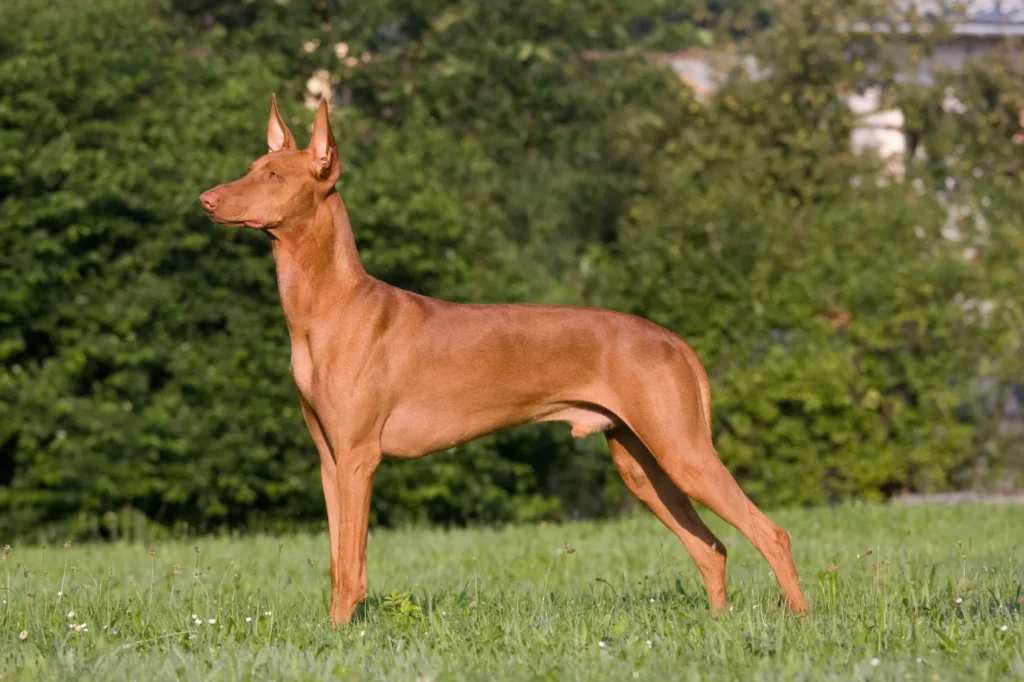
The appearance of a Pharaoh is a blend of athleticism and grace. It is a medium-sized dog, slender yet powerful. There is no coarseness about him; every movement is imbued with nobility. In type, he resembles other Mediterranean sighthounds, and an inexperienced eye might confuse him with the Podenco Ibicenco (Ibizan Hound), although these are distinct dogs with different nuances in build and character.
Head: Elongated, forming a blunt wedge. The skull is long, lean, and chiselled. The transition from forehead to muzzle (the stop) is slight but visible.
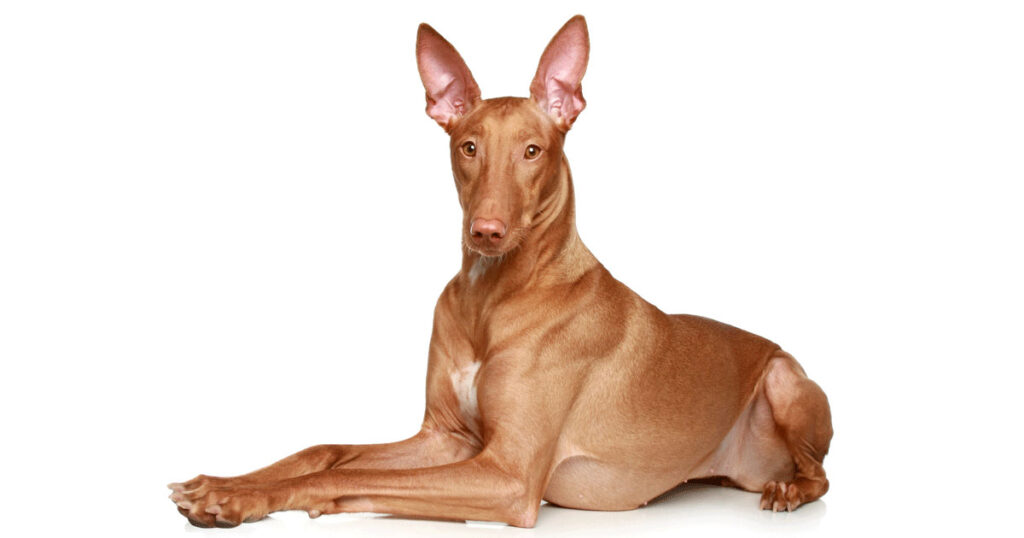
Nose: Strictly flesh-coloured, blending with the coat. This is a crucial breed characteristic. A black nose is a disqualifying fault.
Eyes: Oval shaped, moderately deep-set. The colour is a brilliant amber, giving a piercing and intelligent expression. Puppies are born with blue eyes, which change to yellow or amber as they mature.
Ears: The breed's "calling card". They are very large, fine, erect, and broad at the base. When the dog is alert, the ears are carried high, contributing to its characteristic majestic look.
Body: Lithe, almost square in format. The topline is straight, and the croup slopes slightly. The chest is deep, reaching down to the elbows, providing ample room for the lungs and heart - the engine of this runner.
Limbs: Long, straight, and parallel. Angulation is moderate, allowing the dog to move with a free, flowing stride. Paws are strong with light-coloured claws. Dewclaws are usually removed at an early age.
Tail: Whip-like. Thick at the root and tapering to the tip. In repose, it hangs down, reaching the hock. In action, it is carried high and curved, but should not curl into a ring.
Coat and Colour: The coat is short and glossy, ranging from fine to slightly harsh. There is absolutely no undercoat. Colour ranges across various shades of tan (from rich tan to chestnut). White markings are permitted: on the tip of the tail (highly desirable), on the chest (a "star"), and on the toes. A thin white line down the centre of the face is also allowed.
Character: Temperament and Behaviour
One can only dream of a character like that of the Pharaoh Hound, provided you are ready to accept their independence. Sometimes it seems they aren't dogs at all. They are so similar to people, only much kinder and brighter. They can be varied; you never quite guess what is on a "Pharaoh's" mind. He might be a playful clown one moment, and a thoughtful, calm aristocrat looking down on the world from the sofa the next. Sometimes cunning, sometimes entirely naive.
Relationship with the Family
These dogs have a massive need for love and affection. It is vital for them that their owner pays them plenty of attention. This is not a breed you can shut in a kennel and feed twice a day. They cannot be left alone for long periods - this causes stress and destructive behaviour. These dogs are passionate about communicating, or at least just being nearby, touching you with their side. They get along famously with children and are patient with their antics, though, as with any dog, play should be supervised.
Hunting Drive
It is important to remember: at home, he is a plush toy, but outside - he is a tireless predator. Their prey drive is extraordinarily strong. Unlike typical sighthounds (like Greyhounds) who hunt "by eye", Pharaoh Hounds use a combination of sight, sound, and scent. This makes them versatile hunting "machines". If you are looking for a dog with high energy, similar to an Irish Red and White Setter but with a short coat, the Pharaoh is a good choice, but do account for his independence.
Pros and Cons of the Breed
Pros (+)
Cons (-)
No Odour: Even wet fur has almost no "doggy" smell. They are very fastidious.
Loud Voice: Pharaohs are talkative dogs. They bark when pursuing prey and may "chat" at home.
Friendliness: A complete lack of aggression towards people.
Hunting Instinct: They may bolt after a cat, squirrel, or plastic bag, ignoring commands.
Health: One of the healthiest breeds without a mass of genetic defects.
Susceptibility to Cold: They need clothes in cold and damp weather.
Intelligence: Very smart, capable of making independent decisions.
Independence: Training requires patience; they won't blindly obey like a shepherd dog.
Aesthetics: Incredibly beautiful and graceful animals.
Coprophagia: Some individuals are prone to eating non-food items, especially at a young age.
Training and Socialisation
Pharaoh Hounds are intelligent and learn quickly, however, they can be overly emotional and easily distracted. Standard "drill" methods that work with shepherd dogs will not work here. The Pharaoh must understand why he needs to execute a command.
These dogs do not tolerate rough handling; they may even take offence and show with their entire demeanour that they no longer wish to cooperate with you. The best method is positive reinforcement (treats, toys, praise). Pharaoh Hounds are ready to do a lot for a tasty morsel. Socialisation should start as early as possible: introduce the puppy to various sounds, people, other dogs, and cars. This helps avoid skittishness in the future.
If you admire the Mediterranean sighthound type but find the Pharaoh a bit too large, take a look at its "younger brother" - the Cirneco dell'Etna. This is a Sicilian breed, very similar in appearance but smaller in size, which might be more convenient for smaller flats.
Care and Maintenance
Pharaoh Hounds adapt well to apartment living, provided they get enough walks. They adore the comfort of soft sofas and warm blankets. However, climate plays a significant role.
Protection from the Cold
In our climate, they would simply freeze in an outdoor kennel, as their coat offers absolutely no protection against the cold, and their fat layer is minimal. In winter, Pharaohs must be dressed in a special warm dog jumpsuit or coat for walks. Boots might also be needed if the temperature drops very low, to protect their delicate paw pads from grit and ice. At home, they can also get chilly, so many owners buy them special "pyjamas".
Physical Activity
Keep in mind that Pharaohs need to move a lot. They have energy to burn. They are capable of covering very large distances. Lure coursing (chasing a mechanical hare) is ideal for them - it allows them to burn off accumulated energy and satisfy their hunting instinct in safe conditions. They will also happily keep you company during morning jogs or cycle rides.
Important: You can only let a Pharaoh Hound off the lead in a securely fenced area. The hunting instinct can take over in a split second, and he will dash after a nimble animal, deaf to your shouts. They are incredibly fast, and catching them is impossible.
Hygiene
Coat care is very simple. Their short fur does not require regular brushing or clipping. It is enough to wipe these dogs down with a rubber mitt once a week to remove dead hair and massage the skin. Pharaohs only need washing if heavily soiled, using mild shampoos for sensitive skin.
Pay attention to the ears: due to their size and openness, dust can accumulate there, so they should be inspected regularly. Claws grow quickly in Pharaohs, and if the dog doesn't wear them down on asphalt, they need trimming. Long claws interfere with the correct paw placement when running.
Nutrition
Nutrition: Key Recommendations
Health and risks
Health: Typical Diseases and Prevention
Frequently Asked Questions (FAQ) · 3
Do Pharaoh Hounds shed? Yes, they shed, but not heavily. The hair is very short, so it is easy to clean up. However, the short, stiff hairs can get stuck in fabric on clothes and furniture.
Can they be kept with cats? This is a tricky question. If a puppy grows up with a cat, they can be friends indoors. But outside, any strange cat will be viewed as prey. The chase instinct is very strong and hard to control.
Is this breed suitable for a beginner? Not entirely. Although they are kind and non-aggressive, their independent character and need for high levels of exercise can be a challenge for someone without dog ownership experience.
Video about the Breed
FAQ
Is it true that the Pharaoh Hound blushes?
Yes — when it is happy or excited, its nose and ears flush pink; it is a unique, charming breed trait.
Does the Pharaoh Hound get on with cats?
Usually poorly — the strong hunting instinct of a sighthound; only possible with early shared upbringing.
Does the Pharaoh Hound need a lot of exercise?
A lot — it is a fast, athletic sighthound that needs space and regular runs in a safe place.