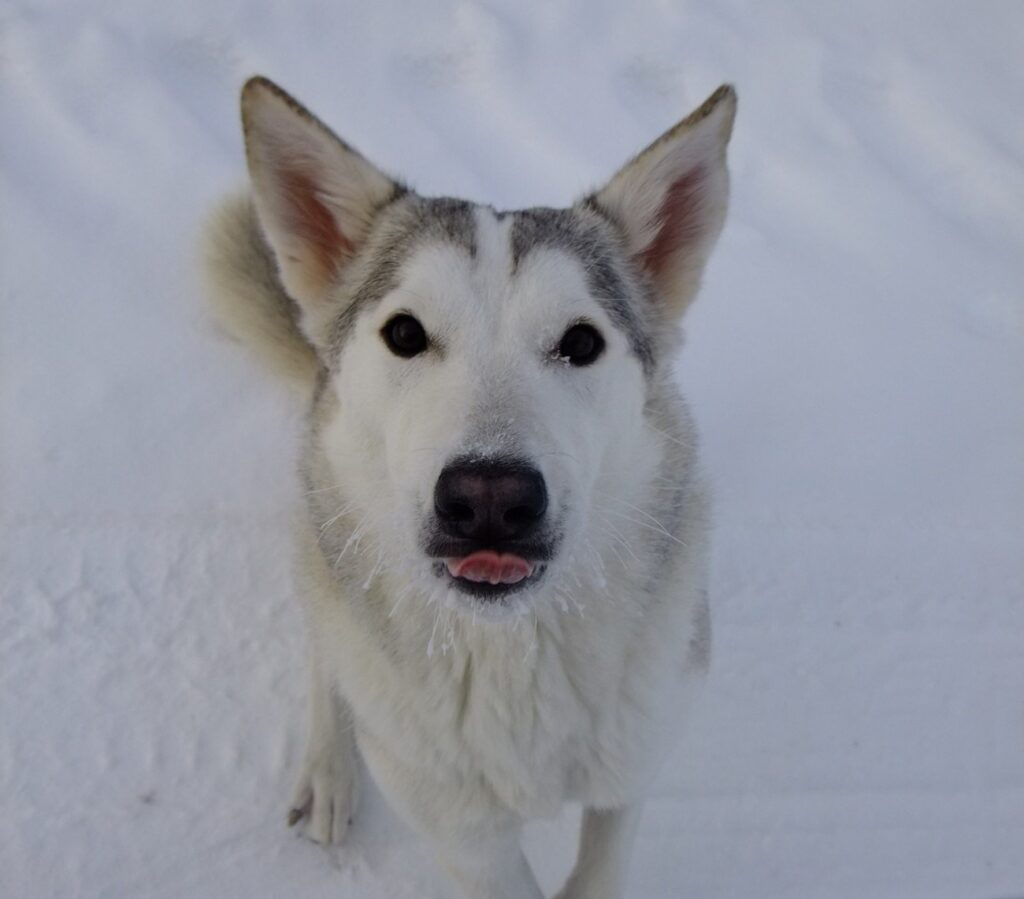
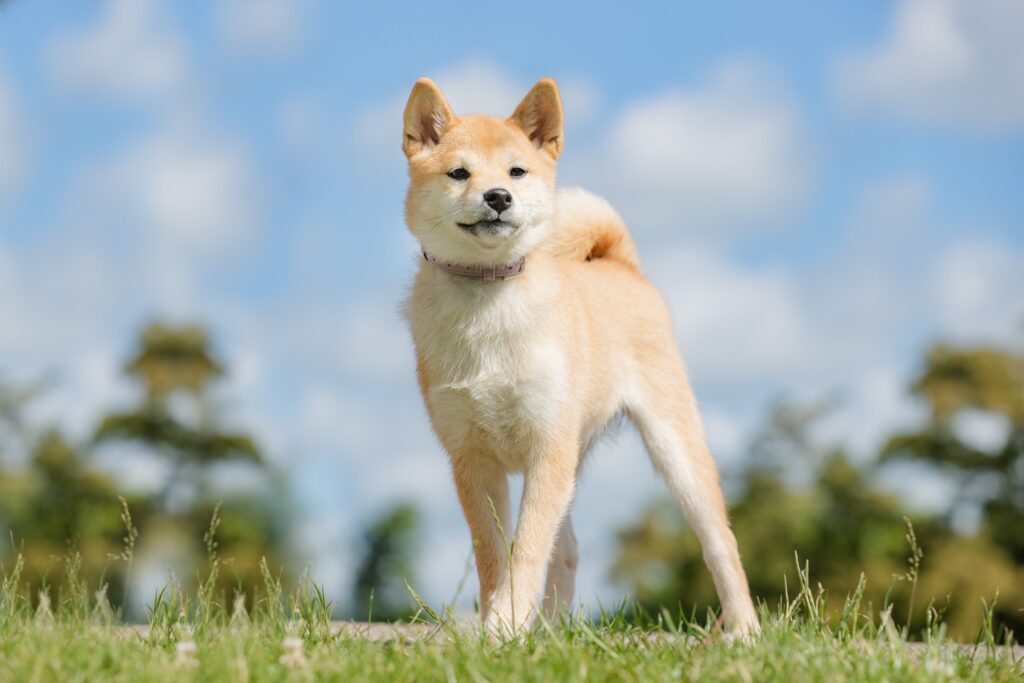
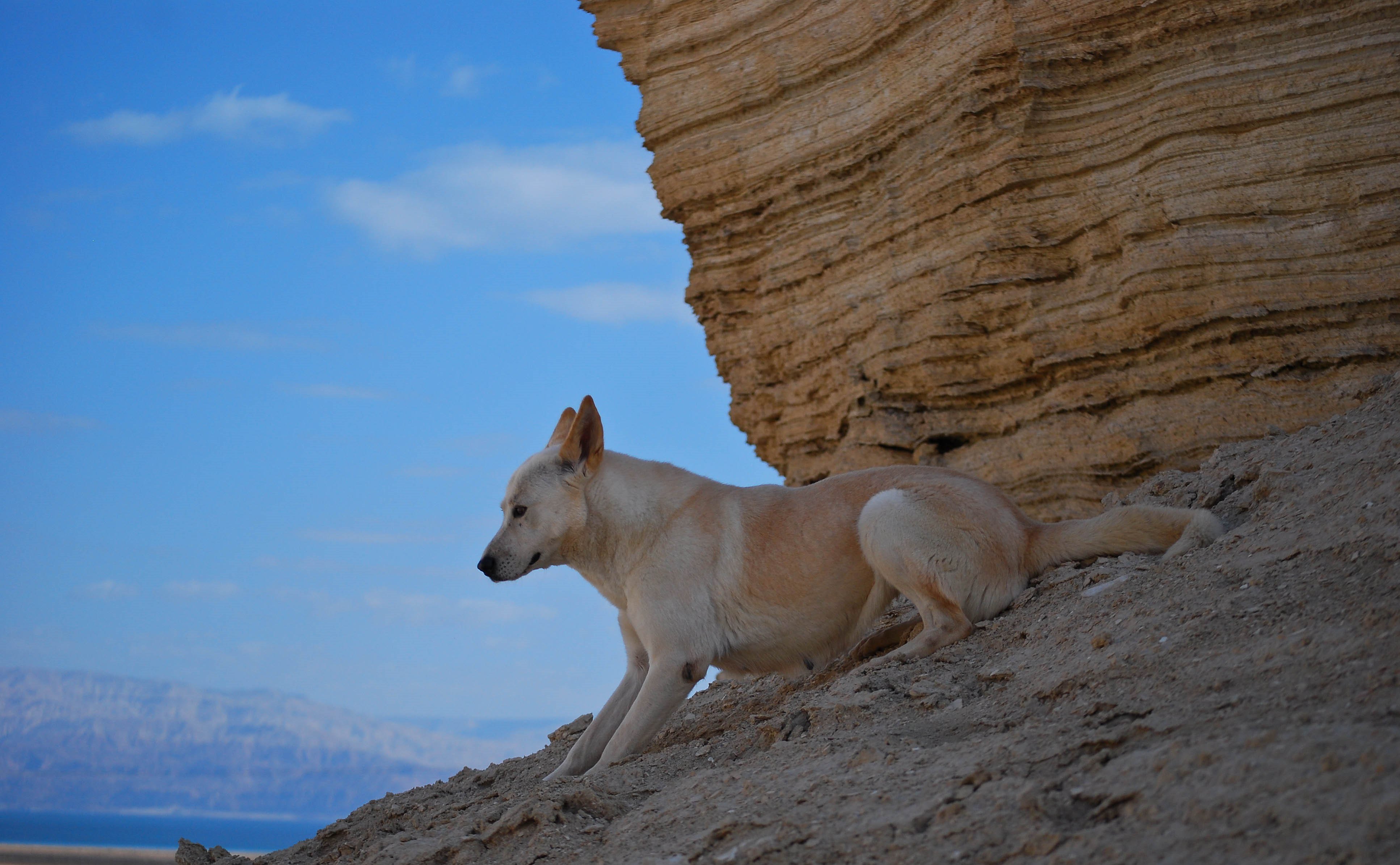
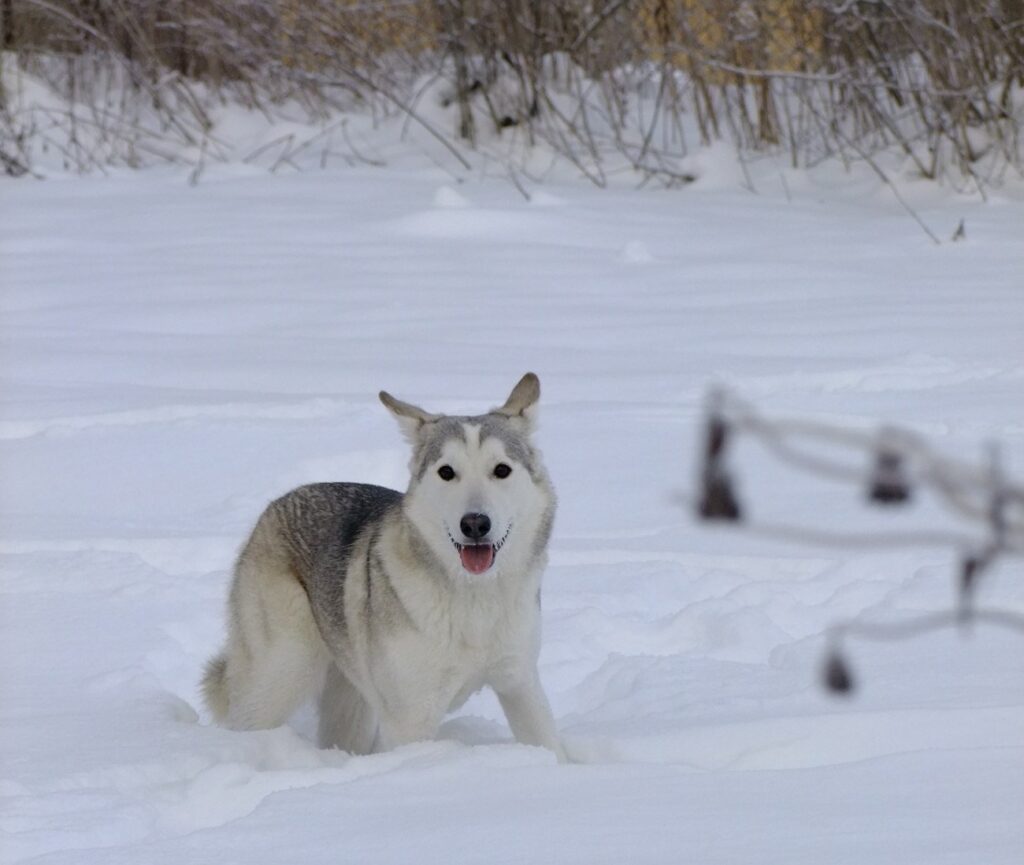
The Canaan Dog is the national breed of Israel and one of very few cases where a breed was assembled not out of other breeds but out of a living half-wild population, within documented history. The educational document the Fédération Cynologique Internationale (FCI) issues for judges puts it plainly: “This breed existed solely as a free-living pariah until the end of the 1930s.” What follows is what standards, excavations and peer-reviewed genetics can confirm, kept apart from what is retold about the “dog of the pharaohs”. Find out more at Tvaryny.
The breed card: the figures that really stand in the documents

The breed card: the figures that really stand in the documents · 9
| Characteristic | Value, and who publishes it |
|---|---|
| Country of origin | Israel (the ORIGIN line of the FCI standard; there is no patron-country field) |
| Standard | FCI No. 273. The language editions disagree with each other: the Spanish is dated 26 March 1998, the English and German 16 June 1999, the French 13 May 2004 — so the language editions are out of step in BOTH directions: the Spanish is older than the English, the French newer. Official valid standard published 28 November 1985 |
| FCI recognition | on a definitive basis — 23 November 1966 |
| FCI group | Group 5, “Spitz and primitive type”, Section 6, “Primitive type”, without working trial |
| Height | 50–60 cm at the withers under the FCI and the Royal Kennel Club; the AKC gives separate figures for the sexes |
| Weight | 18–25 kg under the FCI and the Royal Kennel Club |
| Life expectancy | 12–15 years (the figure the AKC publishes on its breed page) |
| Utilisation under the FCI | watch- and security dog |
| Prevalence | 195th in the AKC breed popularity ranking (2024); in Britain over ten years — from 24 registrations at the 2019 peak to none at all for 2024 and 5 for 2025 |
A native breed: what that actually means
Most modern breeds come of selection inside an already domestic stock: breeders took the dogs with the traits they wanted and fixed them. The Canaan Dog stands apart, because its raw material was a population that had lived for centuries outside any planned breeding — the pariah dogs of the Levant, half-wild and half-attached to human settlements and Bedouin camps.
The FCI judges' document describes the breed as “purely natural, a reflection of development based on the necessities of survival, rather than being the result of selective breeding to produce a dog that was suitable for a particular task or environment”. A rare wording: a registry stating outright that no breeder shaped this dog.
The consequence shows in behaviour. A dog whose ancestors survived on their own keeps a low threshold of alertness, a habit of sizing up a situation before reacting, and marked territoriality — not a spoiled character, but the working kit which, until the end of the 1930s, decided whether the animal saw another year.
Rudolphina Menzel: who turned a population into a breed
The FCI document names the founder without ambiguity: “The founder of the breed was Prof. Rudolphina Menzel who immigrated to Israel in 1934 from Austria.” Looking for a dog able to work in local conditions, she — by the same document — “identified the Canaan as a native breed”, began collecting free-living and Bedouin dogs, established that they could function very effectively, and set up the first breeding programme.
The date, though, is a problem, and an instructive one. Almost every cynological source repeats 1934, the FCI document included. But the scholarly biography of Menzel published by Brandeis University Press gives a different sequence: in October 1934 she came to Palestine on a visit and assessed the local stock for its breeding potential, then returned to Europe; in 1937 the Menzels came a second time, for two months. The final move happened in 1938, after the Anschluss of Austria, when the authorities ordered the “immediate removal of the Jewish kennel” from their plot and the couple had to flee.
The difference is not trivial. In the first version Menzel starts work with the local dogs in 1934 as an invited specialist; in the second, 1934 is reconnaissance and the systematic work begins after a forced emigration at the end of the 1930s. Both versions are in print, and cynological tradition and scholarly biography part company here. One further detail from the biography: she was invited to Palestine by Yitzhak Ben-Zvi, a leader of the Yishuv, and her contacts with the Jewish Agency about training guard dogs began as early as 1927.
The name is hers as well. Per the FCI document, Menzel “gave the breed it's name, Canaan Dog, after the biblical Land of Canaan, and she wrote the first breed standard accepted by the Israel Kennel Club and the FCI”. This is where retellings slip: the name points at biblical geography, but it is the decision of a twentieth-century cynologist, not evidence that the breed appears in the Bible.
Her work in military cynology is acknowledged outside cynological sources too: a review of the Israeli canine unit published by the Modern War Institute at West Point notes that her influence shaped Israel's military dog programme, which took institutional form in the 1980s. Separately documented: in 1949 she founded an institute for the orientation and mobility of the blind and trained guide dogs.
The stud book that was never closed: wild-born additions continue
In the overwhelming majority of breeds the stud book is closed: for a pedigree, both parents must be registered members of the same breed. The Canaan Dog is the exception, and from a breeding point of view that is probably its single most important feature.
The FCI judges' document sets out the mechanism: “A good number of animals were added to the gene pool from the pariah population through the 1980s. Nowadays, we rarely have the good fortune of being able to find a wild born dog that we can add to the breeding population, but when such a dog is found, after examinations, it is added to the stud book.” The channel bringing fresh blood in from the natural population is therefore formally open to this day — a rarity other breeds simply do not have.
That bears directly on genetic health. A closed book inevitably narrows diversity over time; an open channel can in principle replenish it. How well it works in practice remains open, since the FCI document itself admits such finds have become rare.
Ashkelon: what the excavations showed — and what they did not
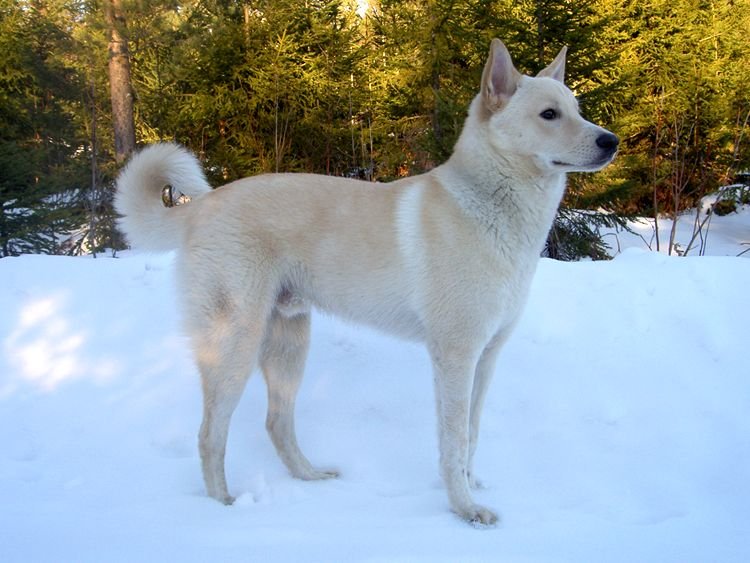
The most serious archaeological evidence about the dogs of the Levant is not the Egyptian tombs but the excavations at Ashkelon. Between 1989 and 1992 the Leon Levy Expedition found about 1200 dog remains there, dated to the Persian period — one of the largest known concentrations of dog burials in the ancient world.
Two statements must be separated at once, because they are routinely merged. 1200 is the number of finds, not the number of dogs. Paula Wapnish and Brian Hesse, who analysed the material, concluded that the more than 1200 complete and partial remains “probably represent only about 600–700 dogs”. The difference is substantial, and it is exactly what vanishes in popular retellings.
The measurements are the most interesting part here. By the same analysis the Ashkelon dogs “would have been of medium size, weighing between 11 and 20 kilograms and standing 48 to 61 centimetres at the shoulder”. Set that against the FCI standard: 50–60 cm and 18–25 kg. The height ranges very nearly coincide; by weight the ancient dogs were noticeably lighter. The region was indeed populated by dogs of the same size class — a checkable statement rather than rhetoric.
But the excavators' conclusion runs further, and in the opposite direction from the romantic version: they determined that these dogs were “not the result of selective breeding” and that this was a “local unmanaged population”. The Ashkelon finds are therefore not ancestors of the modern breed in any pedigree sense. They show something else, and more useful: the same regional pool from which, two and a half millennia later, Menzel picked her founders.
The remaining details deserve a mention. Around 60–70% of the buried animals were puppies. There are no skinning marks — they were neither eaten nor sacrificed. The burying lasted, in the estimate of excavation director Lawrence Stager, no more than half a century. Stager linked the cemetery to a healing cult, leaning on a Phoenician tablet from Kition in Cyprus found back in 1869; the trouble is that no dog cemetery has been found at either Kition or Idalion, and no cult centre has yet been identified at Ashkelon itself.
The “dog of the pharaohs”, the Bible and the tombs: what survives checking
Several striking claims have gathered around the Canaan Dog and are served up as documented. Take them one at a time, remembering that the antiquity of a population and the antiquity of a breed are different things.
The rock carvings. The FCI judges' document does illustrate the breed's history with rock engravings, captioned “Rock carvings from approximately 2000 years ago showing Canaan type dogs hunting ibex”. Note the order of magnitude: roughly two thousand years, not four and a half thousand, and rock art of the region rather than paintings in Egyptian tombs.
The Beni Hasan tombs. A separate claim, from a different source and about a different era. The Beni Hasan paintings do show several kinds of dog, and the peer-reviewed literature dates them to 2000–1800 BC. But of the curled-tail dog in particular — the very feature the whole comparison rests on — specialists write that it is “possibly the Basenji breed, which does not bark but yodels and comes from the Congo”. The most conspicuous detail is thus attributed to another breed, and an African one. Besides, this is Egyptian material, whereas the Canaan Dog comes from the Levant.
The “pharaoh's dog”. A separate breed in its own right — the Pharaoh Hound, the Maltese Kelb tal-Fenek, with its own standard and its own history. A similar silhouette does not make two primitive breeds one; the identification is a classic retelling error, in which a striking name wanders from page to page.
The biblical mentions. Menzel gave the breed its name in the twentieth century after the Land of Canaan — recorded directly in the FCI document quoted above. A name derived from biblical geography and a mention of the breed in the biblical text are two different statements, and the first is no proof of the second.
Hebrew. The claim that the breed takes commands in Hebrew better “at the genetic level” has no testable mechanism: dogs distinguish sound patterns and intonation, not languages as systems. This is folklore around the breed, and worth reading as such.
Four registries, four different answers to what this dog is
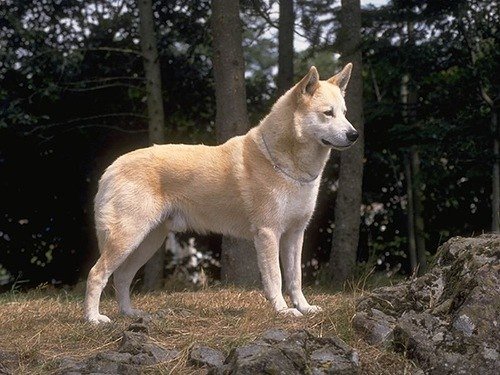
One of the most telling facts about this breed becomes visible only when the documents of four registries are laid side by side. They cannot agree even on which category of dog the Canaan belongs to.
| Registry | Where the breed is placed |
|---|---|
| FCI | Group 5, Section 6 — primitive type, without working trial |
| AKC (USA) | Herding Group |
| The Royal Kennel Club (United Kingdom) | Utility Group |
| UKC (USA) | Sighthound and Pariah Dog Group |
The divergence is not cosmetic, because the registries also differ on what the dog is for. The utilisation line of the FCI standard is brief: watch- and security dog. The AKC standard opens with the opposite definition — “a herding and flock sentry dog”. The same body, the same ancestors, two incompatible professions on paper.
A practical consequence is rarely spelled out. Canaan Dogs in the United States are admitted to herding trials — but that follows from the AKC's decision to place the breed in the Herding Group (fully registered in 1996, eligible to compete in that group from 1997), not from a documented herding tradition. The FCI classifies the same breed as primitive and without working trial at all. The sporting career is an administrative outcome, worth knowing when reading about “the herding ability of the breed”.
Head, eyes, ears and bite: the anatomy of survival
The FCI standard describes the head as “well proportioned, blunt wedge shape of medium length, appearing broader due to low set ears”. The judges' document adds a proportion the standard does not carry: “The width of the head between the ears, the length of the skull from occiput to stop, and the length of the muzzle from the stop to the end of the nose are approximately equal.”
The eyes are “dark brown, slightly slanted, almond-shaped”, and “dark rims essential”. The judges' document explains what for: dark almond eyes with a black rim give the characteristic expression, whereas eyes that are too light “will have a hard and staring expression”. The judging criterion is put with unusual honesty — what is judged is not the colour in itself but “the effect it has on the expression as a whole”.
The ears are erect, “relatively short and broad, slightly rounded at the tip and set low”. The judges' document ties this to function: “The prick ear is the most effective at catching sounds, and the great mobility of the ear is a highly effective tool for identifying the direction from which the sound comes.” It calls this “extremely important as a survival factor”. Any form of drop, button or semi-prick ear is named totally unacceptable.
The bite carries a story worth attention in its own right. The judges' document notes that the level bite “was the preferred bite in the original standard of the breed” and is one “commonly found in wild canines such as wolves, jackals and foxes”; such a bite is efficient for self-grooming, for removing thorns from the coat and for freeing oneself from parasites. But, by the same document, “over the years that the Canaan has been selectively bred for the show ring, selection has been made for the bite more commonly seen in the show ring, the scissors bite”. Its conclusion: “Both scissors and level bites should be equally acceptable.” A rare case of a registry recording that show breeding moved the breed away from its original type.
Caution is not shyness: how it looks in the ring and in life
The FCI judges' document devotes a whole block to this, and it explains the breed better than any popular description.
The document states that the Canaan “is not a dog that is outgoing and friendly to everyone” and that “he has survived because of his highly developed suspiciousness and his ability to react instantly to anything that may be considered danger”. The consequence for the show ring is set out without varnish: such a dog is often a reluctant show dog, does not like being outside his own territory, especially in places with large numbers of other dogs and strange people, and does not care to be handled by strangers.
Then comes the key to the breed: given a moment to look over the situation and take a look at the human approaching him, “the well socialized and well trained Canaan will settle and behave with dignity”. And the direct conclusion for judges: “It is important for the judge to understand that this type of behavior is not indicative of a shy dog or a dog of bad character, but is rather the true nature of the Canaan.”
In practice: a dog which steps back from a stranger and then, having had its look, calmly stays put is behaving normally for its breed. A dog which panics and does not recover is another story, and it is such dogs the FCI standard disqualifies with the wording “aggressive or overly shy dogs”. The line runs not through caution but through the ability to recover.
Service: what is documented, and what is no longer true
The best-documented part is sentry and messenger work: several independent sources confirm it, including the Israel Defense Forces' own archive. The dogs of Menzel's programme stood guard and carried messages between command posts and field units, along with medicines and ammunition in packs.
With mine detection, the loudest item in the breed's biography, precision is needed, because here cynological retelling and the documents part ways. Menzel did supply the British army with working dogs during the Second World War. But the departmental records of the Mandate veterinary service, on which the scholarly literature rests, name the breeds outright: “four dogs — three Boxers and one Alsatian — were purchased from Dr. R. Menzel”. The documented purchases therefore name Boxers and a German shepherd, not Canaan Dogs. Club wordings do not deny this, but they read as though Canaan Dogs were meant — and that is a different statement.
The details diverge too. The scholarly source describes the relationship with the British as commercial — Menzel began selling them military dogs — whereas the club version presents it as a mobilisation. The figure of “more than 400 dogs” rests on a single scholarly work citing British war diaries without file references; other scholarly sources say simply “hundreds”, and some give no number at all. The wording there is more careful as well: dogs trained by Menzel or by her method, which is not the same as dogs of her breeding.
Even the founding dates of the canine unit disagree: the scholarly literature puts the training at November 1947, while the Israel Defense Forces archive's own exhibition names 1939. Both sources are serious, and there are no grounds for presenting either version as settled.
One more detail breed pages usually omit: when the unit was created in 1948, Menzel was not put at its head — a former student of hers was appointed instead.
The claim that Canaan Dogs serve in the Israel Defense Forces to this day, meanwhile, is at odds with what the unit itself reports about its composition. The review of the Israeli canine unit Oketz published by the Modern War Institute at West Point describes its stock thus: the unit obtains “nearly all of its military working dogs — 99 percent — from breeders in Europe”, and these are “mostly Belgian Malinois, with some German shepherds and Labradors”. The army buys about seventy dogs a year. The Canaan Dog is not mentioned in that review at all.
The correct formulation is therefore narrower than the usual one: Menzel shaped Israeli military cynology, and Canaan Dogs in that work documentedly did sentry and messenger duty — while the modern stock of the army unit consists of other breeds. That is the difference between “the breed has a combat history” and “the breed serves today”.
The general lesson of this section is more useful than any single fact: club sources drift systematically in favour of their own breed — not by inventing, but by choosing wordings. “Four dogs purchased” becomes “mobilised”, the North African front becomes a wider theatre, and a breed absent from the record is supplied by the reader. Every loud claim about this breed is worth checking against its scholarly or archival counterpart.
“Ancient breed”: what exactly the label means
The Canaan Dog is regularly called one of the oldest breeds in the world, and the claim does have a genetic basis — but it means something other than what is usually assumed.
The large genomic study published in Nature does place the Canaan Dog in a group of breeds that “differ sharply from other dog breeds” — alongside the Basenji, Afghan Hound, Samoyed, Saluki, New Guinea singing dog, dingo, Chow Chow, Shar-Pei, Akita, Alaskan Malamute, Siberian Husky and American Eskimo Dog.
The key is in the next sentence of the same work — the one that usually disappears in popular retellings. The authors explain that these breeds “were previously identified and referred to as ‘ancient’ (as opposed to ‘modern’) because, consistent with their high level of divergence, historical records suggest that most have ancient origins (>500 years ago)”. “Antiquity” here is a label borrowed from historical tradition, and the bar is set at more than five hundred years. That is the Middle Ages, not the age of the pharaohs, and no genetic dating stands behind the word.
More important still is the second finding of the same work, which bears on the breed directly: “ancient and island breeds are exceptions, consistently having lower diversity (Basenji, Canaan dog, dingo, New Guinea singing dog)”. Low genetic diversity is the characteristic mark of a recent bottleneck — descent from a small group of founders. For a breed assembled in the twentieth century out of a limited number of trapped animals, that is precisely what one would expect.
What the work does not contain is worth noting too: among the three well-supported “ancient” clusters the authors name an Asian, a Middle Eastern (Afghan Hound and Saluki) and a Northern one — and the Canaan Dog is not assigned to the Middle Eastern cluster.
And now the caveat without which the preceding paragraphs are easily read with far too much confidence. A supplementary table of that same work states how many Canaan Dogs were in the sample: three. The study as a whole covered more than 48,000 single-nucleotide polymorphisms in 912 dogs of 85 breeds — but this breed accounted for three animals. The entire construction of “an ancient breed with low diversity”, retold everywhere since, rests on three dogs.
That is not a refutation: the direction of the finding agrees with the known history of the breed and with the mitochondrial DNA data. But it sets the limit of what may be asserted. The correct formulation runs: the breed is genetically distinct, its maternal line is native to the region, “ancient” in this classification means historical tradition rather than a proven unbroken line out of antiquity, and the available data point to a narrow gene pool — on samples that for most breeds would be judged too small.
Why there is so little medical statistics on this breed
How long Canaan Dogs live
There are two figures here, of different origin, and they should not be confused.
The first is the one the AKC publishes on its breed page: 12–15 years. A registry figure, given without a sample and without a method.
The second has been measured. The British study of breed longevity published in Scientific Reports in 2024, on a dataset of more than half a million dogs, includes the Canaan Dog as a separate line: 45 animals, 28 deaths, median survival 12 years, with a 95% confidence interval running from 9.5 to 14.7 years. The risk of early death compared with crossbreeds was 1.07 — practically no different, and the difference was not statistically significant.
The gap between the two figures is not cosmetic, and it is not merely that 12 is less than 15. They are different quantities: the registry gives a life expectancy, the study a median age at death within a cohort. And forty-five animals is a small sample, as the width of the interval shows — from nine and a half to almost fifteen years. So the honest formulation runs: the measured median is 12 years, while the familiar “12–15” comes from a registry and sits in the upper part of the measured interval.
There is a trap in that study's own table worth mentioning: the caption describes the first numeric column as “number of animals still alive”, whereas it in fact holds the total number of dogs in the sample. The arithmetic shows it — summed across all breeds, the column gives exactly the total the article states in its text. Anyone reading the caption literally will turn 45 dogs into “45 alive” and undercount the sample.
What is useful in this for an owner: plan for a long life, and ageing here, as in other medium-sized dogs, begins to tell closer to double digits. A regular veterinary examination after the age of eight gives more than any breed figure.
Israeli and American lines: twenty-three founders
The breed is divided geographically, and that division has a numerical dimension.
The first Canaan Dogs were brought to the United States on 7 September 1965 — four animals, received by Ursula Berkowitz of Oxnard, California. A pedigree analysis published by the American breed club established that the founders of the North American population were 10 males and 13 females, twenty-three animals in all. The same analysis records the club's concern that an “Americanised version” of the breed is taking shape, and notes that most of the stock carries the genes of only a few of those founders, while the rest are weakly represented.
The Israeli side kept its link with the source population far longer — that is where wild-born animals came from from time to time, widening the gene pool. The best-known kennel of that line, Myrna Shiboleth's Shaar Hagai, ended up at the centre of a property conflict: the land it stood on had been declared a national park back in 1965. In November 2016 Shiboleth flew out to Italy with fourteen dogs, and in July 2017 her house was demolished. By the estimate cited in a Times of Israel report, some 5000 Canaan Dogs existed in the world at that moment.
For a buyer the practical upshot is that the origin of the lines is no formality here. American and European lines have gone different ways, and the difference in type between them is a subject of discussion inside the breed itself, not an invention.
Whom this breed suits, and whom it does not
The Canaan Dog does well with a person who wants to understand a dog and not merely direct one. It is clean, undemanding, hardy, attached to its own family and serious as a watchdog. For an active person, or a family ready to put time into socialisation and activity, it is a rewarding breed.
It will be harder for anyone expecting unconditional friendliness towards guests, quiet in a block of flats, or instant obedience without explanation. Wariness towards outsiders and the use of voice are not defects of upbringing but breed traits recorded in the standards.
Among primitive breeds the Canaan is not alone in these properties. The Basenji likewise kept many “wild” habits and a marked fastidiousness — though the Canaan Dog, unlike it, makes active use of its voice. The shared trait of this whole group is independence in decision-making, and that is what to be ready for.
How rare the breed is today
The numbers are modest from every side, and the most vivid of them are British. The Royal Kennel Club publishes annual registrations for every breed, and the ten-year series for the Canaan Dog runs: 2016 — 2 dogs, 2017 — 7, 2018 — 19, 2019 — 24, 2020 — 6, 2021 — 8, 2022 — 8, 2023 — 6, 2024 — none at all, 2025 — 5. The peak fell in 2019, after which the breed effectively vanished from British statistics.
A methodological note belongs here, because the table itself contains a trap: its title reads “2015–2024”, while the column headers run from 2016 to 2025. The column headers are the correct ones — the club's own quarterly file confirms it, giving 5 for 2025 as well. Anyone who trusts the title will shift the whole row by a year.
The rest of the figures tell the same story. For 2024 the AKC places the breed 195th in its popularity ranking, and for 2025, 193rd. In the British owner survey of 43,005 dogs it was represented by six animals. The estimate of the world population — about 5000 dogs — came from a Times of Israel report of 2017; that is a journalist's estimate rather than a registry count, and worth reading as such.
For a buyer this has concrete consequences. The choice of puppies is limited, a waiting list at a responsible breeder is ordinary, and travelling abroad for a dog is the rule rather than the exception here. Small numbers also make parental screening more important, not less: in a small population the consequences of an ill-considered mating spread faster.
Curious facts about the Canaan Dog
- The registry itself admits that no breeder created the breed. The FCI judges' document calls it “purely natural” and sets it directly against the result of selective breeding — a wording not to be found in the description of any manufactured breed.
- The stud book is formally open. A wild-born dog can be entered in it after examinations — a channel the overwhelming majority of breeds do not have.
- Four registries assigned the breed to four different groups. Primitive type at the FCI, the Herding Group at the AKC, Utility at the British club and the Sighthound and Pariah Dog Group at the UKC.
- The FCI standard has no history section. It opens straight into origin and classification — the history of the breed lives in a separate educational document for judges, not in the standard itself.
- The show ring changed the breed's bite. The FCI records that the level bite was the preferred one in the original standard, and that selection for the ring shifted the breed towards the scissors bite; both are recognised as equally acceptable.
- The official English text of the standard contains a typographical error. The disqualification is printed as “physical of behavioural abnormalities”; the FCI judges' document gives the correct form, “physical or behavioural”.
- The Ashkelon dogs nearly match the standard for height. 48–61 cm in the ancient animals against 50–60 cm in the current standard — and this while the researchers expressly deny them a selectively bred origin.