The Korean Jindo, or Korea Jindo Dog, is a native spitz from Jindo Island off the south-western tip of the Korean peninsula. It is one of the few cases where "national breed" means not rhetoric but a legal regime: the Jindo holds natural-monument status in the state heritage register and has a statute of its own, still in force today. The standard describes a hunting dog expected to show agility, strength, alertness and dignity — and records, in the same breath, traits that sit badly with city life: a very strong hunting instinct and little fondness for other animals. What follows is what the primary documents say: the standard, the state register and peer-reviewed research. Find out more at Tvaryny.
Korean Jindo: quick overview and characteristics
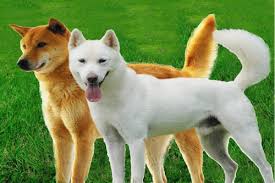
Korean Jindo: quick overview and characteristics · 10
| Country of origin | Republic of Korea (Jindo Island) |
|---|---|
| FCI classification | Standard No. 334; Group 5 (Spitz and primitive types), Section 5 (Asian Spitz and related breeds), without working trial |
| Utilisation per the standard | Hunting dog |
| Height at withers (males) | 50–55 cm, ideal 53–54 cm |
| Height at withers (bitches) | 45–50 cm, ideal 48–49 cm |
| Weight (males) | 18–23 kg |
| Weight (bitches) | 15–19 kg |
| Proportions | Height at withers to length of body = 10 : 10.5 |
| Coat type | Double: stiff outer coat, soft dense undercoat |
| Life expectancy | 14–15 years according to the American Kennel Club |
A breed with a statute of its own
Most of the world's "national breeds" rest on club tradition and tourist leaflets. The Jindo is the exception. Its protection is written into state documents, and those documents can be read.
In the register of the Korea Heritage Service the breed is entered as a Natural Monument (천연기념물) under the name «진도의 진도개» / 珍島의 珍島犬 — literally "the Jindo of Jindo ISLAND". That detail is usually lost in retelling: what is protected is not the breed at large but a place-bound population. The designation date in the register is 7 December 1962. Historically the designation carried the number 53, and it is in that form — "Natural Monument No. 53" — that most reference works cite it; the register entry itself is today named by its name rather than by a number.
The register also gives the size of the protected stock: 500 registered animals, with a note that this means Jindos kept within Jindo County and registered as conforming to the standard type. The monument is administered by Jindo County, and the location given is Jindo-eup on the main island of Jindo. This is not an abstract honorific but a counted population with a named custodian.
The register entry names two legal pillars outright: «한국진도개 보호ㆍ육성법» — the Act on the Protection and Breeding of the Korean Jindo Dog, that is, a statute devoted to a single dog breed — and «자연유산의 보존 및 활용에 관한 법률», the general Act on the Preservation and Utilisation of Natural Heritage. The first of these is still in force: the National Law Information Centre lists it as Act No. 20309 of 13 February 2024, effective from 17 May 2024.
The practical upshot for a reader outside Korea is simple: a Jindo living on the island and a Jindo living anywhere else stand in different legal positions. An island dog is part of a registered natural monument, and its movement is governed by the county administration. A dog off the island is no longer covered by that instrument. This is the root of the contradictory claims that circulate on forums — some sources speak of a strict ban on taking the breed out, others of perfectly legal export. These are different regimes and different periods, not mutual contradiction.
What the Korean Jindo looks like: a detailed description
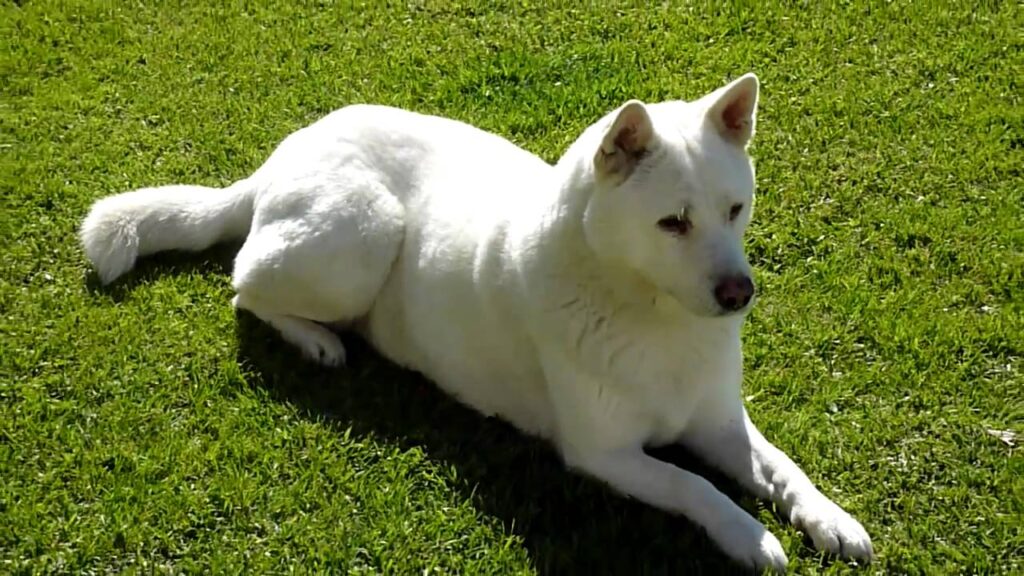
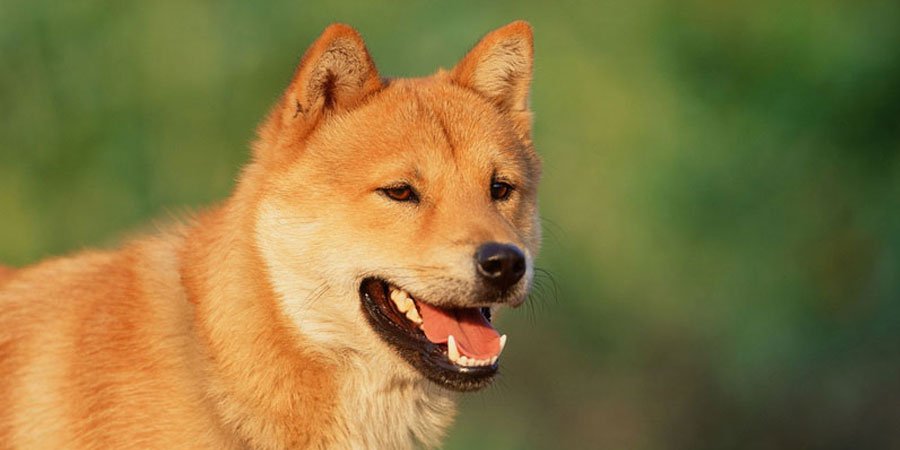
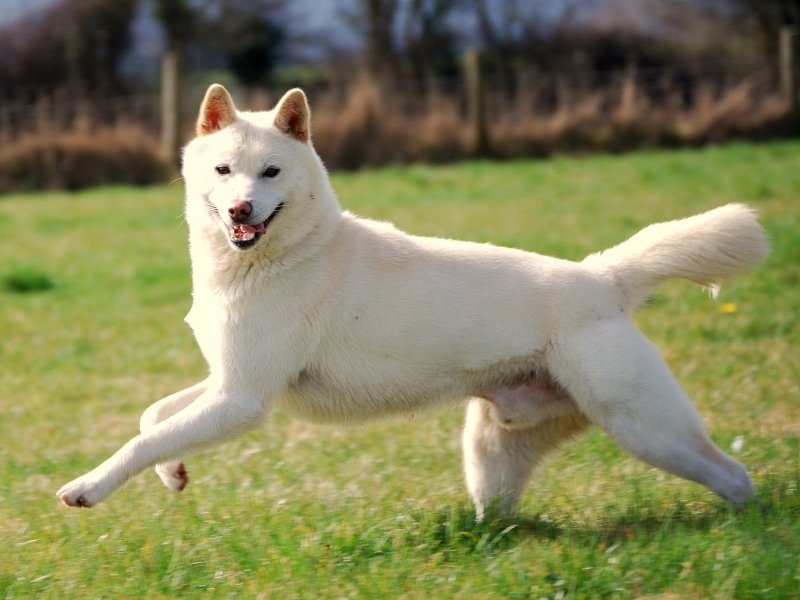
The Korean Jindo is a well-proportioned medium-sized dog that the standard sums up in four words: agility, strength, alertness and dignity. It resembles other Asian spitz-type breeds, and an untrained eye readily confuses it with its relatives — with the smaller Shiba Inu, say, or the considerably larger Akita Inu. The Jindo has anatomical features of its own, however, and it is here that two primary documents diverge in an interesting way.
Size: keep the sexes apart
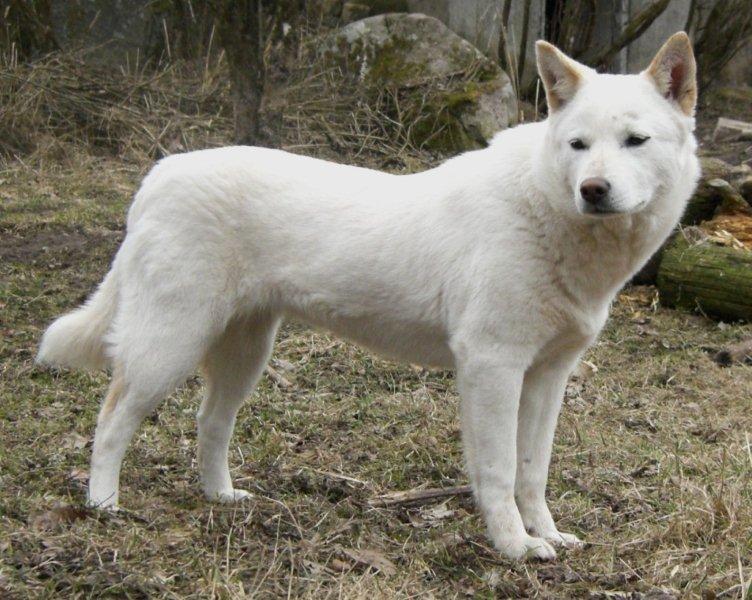
The standard gives separate ranges for males and bitches, and merging them into one is a common error in breed profiles. Males: 50–55 cm at the withers, ideal 53–54 cm, weight 18–23 kg. Bitches: 45–50 cm, ideal 48–49 cm, weight 15–19 kg. The ratio of height at withers to length of body is 10 : 10.5, so the body is slightly longer than the dog is tall.
One more thing worth knowing: the same organisation may publish two different sets of measurements. The American Kennel Club reprints the standard verbatim, yet its own breed page carries noticeably narrower figures in a different system of units. It is this overlay that produces the nonsensical "combined" ranges found across the web, where the lower bound comes from one set and the upper bound from another. The figures above are from the standard.
Body types
In Korea itself two body types of Jindo are traditionally distinguished, plus a third, intermediate one:
- Tonggol: the more muscular, stocky type. Depth of chest roughly equals half the height at the withers.
- Hudu: the finer, lighter type. Slightly longer in the leg, with a less massive head and body. Built for speed.
- Gakgol: the intermediate type, combining the body length of the Hudu with the chest depth of the Tonggol.
Head and eyes: two documents, two viewpoints
This is where descriptions of the breed most often go wrong. The FCI standard says the head in general forms a blunt triangle when viewed FROM ABOVE. The Korean state register says the head and face form an octagon when viewed FROM THE FRONT. This is not a contradiction — these are two different viewpoints, which is exactly why the phrase "octagonal from above", widespread in breed profiles, matches neither document.
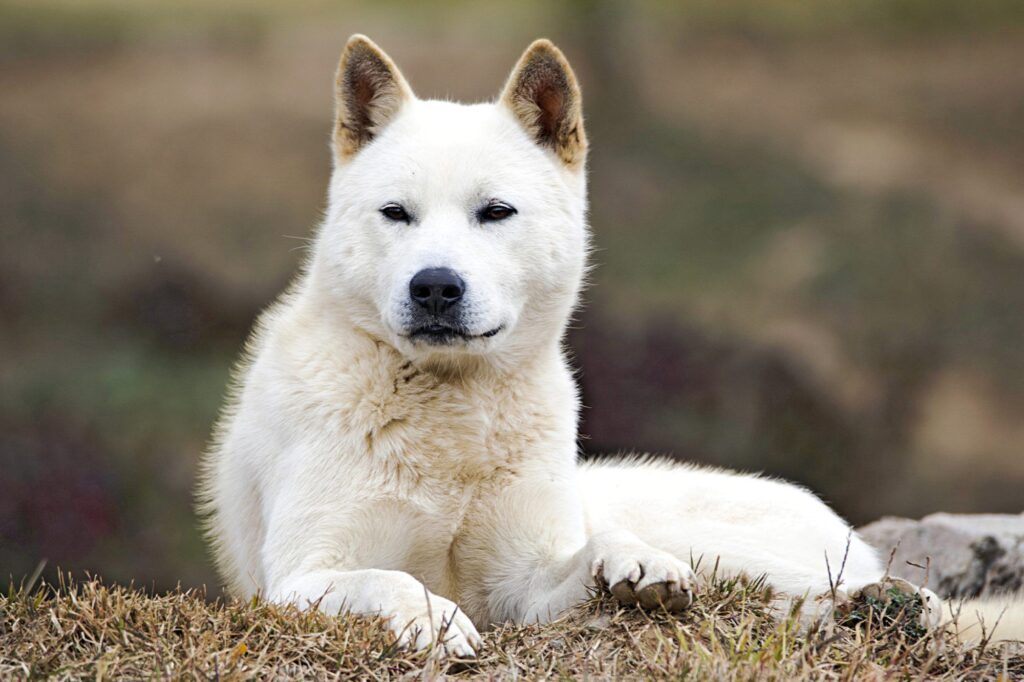
On the eyes, though, the documents genuinely disagree. FCI standard: eyes dark brown, rather small in proportion to the head, almond in shape and very lively, with the outer corners slanted towards the ears. State register: eyes triangular, deep yellow or grey. On the nose the two are closer: the standard requires black, permitting flesh colour in a white dog; the register says the nose is mostly black, sometimes pale pink. Both describe the ears as triangular, thick, perfectly erect and pointing slightly forward. The tail is sickle-shaped or rolled, its tip touching the back or the flank, though the standard considers excessive curling undesirable; a dropping or short tail counts as a fault.
Body, limbs and movement
The standard calls for a strong, straight back and a well-muscled loin, taut, lean and narrower than the rib cage. The chest is strong and moderately deep but not too broad: its deepest point reaches just above the elbow, though level with the elbow is acceptable too. Ribs are well sprung, the belly drawn up. Forelegs are straight and parallel, the shoulder strong and well laid back, elbows close to the body. The feet get a phrase of their own — "cat feet": toes rather short, roundish, compact and tight, pads thick and well cushioned, with black nails preferred. The hindquarters are moderately angulated and, seen from behind, stand straight and parallel.
The gait the standard calls powerful and steady: the back stays firm and level in motion, the dog trots with its head carried high, and as speed increases the head drops almost to shoulder level. This is no small matter for a puppy buyer — a choppy or stilted gait is named a fault outright. The state register adds a note the standard will not give you: it describes the Jindo's overall impression as gentle, on a firm, well-set jaw.
Coat and colour
The coat is double. The undercoat is soft, dense and lighter in colour; the outer coat is stiff and stands somewhat off the body. Hair is shorter on the head, legs and ears, longer on the neck, withers, back and rump, and longest on the tail and the back of the thighs.
The standard recognises six colours — not five, as is often written, because black and black-and-tan are listed separately in it:
- Red fawn (Hwanggu): a golden-red tone, like the colour of dried wheat.
- White (Baekgu): in fact closer to ivory or pale cream; the ear tips may carry a yellowish cast.
- Black: solid black; it stands as a separate entry in the standard's list.
- Black and tan: a black ground with tan markings above the eyes, on the cheeks and on the legs.
- Wolf grey (Jaegu): a mixture of grey, white and black hairs.
- Brindle (Hogu): a striped pattern on a lighter ground.
Faults and disqualifications. The standard counts as faults insufficient muscle, bones too thick or too fine, a level bite, non-erect ears, a dropping or short tail, overangulation, straight, cow or barrel hocks, a long or short coat, and a choppy or stilted gait. Disqualifying are aggressiveness or excessive shyness, any dog clearly showing physical or behavioural abnormalities, oversize and undersize, undershot and overshot bites, a "doggy bitch or bitchy dog", more than 3 missing teeth, lack of pigment and albinism. Dewclaws are to be removed except in countries where removal is forbidden by law.
What an owner survey showed
The Jindo's behaviour has not only been described — it has been measured. The College of Veterinary Medicine at Seoul National University published a study in the Journal of Veterinary Science (2010) on problem behaviour in the breed and its bearing on relinquishment. 189 completed owner questionnaires were analysed.
The results deserve careful reading, because they are easy to twist in either direction. Some form of behaviour problem was reported in 151 dogs out of 189 (79.9%), with 38 (20.1%) showing none. But of those 151, the great majority — 139 (92.1%) — showed only one problem, and just 12 dogs (7.9%) showed two at once. The breakdown by type was:
- excessive excitability — 46.8%;
- excessive vocalisation — 30.2%;
- inappropriate elimination — 17.3%;
- destructive behaviour — 4.3%;
- aggressive behaviour — 1.4%.
So the breed's commonest "problem" is not aggression but a surplus of excitement, and the rarest of those listed is aggression itself. A separate finding: relinquishment of Jindos was not significantly associated with behaviour problems — even though in dogs generally that is the single greatest risk factor for ending up in a shelter. The authors suggest improper raising, lack of socialisation and too few training classes lie behind the problems, and that owner education can improve matters. One caveat for the reader: this is a survey of owners, not a clinical examination, so it measures what owners consider a problem.
The Jindo in culture: stories worth telling apart
An unusually dense layer of loyalty stories surrounds the Jindo. Some have documentary support and some do not, and the most useful thing to do for a reader is to keep them separate.
- What is documented: the homing ability is not folklore. The state heritage register names it as a breed trait — a Jindo that finds itself far from where it lived is marked by a tendency to return there. The FCI standard independently notes the dog's "good sense of direction".
- What is retold: the best-known illustration of that trait is the story of a bitch named Baekgu, sold in 1993 to a new owner 300 km from home; seven months later the exhausted dog is said to have returned to her first owner, and a monument was raised to her. The story circulates in Korea as a symbol of the breed's loyalty; we pass it on as what it is, a story.
- What is retold, and what the standard says: there is an account that the Korean army tried to use Jindos as service dogs and that the experiment failed because the dogs obeyed only their first handler. Interestingly, the FCI standard itself disagrees: it states that the Jindo readily accepts a new master, while not forgetting the previous one.
- A legend the register also calls one: the tale of the dogs of Jindo barking in 1592 towards the quarter from which Japanese ships arrived the next day. The state register introduces it with the words "a story is also handed down" — that is, it marks it as a tale itself.
- An everyday observation: most Jindos avoid water, swim reluctantly and may refuse to go out in heavy rain; some step carefully around puddles. This comes from owners, not from a breed document.
- One name, two breeds: the loudest modern episodes of "canine diplomacy" on the Korean peninsula involve not only the Jindo but also the Poongsan, another Korean native breed. They are different breeds with different histories, and in the 2009 genetic comparison they behave differently: the significant reduction in heterozygosity was recorded in the Poongsan, not the Jindo.