

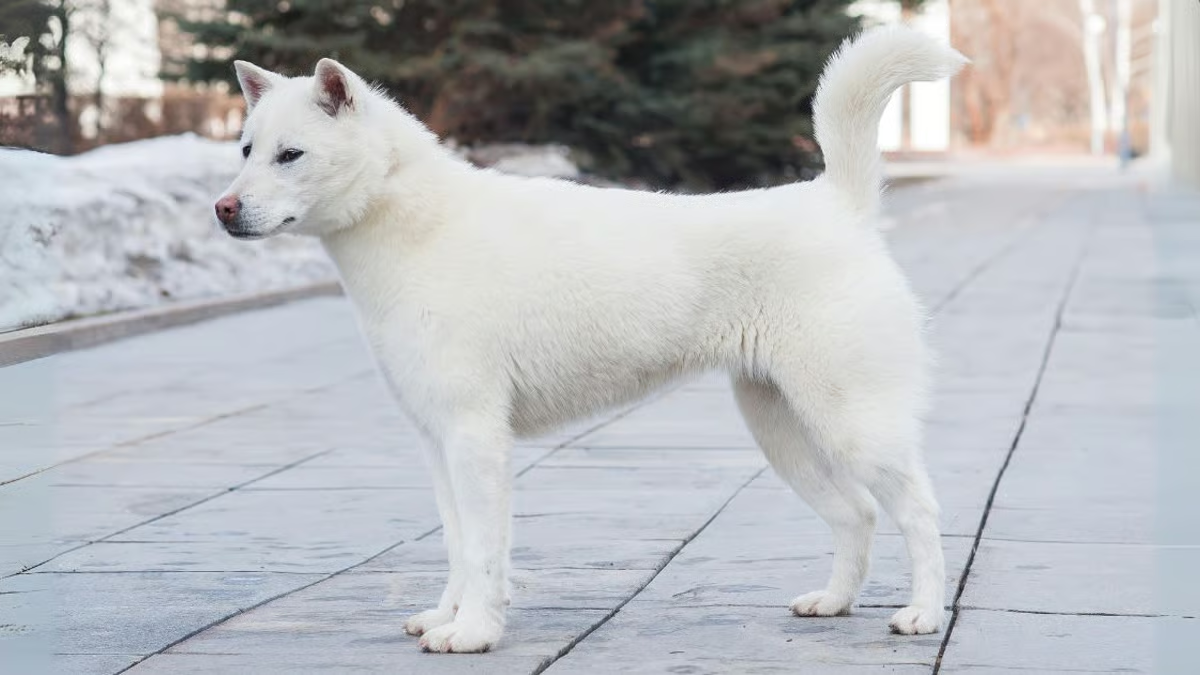
| Height | 46–55 cm |
| Weight | 14–27 kg |
| Lifespan | 11–14 years |
| FCI group | 5 · primitive type |
| Origin | Japan |
Exact ratings
Common health issues
Nutrition
The Kishu Ken or Kishu Inu is the embodiment of the Japanese aesthetic of ‘shibumi’: a restrained beauty that requires no superfluous adornment. These noble Japanese dogs with hunting roots remain largely known only in their homeland, where they are recognised as a national treasure. Thanks to their obedience and high working qualities, they are kept as companions today, although their primal element is hunting large game in the mountains. A representative of this breed is unlikely to make a good friend for an inexperienced owner, as they require a deep understanding of the psychology of primitive breeds. They are ‘one-person dogs’ and usually bond with a single leader rather than the family as a whole, although they respect all ‘pack members’. Learn more on Tvaryny.
Kishu Ken (Kishu Inu): a brief breed overview
| Characteristic | Data |
| Origin | Japan (Wakayama, Mie prefectures) |
| First mention / Standardisation | Ancient times / 1934 (Natural Monument) |
| FCI Classification | Group 5 (Spitz and primitive types), Section 5 (Asian Spitz) |
| Lifespan | 11-15 years |
| Height at withers | Dogs: 52 cm; Bitches: 46 cm (tolerance ±3 cm) |
| Weight | 14-27 kg (depending on sex and build) |
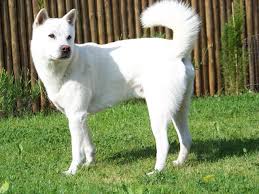
| Main colours | White (most common), red, sesame |
History of the breed: wolf legend and reality
The Kishu Ken belongs to Japan’s oldest breeds and takes its name from the historical Kishu province (now the territory of Wakayama and Mie prefectures). It is a mountainous region with dense forests, where for centuries the unique phenotype of a dog was formed, capable of surviving in harsh conditions and hunting dangerous game.
There is a beautiful Japanese legend about the origin of the Kishu Ken. It tells of a hunter who, finding a wounded wolf, did not kill it but healed it and set it free. After some time, the wolf returned and gifted the rescuer a wolf pup. It was this descendant of the wild predator, according to legend, that became the forefather of all Kishu Inu dogs. This story highlights not only the physical resemblance to the wolf but also the high intelligence and independence of the breed.
The Kai and Shikoku are the closest relatives of these dogs, having developed in parallel in other regions of Japan. Originally, the Kishu had a diverse coat colour, including brindle variations, red, and spotted colours (so-called “spots on a white background”). However, by the mid-20th century, standardisation reduced the diversity primarily to a solid white colour. This occured due to the preferences of hunters: a white dog is easier to spot in the twilight of the forest or in the dark, which helped avoid accidentally shooting the dog instead of the wild boar.
The spotted and brindle dogs of this line have faded into the past, and subsequently, due to the Second World War, other representatives of the breed almost disappeared too. Hunger, epidemics, and the use of dog skins for military clothing brought the Kishu Inu to the brink of extinction. The Japanese authorities intervened in time, recognising them as a “Natural Monument” (National Natural Monument) in 1934. Thanks to this status, the population was saved. Historically, Kishu participated in hunting wild boar and bear; today they sometimes help shepherds or guard farmsteads. Purchasing a puppy outside Japan is still difficult – the annual registration of new puppies in Japan itself is steadily falling, making the breed a rare pearl of the cynological world.
What a Kishu Ken looks like: appearance and anatomy
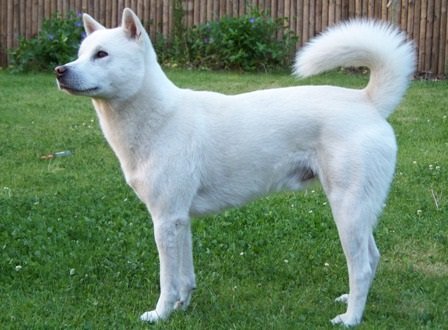
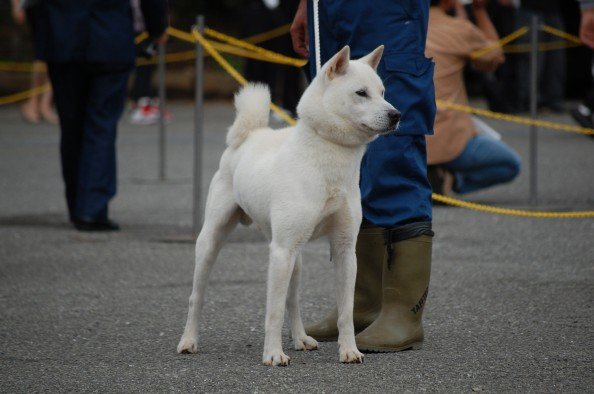
The Kishu Ken is a medium-sized dog of the classic Spitz type. Its appearance radiates strength without heaviness and elegance without fragility. It is a dog with a robust build, well-developed musculature, and a broad, wedge-shaped head.
Head and muzzle
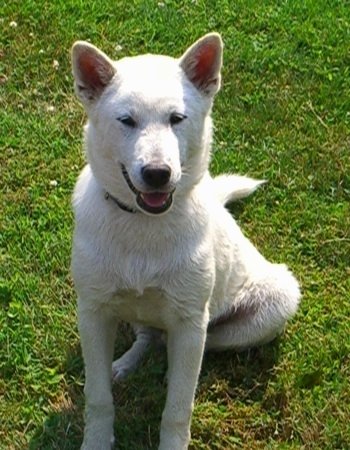
The skull is broad, the forehead flat. The transition from forehead to muzzle (stop) is noticeable but not sharp, rather gentle. The muzzle is wedge-shaped, strong, tapering towards the nose, but not pointed. The Kishu has triangular ears that stand upright and incline slightly forward, giving the dog an attentive expression. The eyes have a specific shape – they are almond-shaped, slightly slanted, and dark brown in colour. The gaze of the Kishu Ken is direct, confident, and somewhat appraising. The nose is predominantly black, but a flesh-coloured shade (the so-called “snow nose”) is permitted in white dogs.
Body and limbs
The neck is thick, muscular, and without dewlap. The back is straight and short, the loins broad. The chest is deep, the ribs moderately sprung. The belly is well tucked up, testifying to its athletic nature. The limbs are straight with heavy bone. The paws are “cat-like”, compact, with thick pads, allowing the dog to move easily on rocky slopes. The tail is set high, thick, curled in a sickle or twisted into a ring over the back.
Coat
Representatives of the breed are well protected by a double coat, which forms longer strands on the tail and cheeks of the dog. The topcoat is straight and harsh; it repels dirt and water. Underneath lies a soft and very dense undercoat, which ensures thermoregulation. The coat colour is the calling card of the modern Kishu. The most common is white, but the standard also recognises red and sesame. It is important to note that the white colour in the Kishu Ken is not albinism, but the result of purposeful selection.
Character: temperament and behaviour of the “silent hunter”
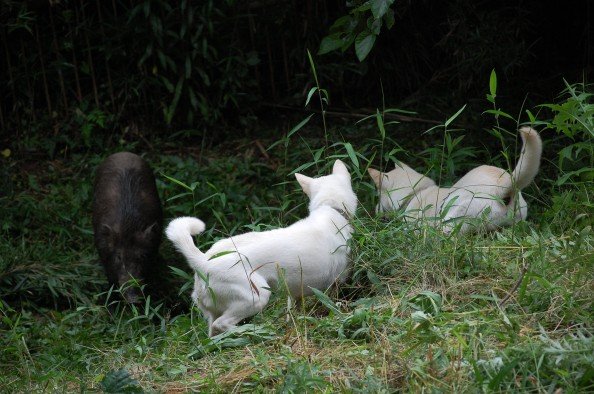
Representatives of this respected Japanese breed are characterised by calmness and composure, which are often confused with indifference. In reality, the Kishu is an observer dog. It does not bark without reason. On the hunt, the Kishu Inu works silently, stalking prey, and gives voice only when the beast is cornered. This trait of “silence” carries over into domestic life – at home, they are very quiet dogs.
- Relationship with the owner: The Kishu Ken tends to choose one master and stay close to them for life. It respects strength of spirit and quiet confidence. Such a dog should not be passed to another owner; this becomes a huge trauma for the animal.
- Attitude towards strangers: The Kishu is distrustful of strangers. It will not rush to hug guests but will rather take up an observer’s position at a distance. The word “aggression” does not apply to it in the context of people, unless there is a direct threat. However, it will not tolerate familiarity from strangers.
- Children and other animals: This is an obedient pet that will coexist peacefully with the family’s children if they respect its personal space. regarding other animals – here it is complicated. The Kishu will be friends with dogs it has grown up with. But small animals (cats, rodents, birds) will always be viewed as prey.
The dog can often be seen in a pensive state; sometimes it seems as if it is meditating. However, it is always ready for action – the Kishu Inu’s reaction time is lightning fast. The friendly character of the Kishu is combined with the courage the dog displays when performing service tasks. This four-legged friend will never pester the owner but will gratefully accept their attention.
The Kishu Ken’s place among other breeds: a comparative analysis
To better understand the uniqueness of the Kishu, it is worth looking at its “relatives”. Many people confuse Japanese breeds with one another.
For example, the Shiba Inu is significantly smaller in size and has a more “kitsch”, independent character, often prone to drama. The Kishu is a workhorse, more serious and less prone to hysterics. On the other hand, the Shikoku (Kochi Ken), sometimes called the Japanese Wolfhound, is more driven and wild in temperament than the balanced Kishu. All three of these breeds are national treasures of Japan, but the Kishu Inu occupies the golden mean – it is larger than the Shiba, but calmer than the Shikoku.
It is also interesting to compare the Kishu with other aboriginal breeds of the world. If the Kishu Inu is a specialised hunter, then the Karst Shepherd demonstrates a completely different type of work – herding and guarding, where interaction is required not with a single leader, but with the flock and territory. Meanwhile, the Carolina Dog (American Dingo) is very close to the Kishu Ken in terms of primitive instincts and the degree of independence from humans, demonstrating a similar survival model.
Health: genetics and risks
Care and maintenance: what the owner needs to know
The Kishu is a tidy dog. They often lick themselves like cats and have practically no specific “doggy” smell. This makes them convenient to keep even in a flat, provided there is sufficient exercise.
How to care for the Kishu Ken’s coat
These pets, capable of adapting to the most difficult conditions, change their coat twice a year. Shedding is a responsible period in the dog’s life when it needs to be brushed frequently (daily). The undercoat comes out in clumps, and if it is not removed, it can cause itching and a greenhouse effect for the skin. In the time between seasonal moults, this can be done once a week with a regular brush or slicker.
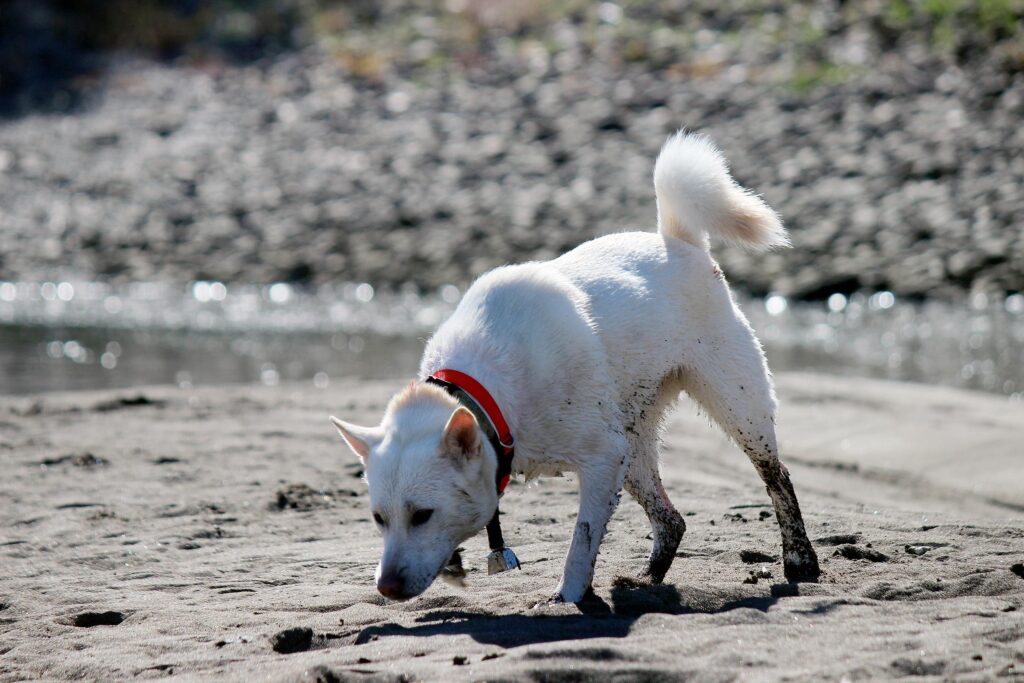
Washing a Kishu Inu frequently is not reccomended – 2-3 times a year or in case of heavy soiling is sufficient. The coat has self-cleaning properties: mud dries and falls off.
Hygienic procedures
If you delay caring for the claws, the owner risks ruining the dog’s posture. The Kishu should have its claws shortened regularly, as they are quite strong and do not always wear down naturally, especially when walking on grass. The hygiene of the dog’s ears requires preventative checks and timely reaction to cracks or scratches obtained during active games in the undergrowth.
Training and socialisation: a battle of intellects
The Kishu Ken belongs to the difficult class of pupils: the path from puppy to obedient helper is both long and complex. Only an experienced trainer or a patient owner who can manage the dog’s stubbornness is capable of walking it. Kishus are very smart, and that is precisely the problem. They will not perform the “sit” command 50 times in a row just because – they must see sense in the actions.
In classes, representatives of the breed strive to take the leader’s place, testing the boundaries of what is permitted. One should not drive the dog from this pedestal with scolding or physical force – this will only lead to a loss of trust and the animal withdrawing. One should persistently and consistently prove human authority to the Kishu through resource control and calm demandingness. Drilling does not work; partnership works.
The dog requires quality early socialisation. The puppy needs to be introduced to different people, city sounds, and transport. Training, hikes in the mountains, active walks, coursing (running after a mechanical hare) – all this will help the Kishu Inu feel good even in urban conditions. Remember, letting a Kishu Ken off the lead in an open area is a risk. The hunting instinct can switch off the dog’s hearing as soon as it sees prey.
Nutrition: the key to longevity
Pros and cons of the breed
| Pros (+) | Cons (-) |
| High intelligence and ability to make independent decisions | Tendency towards dominance and stubbornness |
| Cleanliness, lack of smell, simple hygiene (except shedding) | Heavy shedding twice a year (fur everywhere) |
| Devotion to one owner, reliable protector | Aggression towards small animals (strong hunting instinct) |
| Robust health and stamina | Difficulty in training for novices |
| Quiet dog, almost never barks at home | Distrust of strangers, requires socialisation |
Interesting facts about the Kishu Ken
- Ninja Dog: Kishu Kens can move through the forest absolutely silently, without breaking branches. This is the legacy of centuries of ambush hunting.
- Export rarity: For a long time, exporting Kishu Inus from Japan was practically impossible, as they are considered a national treasure. Even now, the population outside Japan is extremely small.
- Movie star: In Japan, the Kishu Ken is often depicted in manga and anime as a symbol of loyalty and fighting spirit (for example, in the series “Ginga Nagareboshi Gin”).
- Variety of noses: In puppies, noses are often pink but darken with age. However, in winter, the nose may lighten again due to a lack of sun (“winter nose”).
Frequently Asked Questions (FAQ)
Is the Kishu suitable for a flat?
Yes, if you are prepared to dedicate at least 2-3 hours a day to walks. At home, they behave calmly and are inconspicuous, not taking up much space.
Is it difficult to buy a Kishu Inu puppy in the UK?
Yes, it is extremely difficult. Most likely, you will have to look for breeders in mainland Europe or even arrange an import from Japan, which is a lengthy and expensive process.
Do they bark?
Kishu Inus bark extremely rarely. They may give voice to warn of a stranger on the territory or during play, but they do not yap at every rustle.
Video about the breed
- Quiet, clean, “cat-like”
- Devoted to one person
- A hardy hunter
- Robust health overall
- Independent — not for a beginner
- A very strong hunting instinct
- Reserved with strangers
- Needs exercise and occupation
| Shiba Inu | Kai Ken | Hokkaido | |
|---|---|---|---|
| Height | 35–43 cm | 45–56 cm | 46–56 cm |
| Energy | 4 | 4 | 4.5 |
| Apartment | 2.5 | 2.5 | 2 |
| Beginners | 2.5 | 3 | 3 |
How does the Kishu differ from other Japanese breeds?
Does the Kishu get on with cats?
Is the Kishu suitable for a beginner?
FCI Standard No. 318 · The Kennel Club
For apartments · For kids · For beginners · Active · Smartest · Hypoallergenic · All rankings →