

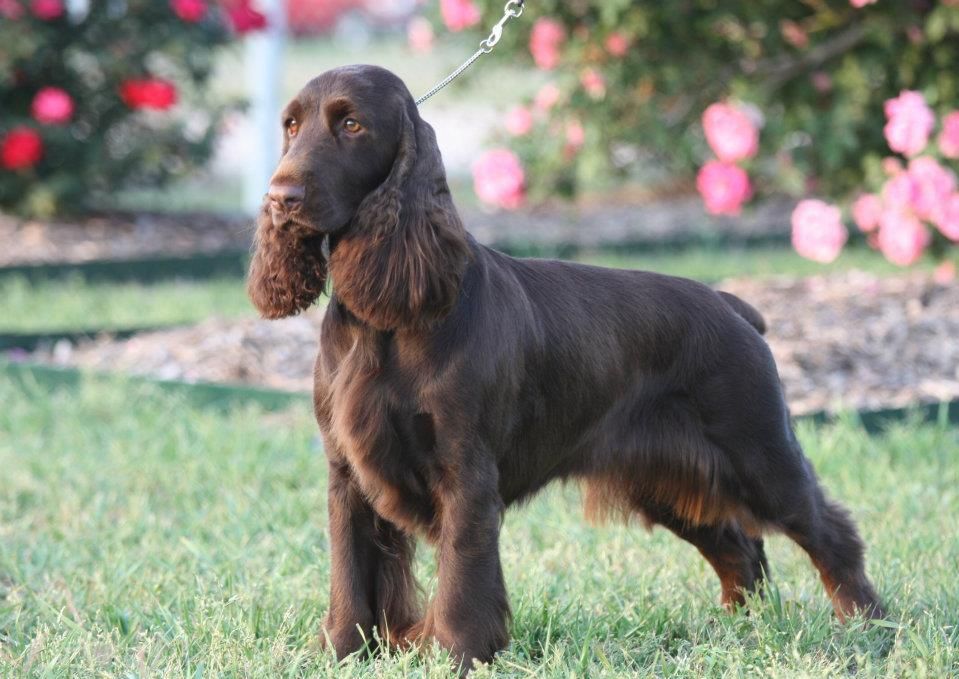
| Height | 43–46 cm |
| Weight | 16–25 kg |
| Lifespan | 12–13 years |
| FCI group | 8 · spaniels |
| Origin | United Kingdom |
Exact ratings
Common health issues
Nutrition
The Field Spaniel is a breed that is impossible to ignore. Elegant, intelligent, and incredibly loyal, it embodies the classic gundog adapted for modern family life. While the Field Spaniel isn’t as common as its close relatives, the Cockers or Springers, it possesses a unique set of qualities that make it a hidden treasure for true connoisseurs.
The Field Spaniel is a rare, versatile gundog, combining the vigour of a field dog with the gentleness of a family companion. Their global numbers are modest (ranking 160th in the 2024 AKC popularity chart), yet dedicated fans prize their balanced temperament, work ethic, and striking appearance. Read more about this over at Tvaryny.
Field Spaniel: A Quick Breed Profile
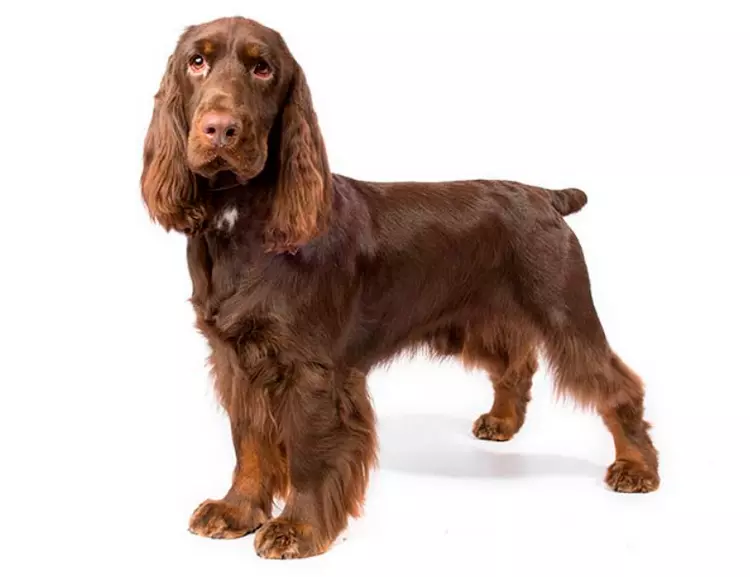
| Metric | Standard | Notes |
|---|---|---|
| Origin | Great Britain | Developed in the late 19th century |
| FCI Classification | Group 8, Section 2 | Flushing Spaniels |
| Height at Withers | 43–46 cm (FCI/KC standard) | US standard (AKC) – 45.7 cm |
| Weight | 18–25 kg | Maintaining working condition is important |
| Life Expectancy | 12–14 years | Average for the breed |
| Rarity | Very High | The breed is on the UK Kennel Club’s list of Vulnerable Native Breeds |
Breed History
The history of the Field Spaniel began in Victorian England, when breeders set an ambitious goal: to create a black solid-coloured spaniel for the show ring. This was a time when “dog shows” were gaining immense popularity, and exterior appearance was often valued above working ability.
The breed was developed from the so-called “Land Spaniels,” which were the ancestors of modern Cockers and Springers. Phineas Bullock is considered one of the founders of the breed, as he started breeding dogs that were heavier and lower than Cockers. To achieve the desired black colour and massiveness, it is rumoured that the blood of… Basset Hounds was introduced. This gave the dogs length of body and heavy bone structure, but it catastrophically affected their working abilities. Early Field Spaniels became so long, low, and heavy that they could barely move in dense thickets. They became a caricature, the “king of failed spaniels” at shows.
Popularity came quickly but faded just as fast. By the early 20th century, the breed was on the brink of extinction. Hunters preferred the lighter, more agile Springers, and show breeders switched to the decorative Cockers. The breed effectively had to be “reinvented.”
The revival began in the mid-20th century. Breed enthusiasts, notably the Field Spaniel Society (founded in 1892), began the difficult work of restoration. They rejected the extreme “show” type and began to introduce the blood of English Springer Spaniels and English Cocker Spaniels to restore the breed’s function, lighten the bone structure, and improve proportions. This step saved the Field Spaniel. The modern type – is the result of these efforts, combining elegance and workability.
Despite all efforts, the Field Spaniel never became a popular breed. It remains rare even in its homeland, the UK, where The Kennel Club placed it on the Vulnerable Native Breeds list. This means fewer than 300 puppies are registered annually. The breed is also scarce in the US. This makes every Field Spaniel a genuine exclusive.
What Does a Field Spaniel Look Like?
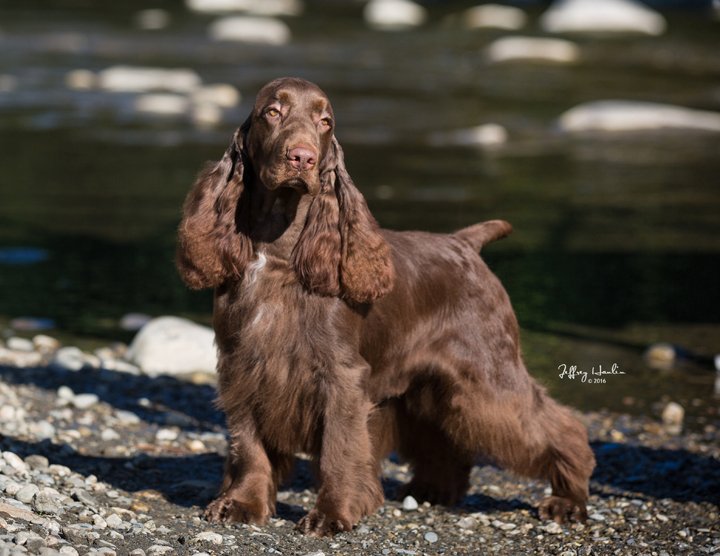
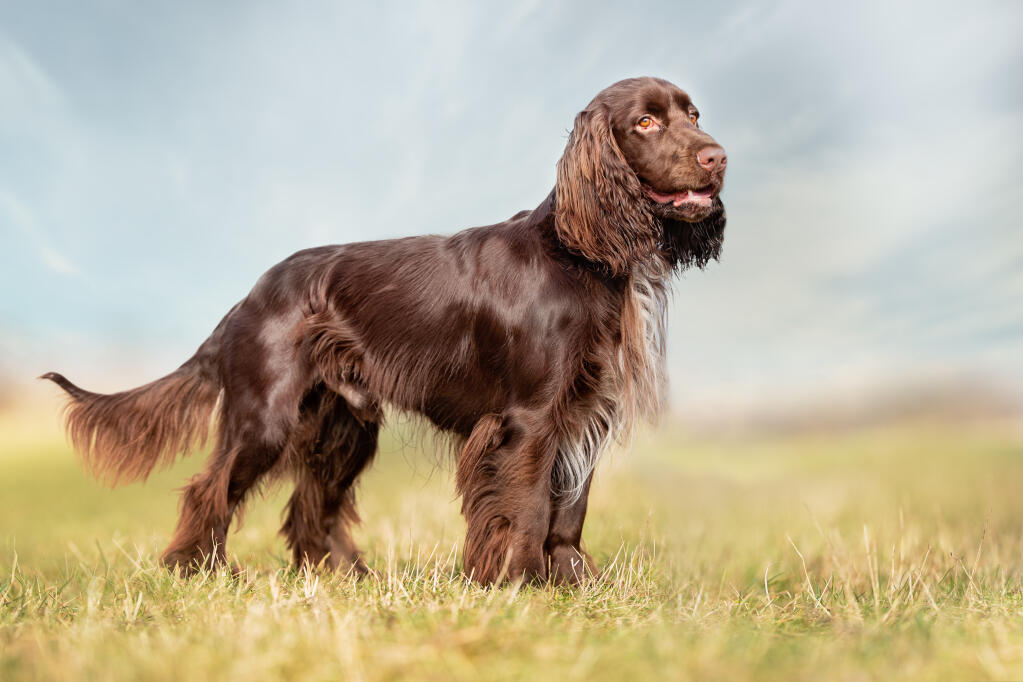
The Field is a dog of noble proportions, medium size, with an elongated body, yet strong and functional. He is longer than he is tall, but should in no way appear squat or over-burdened. He is a balanced athlete.
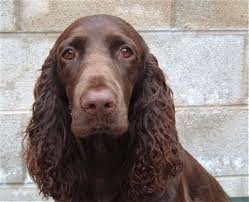
The Head is one of the breed’s distinguishing features. It is long, clean-cut, with defined lines, and not wide in the skull. The “expression” is unique: it is described as serious, soft, and slightly melancholy or “grave”. The eyes are almond-shaped, dark brown or hazel, with an attentive gaze. The ears are set low (at or slightly below eye level), quite long and wide, covered with silky “feathering.”
The Body is moderately long, with a deep chest reaching the elbows and well-developed ribs. The topline is straight and strong. The tail was traditionally docked by a third, but today in most countries, it is left at its natural length. It is set low, never carried above the line of the back, and is in constant cheerful motion when the dog is working.
The Coat is another ornament. It is long, flat, silky, and glossy, without curl. A slight wave is permissible. There are profuse but not excessive frinches (feathering) on the chest, under the body, on the back of the legs, and on the ears. The undercoat is moderate, protecting against bad weather. The colouring is much richer than the first breeders planned: Black, Liver, or Roan (a mix of coloured and white hairs) are seen. Tan points are also possible on these colours. White markings are permitted on the chest and throat but should not dominate.
| Field Spaniel Colour Variations | |
|---|---|
| Solid | Black, Liver (Brown) |
| With Tan Points | Black with Tan, Liver with Tan |
| Roan | Blue Roan, Liver Roan (may include Tan points) |
| Permitted Markings | White or Roan markings on chest, throat |
The Field Spaniel’s movement should be flowing and effortless, with a good reach in the forequarters and powerful drive from the hindquarters. He is a tireless runner, capable of covering great distances.
Temperament and Behaviour
The Field Spaniel’s hallmark is the balance between gentleness and working passion. At home, he is quiet, affectionate, and unobtrusive – a true “velcro dog.” In the countryside, however, he transforms, becoming an active, enduring, and keen hunter.
This is a highly sensitve breed. Fields react acutely to their owner’s mood, tone of voice, and any tension within the family. They absolutely cannot tolerate harsh training methods, shouting, or physical punishment. This causes the dog to “shut down,” become timid, and lose trust. They are famed for their intelligence and capacity for independent decision-making, so training must employ positive motivation, patience, and varied tasks to avoid boredom.
Fields bond deeply with their families, often choosing one “main” person they follow like a shadow. They generally get on well with children, especially if raised together, but their sensitivity makes them better companions for older, calmer children who understand how to handle a dog. They are not suited to kennel life – they need constant human contact.
If you need a shadow dog to accompany you on hikes, runs, or bike rides – the Field is the one. But left alone, he will pine deeply. This breed is prone to separation anxiety. They can exhibit destructive behaviour (barking, howling, chewing things) if left alone for too long. They must be accustomed to short absences from an early age, provided with a safe space (such as a crate) and mental enrichment toys.
As a working spaniel, the Field has a strong “flushing” instinct – raising game (birds) “to the wing” for the hunter. In an urban environment, this means they will keenly chase birds in the park. They also have an excellent nose and love to use it. Socialisation with other pets, especially cats and small domestic animals, must be very early.
- Guard Qualities: Low. They will alert you to a guest with a bark, but are usually very friendly with strangers, though they may be a little reserved initially.
- Energy Level: Medium-High. They need a minimum of 90 minutes of activity daily, which includes both physical and mental exercise.
- Need for Attention: Very High. This is not a breed you can leave alone for 8 hours while you are at work.
- Tendency to Bark: Low. They are not “barky” without reason, but may vocalise out of boredom or anxiety.
Pros and Cons of the Breed
- Pros
- Extremely gentle and loyal nature.
- High intelligence and desire to please (with the right motivation).
- Versatile: excellent gundog, ideal companion, successful in dog sports (Agility, Nosework, Obedience).
- Moderate coat care – 1-2 brushes per week are sufficient.
- Low aggression, gets along well with other dogs.
- Has a natural “off-switch”: active outdoors, but very calm and quiet indoors.
- Handsome, noble appearance.
- Cons
- Very rare breed – difficult to find a puppy, long waiting lists, and high price.
- Strong propensity for separation anxiety (not for people who work long hours away from home).
- High need for daily activity and mental stimulation.
- Prone to ear infections due to drop ears and hip dysplasia.
- Exceptional sensitivity – cannot tolerate harsh training methods or shouting; may become fearful without early socialisation.
- High hunting instinct – may “prey” on cats or birds.
- Requires regular, though not complex, grooming.
Health and Disease
Coat Care and Hygiene
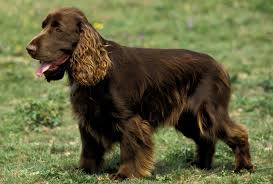
The Field Spaniel’s coat, while luxurious-looking, is surprisingly easy to care for compared to other spaniels. It is moderately long, lies close to the body, with a water-repellent undercoat. It’s enough to brush 1-2 times a week to prevent mats, especially in the areas of feathering – behind the ears, under the elbows, and on the “trousers.” During seasonal shedding (spring/autumn), grooming frequency increases to 3-4 times a week.
Essential grooming tools:
- Slicker Brush: For removing dead undercoat.
- Metal Comb: For checking for tangles, particularly in the fine hair behind the ears.
- Bristle Brush or “Massager”: For final shine and distributing skin oils throughout the coat.
Field Spaniels do not require intensive trimming or clipping like Cockers. Their coat should look natural. However, light “sanitary” grooming is recommended: careful trimming of the hair between the paw pads (to prevent dirt build-up) and around the ear canal (for ventilation). Some owners also lightly thin the hair on the neck and shoulders to emphasise the elegant lines.
Ears – as mentioned, this is a weak spot. After bathing or swimming, always thoroughly dry the ear canal (a special ear powder can be used) and use cleaning lotions once a week. Claws should be trimmed monthly if they do not wear down naturally. Teeth – brush at least 2-3 times a week with veterinary toothpaste to prevent tartar build-up.
Physical Exercise and Activities
The Field requires 90-120 minutes of intense activity daily. This is not a dog that will be satisfied with a 15-minute walk around the block. A bored Field Spaniel – is a destructive Field Spaniel. They need work for the body and the mind.
Best suited activities include:
- Long Walks or Hikes: Especially over varied terrain where the dog can run freely (assuming perfect recall) and use its nose.
- Swimming: Most Fields adore the water. This is an excellent, low-impact exercise for the joints.
- Dog Sports: They excel in Agility, Rally Obedience, and especially “Nose Work” or field trials for spaniels (game retrieval).
- Retrieval Games: The classic game of fetch with a ball or frisbee.
- Running alongside a bicycle (Bikejöring) or Canicross: Only for adult dogs (after 1.5-2 years) when the joints are fully formed.
Equally important is mental stimulation. Field Spaniels are intellectuals. They need problem-solving tasks. Use interactive toys (Kong, dog puzzles), hide food around the house or garden for the dog to find by scent, and teach new tricks. 15 minutes of “nose work” fatigues the dog better than an hour’s run.
| Dog Age | Type of Exercise | Duration, min/day |
|---|---|---|
| 3–6 Months | Search games, basic commands, short walks | 25–30 (multiple times a day) |
| 6–12 Months | Longer walks, swimming, beginning formal training (e.g. Agility) | 45–60 |
| >12-18 Months | Full training, hunting, running | 90–120+ |
Field Spaniel Nutrition
Training and Socialisation
Positive Reinforcement – is the only path to success with the Field Spaniel. As mentioned, they are extremely sensitive. Shouting, leash jerks, or any form of “dominance” will only lead to fear and a loss of trust. They respond wonderfully to clicker training, food motivation (treats), and play motivation.
Early Socialisation is critically important. Due to their sensitivity, a Field Spaniel without proper socialisation can grow up to be timid or overly reserved. During the “socialisation window” (up to 16 weeks), the puppy must be introduced to the maximum number of positive stimuli: different people (in hats, with sticks), loud noises (traffic, fireworks – at a safe distance), various surfaces (grass, tarmac, gravel), and other dogs (only vaccinated and calm ones).
Fields are intelligent, but that doesn’t mean they are easy to train. Their intelligence is combined with a certain “spaniel-like” stubbornness and independence. If they get bored, they will simply “switch off” and go off to pursue their own interests (usually sniffing something out). Training must be short, fun, and varied. They are poor students for monotonous repetition. The right training is the key to a happy life.
Recommended activities:
- Obedience Class: Essential for establishing a good bond and control.
- Nose Work: An ideal sport that unlocks their natural searching instinct and tires the brain immensely.
- Recall Training: The most vital command. Due to their hunting instinct, recall must be 100% reliable before you let the dog off the lead.
- Trick Training: Stimulates thinking and strengthens the bond with the owner.
Interesting Facts About the Field Spaniel
- The breed has been on the verge of extinction three times, the last time – being in the 1950s, when only a handful of litters were registered across the whole of Great Britain.
- In 1909, a Field Spaniel named Dash belonged to the British Prime Minister Herbert Asquith and often accompanied him to meetings with constituents.
- The Field Spaniel was one of the first breeds officially recognised by the American Kennel Club (AKC) in 1884.
- Unlike many other spaniels, Fields do not come in white-and-parti colours. Their coats are always dark – solid or roan.
- Fields are natural swimmers: they have small webbing between their toes that helps them in the water, similar to retrievers.
- In the show rings, they are often judged on a “natural” look. Excessive grooming or clipping that hides the silhouette is discouraged.
Frequently Asked Questions (FAQ)
How much does a Field Spaniel puppy cost?
Due to the breed’s extreme rarity, the price for a puppy from a responsible breeder (with all health tests for the parents) is very high. There are often long waiting lists for puppies. Expect to wait: established breeders have their litters spoken for well in advance.
Is the Field Spaniel suitable for an apartment?
Yes, absolutely. Despite their hunting background, they are very calm and quiet indoors. But this is only possible under one condition: if you are prepared to provide them with a minimum of 1.5-2 hours of intensive activity and mental exercise daily. If the dog is not “exercised out,” he will be unhappy and destructive in any home.
How does the Field Spaniel differ from the English Cocker Spaniel?
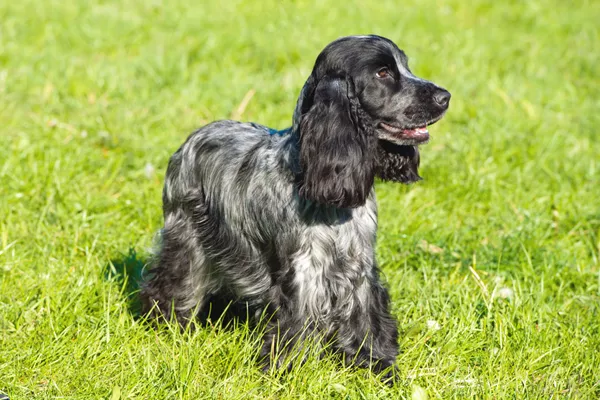
The main differences: size (the Field is significantly larger, heavier, and longer), head (the Field has a longer muzzle and a less pronounced stop, a “graver” expression), temperament (the Field is generally more reserved, calm, and sensitive than the hyperactive working Cockers), and coat colour (Fields do not have white and patched colours).
Do they shed heavily?
Moderately. They have seasonal sheds (spring and autumn), during which more hair will be present. But this is not comparable, for instance, to the shedding of a German Shepherd. Regular brushing (1-2 times a week) keeps shedding under control.
How does he get along with other animals?
They usually get along wonderfully with other dogs. With early socialisation, they also cohabit easily with cats, although they may try to “herd” them. However, small domestic pets (hamsters, guinea pigs) and especially domestic birds pose a high risk. Their hunting instinct may be triggered.
What alternative breeds should be considered?
If you like the type of working spaniel but the Field is impossible to find, look into: the Sussex Spaniel (also rare, but more low-set and “bassy”), the Clumber Spaniel (significantly larger, more massive, and calmer) or the English Springer Spaniel (more common and energetic). Lovers of rare working gundogs may also like the German Spaniel (Deutscher Wachtelhund) (very work-oriented) or the Kooikerhondje (smaller, but also a sensitive spaniel).
Video About the Breed
- Gentle, calm, devoted
- Calmer than the Cocker Spaniel
- Affectionate with its family
- Elegant, silky coat
- A very rare breed
- Reserved with strangers
- Coat and ear care
- Dislikes being alone
| English Cocker Spaniel | Clumber Spaniel | Sussex Spaniel | |
|---|---|---|---|
| Height | 38–43 cm | 43–51 cm | 33–41 cm |
| Energy | 4 | 2.5 | 3 |
| Apartment | 3 | 3 | 3 |
| Beginners | 3.5 | 3.5 | 3.5 |
How does the Field Spaniel differ from the Cocker Spaniel?
Is the Field Spaniel good for a family?
How rare is the Field Spaniel?
FCI Standard No. 123 · The Kennel Club
For apartments · For kids · For beginners · Active · Smartest · Hypoallergenic · All rankings →