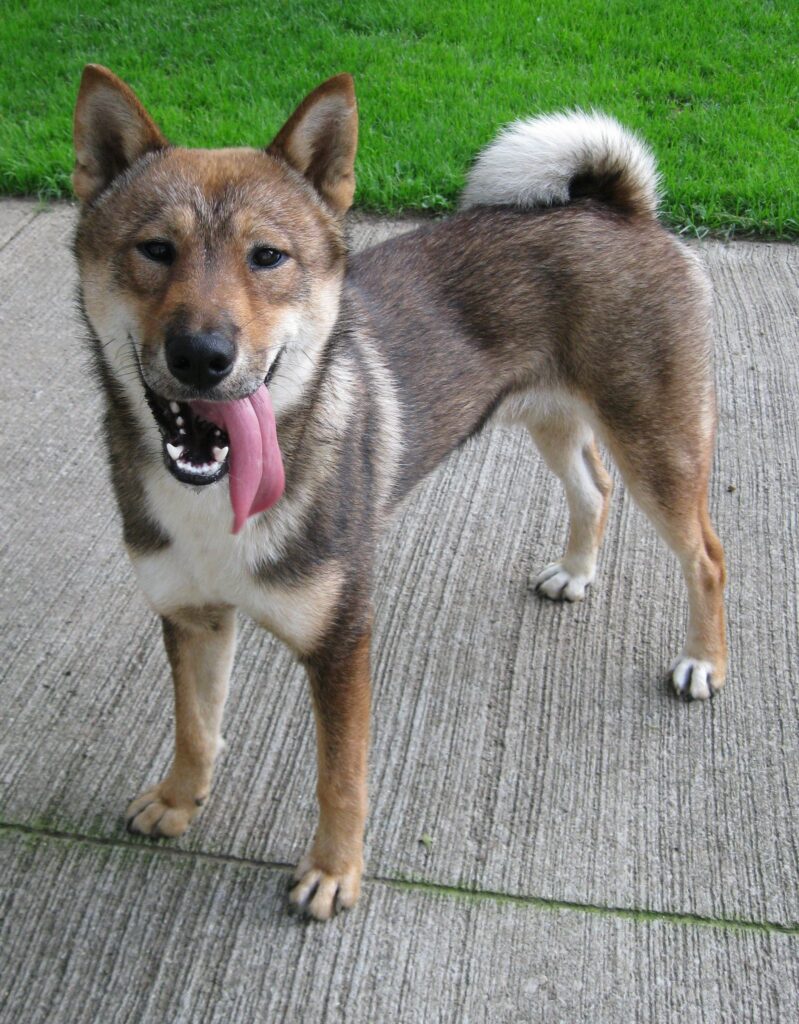
Group 5 (Spitz and primitive types), Section 5 (Asian Spitz) · Japan (Shikoku Island, Kochi Prefecture)
Shikoku
The Japanese "wolf" of the mountains of Kōchi — a samurai spirit in a dog's body: brave, hardy, devoted to its master and independent. The Shikoku is a rare Japanese Spitz boar-hunter, "drier" and wilder-looking than the Akita; it bonds deeply with its person but stays reserved with strangers and needs respect, exercise and calm, firm training.
Apartment · with caveatsKids · with caveatsCats · not suitableOther dogs · with caveatsBeginners · not suitable
The Shikoku (Shikoku Ken / Kochi Ken) is not just a dog, it is a living legend of Japan, the embodiment of the samurai spirit in an animal's body. This affectionate, yet simultaneously independent dog will become a loyal friend and reliable protector for your entire family, provided you can earn its respect. Dogs of this breed have helped people with farm work in the mountainous regions of Kochi Prefecture since ancient times: they procured food by hunting wild boars and transported heavy loads. To this day, they remain excellent helpers and faithful companions, although meeting them outside Japan is a great rarity. Find out more on Tvaryny.
Shikoku: a brief breed overview
Shikoku: a brief breed overview · 7
Origin
Japan (Shikoku Island, Kochi Prefecture)
Other names
Shikoku Ken, Kochi Ken, Mikawa Inu, Japanese Wolfdog
Year of first mention / FCI Standard
Ancient times / 1936 (recognised as a living natural monument)
FCI Group
Group 5 (Spitz and primitive types), Section 5 (Asian Spitz)
Lifespan
11–13 years (sometimes up to 15)
Height at withers
Males: 49–55 cm; Females: 46–52 cm
Weight
15–25 kg (depending on sex and build)
Comparison with other breeds
People often confuse Japanese dogs with each other. Let's sort out how the Shikoku differs from its "relatives".
The Akita is significantly larger, heavier, and calmer. The Shikoku is more reactive, athletic, and resembles a wolf, whereas the Akita resembles a bear.
Although visually (due to prick ears and tail) they may resemble each other, the Bangkaew originates from Thailand, has longer fur ("ruff"), and a different temperament.
Interesting facts about Shikoku
In the film "Wolf's Rain" (anime), the prototype for the wolves was the Shikoku breed, due to their striking resemblance.
In Japan, there is an expression: "Samurai among dogs". This is often attributed to the Akita, but true connoisseurs know that in spirit, this fits the Shikoku best due to their stoicism.
Unlike the Shiba Inu, which "smiles", the Shikoku's facial expression is more severe and wild.
This is one of the few breeds that has preserved the ability to hunt wild boar alone, holding the beast in place until the hunter arrives.
History of the breed
Shikoku is one of the Japanese islands, considered one of the most beautiful and wild in terms of nature. This island is famous for its magnificent landscapes of rivers, mountains, and dense forests, as well as an abundance of castles and sacred temples. Numerous farmlands are located here, and the coast is lined with fishing villages. It was here, in isolated mountain regions, that these magnificent dogs were formed several centuries ago. Local inhabitants (Matagi - traditional hunters) began using them to hunt large game, primarily wild boar, as well as to guard their homes.
Historically, due to the inaccessibility of the terrain, the breed developed in purity, without the admixture of blood from other dogs. Breeding of these dogs took place in various districts of Kochi Prefecture, such as Awa, Hata, and Hongawa. This led to the emergence of different breed lines:
Hongawa Line: Considered the purest and wildest. These dogs lived in the most remote mountain regions, thus retaining the most "wolf-like" appearance and light body structure.
Hata Line: More massive dogs with broad skulls, which likely had a minor influence from other breeds in the past.
Awa Line: Currently, this line has practically disappeared or dissolved into the others.
The breed recieved its modern name, Shikoku, only in 1937, when it was officially recognised as a "Living Natural Monument" and a national treasure of Japan. Before this, they were often called "Tosa-ken", which created confusion with the fighting breed Tosa Inu. Interestingly, many cynologists consider the Shikoku a direct descendant of the extinct Japanese wolves due to their phenomenal physical resemblance, although genetically, it is still a dog.
What a Shikoku looks like: standards and appearance description
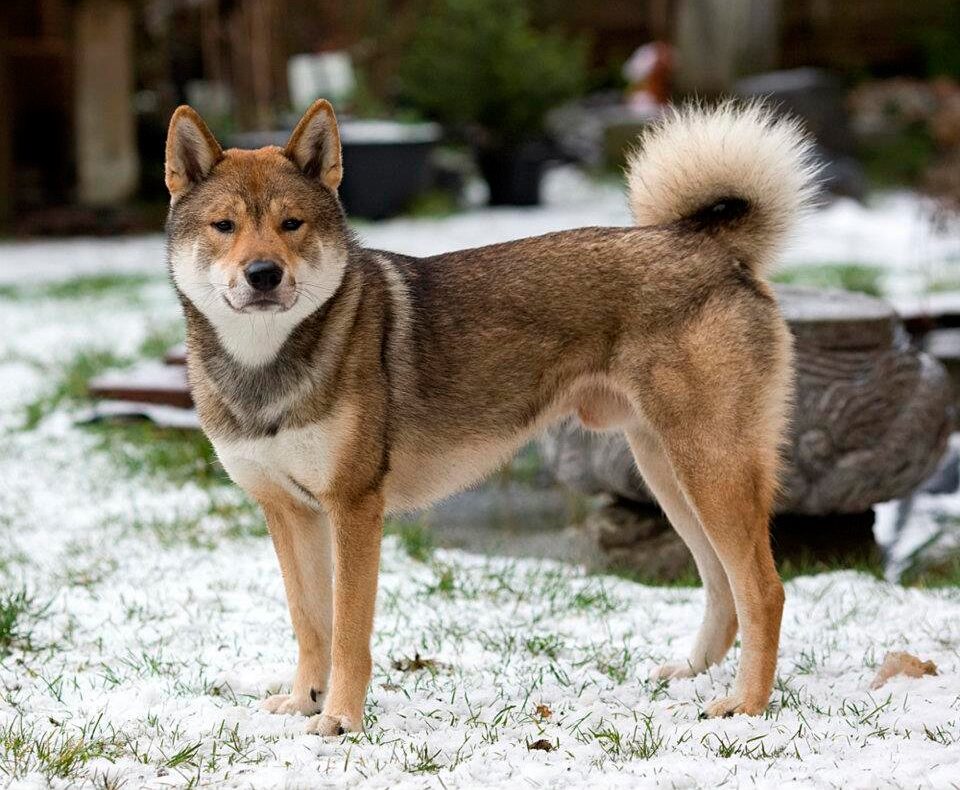
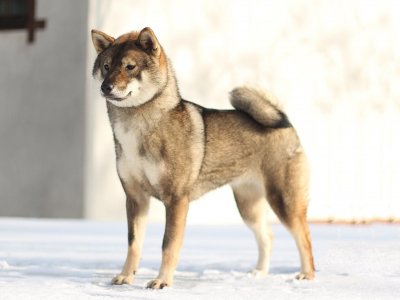
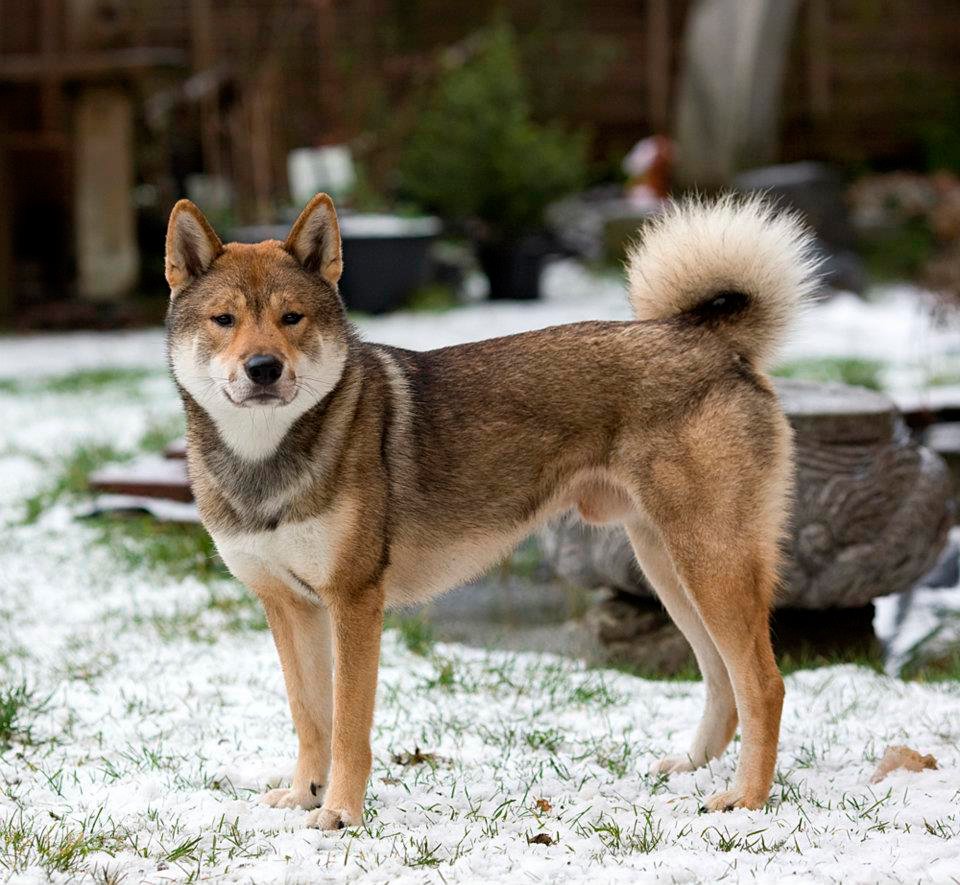
The Shikoku is a compact, medium-sized dog, well-proportioned, with strong bone structure and well-developed muscles. Unlike Western breeds, the beauty of the Shikoku is a functional beauty. They have nothing superfluous; everything is adapted for fast running through the mountains and clashes with predators.
Head and Muzzle
The head is quite large, corresponding to the body. The skull is broad, the forehead flat. The transition from forehead to muzzle (stop) is shallow but noticeable. The muzzle tapers slightly towards the nose, wedge-shaped. The nasal bridge is straight, which is an important breed characteristic. The nose is always black. The lips are tight-fitting, not drooping. The eyes are small, almond-shaped or triangular, set well apart, dark brown in colour. The gaze has a specific oriental expression - attentive, slightly wary, and penetrating.
Body and Limbs
The ears are pricked, small, triangular, with pointed tips, slightly inclined forward, giving the dog a focused look. The neck is strong, thick, without a dewlap. The back is straight, broad, and strong. The withers are well-developed and high. The loin is broad and muscular. The chest is deep (reaching the elbows), broad, with well-sprung ribs for large lung capacity. The belly is well tucked up, creating an elegant silhouette.
The limbs are straight, parallel to each other, strong, and muscular. The angles of the joints are moderate, allowing the dog to move with an economical trot. The paws are strong, "cat-like", with tightly closed toes; the pads are dense and elastic, claws are dark (sometimes black). The tail is set high, thick, carried over the back, curled in a ring or sickle-shaped (the latter is rarer but acceptable).
Coat and Colour
The coat is double: the outer coat is harsh and straight, the undercoat is soft and very dense. On the tail, the hair is longer, forming a "brush". The main feature of the breed is the "sesame" colour. This is an even mixture of white, red, and black hairs. There are three variations:
Sesame: An even mixture of black and white hairs with a reddish tint.
Black Sesame: A predominance of black hairs over white. Looks the darkest.
Red Sesame: The basic background is red, mixed with black hairs.
Mandatory is the presence of "urajiro" - whitish markings on the sides of the muzzle, cheeks, under the lower jaw, neck, chest, belly, on the underside of the tail, and the inside of the legs.
Character: temperament and true essence
If you are looking for a dog that will love the whole world and joyfully jump on every passerby, the Shikoku is not your choice. These Japanese dogs have a complex, "primitive" (in the cynological sense) character. They are very energetic, active, but at the same time reserved. They become strongly attached to their owner and remain loyal and devoted companions throughout their lives, but this devotion is not clingy.
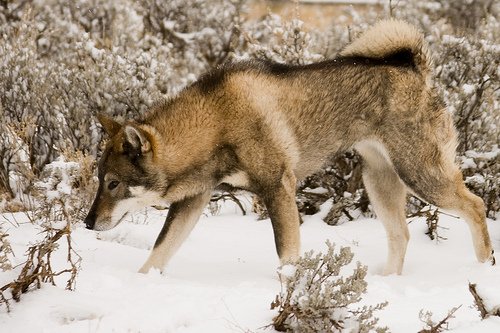
Shikokus are selflessly ready to fulfill all instructions of their owners; they are not afraid of bad weather or difficult paths - these dogs are some of the most enduring in the world. A key trait is a high hunting instinct. They react to movement instantly. On a walk in the forest, the Shikoku transforms: its nose constantly scans the air, and its ears catch every rustle.
Shikokus are friendly with their family but often indifferent or wary of strangers. They do not show aggression without reason, but they won't let just anyone stroke them either. In interaction with other animals, there are nuances: they might get along with cats they grew up with, but a stray cat or squirrel will be percieved exclusively as prey.
Important: Shikokus are prone to dominance and same-sex aggression. Two male Shikokus on one territory is almost a guaranteed conflict.
Training and Socialisation
Shikokus are very intelligent dogs, but their intellect differs from that of a shepherd. They are prone to independent decision-making, which was vitally necessary during hunting but creates problems in everyday life. Representatives of this breed are trainable but require patience and a partnership approach.
So-called socialisation is very important for a puppy; it is needed so that your pet grows up confident: not afraid of strangers and other dogs, calmly perceiving various sounds and unfamiliar objects. You must introduce the puppy to the surrounding world from the first days of its arrival. It is especially important to take the puppy to the forest from childhood if you plan to hunt with him in the future.
Tips on upbringing:
Be the leader: From the first days, make it clear that you are the head of your pack. Do not allow the puppy to lie in your place, do not feed him first, and also do not allow him to pass through doors first.
Games: During tug-of-war games, do not let the puppy win constantly (dogs compete for supremacy amongst themselves in this way).
No violence: Never physically punish your pet. These are proud dogs; physical punishment will destroy trust forever. A raised tone or ignoring will be enough.
Shikokus are excellent hunters: enduring, fast, with a superb sense of smell. If you are not a hunter, your Shikoku will gladly engage in coursing (chasing a mechanical lure) or agility.
Pros and Cons of the breed
Pros (+)
Cons (-)
Exotic, beautiful appearance
Sheds heavily twice a year
Robust health and longevity
Not suitable for novices
Loyalty and guarding qualities
Tendency to escape and roam
Cleanliness (almost no smell)
Aggression towards other dogs (especially same sex)
Quiet at home (barks little without cause)
High hunting instinct (danger to cats)
Care and Maintenance
The main thing all dogs of this breed need is regular physical exercise and long walks. Shikokus are full of strength and energy; you need to walk a lot with them. Every day, these dogs need to cover at least five kilometres, and it is desirable that part of the route passes through rough terrain. They will gladly keep you company during sports activities; for example, it is a pleasure to run with them in the morning.
Life in a flat or a house?
Of course, these dogs will live better outside the city, in a private house with a well-fenced area (the fence must be high and dug into the ground, as they are prone to digging and jumping), where nature and space will surround them. However, if you are a traveller or simply a very active person, you can live with such a dog in a flat. The main thing is not to leave him alone for a long time in a confined space without "work" for the brain, otherwise the flat might be destroyed.
Hygiene
Otherwise, Shikokus are not fussy at all. They are very simple to look after. Their coat does not need cutting, stripping, or other similar procedures; it is enough to brush it once a week, and during the shedding period (twice a year) - daily with a slicker brush.
Bathing: Their coat hardly gets dirty and does not have a specific "doggy" smell, so frequent bathing of the Shikoku is not necessary (2–3 times a year is enough).
Claws: Trim the claws every month if they do not wear down naturally on the asphalt.
Ears and Eyes: Regularly inspect for dirt.
Nutrition
Nutrition: key recommendations
Health and risks
Health: typical diseases and prevention
Frequently Asked Questions (FAQ) · 3
Is the Shikoku suitable for a family with children?
Yes, but with reservations. Shikokus are loyal to "their" children, but they do not tolerate familiarity and roughness. A child must understand that a dog is not a toy. Adult supervision is always needed.
Is it hard to buy a Shikoku puppy in the UK?
Yes, this is a very rare breed. Most likely, you will have to join a waiting list at breeders abroad (often in Europe or Japan itself) and wait for a puppy for quite a long time.
Can they be let off the lead?
Only in a fenced area. In a forest or park, if a Shikoku sees prey, it may stop hearing commands. Their hunting passion is stronger than obedience.
Video about the breed
FAQ
How does the Shikoku differ from the Akita and Shiba Inu?
It is a medium-sized Japanese Spitz — larger than the Shiba Inu but lighter and "drier" than the Akita, with a more pronounced "wolfish" look; historically a specialised boar-hunter.
Is the Shikoku suitable for a novice?
No — it is an independent, stubborn primitive dog with a strong hunting instinct; it takes experience, early socialisation and calm, firm training.
Does the Shikoku get on with cats?
Usually poorly — its pronounced hunting instinct makes living with cats and small animals risky.