Group 5 (Spitz and primitive types), Section 5 (Asian Spitz) · Japan
Kai Ken (Tiger Dog)
The Japanese "tiger dog" from the mountains of Kai: devoted, clever and agile. The Kai Ken is a rare native spitz with its signature tiger-brindle coat; a natural monument of Japan, it is a family-devoted hunter, a little more sociable than other Japanese breeds.
Apartment · with caveatsKidsCats · with caveatsOther dogs · with caveatsBeginners · with caveats
The Kai Ken, also known as the Tiger Dog (Tora Inu), is not merely a dog; it is the living embodiment of the spirit of ancient Japan, a national treasure of the Land of the Rising Sun, and a true legend among cynologists. Dogs of this breed are exceptionally brave, strong-willed, hardworking, and possess an inteligence that can sometimes be startling in its depth. They are well-suited to individuals with a strong and independent character who value loyalty, discretion, and devotion above all else. These "tigers" do not strive to please everyone; they are extremely mistrustful of their surroundings and never waste time on trivialities. The only person lucky enough to see a Kai Ken representative playful, cheerful, and friendly is their owner. These dogs are an ideal match for active people involved in hunting or hiking who need a reliable guardian and a best friend. Read more on Tvaryny.
Kai Ken (Tiger Dog): A brief breed overview
Kai Ken (Tiger Dog): A brief breed overview · 6
Country of Origin:
Japan (Yamanashi Prefecture)
First Mentioned:
18th Century (Officially recognised in 1934)
FCI Group:
Group 5 (Spitz and primitive types), Section 5 (Asian Spitz)
Life Expectancy:
12–15 years
Height at withers:
45–56 cm
Weight:
14–25 kg
Interesting facts about the breed
The tree-climbing dog: Kai Kens are known for their unique ability to climb trees and steep slopes in pursuit of prey. Their claws and paw structure allow them to do this better than any other Japanese breed.
Movie star: Many people learned about this breed thanks to the popular Japanese anime and manga "Ginga Nagareboshi Gin", where the Kai Ken brothers (Kurotora, Chutora, and Akatora) were among the main characters.
Natural camouflage: The brindle colouration serves as perfect camouflage in the mountain forests of Japan, where light and shadow intertwine amidst bamboo and trees.
History of the breed
Dogs of this breed are rare, even in their homeland. The history of the Kai Ken is shrouded in legend and is closely intertwined with the geography of Japan. They formed as a distinct breed in the Kai district (modern-day Yamanashi Prefecture), a region surrounded by moutains. It was this geographical isolation that played a key role in preserving the purity of their bloodline. For centuries, these dogs were used for hunting in mountainous, forested terrain. They are incredibly enduring and strong, capable of pursuing prey where humans can barely walk. Local hunters highly valued them for their ability to work on boar, deer, and even bear.
Due to their outstanding hunting qualities and natural reclusiveness, they were considered semi-wild for a long time. There is a belief that Kai Kens have a mixture of wolf blood, which explains their phenomenal caution and lightning-fast reactions. Local residents sometimes thought they were too aggressive or too independent to live among people as ordinary domestic pets.
The turning point came in the 20th century. In 1934, the Kai Ken breed was designated a National Natural Monument of Japan. This high title is granted only to breeds considered an integral part of Japanese culture and history (Nihon-ken). However, this did not lead to mass popularity - the Kai Ken remained a dog for the chosen few. In the post-war period, the number of dogs dropped significantly due to the difficult economic situation and disease. It was only thanks to the efforts of enthusiasts, particularly Haruo Isogai, who studied all local breeds, that these unique animals did not vanish from the face of the earth.
Today, the Kai Ken remains a rarity. Despite strict rules in Japan regarding the export of dogs that are national treasures, representatives of the Kai Ken breed have managed to reach the USA, Canada, and several European countries, where they have found ardent admirers. Interestingly, the Kai Ken is genetically closer to the Hokkaido (Ainu) than to other Japanese breeds, indicating their ancient and primitive roots.
What does the Kai Ken (Tiger Dog) look like: appearance description
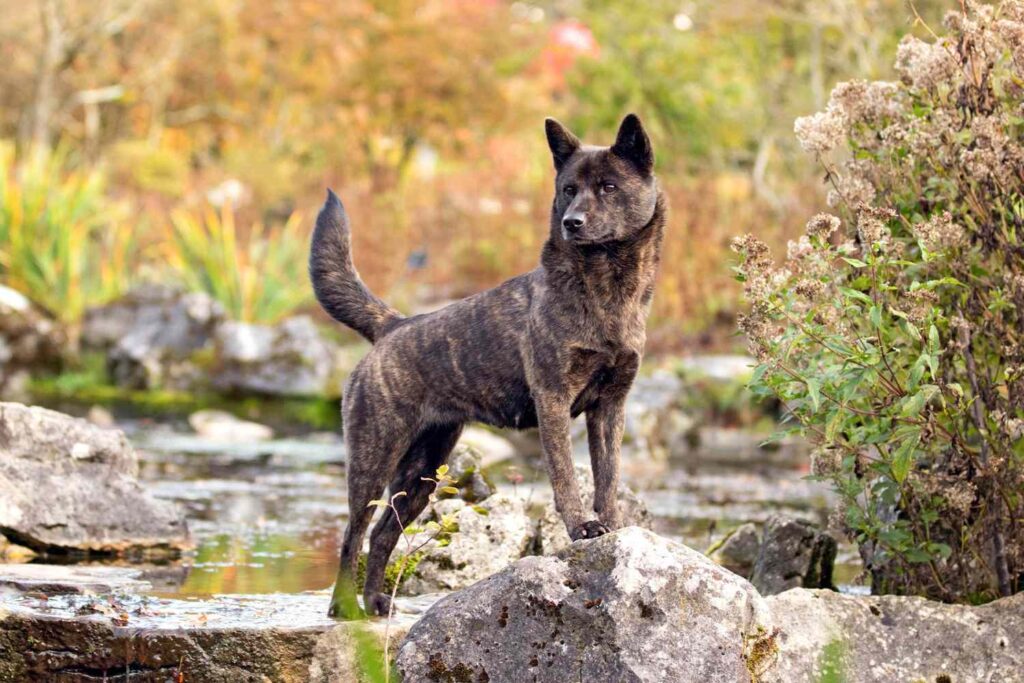
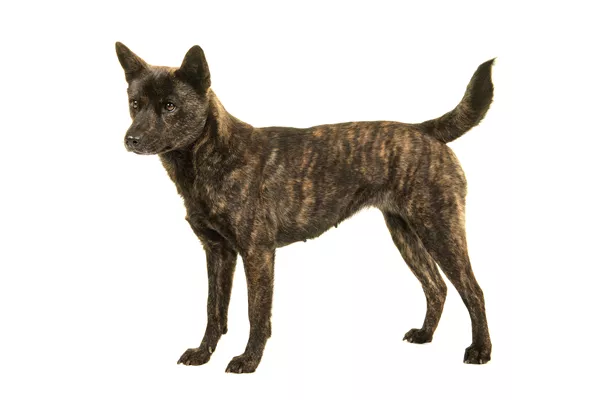
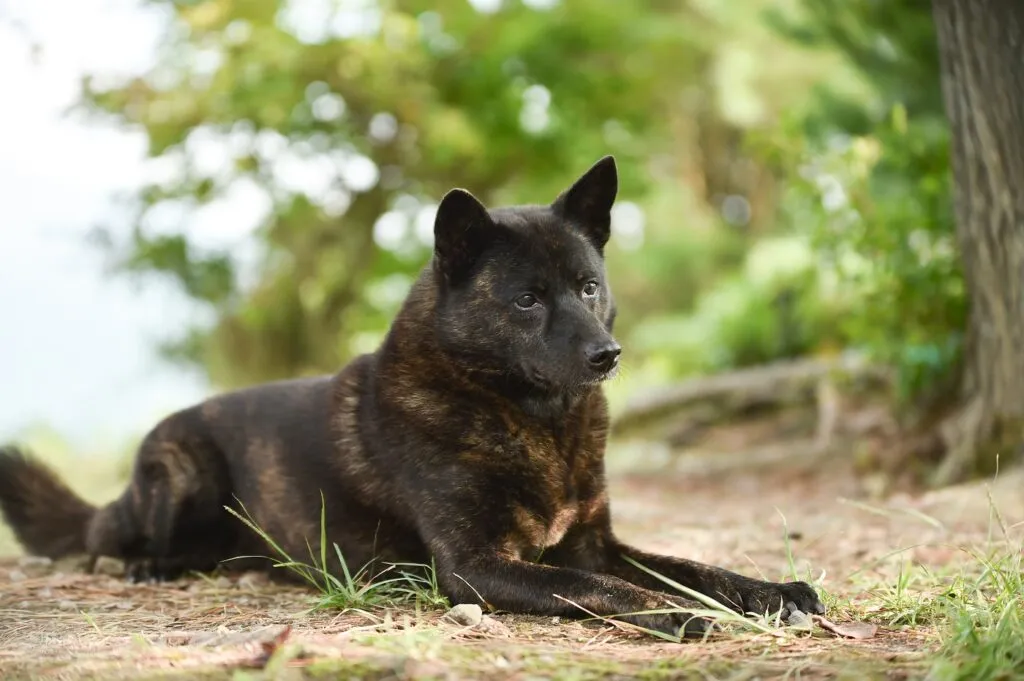
The Kai Ken is a medium-sized dog with a sturdy and proportional build, featuring well-developed musculature that does not appear coarse. This is an athlete built for running across rough terrain. At first glance, the Kai Ken gives an impression of wild, natural power.
Head: Quite large with a broad skull, wedge-shaped. The transition from forehead to muzzle (stop) is well-defined but not abrupt.
Muzzle: Medium length, moderately voluminous, not pointed. Lips fit tightly and often have dark pigmentation. The jaws are very strong with a scissor bite. Incidentally, unlike the Chow Chow, the Kai Ken's tongue is usually pink, although spots are sometimes found (which is permissible for many Asian breeds).
Eyes: Small in size, triangular in shape (a characteristic feature of Japanese breeds), dark brown in colour. The gaze is vigilant, piercing, and intelligent.
Ears: Prick ears, medium-sized, triangular, leaning slightly forward, which gives the dog an attentive expression.
Body: Neck is of medium length, strong and muscular. The back is short and straight. The loin is broad. The chest is deep, of moderate width, with moderately sprung ribs. The belly is well tucked up, highlighting the athletic physique.
Tail: High set, thick at the base. Usually curled in a ring or sickle-shaped, carried over the back.
Limbs: Straight, strong, and muscular. Hocks are tough and elastic. Paws are sturdy with tightly closed toes ("cat foot"), thick pads, and strong dark claws. This allows the dog to move easily over rocks.
Unique Brindle Colouration
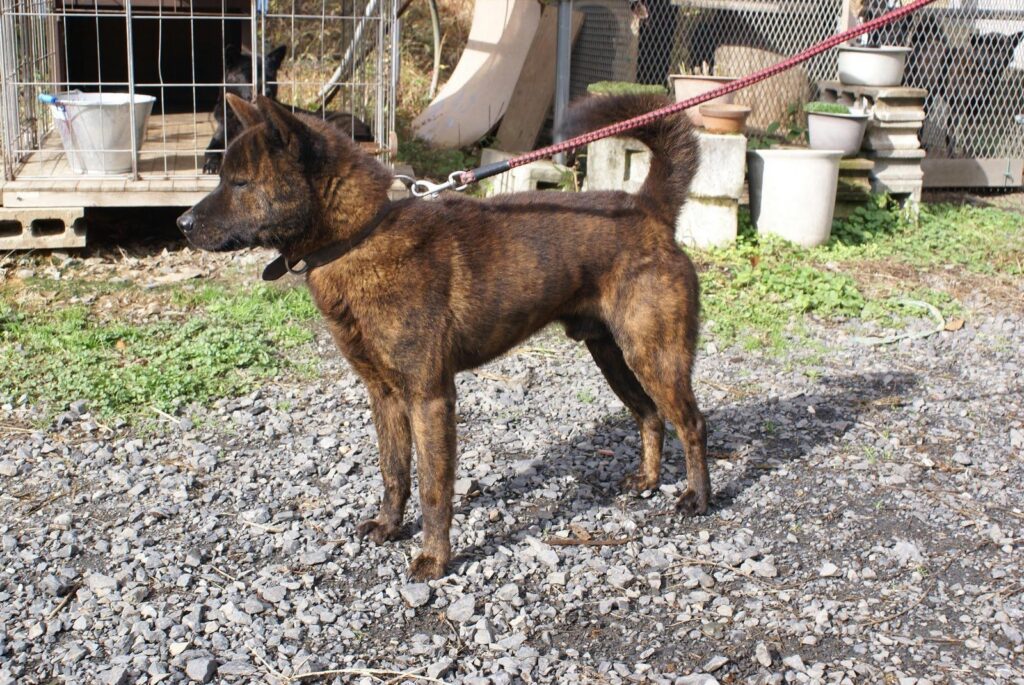
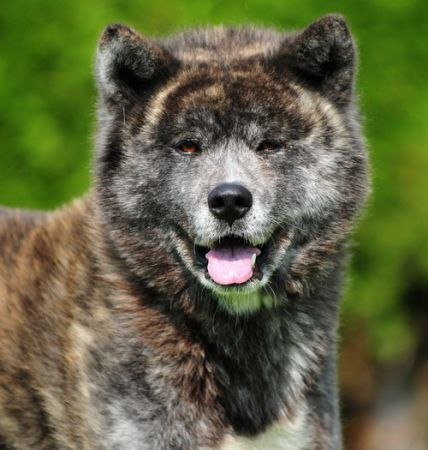
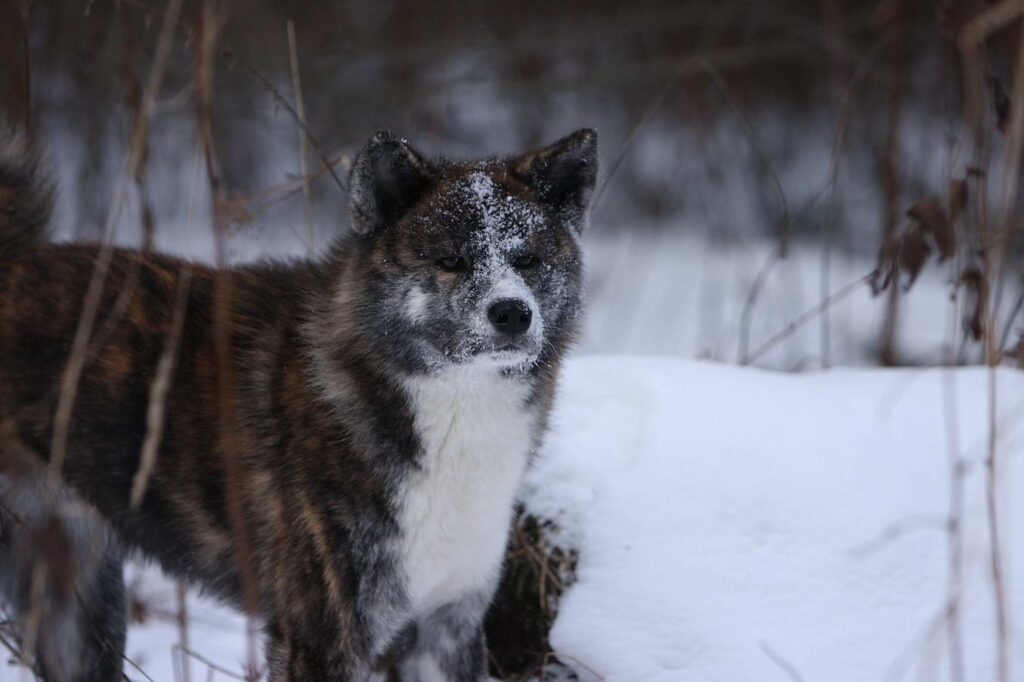
The breed's main calling card is its coat. It is harsh, straight, and stands off the body, with a dense and soft undercoat that protects against cold and wind. But the most interesting aspect is the colour. The Kai Ken is called "Tora Inu" (Tiger Dog) precisely becuase of this.
There are three main types of brindle colouration:
Colour Type (Jap.)
Description
Features
Kuro-tora
Black Brindle
Black background with less noticeable reddish stripes. The darkest variant.
Chu-tora
Medium Brindle
Classic balance between black and red. The stripes are clearly defined.
Aka-tora
Red Brindle
Red background with black stripes. The rarest and a very valuable variety.
Important Fact: Kai Ken puppies are often born a solid black or dark colour. The famous tiger stripes appear with age, and the final pattern may only fully form by the time the dog is 3–5 years old. This makes raising a Kai Ken a fascinating process - you never know exactly which "tiger" will grow up in your home.
Character: temperament and behaviour
Dogs of this breed love freedom and independence; they are fearless, fast, and agile. However, the defining trait of the Kai Ken character is the concept of the "one-person dog". They do not trust anyone except their owner, to whom they are endlessly loyal and devoted. In Japan, this behaviour is described by the term "ichidai ippu" (one life - one master).
They are similar to wolves: within their circle of close people, they are gentle and affectionate, allowing themselves to be stroked, but outside of it, they are wary, watching every movement of a stranger. The Kai Ken will not bark without reason; he is a silent guardian. But if the situation demands action, the reaction will be instantaneous. They can sometimes show aggression, especially if there is a threat to a loved one or if the territorial integrity of their domain is violated.
Unlike the larger and more phlegmatic Akita Inu, the Kai Ken is more reactive and mobile. These dogs are purposeful and tireless in their work; they are smart and quick-witted. Their intellect is specific: they are not servants, but partners. A Kai Ken can make independent decisions during a hunt, which makes him difficult for a novice to manage. Kai Ken dogs are true, reliable friends who will never leave you in trouble and are always ready to accompany their master to the ends of the earth, overcoming any obstacles.
Pros and Cons of the breed
Before getting this Japanese "tiger", it is worth weighing all the pros and cons, as the breed is specific and will certainly not suit everyone.
Pros:
Devotion: Incredible attachment to the family.
Cleanliness: They are very clean, quickly house-trained, and have almost no specific "doggy" smell.
Health: One of the healthiest breeds without significant genetic defects.
Guarding qualities: Innate instinct to protect territory.
Uniqueness: You will be the owner of an exclusive dog with an amazing coat colour.
Cons:
Independence: Can be stubborn, requiring an experienced approach in training.
Moulting: Heavy seasonal shedding twice a year.
Need for activity: This is not a sofa dog; it needs movement.
Socialisation: Without early socialisation, they can become overly fearful or aggressive towards strangers.
Hunting instinct: May run off after prey (cats, squirrels); they walk poorly off-lead.
Training and socialisation
Dogs of this breed live by pack laws, which you must know and adhere to accordingly once such a dog appears in your home. This is a primitive breed, and its logic differs from that of service dogs. You need to train the puppy from the first days of its arrival in your home. The main thing is to be patient and persistent, but not cruel.
Your task is to show the puppy who is boss in the house and never deviate from your principles. For example, if you have given a command, you must absolutely ensure it is carried out. If the dog fails to execute a command once and you do not insist on the task being completed, he will decide that the requirements are not mandatory and will simply ignore you next time.
To help the dog understand what is required of him more easily, reward him with treats and games when a command is performed correctly. Kai Kens are very food-motivated; they love to eat, and this is the key to their heart. To consolidate your leadership position (not through violence, but through resource control), you need to familiarise yourself with some rules:
You control the start and end of the game.
You eat first (psychologically), and then you feed the dog.
The dog must perform a simple command (for example, "sit") before receiving a bowl of food or going for a walk.
Socialisation is even more important for the Kai Ken than for the Shikoku. Introduce the puppy to different people, traffic sounds, and other dogs. If this is not done, natural distrust will develop into fear or aggression. Remember, you cannot physically punish a Kai Ken - this will destroy trust forever, and instead of a friend, you will get an enemy in your own home.
Coat care and maintenance
Kai Kens are capable of adapting to any climatic conditions. They can also live in both rural and urban areas. Naturally, a private house with a large garden, securely enclosed by a high fence, as well as surrounding forests and fields, would be preferable for a Kai Ken to live in. Why a high fence? Because Kai Kens are known for their ability to climb!
However, they will not do badly in urban conditions either, provided the owner of such a dog can ensure their pet gets regular physical exercise and engages in active sports with them, such as frisbee, agility, and coursing. Note that these dogs need not only physical but also intellectual occupation. A bored Kai Ken is a destroyer of apartments.
Caring for a Kai Ken is not difficult, but it is important to do it regularly:
Coat: You can brush them just a few times a week with a metal comb or brush. During seasonal moulting (in spring and autumn), you will have to brush daily to remove the dead undercoat.
Bathing: You should only bathe a Kai Ken when necessary, if he has become very dirty. Their coat has self-cleaning abilities. Frequent washing can strip away the protective oily layer.
Hygiene: Pay special attention to the cleanliness of your pet's eyes and ears. The Kai Ken's claws need to be trimmed monthly, unless, of course, they have worn down naturally enough on asphalt or hard ground. Long claws can deform the paw.
Teeth: Brushing teeth 2–3 times a week will prevent the formation of tartar, which older dogs are prone to.
Nutrition
Nutrition: key recommendations
Health and risks
Health: typical diseases and prevention
Frequently Asked Questions (FAQ) · 3
Is the Kai Ken suitable for an apartment?
Yes, if you are prepared to walk him for at least 2 hours a day with active games. At home, they are calm and tidy.
Do these dogs bark?
They are not "yappers". The Kai Ken barks only when necessary, warning of strangers. But they can make interesting "grumbling" sounds when communicating with their owner.
Is it hard to buy a Kai Ken puppy?
Yes, it is difficult. The breed is rare even in Japan. The waiting list for puppies from good breeders in Europe or the USA can stretch for a year or two. Beware of scammers selling mixed breeds under the guise of a rare breed.
Video about the breed
FAQ
Why is the Kai Ken called the "tiger dog"?
Because of its signature tiger-brindle coat — in Japanese "tora-ge"; hence the name "Tora Inu", tiger dog.
How does the Kai Ken differ from other Japanese breeds?
It is a little more sociable and easier to train, as it historically hunted in a pack; it remains a devoted spitz that is reserved with strangers.
Is the Kai Ken healthy?
The absence of described hereditary disease is not the absence of risk — breeding animals are screened all the same.