

| Height | ♂ 62–68 · ♀ 56–64 cm |
| Weight | 25–45 kg |
| Lifespan | 10–12 years |
| FCI group | 1 · sheepdogs |
| Origin | France |
Exact ratings
Common health issues
Nutrition
The Briard, or Berger de Brie, is described by FCI standard No. 113 with telling plainness: «chien de berger et de garde», a herding and guarding dog, group 1, section 1, with a working trial. Everything else — the flowing wavy coat, the beard, the eyebrows, the fall of hair over the eyes — is built on top of a farm dog’s frame. The breed has two features almost no other shares: an anatomical requirement whose absence bars a dog from breeding, and a role in medical history that put its name into ophthalmologists’ reference lists. We work through both — and everything else — here on Tvaryny.
The Briard: A Quick Breed Overview
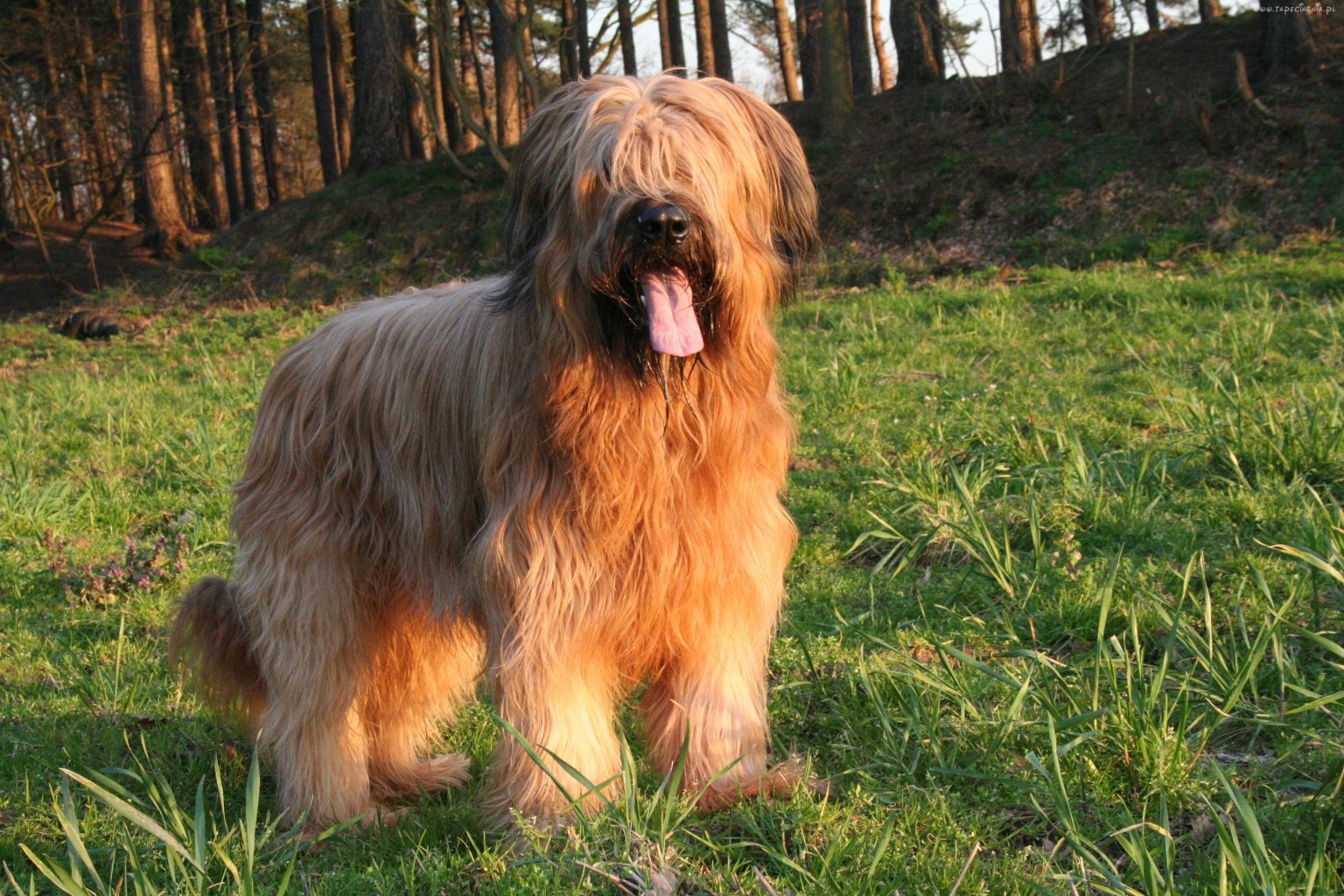
| Characteristic | Value |
| Origin | France |
| FCI classification | Standard No. 113, group 1 (sheepdogs and cattledogs except Swiss cattledogs), section 1 (sheepdogs), with working trial |
| Standard in force | Published 04.11.2008; FCI edition of 23.01.2009 |
| Utilisation per the standard | Herding and guarding dog |
| Height at withers (FCI No. 113) | Males 62–68 cm; females 56–64 cm. Outside these limits, with a tolerance of +2 cm and −1 cm: a disqualifying fault |
| Weight | FCI standard No. 113 regulates height, not mass: it carries no weight figures at all |
| Coat (FCI No. 113) | Supple, long, dry («goat hair» type), with a light undercoat; under 7 cm, soft or woolly is a serious fault |
| Colours (FCI No. 113) | Black, fawn, fawn with dark overlay (slight to moderate), often masked, grey, blue |
| Hindquarters | Double dewclaw compulsory; a single dewclaw or their total absence is a disqualification |
| Temperament per the standard | Balanced, «neither aggressive nor fearful»; character «wise and bold» |
What follows is everything the table condenses: where the breed came from, why it needs a sixth toe, what breeding clubs actually check in different countries, and how the Briard ended up in the history of medicine.
History of the Briard Breed: From an Agricultural Treatise to the Ambulance Dogs
The Briard’s history has a convenient starting point, and it is written into the FCI standard itself. For a long time these dogs were known under the collective name «French plains sheepdogs», and the name «chien de Brie» — the dog from Brie — first appears in 1809, in the Cours complet d’agriculture of the abbé Rozier. In other words, the breed entered the written record not through dog fancy but through an agronomic reference work — as farm equipment, listed alongside descriptions of sheep breeds.
Brie is an arable region east of Paris, and the dog’s job there was exactly the one the standard still records: to drive and guard the flock. The French plain is not the mountains: there are no natural barriers, sheep graze on unfenced fields along the crops, and what is asked of the dog is not to push the flock forward but to hold it within bounds, acting as a living hedge. Hence the characteristic gait — an extended trot with good drive from behind, which the standard demands in as many words: the dog must move and work «with a minimum of effort and fatigue».
The public biography starts later. Briards were shown at the Paris agricultural exhibition in 1863, where they were regularly confused with the other French plains sheepdog, the Beauceron: the same country, the same work, the difference lying chiefly in the coat. A first breed standard was drawn up in 1897, and the specialist club — Club des Amis du Briard — appeared in 1909; these are two separate events, and summaries often merge them into one.
The American chapter is rather well documented. In October 1789, at Le Havre, Thomas Jefferson, then on his way home from France, bought a pregnant bitch named Bergère; she whelped two puppies during the Atlantic crossing, and the dogs were at Monticello by the beginning of 1790. The Marquis de Lafayette later sent Jefferson another pair. The American breed club identifies these «chiens bergers de Brie» as Briards. The link with Napoleon is of a different order: it rests on breed tradition and the cynological literature, not on an archival record comparable to Jefferson’s.
And finally, the war. Here there is no need to lean on club lore: the brief historical summary in FCI standard No. 113 itself states that the breed was used by the French army in both world wars — among other things as a sentry (sentinelle) and as an ambulance dog (chien ambulancier) searching for the wounded on the battlefield. It is a rare case of a breed’s military past being recorded not in a popular book but in its own current official document. The ambulance dog worked methodically rather than heroically: quartering the ground, locating a man lying down, and returning to its handler either carrying an object from the casualty or indicating the direction — precisely the pasture task, except that the object of the search was no longer a straying lamb. Both wars cut through the population, and the breed was rebuilt by breeders in peacetime.
The mediaeval tale of Aubry de Montdidier, whose dog is said to have exposed his master’s murderer, has no documentary basis — it is a durable legend, retold from book to book, and one in which the name «Aubry» is sometimes offered as the origin of the word «Brie» itself. It is worth keeping in exactly that status: a legend.
What a Briard Looks Like: Exactly What FCI Standard No. 113 Requires
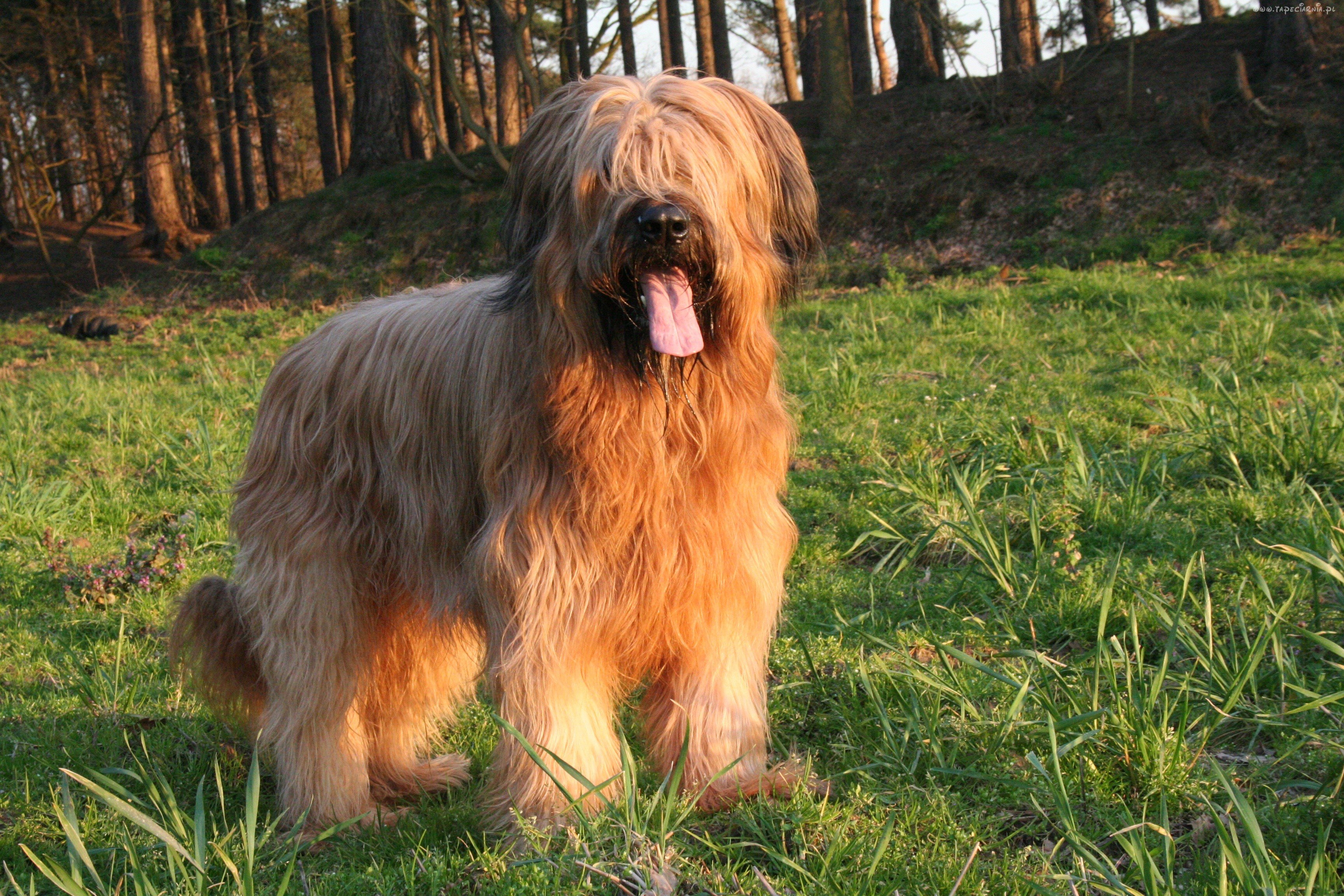
The general appearance is set out in four words: a dog that is rustic, supple, muscular and well proportioned, lively and alert. The format is slightly long: body length from point of shoulder to point of buttock is a little greater than height at the withers.
The head is measured, not judged by eye. The standard gives three proportions at once: head length equals 2/5 of the height at the withers; skull width is slightly less than half the length of the head; skull and muzzle are equal in length. In profile the lines of skull and bridge of nose are parallel; the stop is marked and lies exactly halfway between the occiput and the tip of the nose. The nose is large, with open nostrils, and always black — except in blue dogs, where it is blue or bluish. The head carries hair forming a beard, moustache and eyebrows lightly veiling the eyes.
The eyes are oval, set horizontally, well open, rather large and dark; in blue dogs slightly lighter eyes are admitted. An eye that is too light (yellow) or wall eyes are on the list of faults entailing exclusion.
The ears are set high and not held flat to the head; left natural, they are on the short side — the cartilage should be equal to or slightly less than half the length of the head. They are always flat and covered with long hair. The standard still describes the cropped variant, «in countries where the practice is not prohibited», but cropping is banned in most European jurisdictions and the natural ear has long been the norm in the ring. Note separately that an ear standing naturally erect is a disqualifying fault: this is not a breed in which the ear is meant to stand of its own accord.
The body: back straight, loin short and firm, croup slightly sloping and gently rounded. The chest is broad and long, let down to the elbows, ribs well sprung. This wording is not decoration: it is precisely a deep chest that places the breed in the risk population for gastric torsion, discussed below.
The tail is undocked, set low, reaching at least to the point of the hock, carried without deviation, and forming a slight hook in the shape of a J at the tip. In action it may rise no higher than the line of the back. A tail carried over the back like a hunting horn, or held vertically, excludes the dog.
The coat is described compactly and very precisely: supple, long, dry, «goat hair» in type (genre poil de chèvre), with a light undercoat. A coat under 7 cm, or a soft or woolly one, is a serious fault — the breed regulates not only length but texture. Dry, springy hair does not felt at the speed a soft coat does; a dog with an «incorrect», woolly coat is also, in very practical terms, a dog that is harder to keep.
Colour is the point on which summaries go wrong most often. The standard does not permit «any solid colour except white»: it lists the admissible colours as a closed set — black, fawn, fawn with a dark overlay (slight to moderate, often masked), grey and blue. A warm fawn may lighten tone on tone on the extremities and lower parts; black, grey and blue likewise admit lighter tone-on-tone areas; any colour may grizzle to a greater or lesser degree. Excluded from breeding are white, brown and mahogany colours, a coat of two clearly distinct colours, a white blaze, white hairs at the tips of the limbs, and the fawn mantled and dark-overlaid mantled coats. An overall coat tone that is too light is a serious fault.
And one line that everyone choosing a puppy should read: the standard closes with the note that only functionally and clinically healthy dogs, capable of performing the work for which the breed was selected, and typical in conformation, may be used for breeding. That is not a courtesy formula — it is the rule every national club leans on.
The Double Dewclaw: Anatomy Written into the Rules
Breed standards normally require proportions, angulations, colour and type. The Briard is one of the rare cases where the standard requires the presence of a specific anatomical structure, and where its absence is punished not by a lower grade but by exclusion.
The wording of FCI No. 113 under hindquarters runs: «Dewclaws: by tradition, shepherds insisted on keeping the double dewclaw. The dewclaws form well separated “thumbs” with nails, fairly close to the foot.» And among the faults entailing exclusion there is an unambiguous line: «single dewclaw or total absence of dewclaws on the hind limbs».
Note how the standard explains the requirement to itself. It does not invoke biomechanics: it writes «par tradition» — by tradition, because the shepherds held on to the feature. The widespread explanation that the double dewclaw helped the dog grip the ground on slopes circulates in the breed literature and in older French editions of the standard; the FCI text in force names breeding tradition as the reason. That is more honest and, on reflection, more interesting: here is a feature deliberately preserved by a community of breeders as a mark of identity — and locked in so firmly that a dog without it drops out of the breeding pool.
What does that mean in practice?
- The puppy is examined for this from its first days. Double dewclaws must be present on both hind limbs, well separated, with nails. A breeder knows the state of the dewclaws of every puppy in the litter — it is the first question they should answer without hesitating.
- They are not removed. In breeds where the dewclaw counts as a vestige it is sometimes taken off in the first days of life. In the Briard, removal means the dog no longer conforms to the standard.
- The nails need separate attention. The dewclaw does not touch the ground, so its nails are not worn down in movement — they grow round in a ring and can grow into the skin. Practical Briard grooming guides warn about this explicitly: dewclaw nails grow in a circle and need trimming on a schedule. On top of that, the long coat hides both the toe and the problem; when brushing out the hindquarters you go and find it by hand.
- It is a vulnerable spot. A projecting toe with a long nail catches — on carpet, in long grass, on wire. Checking the hind limbs after an active walk through rough cover is a sensible habit.
The Briard’s Character: Temperament and Behaviour
Here too the standard sets the frame: the character must be balanced, «neither aggressive nor fearful», and at the same time «wise and bold». An aggressive or fearful dog is excluded from breeding — that is its own line in the list of disqualifying faults. For a buyer this means something simple: in the Briard, neither nastiness nor timidity is a «line trait» — both are faults.
The breed’s working specialisation explains its domestic behaviour better than any string of adjectives. A herding «hedge» dog spends the whole day making its own decisions: the handler is far off, the sheep are moving, the situation changes by the minute. Two consequences follow, which owners describe as a virtue and a problem at the same time.
The first is independence of judgement. The Briard picks things up fast and, just as fast, starts offering its own version of the exercise. It does not refuse to work — it checks whether it really has to be done that way. From the handler’s point of view this looks like stubbornness; from the sheep’s, like competence.
The second is selectivity about contact. With strangers the Briard is reserved: assessment first, trust afterwards. This is neither aggression nor timidity but the guarding half of the breed’s stated purpose («chien de berger et de garde»). Without early and varied socialisation, reserve slides easily into suspicion.
Attachment to the family is very strong. The Briard copes badly with solitude and with a change of owner, wants a part in everything that happens in the house, and switches off if pushed to the margins of family life. With children it is usually patient, but the herding instinct does not go away: the dog may try to «gather» a running child by nudging it with its body. That can be corrected — and it should be corrected rather than found endearing. Games between children and a large dog happen under adult supervision, without exception.
The breed does well in herding work, search and rescue, French Ring, agility, obedience, carting and canine freestyle; Briards also work as assistance dogs. Like other herding breeds — the Australian Shepherd or the Australian Kelpie — the Briard needs mental as well as physical load: a dog with nothing to decide will end up deciding something on its own.
Briard Health: What the Literature Actually Says
Questions to Ask a Breeder: What the Rules Do Not Require
Caring for a Briard’s Coat: How It Is Actually Done
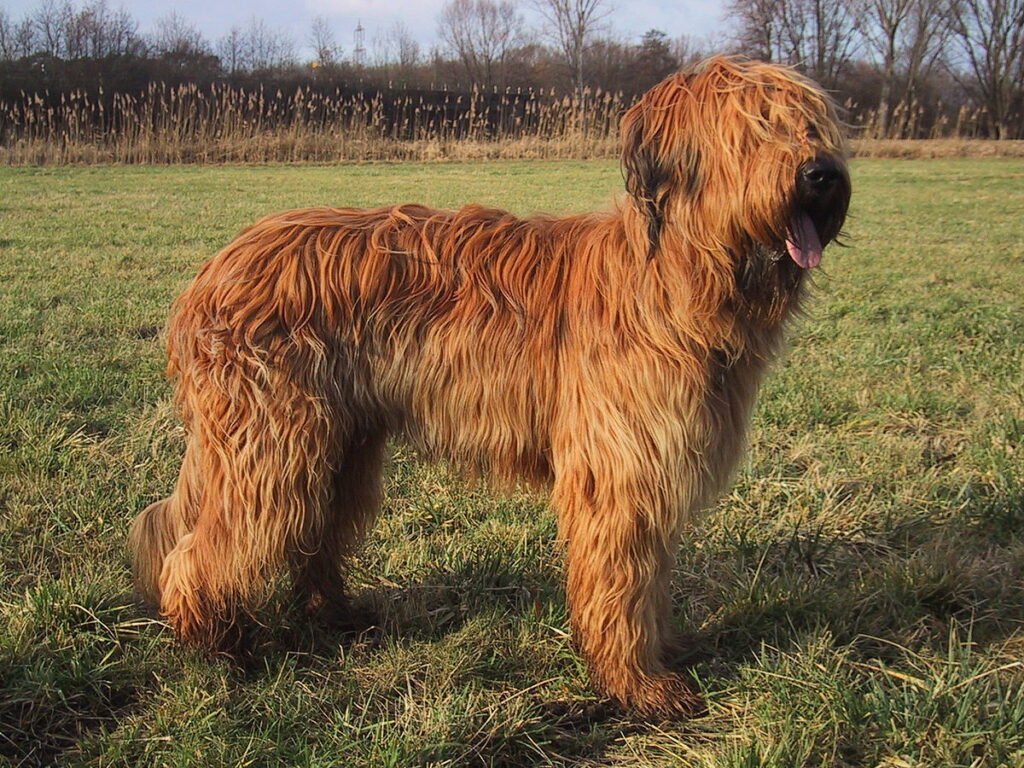
The key to Briard grooming lies in the construction of the coat. The hair is long, dry, of the «goat» type, the undercoat is light, and the coat grows continuously, like human hair. Dead hair does not fall to the floor — it stays in the coat. Hence the paradox of the breed: brushed regularly, a Briard leaves almost no hair in the house; neglected, it felts into a dense mat that only clippers will take off.
The basic technique is line brushing. You work not over the surface but in layers: on a given area the coat is lifted and held up, then brushed down in fine strands starting from the bottom — from the foot — with the parting line moving progressively higher. Each pass releases a new strand. That way you physically see the parting down to the skin and know a whole layer has been worked through rather than smoothed on top.
The order of tools matters more than the tools. Brush first, comb second — never the other way round: run over unbrushed hair, a comb tears and breaks it. The comb works here as an inspector: if it passes freely to the skin, the area is done. The basic kit is a long-pinned pin brush, a metal comb with coarse and fine sides, and a separate long-toothed comb for checking.
The rule that saves a coat: never wash a matted dog. Water pulls a mat that has already started into a solid knot, and afterwards it is next to impossible to open. The order is always the same: comb out completely, then bathe.
- Frequency: for an adult, 2–3 times a week, a good hour to an hour and a half each time, whole body. A puppy is accustomed to it in short sessions from its first weeks at home: learning to lie quietly on its side saves hundreds of hours later.
- Areas that felt first: behind the ears, the ruff under the collar, the armpits, the groin and inner thighs, the trousers, and around the dewclaws. These are the friction and moisture zones.
- Bathing: as soiling requires, with a shampoo for long coats, conditioner without fail and thorough rinsing. Dry with a cool-air dryer while brushing: natural drying under the weight of a long coat creates fresh mats.
- Clipping: as a rule a Briard is not clipped — coat length is regulated by the standard. Hygienic tidying is done between the pads, around the genitals and anus; the foot is rounded off rather than left to spread like a snowshoe.
- The fall of hair: the standard expects head hair lightly veiling the eyes. Some owners shorten the hair between the eyes a little, or clip the fall back in hot weather and at work.
- Nails: separately and without fail, the dewclaw nails, which are not worn down and grow in a ring.
The undercoat collected while brushing can, incidentally, be spun: it yields yarn, something done both in breed circles and in domestic craft. A coat of comparable demands is found on the Bearded Collie, and the logic of care there is the same: in layers, brush before comb, regularly.
Briard Training and Socialisation
The Briard learns fast — which is exactly why everything fixes fast with it, including what you had no intention of fixing. The work starts on the first day at home.
- Positive reinforcement. The breed is responsive to fairness and copes very badly with roughness: with an independent herding dog, harsh methods produce not obedience but shutdown.
- One set of rules for the whole family. The Briard reads perfectly well who in the household allows what, and uses it.
- Short, varied sessions. Monotonous repetition of something already learnt reads to the breed as meaningless, and it starts improvising.
- Legible boundaries. The dog will test them: that is a normal part of growing up, not «dominance».
- Mental load alongside physical. New skills, search tasks, puzzle toys, dog sport.
Early socialisation is critical for the Briard precisely because of the guarding half of its purpose: the puppy needs different people, surfaces, sounds, towns, transport and calm dogs — before reserve hardens into character. Two typical «side effects» of the breed are attempts to herd the household and a tendency to alert barking; both are corrected early and both become nearly intractable if left to settle in for years.
In several European countries Briards work in disaster rescue services and in searching for missing people. Solitude remains their weak point: a dog left alone for whole days compensates with barking, destruction and compulsive behaviour.
Briard Nutrition: Key Recommendations
Pros and Cons of the Briard Breed
| Pros | Cons |
|---|---|
| High intelligence and quick learning | Independence in decisions: argues when the point of an exercise escapes it |
| Deep attachment to the family | Copes badly with solitude and with a change of owner |
| Natural guarding qualities without gratuitous aggression | Reserve towards strangers turns into suspicion without early socialisation |
| Almost no hair left in the house when brushing is regular | Grooming means hours every week, not an occasional once-over |
| Versatility: herding, search, sport, assistance work | High activity requirement — physical and mental |
| Clear breeding landmarks: an RPE65 DNA test and hip scoring schemes exist | Tests are not compulsory everywhere — the buyer has to ask for the paperwork |
| Marked, recognisable type, locked in by a demanding standard | Large size and a deep chest: you need space and knowledge of torsion signs |
Interesting Facts about Briards
- The breed entered the written record through agronomy. The name «chien de Brie» is first attested in 1809 in the abbé Rozier’s Cours complet d’agriculture — FCI standard No. 113 itself points this out.
- The military past is written into the standard in force. The FCI states directly that the breed was used by the French army in both world wars — as a sentry and as an ambulance dog searching for the wounded.
- The double dewclaw is a requirement backed by exclusion. A single dewclaw or the total absence of dewclaws on the hind limbs puts the dog out of breeding; the standard ties the rule to the shepherds’ tradition.
- The Briard is the model breed for ocular gene therapy. The RPE65 mutation was described in Briards in 1999, restoration of vision in this model was published in Nature Genetics in 2001, and in 2017 the FDA approved a gene therapy for people with biallelic RPE65 mutations.
- A bitch at Jefferson’s. In October 1789, at Le Havre, Thomas Jefferson acquired Bergère, a pregnant bitch; the puppies were born on board and the dogs were at Monticello by the beginning of 1790. Lafayette later sent him another pair.
- The coat is regulated by texture, not only by length. Soft or woolly hair is a serious fault on the same footing as a coat under 7 cm.
- «A heart wrapped in fur» — the breed’s traditional nickname, a reference to its attachment.
- Not a beginner’s dog. An independent character, a need for work and demanding grooming together make the Briard a breed for an owner with time and experience.
Frequently Asked Questions about the Briard Breed (FAQ)
What are double dewclaws and can they be removed?
They are two well separated «thumbs» with nails on the hind limbs. FCI standard No. 113 requires their presence and places a single dewclaw or the total absence of dewclaws among the faults entailing exclusion. In the Briard they are not removed: the dog would cease to conform to the standard.
What tests should a puppy’s parents have?
At a minimum: the CSNB/RPE65 DNA status of both parents with the laboratory certificate, a hip evaluation under one of the recognised schemes (A/B under FCI, BVA/KC, OFA, PennHIP) and a recent eye examination. Note that in different countries these examinations may be recommendations rather than a condition of mating, so the paperwork is yours to ask for.
Do Briards shed heavily?
Dead hair stays in the coat instead of falling out, so with brushing 2–3 times a week there is little hair in the house. The flip side: without regular care that same hair felts.
Is «stationary night blindness» really non-progressive?
The name is historical. The original 1999 publication describes retinal dystrophy in Briards as early-onset and progressive, and later literature uses the term «hereditary retinal dystrophy». The word «stationary» comes from the first clinical descriptions.
Is a Briard suitable for a flat?
Yes, provided the dog gets several hours of physical and mental work a day and is not left alone for long. What limits it is not the floor area but the owner’s way of life.
Does the Briard get on with children?
Generally yes, especially if it grew up with them. Because of its size and herding instinct — it may push a running child with its body — games take place under adult supervision.
Is the Briard aggressive towards strangers?
The standard requires a balanced character, «neither aggressive nor fearful», and places aggression and fearfulness among the faults entailing exclusion. A Briard’s normal reaction to a stranger is reserved assessment, neither attack nor flight.
How much exercise does a Briard need?
Long walks, free running and regular occupation — agility, obedience, search or herding work. The breed is registered with the FCI as a working breed, with a working trial, and that shows in its needs.
Video about the breed
- Clever, devoted, sensitive
- A lavish wavy coat
- A good herder and guard
- Bonds deeply with its family
- A lavish coat = serious grooming
- A high need for exercise and work
- Wary of strangers
- A risk of gastric torsion
| Old English Sheepdog | Bergamasco | Beauceron | |
|---|---|---|---|
| Height | 53–61 cm | 54–62 cm | 61–70 cm |
| Energy | 3.5 | 3.5 | 5 |
| Apartment | 3 | 3 | 2 |
| Beginners | 3 | 3 | 1.5 |
Why is the Briard called a “heart wrapped in fur”?
Does the Briard's coat need much care?
What are the Briard's double dewclaws?
FCI Standard No. 113 · The Kennel Club
For apartments · For kids · For beginners · Active · Smartest · Hypoallergenic · All rankings →