Group 1 · sheepdogs and cattle dogs · Italy (Alpine region, Bergamo province)
Bergamasco Shepherd
An Alpine herder in “dreadlocks” — clever and unflappable: patient, devoted, watchful and independent. The Bergamasco is one of the oldest herding breeds, with a unique felted coat in “flocks” that protected it from cold and predators' teeth; level-headed and clever, it combines herding with guarding and bonds deeply with its family, needing work.
Apartment · not suitableKidsCats · with caveatsOther dogsBeginners · with caveats
The Bergamasco Shepherd(Cane da Pastore Bergamasco) stands out as one of the most ancient and distinctive herding breeds, boasting a truly unique appearance and remarkable working capabilities. A Bergamasco isn't just a dog; it's the embodiment of loyalty, intelligence, and a strong work ethic. Bred for the harsh conditions of the Alpine pastures, these dogs have spent centuries assisting shepherds in herding and guarding their flocks. Their incredible coat, which forms characteristic "dreads" or "flocks," not only gives them an exotic look but also provides robust protection against the elements and predators. This is a medium-sized dog with a sturdy build and well-developed musculature, indicative of its strength and endurance. This comprehensive overview has been put together for you by Tvaryny, so you can delve into the fascinating world of this incredible dog.
These dogs aren't meant to languish indoors within the confines of a city flat without adequate stimulation; their true calling lies in work, activity, and a deep bond with their owner. In Italy, their homeland, Bergamasco Shepherds are highly valued for their ability to make independent decisions, their exceptional sense of smell and hearing, and their boundless devotion. They are renowned for their balanced and patient nature, coupled with unwavering determination and courage when the situation demands it. Discover more about their incredible traits right here on Tvaryny!
Unique; doesn't require brushing once flocks are formed, but needs manual separation of strands at a young age
Activity Level
Medium (requires daily walks and mental stimulation)
Training
Responds well to training but can be stubborn; needs an experienced owner
Attitude towards Children
Good, patient and protective (with proper socialisation)
Attitude towards Other Animals
Can get along (with proper socialisation)
What the Bergamasco Shepherd Looks Like: A Detailed Description
The Bergamasco Shepherd is a medium-sized dog, sturdily built but not heavy, with well-developed musculature and a proportional body that conveys an impression of strength and agility. The overall appearance of the dog is harmonious, somewhat rustic, which underlines its working purpose.
Head: Massive but proportionate to the body. The skull is broad and slightly convex between the ears. The stop is well-defined. The muzzle should be approximately the same length as the cranial part, broad at the base, tapering towards the nose but not pointed. The bridge of the nose is straight. Lips are tight-fitting.
Eyes: Large, oval-shaped, neither protruding nor deep-set. Eye colour varies from hazel to dark chestnut, depending on the coat colour. The gaze is attentive, calm, and intelligent. The hair on the head often forms a kind of "curtain" over the eyes, which, however, does not prevent the dog from seeing well.
Ears: Pendulous, triangular, medium-sized, set high. They are soft and mobile, covered with long, slightly wavy hair that forms fringes.
Nose: Large, black, with well-opened nostrils.
Bite: Scissor bite, with strong white teeth.
Neck: Strong, muscular, medium length, without dewlap.
Body: Slightly elongated. The back is straight and strong. The loin is well-developed, slightly arched. The croup is broad, muscular, slightly sloping. The chest is deep and spacious, reaching the elbows. Ribs are well-sprung.
Tail: Thick at the base, gradually tapering towards the end. Covered with thick, slightly "shaggy" hair. When at rest, it hangs down, reaching the hock or slightly below, and may be slightly curved at the tip. When moving or excited, it is raised, but not above the topline.
Limbs: Forelegs are straight, parallel, with strong bone. Shoulders are obliquely set, and upper arms are muscular. Hindquarters are powerful, with well-developed musculature and well-angulated joints. Feet are oval, compact, with tightly closed toes and strong, dark claws. Pads are firm.
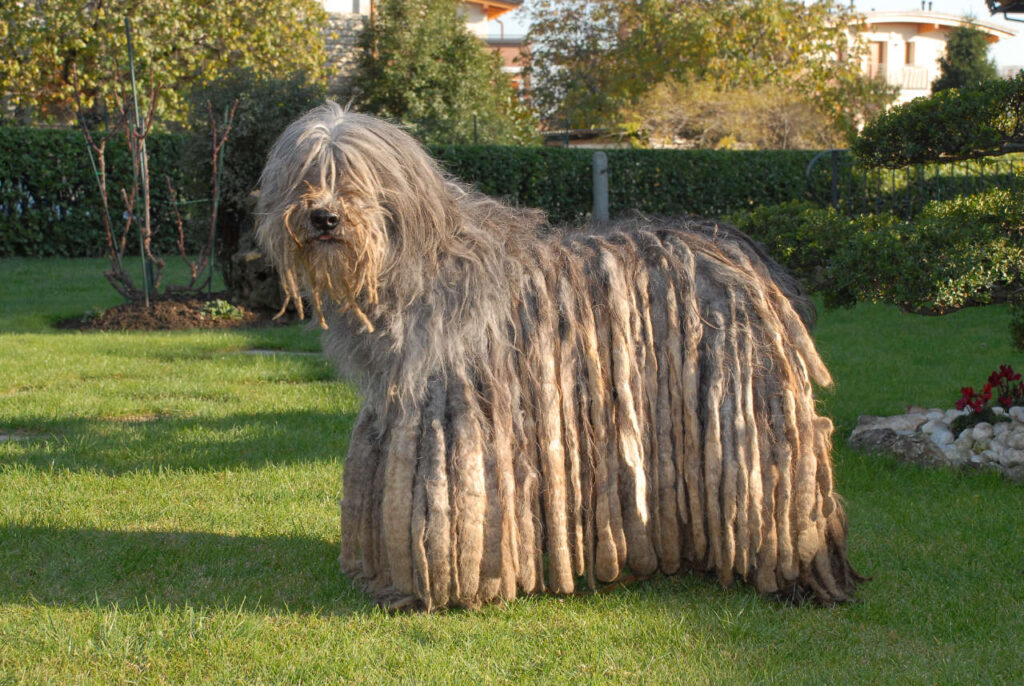
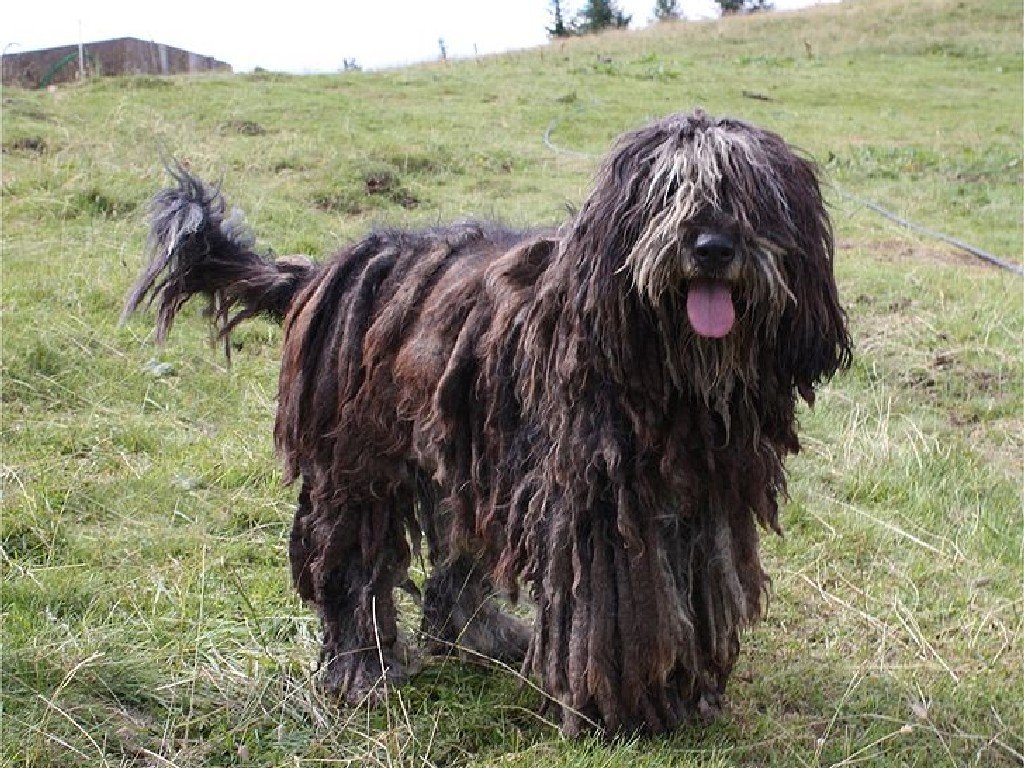
Coat: The most characteristic feature of the breed. Very dense, long, and its texture varies across different parts of the body. It consists of three types of hair: soft and dense undercoat ("woolly"), longer and harsher "goat-like" guard hair, and a softer, finer top layer resembling lamb's wool. These three types of hair intertwine to form wide, flat strands called "flocks" or "mats." Flocks begin to form at approximately one year of age and fully develop by 3–5 years, reaching a significant length, sometimes to the ground. The coat is oily to the touch, providing waterproofing. The flocks cover the entire body of the dog, including the head and limbs, giving it a unique appearance reminiscent of dogs like the Komondor or the Puli, although the structure of the Bergamasco's coat is distinct.
Colour: Various shades of grey are permitted (from light grey to deep slate), including mottled grey (merle). Solid matte black is also allowed. White markings are permissible if they do not exceed 1/5 of the total body area. Isabella and light fawn colours also occur. Solid white is not permitted by the standard.
Interesting Facts About the Bergamasco Shepherd
Ancient History: Bergamasco Shepherds are believed to have existed for over 2,000 years, making them one of the oldest herding breeds.
Three Coat Types: Their unique coat comprises three distinct hair types – woolly undercoat, long and harsh "goat-like" guard hair, and softer, finer outer hair – which intertwine to form the characteristic flocks.
Natural Protection: The flocks not only protect the dog from the elements (rain, snow, cold, heat) but also served as protection against wolf bites and other predators while guarding flocks.
"Non-shedding" Breed: Once the flocks are fully formed, Bergamascos practically don't shed in the traditional sense. Dead hair remains within the flocks rather than falling out around the home.
Independent Workers: These dogs were bred for independent work, often making decisions without direct command from the shepherd, which speaks to their high intelligence and intuition.
Rare Breed: Despite their unique qualities, the Bergamasco Shepherd remains a relatively rare breed outside of Italy.
Named After the Region: The breed's name comes from the province of Bergamo in the Italian Alps, where these dogs were traditionally used by shepherds.
Masters of Camouflage: Their coat helped them blend in with flocks of sheep, making them less noticeable to predators.
"Curtains" over the Eyes: The hair falling over the eyes doesn't hinder the dog's vision; instead, it protects their eyes from bright sun and snow in the mountains.
History and Origins of the Bergamasco Shepherd
The history of the Bergamasco Shepherd stretches back into antiquity, with its exact origins shrouded in mystery. These dogs are believed to be over two thousand years old. Some sources suggest their ancestors were brought to Italy from Asia, possibly Persia, by nomadic tribes or Phoenician traders who journeyed across the Mediterranean. These eastern herding dogs, with their distinctive shaggy coats, gradually adapted to the conditions of the European mountains. However, it was specifically in the Italian Alps, particularly in the province of Bergamo (from which the breed takes its name), that the Bergamasco Shepherd developed into a unique breed, perfectly adapted for working in harsh mountainous environments. For centuries, these dogs were indispensable helpers to Alpine shepherds, assisting them in herding and guarding flocks of sheep and goats. Their thick, matted coat provided protection from cold, moisture, heat, and the bites of predators. The breed was officially recognised relatively late, but its working qualities and unique appearance were always highly valued by the local population. Unfortunately, after World War II, the Bergamasco Shepherd population significantly decreased due to the diminishing need for traditional sheep farming. Only through the dedicated efforts of enthusiasts was the breed saved. Today, the Bergamasco Shepherd remains quite rare, but its popularity is gradually growing among admirers of unique and intelligent dogs worldwide.
Bergamasco Shepherd Character: Temperament and Behaviour
The Bergamasco Shepherd is a dog with high intelligence, a strong will, and a balanced temperament. This isn't a dog that will blindly follow commands; it's inclined to analyse situations and make independent decisions, a trait stemming from its centuries-old history as a herding dog, where it often had to act without direct human instruction. These characteristics make it a wonderful companion for an experienced owner who values intelligence and initiative in their dog.
Loyalty and Affection: A Bergamasco becomes deeply attached to its family and an integral part of it. They are extremely faithful and loving towards their people, but can be reserved or wary with strangers, which makes them good guard dogs. They are not prone to unprovoked aggression but are always ready to protect their family and territory.
Intelligence and Astuteness: Their sharp minds allow them to learn quickly, but can also lead to stubbornness if training isn't engaging or the owner is inconsistent. They have a keen understanding of human intonation and mood.
Patience and Calmness: Bergamasco Shepherds are renowned for their patience, especially when interacting with children. They can be excellent nannies, calmly tolerating children's antics, provided the children are taught to respect the dog. However, as with any dog, interactions with small children should be supervised.
Guarding Qualities: With a natural protective instinct, the Bergamasco is a vigilant guardian. They are always acutely aware of their surroundings and will alert their owner to the approach of strangers or unusual sounds with a loud, but not excessive, bark.
Independence: Historically, Bergamasco Shepherds had to make their own decisions when herding flocks, so they have retained a certain independence in character. This means they need an owner who can establish clear rules and boundaries, while also demonstrating patience and respect for the dog's intelligence.
Socialisation: Early and proper socialisation is extremely important for a Bergamasco Shepherd. Introducing a puppy to different people (adults, children), other dogs (after appropriate vaccinations), other animals (if cohabitation is planned), sounds, smells, and situations from a young age will help them grow into a confident and well-adapted dog.
Energy and Playfulness: While a Bergamasco may appear calm, they have ample energy for active games and long walks. They enjoy spending time with their family, participating in shared activities.
Overall, the Bergamasco Shepherd is a sensitive, observant, and resolute dog. They form a strong bond with their owner and strive for mutual understanding. Their character makes them not only an excellent working dog but also a loyal friend and family member.
Training and Socialisation of the Bergamasco Shepherd
Training a Bergamasco Shepherd is an interesting, yet demanding process. These dogs are exceptionally intelligent and quick-witted, which allows them to quickly absorb new information. However, their natural independence and tendency to make their own decisions mean they need an owner who will be an authority figure, but who will also act consistently, patiently, and with respect.
Key Aspects of Training:
Early Start: Training and socialisation should begin as early as possible, literally from the first days a puppy arrives in your home. This will help lay a proper foundation for behaviour.
Positive Reinforcement: Bergamascos respond best to training methods based on positive reinforcement – praise, treats, toys. Harsh methods or punishment can lead to stubbornness and a loss of trust.
Consistency and Patience: It's vital to be consistent in your demands and commands. All family members should adhere to the same rules. A Bergamasco may test boundaries, so patience and persistence from the owner are key.
Variety: To keep the dog interested, sessions should be varied and not too long. Monotonous repetitions can quickly bore a Bergamasco.
Socialisation: This is a critically important aspect for the Bergamasco Shepherd. From an early age, introduce your puppy to various people (adults, children), other dogs (after appropriate vaccinations), other animals (if cohabitation is planned), sounds, smells, and situations. A well-socialised Bergamasco will grow into a confident, calm, and well-adjusted dog. Attending puppy classes can be very beneficial.
Bergamasco Shepherds possess excellent memory and sharp minds, making them capable of excelling in various dog sports such as agility, obedience, or herding trials. They can be trained not only as companions but also to perform complex tasks. When comparing them to other herding breeds, for instance, the Long-haired German Shepherd Dog, a Bergamasco might exhibit greater independence in decision-making, requiring a slightly different approach to training. Another intelligent shepherd, needing a thoughtful training approach, is the Picardy Sheepdog.
Pros and Cons of the Bergamasco Shepherd Breed
Pros and Cons of the Bergamasco Shepherd Breed · 8
Pros
Cons
Unique Appearance: Their striking dreadlock-like coat is a real head-turner.
Specific Coat Care: Particularly during the flock-forming stage (1–3 years), it requires time and patience. It can look scruffy during this process.
High Intelligence: They're clever, quick-witted, and learn well.
Prone to Stubbornness and Independence: Needs an experienced, consistent, and patient owner. Not for novices.
Family Loyalty: They bond very strongly with their people, making them wonderful companions.
Requires Early and Extensive Socialisation: Without it, they can become overly wary of strangers or display dominance.
Good Guard Dog Qualities: Alert and attentive, they'll always warn you of danger.
Not Suitable for Exclusive Flat Living Without Sufficient Exercise: Needs space and activity.
Patient with Children: With proper socialisation, they get along wonderfully with children.
Long Drying Time After Bathing: Requires thorough drying to prevent skin problems.
Generally Healthy Breed: no one has studied this breed systematically, so no list of hereditary diseases exists for it — that is a gap in the data, not evidence of health.
Potential Skin Problems: If the coat isn't properly cared for.
Low Shedding (Adult Coat): Once flocks are formed, they practically don't shed.
"Rustic" Look Not for Everyone: Can pick up dirt and debris on walks.
Good Adaptation to Various Weather Conditions: Their coat protects against cold and heat.
Can be Noisy: If not taught to control barking.
Caring for a Bergamasco Shepherd: Specifics of Upkeep
Caring for a Bergamasco Shepherd comes with its unique aspects, primarily due to its unusual coat. However, despite its exotic appearance, looking after an adult dog isn't as complicated as it might seem at first glance, provided you have a proper understanding of the breed's needs.
Caring for the Bergamasco Shepherd's Coat: From Puppy to Adult Dog
The Bergamasco's coat goes through several stages of development:
Puppy Age (up to 8–12 months): At this stage, Bergamasco Shepherd puppies have soft, short, and fluffy coats that don't tend to form flocks. Regular brushing (several times a week) with a standard brush or a metal-toothed comb is recommended to accustom the puppy to the procedure and remove dead hair.
Transition Period (approximately 8–12 months to 2–3 years): This is the most crucial and demanding stage in coat formation. The soft puppy coat begins to mix with coarser "goat-like" hair and the soft undercoat. The hair starts to naturally mat into strands or clumps. At this stage, brushing should stop! Instead, the owner must manually separate these forming strands all the way down to the skin to prevent them from becoming one solid mat. The goal is to create separate, flat flocks about 1–3 cm wide. This needs to be done regularly, checking the dog's entire coat. Improper separation or neglecting it can lead to the formation of one large tangle, which can cause skin problems. This process may seem laborious, but it lays the foundation for an easy-to-care-for adult coat.
Adult Coat (after 2–3 years): By three years of age (sometimes up to five), the flocks are fully formed and reach a significant length. From this point, the Bergamasco's coat requires minimal care. It does not need to be brushed. The flocks naturally protect the skin from dirt and moisture. The primary care involves periodically checking the skin under the flocks, ensuring the flocks haven't matted at the base, and removing any debris that might have become tangled in the coat after walks (twigs, leaves). Some owners slightly trim the hair around the anal area and genitals for hygiene reasons, as well as the hair on the paws to prevent it from hindering movement.
Bathing a Bergamasco Shepherd
Bergamasco Shepherds are not recommended for frequent bathing. Their coat has a natural oily layer that protects against moisture and dirt. Washing too often can disrupt this protective barrier. Adult dogs with fully formed flocks are typically bathed once or twice a year, or when absolutely necessary. It's crucial to use a mild dog shampoo and rinse the coat very thoroughly. The most challenging part is drying. A Bergamasco's coat takes a very long time to dry, sometimes up to 2–3 days. Insufficient drying can lead to skin irritation, dermatitis, fungal infections, or the development of "hot spots" (acute moist dermatitis). It's recommended to use a powerful dog dryer (blower) or to blot the coat with a large number of towels and ensure the dog stays in a warm, well-ventilated room until completely dry. Some owners avoid full bathing, limiting themselves to washing paws and spot-cleaning soiled areas.
Other Aspects of Care
Ears: Regularly inspect the ears for dirt, redness, or signs of infection. As the ears are pendulous and covered with hair, they can be prone to inflammation. Clean them with a special dog ear cleaner as needed.
Eyes: Periodically clean the corners of the eyes from natural discharge with a soft, damp cloth. The hair falling over the eyes usually doesn't bother the dog, but ensure it doesn't cause irritation.
Claws: Trim claws regularly, approximately once a month, if they don't wear down naturally during walks.
Teeth: To prevent oral health issues, it's recommended to regularly brush your dog's teeth with a special dog toothpaste and brush, or provide dental chews.
Living Conditions: A Bergamasco Shepherd thrives best in a private home with access to a fenced garden where it can move freely. While it can adapt to living in a large flat, this is only feasible with sufficient daily physical and mental exercise; it's not an ideal option. These dogs need space. They don't cope well with solitude and require close contact with their family.
Nutrition
Feeding the Bergamasco Shepherd: Key Recommendations
Health and risks
Bergamasco Shepherd Health: Common Illnesses and Prevention
Frequently Asked Questions about the Bergamasco Shepherd (FAQ) · 7
Does the Bergamasco Shepherd shed a lot?
Once the Bergamasco Shepherd's characteristic flocks are fully formed (usually by 2–3 years of age), it practically doesn't shed. Dead hair remains within the flocks rather than falling out onto the floor or furniture. However, in puppyhood and during the transitional period of coat formation (approximately from 8–12 months to 2 years), when the soft puppy coat changes, some hair shedding may be observed.
Is Bergamasco coat care difficult?
Caring for a Bergamasco's coat is unique but not overly difficult, provided you understand its specific needs. The most laborious period is during the formation of the flocks (from 1 to 3 years of age), when you need to manually separate the matting strands to prevent them from forming one solid mat. Once the flocks are fully formed, care becomes minimal: they don't need brushing, just periodic checks and removal of debris. They are bathed infrequently.
Do Bergamasco Shepherds have a specific smell?
A healthy Bergamasco Shepherd with a properly maintained coat should not have a strong, unpleasant odour. Their coat has a natural oily layer that repels dirt. However, if the coat is not dried properly after bathing, it can remain damp for a long time, which may lead to a musty or mouldy smell. Additionally, an odour could indicate skin conditions.
Are Bergamasco Shepherds suitable for flat living?
The Bergamasco Shepherd thrives best in a private home with a fenced garden, where it will have ample space to move around. It can adapt to living in a large flat, but only with daily long and active walks, as well as sufficient mental stimulation. This breed is not particularly well-suited for small flats, as it requires activity and space.
How do Bergamascos get along with children and other animals?
With proper early socialisation, Bergamasco Shepherds generally get along well with children, showing patience and protective qualities. They can become wonderful play companions. As for other animals, early socialisation is also key. They can coexist with other dogs and cats, especially if they've grown up together. However, as a herding breed, they may sometimes try to "herd" other animals or small children.
How much physical activity does a Bergamasco Shepherd need?
The Bergamasco is a dog with a moderate energy level. They need daily physical activity to stay healthy and happy. At least an hour of activity per day is recommended, which can include long walks, jogging, outdoor games (e.g., with a ball), or participation in dog sports. They also need mental stimulation to avoid boredom.
Are they easy to train?
Bergamasco Shepherds are intelligent and highly trainable, but their independence and occasional stubbornness can present a challenge. They respond best to patient, consistent training using positive reinforcement methods. Harshness or unfairness can lead to resistance. This breed is better suited for experienced dog owners who understand the nuances of herding breed mentality. Their relatives, such as the Picardy Sheepdog, are also known for their cleverness and the need for a thoughtful approach to training.
Video about the Bergamasco Shepherd breed
FAQ
Why does the Bergamasco have such an unusual coat?
Its three types of hair weave into the characteristic felted “flocks” that protected the dog from Alpine cold and predators' teeth; this “armour” is a natural working adaptation.
Is the Bergamasco good for a family?
Very — a clever, patient and devoted dog, good with children, treating its owner as a partner; but it needs work, space and special coat care.
How do you care for the flocked coat?
The adult coat is not brushed but periodically separated by hand into flocks so they do not fuse into one mat; full flock formation takes years.