

| Height | dogs 48.5–51.5 · bitches 45.5–48.5 cm |
| Weight | 20–30 kg |
| Lifespan | 12–15 years |
| FCI group | 5 · primitive types |
| Origin | Japan |
Exact ratings
Common health issues
Nutrition
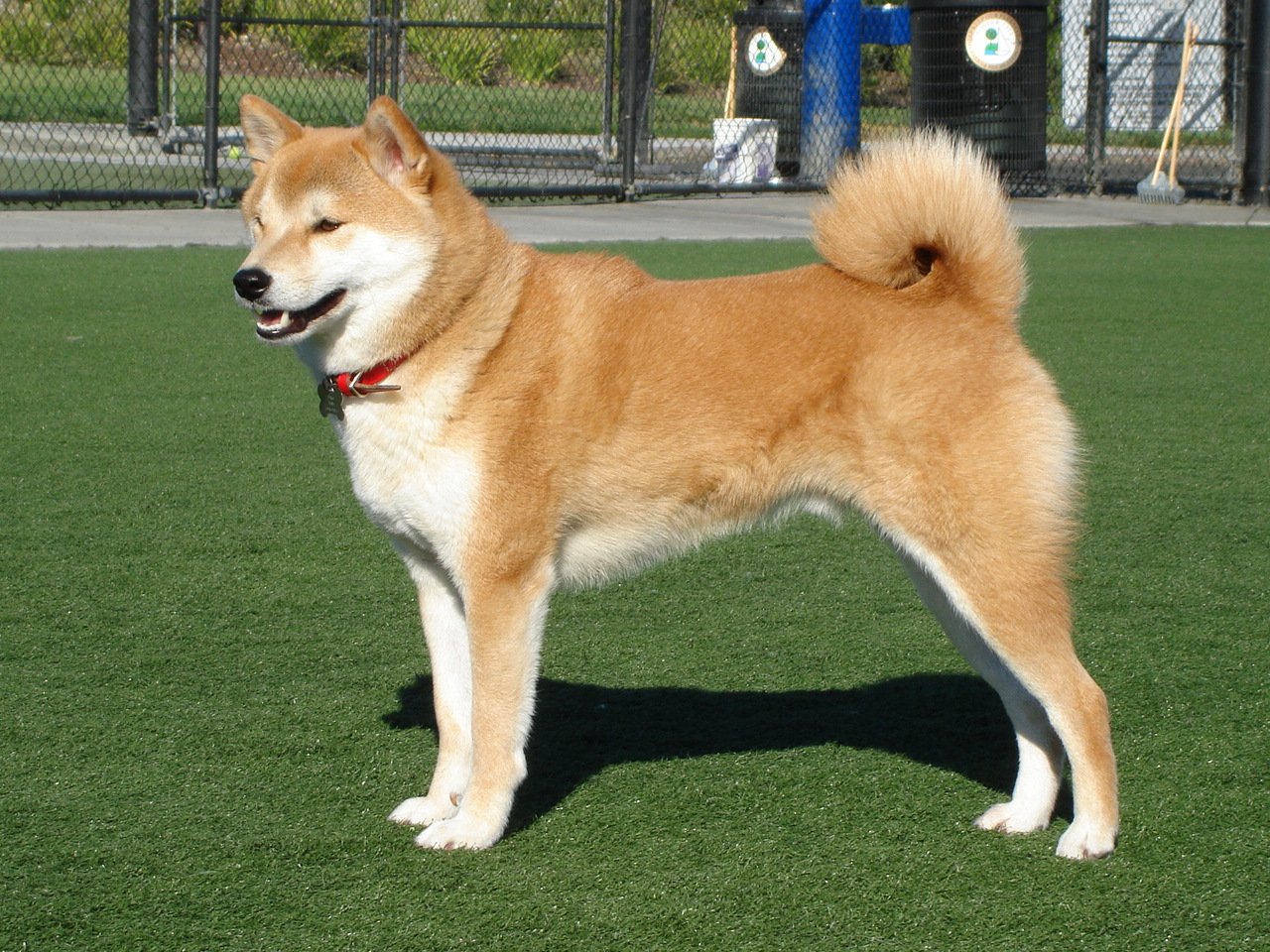
The Hokkaido, also called the Hokkaido Ken and the Ainu Ken, is one of six Japanese breeds that the state has entered in its register of natural monuments. It is a medium-sized native spitz with a thick double coat, pricked ears and a curled tail, bred for hunting in the mountains and snows of northern Japan. The breed stays rare even at home: in 2025 the Japan Kennel Club registered 24 Hokkaido, against 3,598 Shiba Inu in the same year. What we have gathered below is what can be checked against documents – FCI Standard No. 261, the register of Japan’s Agency for Cultural Affairs, the standard of the Japanese association NIPPO, and peer-reviewed veterinary publications. More about breeds on Tvaryny.
Hokkaido (Ainu): a brief overview and characteristics
| Parameter | Characteristic |
|---|---|
| Country of origin | Japan |
| FCI standard | No. 261 “HOKKAIDO”, version in force published 30.10.2016, English version dated 09.02.2017 |
| FCI classification | Group 5 (spitz and primitive types), Section 5 (Asian spitz and related breeds), without working trial |
| Use under the standard | Hunting dog, companion dog |
| Height at withers, dogs | 48.5–51.5 cm (FCI No. 261) |
| Height at withers, bitches | 45.5–48.5 cm (FCI No. 261) |
| Height under the Japanese NIPPO standard | dogs 52 cm (range 46–55), bitches 49 cm (range 43–52) |
| Weight | FCI Standard No. 261 lays down no weight |
| Coat | Double: outer hair harsh and straight, undercoat soft and dense |
| Colours under the standard | Sesame, brindle, red, black, black and tan, white |
| Status in Japan | A national natural monument since 21 December 1937 |
| JKC registrations in 2025 | 24 dogs (across all 141 breeds – 302,530) |
Origins: what the documents actually say
A handsome legend about Japan’s native breeds is easy to write; a page that can be checked is hard. Let us begin, then, with the document that describes the breed officially. The historical summary in FCI Standard No. 261 states that the breed descends from medium-sized Japanese dogs brought to Hokkaido by settlers from Honshu in the Kamakura era, in the 1140s, when exchange between Hokkaido and the Tohoku region was taking shape. That wording repays attention, because it contradicts the commonest account circulating online, the one about “direct descendants of Jomon-period dogs”. The standard traces the breed not to the Neolithic but to a medieval migration from the main island.
Science is more cautious here than popular writing. The study of the mitogenomes of ancient Japanese dogs (Xiaokaiti and colleagues, Anthropological Science, 2024) sets out from an archaeological fact: dogs have been present in Japan for at least 9,300 years, from the Jomon period onwards. The authors then show that the mitochondrial lineages of dogs from the late 8th century are already different from, and more varied than, the Jomon lineages – later waves of settlers brought dogs of their own, and the ancient haplogroups were largely displaced. A straight descent from “Jomon dog” to modern breed does not follow from this evidence.
There is, though, an old and very concrete observation that sets the Hokkaido apart from the southern Japanese breeds. In 1984 Hashimoto, Yamakawa and Tanabe published in the Journal of Biochemistry a study of red-cell glycolipids in 1,591 dogs of 36 breeds. They identified a polymorphism in the terminal sugar of haematoside: some dogs carry N-acetylneuraminic acid, others N-glycolylneuraminic acid. The second variant turns up in only a handful of eastern breeds, and the Hokkaido in that sample did not carry it – unlike the native breeds of southern Japan, northern China and Korea. From this the authors inferred separate routes of settlement: the dogs of southern Japan came from northern China by way of the Korean peninsula, whilst the dogs of the north of the archipelago have a different origin.
The name “Ainu Ken” points to the Ainu, the indigenous people of Hokkaido, Sakhalin and the Kuril Islands. The historical section of the FCI standard says outright that the Ainu bred these dogs for hunting bear and other game, and that the breed’s second name comes from that. In the Ainu language the dog goes by several names, which the language archive of the National Ainu Museum (国立アイヌ民族博物館) records with precision: seta is the principal word, current across Hokkaido, Sakhalin and the Kurils; in the north-east of the island – the Kitami, Kushiro and Tokachi districts – everyday speech says sita, whilst seta stays in the elevated register. Descriptive names exist as well: reyep, “the one that crawls”, because a dog seeking affection creeps up to a person, and apacampe, “the one by the door”. There is nothing exotic in this: it is the ordinary synonymy of a living language, documented by a national scholarly institution.
The turning point came in 1937. The database of national cultural properties kept by Japan’s Agency for Cultural Affairs holds a record under the name 北海道犬 (ほっかいどうけん, “Hokkaido Ken”): category, natural monument; date of designation, 21.12.1937. Under “location” stands the entry 地域を定めない, “no territory specified” – the status was granted to the breed as such, and not to a place or to particular animals. The description in the record, written in an older administrative Japanese, lists precisely the features that the standards would afterwards take up: it is one of the medium-sized Japanese dogs long kept on Hokkaido; ears small, muzzle pointed, body rather longer than the height at the withers, hock angle open.
The FCI standard adds a point about the name: when the breed was declared a natural monument, it took the name of the region. “Hokkaido Ken” accordingly became the official designation, whilst “Ainu Ken” remained the second, historical name. Both are still used today, and the FCI itself carries “Ainu” as a gloss on the breed name.
That same register lets us set the Hokkaido in a sequence: through the 1930s the Japanese state designated dog breeds as natural monuments one after another, and the Hokkaido comes last in the line.
| Breed in the register | Date of designation as a natural monument |
|---|---|
| 秋田犬 — Akita | 31.07.1931 |
| 甲斐犬 — Kai | 22.01.1934 |
| 紀州犬 — Kishu | 01.05.1934 |
| 越の犬 — Koshi no Inu | 28.12.1934 |
| 柴犬 — Shiba | 16.12.1936 |
| 土佐犬 — Tosa Ken (now the Shikoku Ken) | 15.06.1937 |
| 北海道犬 — Hokkaido | 21.12.1937 |
Alongside the state register, the breed is looked after by a voluntary body. The Japanese dog preservation society NIPPO (公益社団法人日本犬保存会) adopted its “Standard of the Japanese Dog” as long ago as 1934 – a single document covering all six breeds, sorted by size into small, medium and large. In it the essence of the Japanese dog is set out in three concepts: kan’i (悍威), restrained inner strength and dignity; ryosei (良性), a good and even-tempered nature; soboku (素朴), natural plainness without adornment. These three words matter for more than their exoticism: they explain why Japanese standards say so little about “character” in the Western sense, and why timidity counts in them as a serious fault.
One clarification belongs here, since this is perhaps the confusion met most often. The “six Nihon Ken” are not the whole of Japan’s native dogs, but the six breeds entered by the state in the register of monuments and overseen by NIPPO. The scientific literature – Gojobori and colleagues in Nature Communications (2024), among others – puts the number of Japanese native breeds at eleven. The formula “one of the six original Japanese breeds” is therefore accurate in the sense of protected status only, and not in the sense of Japanese dogs taken together.
A final historical detail, this one from our own day: NIPPO notes that the former local lines of the Hokkaido are gradually being effaced and that the breed is converging on one unified type. For a rare breed the news cuts both ways – typicality is rising, whilst the diversity of lines from which unrelated stock can be drawn is narrowing.
What the Hokkaido looks like: a reading of FCI Standard No. 261
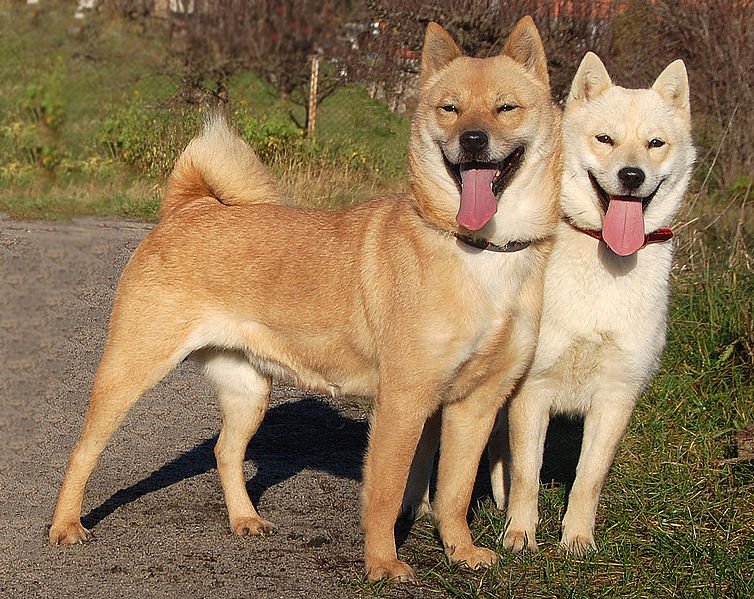
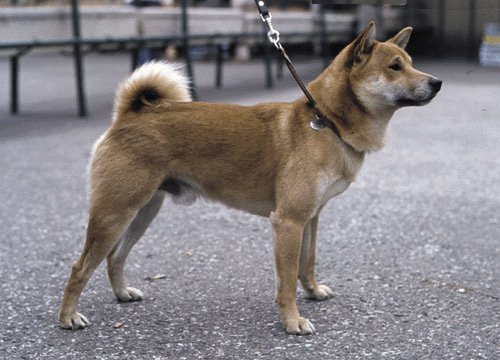
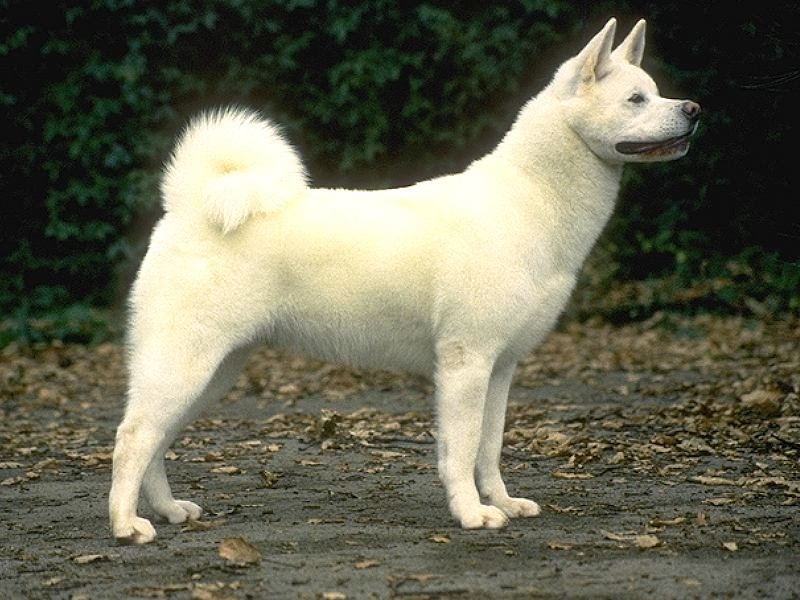
The general appearance is described in these terms: a dog of medium size with sharply marked sexual dimorphism, well balanced, of sturdy build and with good bone; the musculature firm and clean-cut. The proportions are spelled out in unusual detail for a Japanese breed – there are three of them here: height at the withers to length of body, 10 : 11 (in bitches the body may be a little longer); length of skull to length of foreface, 3 : 2; length of skull equal to the width of the cheeks. By way of comparison, the standards for the Shiba, Kai, Kishu, Shikoku and Akita go no further than the first of these.
- Skull and forehead: broad and slightly flat. The stop is shallow but defined.
- Nose: black. A slight shortage of pigment is allowed in white dogs.
- Muzzle: wedge-shaped, with a straight bridge of nose. Cheeks well developed.
- Lips and tongue: lips tight, with black rims. A separate sentence of the standard notes that a blue-black tongue is not a fault.
- Teeth: strong, with a scissor bite.
- Eyes: almost triangular, not too small, dark brown; the outer corners slightly raised. This is the detail that popular accounts of the breed get wrong most often: the standard asks for eyes that are “not too small”, rather than for small eyes.
- Ears: small, triangular, tilted slightly forward and firmly pricked. Ears that fail to stand are a disqualifying fault.
- Neck: powerful and muscular, without dewlap.
- Body: withers high, back straight and strong, loin moderately broad and muscular, croup correctly sloping. Forechest well developed, chest deep and moderately broad, ribs well sprung, belly slightly drawn up.
- Tail: set high, thick, carried over the back in a vigorous curl or bent like a sickle; hanging down, the tip nearly reaches the hocks.
- Limbs: shoulders moderately sloping, forearms straight and lean, pasterns slightly sloping, hindquarter angulation moderate, hocks strong. Toes tight and well arched, pads thick and springy, nails hard, black or dark in colour.
- Gait: lively, quick, light and springy.
The blue-black tongue: what sets the Hokkaido apart from the Akita
Patches of pigment on the tongue get a mention in almost every text about the Hokkaido, usually with a nod towards kinship with the Chow Chow. Let us check that against the documents – what emerges is rather more interesting than the nod. The Hokkaido standard (FCI No. 261) permits a blue-black tongue in so many words: it “is not a fault”. The Akita standard (FCI No. 255) carries in its list of faults the line “blue or black-spotted tongue”. The standards for the Shiba (No. 257), Kai (No. 317), Kishu (No. 318) and Shikoku (No. 319) make no mention of the tongue at all. Among the six Japanese breeds, in other words, the Hokkaido is the only one whose standard makes specific provision for a pigmented tongue as acceptable, and it does so where the same thing counts as a fault in its closest relative within the group. On the cause of the pigmentation the standards are silent, so we draw no pedigree from it; the discrepancy itself, however, can be verified against two PDFs on the FCI website.
Coat and colour
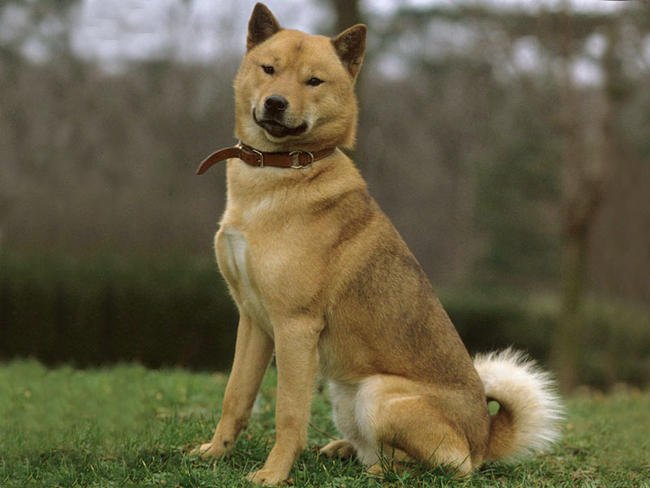
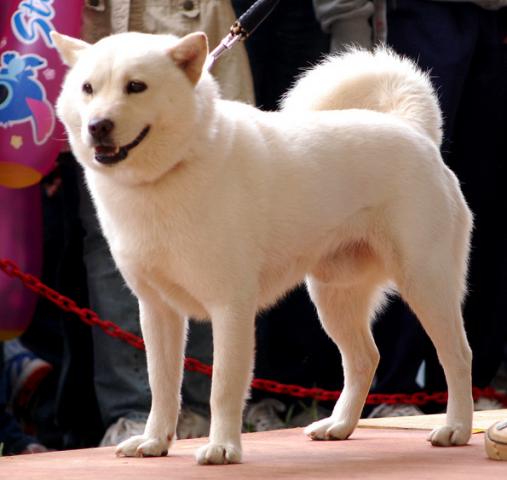
The coat is double: the outer hair harsh and straight, the undercoat soft and dense, the hair on the tail fairly long and standing off. The standard recognises six colours, the broadest palette among the Japanese breeds in the FCI nomenclature.
- Sesame: the standard defines it as an even mixture of black, red and white hairs over the whole body.
- Brindle: a striped pattern.
- Red.
- Black. Solid black is a recognised entry in its own right, one that most popular accounts of the breed drop, keeping only “black and tan”.
- Black and tan.
- White. By NIPPO’s observation, the share of white dogs has been growing in recent years.
Two details are easily missed. First, the Hokkaido standard does not require “urajiro” – the pale areas on the sides of the muzzle, the cheeks, throat, chest, belly and inner sides of the limbs – whereas for the Shiba it is obligatory in every colour, and for the Akita in every colour but white. Second, the list of faults in the Hokkaido standard includes “pinto colour”, meaning large white patches on a coloured ground: white is recognised as a solid coat, not as piebald marking.
Height: why the figures differ from source to source
It pays to be careful here, because height is where the muddle arises most often. FCI No. 261 gives height as a range: dogs 48.5–51.5 cm, bitches 45.5–48.5 cm. That is an exception among the Japanese breeds, since every other FCI standard gives a single ideal figure with a tolerance – Shiba 39.5 / 36.5 cm with a tolerance of 1.5 cm, Kai 50 / 45 cm with +3 cm, Kishu and Shikoku 52 / 49 cm each with +3 cm, Akita 67 / 61 cm with ±3 cm. The Hokkaido is the only one of the six for which the FCI has written limits.
Japan’s NIPPO measures the breed on a different basis: dog 52 cm (working range 46–55 cm), bitch 49 cm (43–52 cm). The Japanese association thus places the Hokkaido in the same format as the Kishu and the Shikoku, whereas the FCI describes it as somewhat lower and between bounds. Both sets of figures are correct; they simply belong to two separate documents. If a breed description shows “46–56 cm” as one span for both sexes, that is no longer a standard but two ranges run together. Neither FCI No. 261 nor the natural-monument record fixes a weight.
Faults and disqualifications: what the judge looks for in the ring
The standard opens this chapter with the formula shared across the whole of the FCI: any departure from what has been described is to be counted a fault, and the seriousness of the fault is judged in exact proportion to its degree and to its effect on the health and welfare of the dog. There follows a short list, which for the Hokkaido runs as below.
- Faults: absence of sexual dimorphism (a dog of bitchy type, or the reverse); slightly overshot or undershot mouth; timidity; pinto colour.
- Disqualifying faults: aggressiveness or excessive shyness; any obvious physical or behavioural abnormality; markedly overshot or undershot mouth; ears that fail to stand; a hanging or bobbed tail.
Note that behaviour stands here beside anatomy: under the standard a dog may be faultless in build and still be put out of the judging on temperament. For a breed that popular writing presents as “stern and mistrustful”, that is an important correction – reserve towards strangers and excessive shyness are two different things, and the second is officially unacceptable.
A comparison with close relatives: the stately Akita Inu stands 15–19 cm taller at the withers under the standards, whilst the Shiba Inu stands roughly 9–12 cm lower. The Hokkaido belongs, with the Kai, the Kishu and the Shikoku, to the medium-sized Japanese dogs, and confusing them with one another is easy enough: NIPPO notes specifically that the forechest of the Hokkaido is particularly well developed, which gives it the look of a dog with a lower centre of gravity and a stockier outline than the other medium Japanese dogs.
Character: what the standards say, and what they leave out
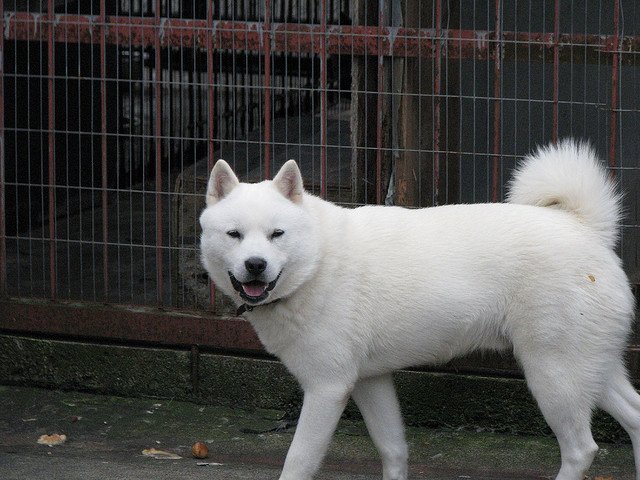
The “Behaviour / temperament” section of FCI Standard No. 261 reads as follows: a dog of exceptional endurance, showing dignity and natural artlessness; the temperament is faithful, docile, very alert and bold; the dog also shows soundness of judgement and great stamina. The word “docile” is neither a slip nor a softening: it appears in the Kishu and Akita standards as well, and the Shikoku is described as “docile towards its master”.
NIPPO goes further still in its own account of the Hokkaido and warns pointedly against romanticising the breed: in character the Hokkaido differs little from the other Japanese dogs, and for all its work on big game this is not a breed whose fierceness ought to be emphasised. That runs directly counter to the mass image of the “fearless bear-fighter” which travels from one text to the next. A hunting breed, yes; a breed whose aggressiveness is worth advertising, no.
The standard has one further dimension, seldom mentioned though thoroughly practical. Timidity is placed on the list of faults, and a dog that is “aggressive or overly shy” is disqualified along with “any dog showing obvious physical or behavioural abnormalities”. For a buyer this reads plainly enough: in a breed where shyness is officially a fault, a puppy that flinches from people at 8–10 weeks and will not come forward is no “typically reserved Japanese dog” but a reason to put further questions to the breeder.
What this means for daily life with the dog:
- Attachment with a preference. The Hokkaido usually builds a particularly close bond with one person, though the rest of the household counts as “its own” too. Plan the training so that the basic commands are worked through by more than the “chief” owner, or the dog will obey selectively.
- Hunting motivation. The breed was made for work on game, so the quick movement of a small animal is a powerful trigger. Reckon on secure fencing, a long line in unfamiliar places, and separate work on the recall.
- Alertness without fuss. The standard calls the breed “very alert”. In practice that gives you a dog which responds to change rather than one which barks as background noise.
- Friction with dogs of the same sex. This is a common trait of the hunting spitz breeds, and it belongs in your planning of walks and introductions.
If you are after something equally out of the ordinary but with a different attitude to small animals, have a look at the Mexican Hairless Dog (Xoloitzcuintli) – a primitive breed as well, but with an altogether different temperament and altogether different grooming needs.
Pros and cons of the breed
| Pros (+) | Cons (−) |
|---|---|
| Deeply attached to the family; the standard describes a faithful and docile temperament | Inclined to work “for itself” and to test where the limits lie |
| Endurance is the standard’s key word for this breed | Heavy seasonal moult of the dense undercoat |
| Attentive and responsive to changes at home | Friction with dogs of the same sex is possible |
| Undemanding coat care outside the moult | Needs a long daily workout |
| Copes well with cold thanks to the double coat | Takes heat worse than frost |
| A rare breed with a documentary history that stands up | A puppy is hard to come by, and the lines must be checked without fail |
Health and genetics: collie eye anomaly, and what to do about it
Care and maintenance
The Hokkaido does well in a flat and in the yard of a private house alike, provided the yard is fenced, the dog is not kept on a chain and is not left on its own round the clock. The breed was made to work at a person’s side, and what breaks such dogs is social isolation rather than cold. If you live in a flat and are not prepared to give the breed two or three hours of active movement every day, it is more honest to look at the Japanese Spitz: white and Japanese as well, but far less demanding in the matter of exercise.
Grooming
The coat type set out in the standard – harsh, straight outer hair plus a soft, dense undercoat – governs the whole of the care. Clipping is contraindicated for such a coat: the outer hair does a protective job, including protection against overheating.
- Outside the moult: combing through with a metal comb once or twice a week.
- During the moult: daily, with a slicker brush or a wide-toothed comb; the undercoat comes away in sheets, and the more thoroughly you take it out, the fewer the mats and the less the skin irritation.
- Bathing: seldom and as the need arises; frequent washing strips out the greasy film that keeps water and dirt on the outside.
- Nails, ears, teeth: regular checks and nail trimming; pricked ears air well, but they are worth inspecting for ticks after a trip to the woods.
Training: not a struggle but an agreement
The standard credits the breed with “soundness of judgement”, and that is the most exact description of what you will be dealing with on the training ground. The trouble usually lies not in the dog failing to understand the command, but in its weighing the situation for itself and deciding whether the command is worth carrying out just now. Monotonous repetition therefore works less well than short, clear spells that are worth the dog’s while.
- Firmness without harshness. Physical pressure, in a breed where timidity is officially a fault, is the shortest road to a dog that shuts down or begins to defend itself. What works is consistency and predictable rules.
- Early socialisation. By four months the puppy should meet the town calmly: traffic, crowds, loud noises, other dogs, the vet’s consulting room. Alertness is a trait of the standard; mistrust of everything new is what follows from a socialisation window that was missed.
- The recall as a project of its own. For a hunting breed this is not “one command among many” but a skill worked at for years, and never tried for the first time where woods and game are close at hand.
- Work for the head. Searching games, scent work and routes that take in new places tire such a breed far better than mechanically clocking up the kilometres.
If other Japanese breeds with a comparable working background appeal to you, take a look at the Kai Ken (Tiger Dog) – another member of the six “Nihon Ken”, whose FCI standard recognises brindle coats alone.
Feeding
The Hokkaido among the six Japanese breeds
The six breeds kept together as the “Nihon Ken” are constantly muddled with one another online. Here is a short guide resting strictly on the FCI standards in force – Akita No. 255, Shiba No. 257, Hokkaido No. 261, Kai No. 317, Kishu No. 318, Shikoku No. 319.
| Breed | Height under FCI (dog / bitch) | Colours under the standard | Tongue |
|---|---|---|---|
| Hokkaido (No. 261) | 48.5–51.5 / 45.5–48.5 cm – a range | Sesame, brindle, red, black, black and tan, white | Blue-black – not a fault |
| Akita (No. 255) | 67 / 61 cm ±3 | Red, sesame, brindle, white; “urajiro” obligatory except in white | Blue or black-spotted – a fault |
| Shiba (No. 257) | 39.5 / 36.5 cm ±1.5 | Red, black and tan, sesame, black sesame, red sesame; “urajiro” obligatory | Not mentioned |
| Kai (No. 317) | 50 / 45 cm +3 | Black brindle, red brindle, brindle | Not mentioned |
| Kishu (No. 318) | 52 / 49 cm +3 | White, red, sesame | Not mentioned |
| Shikoku (No. 319) | 52 / 49 cm +3 | Sesame, red, black and tan | Not mentioned |
One further difference shows up only when the documents are read side by side: the stated use. For the Hokkaido, the Kai, the Kishu and the Shikoku the standard gives “hunting dog, companion dog”; for the Shiba, “hunting dog for birds and small game, companion dog”; and for the Akita, in the version of the standard now in force, simply “companion dog”.
Interesting facts about the Hokkaido
- The best-known Hokkaido came from advertising. A white dog by the name of Kai-kun played the “father” in a long series of commercials for the Japanese operator SoftBank. According to the company’s own newsroom, he was the first “father dog” of the Shirato family and appeared in roughly 300 television advertisements. The Jiji Press agency reported that Kai-kun died of old age on 28 June 2018 at the age of 16, and that he was indeed a Hokkaido Ken.
- 24 dogs in a year. Japan Kennel Club registration statistics for 2025: Hokkaido 24, Shikoku 51, Kai 60, Akita 263, Shiba 3,598. Across all 141 breeds the club registered 302,530 dogs.
- A status without an address. In the state register of monuments the location field for the Hokkaido carries the entry “no territory specified”: the protected status belongs to the breed, and not to a locality or to particular animals.
- Four names in the Ainu language. The language archive of the National Ainu Museum records for the dog the words seta, sita (the everyday variant in the north-east of Hokkaido), together with the descriptive reyep, “the one that crawls”, and apacampe, “the one by the door”.
- The only one with a range. The Hokkaido is the only one of the six Japanese breeds for which the FCI standard sets height by limits rather than by a single ideal figure with a tolerance.
- Last on the list of 1937. Of the dog breeds entered in Japan’s register of natural monuments between 1931 and 1937, the Hokkaido was designated last, on 21 December 1937.
Frequently Asked Questions (FAQ)
Are the Hokkaido, the Ainu Ken and the Hokkaido Ken one and the same breed?
Yes. In the FCI nomenclature the breed is called Hokkaido (Standard No. 261). “Hokkaido Ken” is the same name in Japanese; “Ainu Ken” is the historical name, bound up with the fact that the Ainu bred these dogs for hunting. The breed was given its official Japanese name after the region when it was entered in the register of natural monuments in 1937.
What sets the Hokkaido apart from the Akita and the Shiba?
Size, first and foremost: under the standards the Akita is 67 cm in dogs, the Shiba 39.5 cm and the Hokkaido 48.5–51.5 cm. Then: the Hokkaido admits six colours, among them solid black and brindle, which the Shiba has not; “urajiro” is not required of it; and the blue-black tongue, a fault in the Akita standard, is expressly called no fault in the Hokkaido standard.
What is the main health test for this breed?
The DNA test for collie eye anomaly (a deletion in the NHEJ1 gene). The 2012 study in Veterinary Ophthalmology showed that of 17 Hokkaido examined from three kennels, 12 were carriers and 5 affected, and concluded that the breed is highly susceptible. Ask the breeder for the test results for both parents.
Do Hokkaido bark a great deal?
The standard describes the breed as very alert, and in practice this is a dog that gives voice for a reason rather than in the background. That said, quietness is not a guaranteed characteristic of the breed: much depends on whether the dog is getting enough exercise and whether it is left alone for long stretches.
Is the breed suitable for a first-time owner?
The FCI standard calls the temperament faithful and docile, and NIPPO notes separately that fierceness is not a thing to emphasise in this breed, so the picture of an “unmanageable beast” is overdrawn. But it is a hunting breed with a strong instinct and a high requirement for movement, so a first-time owner will need a trainer and an honest look at their own timetable.
How does the Hokkaido take the heat?
Worse than frost. The standard ties the build of the breed directly to its capacity to withstand severe cold and heavy snowfall; the dense undercoat that rescues it in winter hinders heat loss in summer. In summer, walk the dog in the morning and the evening, provide shade and water, and do not clip it “to make it cooler”.
How long do Hokkaido live?
A figure that we would be willing to put our name to, with a reference to a longevity study of this breed in particular, is one we do not quote. As a rough guide: the best-known representative of the breed, the advertising dog Kai-kun, lived 16 years according to Jiji Press.
Sources
- FCI Standard No. 261 “HOKKAIDO”, version in force of 30.10.2016 (English version of 09.02.2017); for comparison, FCI Standards No. 255, 257, 317, 318, 319.
- Database of national cultural properties of Japan’s Agency for Cultural Affairs, record “北海道犬”, natural monument, designated 21.12.1937.
- NIPPO — 公益社団法人日本犬保存会: “Standard of the Japanese Dog” (1934) and the breed description 北海道犬.
- Mizukami K. et al. Collie eye anomaly in Hokkaido dogs: case study. Veterinary Ophthalmology, 2012, 15(2), 128–132.
- Hashimoto Y., Yamakawa T., Tanabe Y. Further studies on the red cell glycolipids of various breeds of dogs. Journal of Biochemistry, 1984, 96, 1777–1782.
- Xiaokaiti X. et al. The history of ancient Japanese dogs revealed by mitogenomes. Anthropological Science, 2024.
- Language archive of the National Ainu Museum (国立アイヌ民族博物館), dictionary entries on the names for the dog.
- Japan Kennel Club (JKC), registration statistics for 2025.
Video about the breed
- Faithful and closely attached to the family
- Endurance is the standard's key word
- Copes well with severe frost
- Attentive, with a sure read of the situation
- Independent, tests where the limits lie
- Strong hunting instinct
- Dense undercoat moults heavily
- Takes heat worse than frost
| Shiba Inu | Kai Ken (tiger dog) | Kishu Ken | |
|---|---|---|---|
| Height | dogs 38–41 cm | dogs 50–53 cm | dogs 52–55 cm |
| Energy | 4 | 4 | 4 |
| Apartment | 2.5 | 2.5 | 2.5 |
| Beginners | 2.5 | 3 | 3 |
Are the Hokkaido, the Hokkaido Ken and the Ainu Ken one and the same breed?
What is the main health test for the Hokkaido?
How tall is the Hokkaido?
Is the Hokkaido suitable for a first-time owner?
What sets the Hokkaido apart from the Akita and the Shiba?
How does the Hokkaido take the heat?
FCI Standard No. 261 · NIPPO (日本犬保存会) · register of Japan's Agency for Cultural Affairs · Veterinary Ophthalmology, 2012 · JKC
For apartments · For kids · For beginners · Active · Smartest · Hypoallergenic · All rankings →