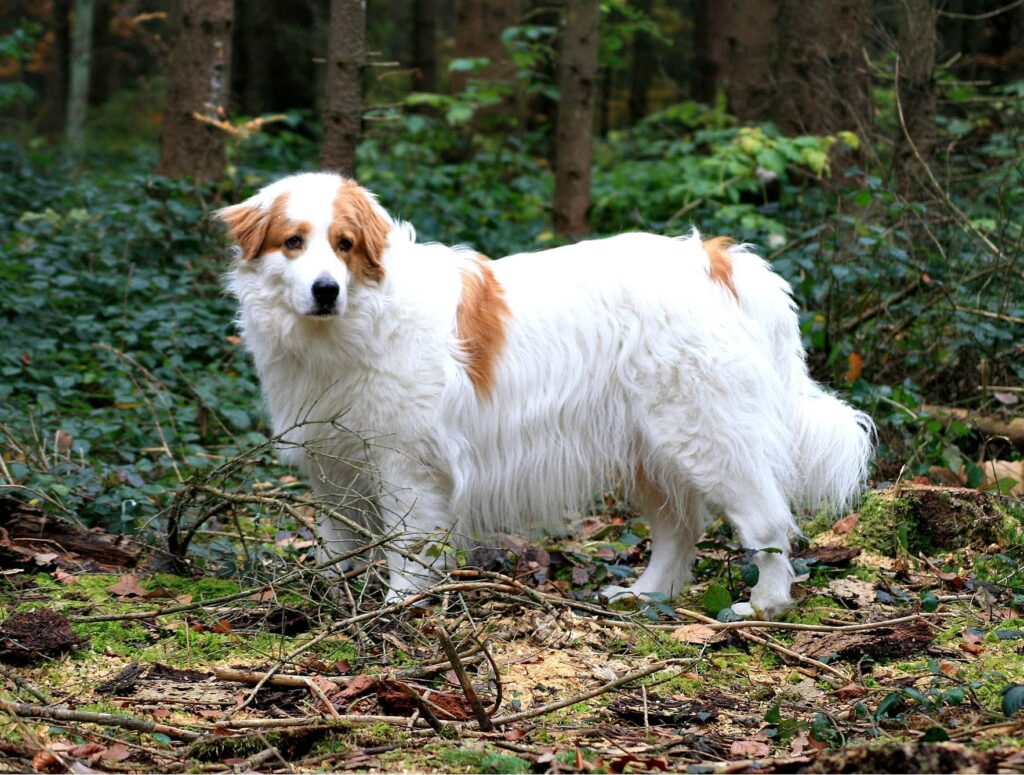
Group 2 · pinschers, schnauzers, molossoids, mountain dogs · Bosnia and Herzegovina / Croatia
Tornjak
A fluffy Balkan flock guardian — hardy and dignified: level-headed, brave, clever and devoted to its owner. The Tornjak (Bosnian-Herzegovinian–Croatian shepherd dog) is an ancient mountain guardian breed that for centuries protected flocks from predators in harsh conditions; an incorruptible watchdog, wary of strangers, it is calm and affectionate with “its own” and makes an excellent companion for the right family.
Apartment · not suitableKidsCats · with caveatsOther dogs · with caveatsBeginners · not suitable
The Tornjak, also known as the Bosnian-Herzegovinian-Croatian Shepherd Dog, is far more than just a large, fluffy canine. This ancient breed boasts a history deeply intertwined with the shepherding traditions of the Balkans. For centuries, these dogs have diligently guarded flocks from predators, toiling in harsh mountainous conditions. They are exceptionally resilient, loyal, and intelligent, making them not only first-class working dogs but also wonderful companions for the right family. In this comprehensive review, prepared by the experts at Tvaryny, we'll delve into the world of these magnificent animals, uncovering every aspect of their character, care, and fascinating history.
Tornjaks are dogs with an inherent sense of dignity. They form strong bonds with their family and territory, proving to be reliable and fearless protectors. Their swift reactions, agility, and strength allow them to confidently confront danger. Yet, in a domestic setting, they are calm and obedient animals who demand respect and close human contact.
Tornjak: Key Breed Characteristics
To get a first impression of this unique breed, let's look at its key parameters in a convenient table.
Tornjak: Key Breed Characteristics · 10
Parameter
Characteristic
Origin
Bosnia and Herzegovina, Croatia
FCI Classification
Group 2 (Pinscher and Schnauzer, Molossoid breeds, Swiss Mountain and Cattle Dogs), Section 2.2 (Molossoid breeds / Mountain type)
Type
Herding dog, guardian, companion
Lifespan
10–14 years
Height at Withers
Males: 65–70 cm; Females: 60–65 cm
Weight
Males: 35–50 kg; Females: 28–40 kg
Temperament
Calm, confident, loyal, brave, wary of strangers
Exercise Needs
High
Shedding
Very intense, especially seasonal (twice a year)
Grooming
Requires regular brushing, especially during shedding periods
Interesting Facts About the Tornjak
Shared Heritage: The Tornjak is a shared breed of Bosnia and Herzegovina and Croatia. Both countries consider it their national heritage and have jointly worked on its restoration and recognition.
Unbribable Guardian: It is believed that a Tornjak cannot be bribed with treats or distracted from its guarding duties if it senses a threat.
"Weather Dog": Thanks to its double coat, the Tornjak feels perfectly comfortable in any weather. The thick undercoat keeps it warm in winter, and the harsh outer coat protects it from rain and snow.
Silent Observer: Unlike many other guardian breeds, the Tornjak does not bark without reason. It usually observes the situation silently and only barks when it deems it necessary. Its bark is low and very powerful.
Connection to History: The breeding of Tornjaks is sometimes compared to the breeding of another indigenous breed of the region – the Bosnian Coarse-haired Hound (Barak). Both breeds are an important part of Bosnia's cultural heritage, although they have completely different purposes.
History of the Bosnian Shepherd Dog
The history of the Tornjak stretches back through the ages. The first written mentions of dogs resembling modern Tornjaks date back to as early as 1067. They were discovered in the archives of the Diocese of Đakovo (Croatia). This proves that the breed is indigenous to the mountainous regions of Bosnia and Herzegovina and Croatia, particularly the Dinaric Alps. The name "Tornjak" derives from the word "tor," which in local dialects means "sheep pen." This directly indicates their primary purpose – protecting flocks.
It is believed that the ancestors of the Tornjaks were Molossers who arrived in the Balkans with the Roman legions and subsequently interbred with local shepherd dogs. The isolation of the mountainous areas fostered the development of a unique type of dog, perfectly adapted to the challenging conditions. For centuries, these dogs were indispensable helpers to shepherds, defending flocks from wolves and bears. Their development occurred through natural selection – only the strongest, most resilient, and most intelligent individuals survived.
With the decline of traditional nomadic shepherding in the mid-20th century, the breed found itself on the brink of extinction. The population of purebred dogs dramatically decreased. However, thanks to the efforts of enthusiasts, a breed recovery programme began in Bosnia and Croatia in 1972. Cynologists started searching for surviving specimens that matched historical descriptions and undertook systematic breeding work. This work was successful: in 1981, the breed was registered at a national level, and in 2007, it received preliminary recognition from the Fédération Cynologique Internationale (FCI). Full recognition followed in 2017. Today, the Tornjak is a national pride of Bosnia and Herzegovina and Croatia, embodying the living history of the Balkans. It is often compared to other shepherd dogs of the region, such as the Šarplaninac or the Karst Shepherd, each with its own unique history and traits.
Tornjak Standard and Appearance
The Tornjak is a large, powerful, yet proportionally built and agile dog. It conveys an impression of strength and dignity. Its appearance fully corresponds to its working purpose.
General Appearance: Body is almost square in format, strong, but not coarse. Bone structure is strong, but not overly heavy. Movements are harmonious and balanced.
Head: Long, wedge-shaped. The cranial part is slightly wider than the muzzle. The stop is moderate. The bridge of the nose is perfectly straight.
Muzzle: Rectangular, with strong and long jaws. The nose is large, with wide nostrils, always dark in colour. Lips are tight-fitting, with dark pigmentation.
Eyes: Almond-shaped, dark brown. The gaze is calm, confident, without a hint of fear or aggression. Eyelids are tight-fitting, with dark pigmentation.
Ears: Medium-sized, triangular, pendulous and close-lying to the cheeks. Set rather high.
Neck: Medium length, muscular, without dewlap. Covered with thick, long hair, forming a distinct mane.
Body: Withers are moderately pronounced. Back is straight, broad, and strong. Loin is short, muscular. Chest is very broad, deep, and oval in shape.
Tail: Long, set high, very mobile. Covered with thick and long hair. In motion and when excited, it is carried high above the topline.
Coat: The Tornjak has a double coat. The outer coat is long, straight, harsh to the touch. The undercoat is very dense, soft, and thick, especially in winter. On the head and front part of the limbs, the hair is short. On the neck (mane), hindquarters ("trousers"), and tail, the hair is particularly long.
Colour: As a rule, the Tornjak has a parti-colour coat. The main colour – white – with clearly defined patches of various colours (black, brown, red, fawn). A mantle pattern is also possible, where a black "mantle" covers the body, while the head, neck, and limbs remain white. Solid colours are undesirable.
Tornjak Character and Temperament
The Tornjak's character is a unique blend of calmness and determination. Within its family circle, it is an exceptionally gentle and affectionate dog. It is very people-oriented and tolerates loneliness poorly. Its loyalty knows no bounds, and it forms a deep bond with all family members, including children, whom it treats with great patience and caution. However, one should not forget its primary purpose.
The guardian instinct is in the Tornjak's blood. It vigilantly monitors its territory and is wary of any strangers. Its behaviour is not causelessly aggressive. Initially, it will warn of its presence with a low, deep bark. But if it senses a real threat to its family or property, it will not hesitate to defend. This is a serious protection dog, whose temperament differs significantly from, for example, the energetic and play-oriented German Boxer.
Tornjaks are very intelligent and capable of independent decision-making – a quality necessary for a herding dog that often works far from its owner. This independence can sometimes manifest as stubbornness during training. They will not blindly follow commands if they don't see the point. With other animals, especially if they have grown up together, Tornjaks usually get along well, perceiving them as part of their "pack" to be guarded. However, given their size and strength, early and proper socialisation is absolutely essential. This is not a dog suitable for an inexperienced owner. Its upbringing requires patience, consistency, and an understanding of the psychology of working breeds with similar purposes, such as the Cão Fila de São Miguel.
Pros and Cons of the Breed
Before acquiring such a serious dog as a Tornjak, it's crucial to soberly assess all its advantages and potential challenges. This will help avoid disappointment and ensure a happy life for both the dog and its owner.
Pros and Cons of the Breed · 6
Pros (+)
Cons (-)
Exceptional Guardian Qualities: Innate instinct to protect territory and family.
Not Suitable for Apartment Living: Requires ample space and a fenced area.
Loyalty and Affection towards Family: Very loving and devoted to its people.
High Socialisation Needs: Without early socialisation, can be overly wary or aggressive towards strangers.
High Intelligence: Capable of independent situation analysis and decision-making.
Tendency towards Dominance and Stubbornness: Requires an experienced and confident owner.
Stable Psyche: Balanced and calm, not prone to hysterics or causeless aggression.
Very Heavy Shedding: Hair will be everywhere, especially twice a year during seasonal shedding.
Gets along well with children and other animals (if raised together).
Loud Bark: Its voice is designed to be heard over long distances.
Unpretentious and Robust Health: Adapted to harsh living conditions.
Not for Novices: Requires a deep understanding of the psychology of guardian dogs.
Training and Socialisation
Raising a Tornjak must be based on mutual respect. This is not a breed where results can be achieved through force or harshness. They will only obey someone they consider a confident and consistent leader. Training must be patient but persistent. Early socialisation is key. From puppyhood, the dog needs to be introduced to various people, sounds, places, and other animals (under supervision). This will help raise a well-balanced dog that reacts appropriately to new situations.
Tornjaks learn quickly, but their independence can create certain difficulties. They may refuse to perform a command if they don't understand its purpose. Special guard training is usually not needed – this instinct is innate in them. The owner's main task is to teach the dog to control its impulses and trust its judgment when intervention is needed.
Tornjak Care and Maintenance
Proper care for a Tornjak is key to its health and well-being. Although the breed is generally undemanding, some aspects require special attention.
Grooming and Coat Care
The Tornjak's luxurious coat is its calling card, but it requires regular care. The main tool is a brush or a metal comb with long teeth. You should brush your dog at least 1–2 times a week to prevent matting. During seasonal shedding, which occurs in spring and autumn and is very intense, the procedure will need to be daily. Special attention should be paid to areas with the longest hair: the "mane," "trousers," and tail. Bathe your Tornjak only when absolutely necessary, as its coat has a natural protective layer that is easily washed away by frequent bathing. Regularly check and clean its ears and eyes, and trim its nails if they don't wear down naturally.
Physical Exercise and Activity
The Tornjak is a working dog that needs not only space but also a purpose. Simply running freely in the yard is not enough for it. It needs long walks (at least 1–2 hours a day) at a calm pace, during which it can "patrol" its territory. They are not fond of intense running training or agility. Their element is a leisurely, thoughtful patrol of their domain. The best exercise for a Tornjak is guardian work.
Living Conditions
Categorically unsuitable for apartment living. Confinement, the inability to fulfil its guarding instinct, and loud barking will make life with it in urban conditions unbearable for you, your neighbours, and the dog itself. The ideal place for a Tornjak is a private house with a large, securely fenced plot where it can move freely and perform its "work." Keeping this dog on a chain is a crime against its nature, which can lead to serious psychological problems.
Nutrition
Tornjak Feeding Recommendations
Health and risks
Health and Typical Breed Ailments
Frequently Asked Questions About the Breed (FAQ) · 4
Is the Tornjak suitable for apartment living? No, absolutely not. This breed needs space, a large fenced area for patrolling, and the opportunity to fulfil its guarding instincts. Keeping it in an apartment will lead to behavioural problems and suffering for the animal.
How do Tornjaks get along with children? Usually, very well. They are patient, gentle, and careful with their family's children, often taking on the role of their protector. However, any interaction between a large dog and a small child should be supervised by adults.
Does the Tornjak shed a lot? Yes, very heavily. Particularly intense shedding occurs twice a year (spring and autumn) when the dog changes its undercoat. During this period, daily brushing is mandatory. At other times, hair also falls out, so this breed is not for those who dislike dog hair in the house.
Can a Tornjak be a first dog? It is not recommended. The Tornjak is a serious working breed with a tendency towards independence and dominance. It requires an experienced owner who understands the psychology of guardian dogs, can become a confident leader for it, and ensure proper socialisation and living conditions.
Video about the Breed
FAQ
Where does the Tornjak come from?
An ancient Balkan shepherd breed of Bosnia and Herzegovina and Croatia that for centuries guarded flocks from predators in harsh mountain conditions; today a reliable guardian and companion.
What is the Tornjak's character?
The standard describes it as level-headed, brave, clever and dignified: an incorruptible watchdog, wary of strangers, but calm, devoted and affectionate with its family.
Is the breed suited to a novice?
Not really — a self-reliant mountain guardian with a strong instinct; it needs space, early socialisation and an experienced, calm owner.