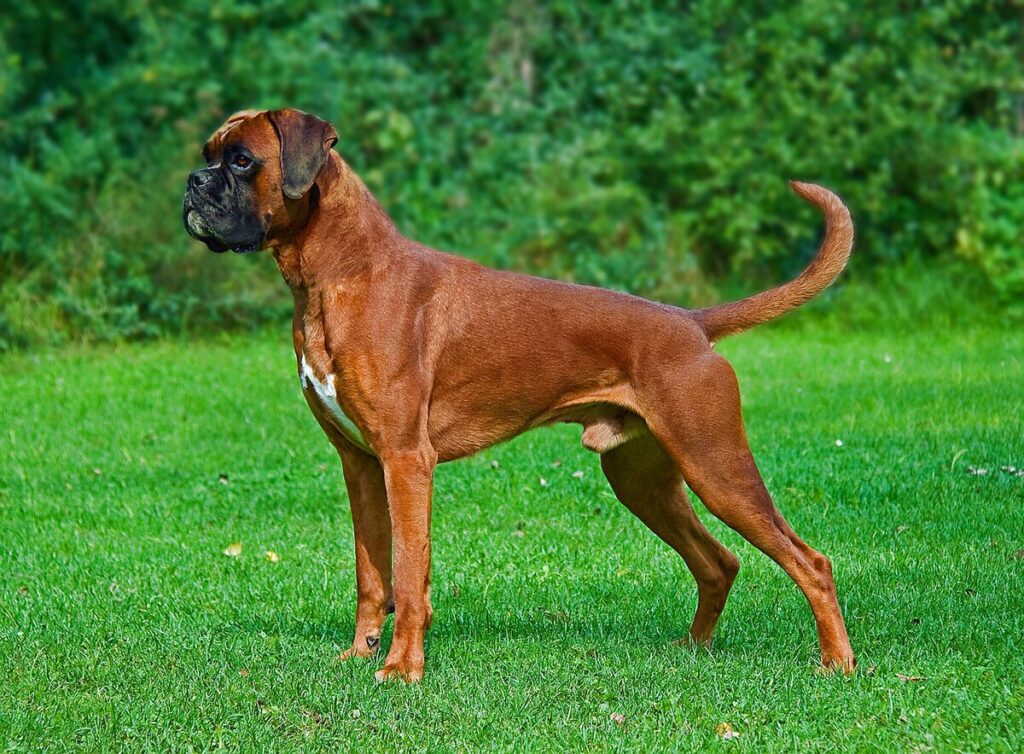
The German Boxer is easy to recognise and hard to sum up in a single word. A square silhouette, dry sculpted musculature, a short broad muzzle with the characteristic undershot bite, and a look in which curiosity outweighs threat. A working dog with a hunting past that became a family companion without losing strength or stamina. This overview was prepared by the Tvaryny team: we rely on the current standard's text, on peer-reviewed veterinary literature and on primary-care veterinary data, not on retold club legend.
The Boxer has a reputation as the "eternal puppy" — playful, attached to people, patient with children. That is largely fair, but it is not the whole truth. The Boxer is one of the best-documented breeds in veterinary cardiology and oncology, and that is exactly where a future owner's main decisions lie: which examinations a puppy's parents must have, and what to watch for across the dog's life.
The German Boxer: a brief breed overview

The German Boxer: a brief breed overview · 14
| Characteristic | Value |
| Country of origin | Germany |
| Current standard | FCI No. 144, edition valid from 1 April 2008, published 9 July 2008 |
| FCI classification | Group 2 (pinschers and schnauzers, molossoid breeds, Swiss mountain and cattle dogs), section 2.1 (molossoid, mastiff type), with working trial |
| Purpose per the standard | Companion, guard and working dog |
| Height at withers (males) | 57–63 cm (FCI) |
| Height at withers (females) | 53–59 cm (FCI) |
| Weight (males) | over 30 kg at a height of about 60 cm (FCI) |
| Weight (females) | about 25 kg at a height of about 56 cm (FCI) |
| Mean adult weight in UK practice | males 32.99 kg, females 27.56 kg |
| Median lifespan (United Kingdom) | 10.46 years |
| Coat | Short, hard, close-lying, without undercoat |
| Colour per the standard | Fawn or brindle, with a black mask |
| Temperament per the standard | Fearless, self-assured, calm and balanced |
Boxer colour and the question of white puppies
The standard recognises two colours. Fawn — in shades from light fawn to dark deer red, with the standard calling the middle shades the most attractive. Brindle — a fawn ground with dark or black stripes running parallel to the ribs and contrasting distinctly with the ground. A black mask is required in both variants. On white markings the FCI is mild: they "should not be rejected, they can be quite pleasing" — but markings exceeding one third of the ground colour already count as faults.
Practice looks different from the text. In a British study covering 2016, in which colour was recorded for 2,940 Boxers, the distribution was: brindle — 22.82%, dark fawn — 22.62%, dark fawn with markings — 20.92%, brindle with markings — 11.29%, white — 10.71%, light fawn — 5.34%. One Boxer in ten under veterinary care in Britain was thus recorded as white, although no standard recognises a white Boxer.
White Boxers have existed in the breed since its founding. Gene mapping showed the same mutation responsible for white colour in the Boxer and the Bull Terrier, and the link between white colour and congenital deafness has been described for over a century — which is why breeders traditionally regarded white puppies as undesirable. The most precise figures come from a Dutch cohort of puppies born between January 1994 and March 1995: in 414 litters there were 2,629 puppies, mean litter size 6.4. By weaning at 50 days of age, 571 puppies (21.7%) had died or been euthanised; of these, 147 (25.7%) were stillborn, and 102 (17.9% of all pre-weaning losses) were euthanised specifically because of white colour.
So how many white Boxers are actually deaf? One direct study of the breed exists and it is very small: brainstem auditory evoked response testing on 43 Boxers, 14 of them white; two white dogs proved deaf in both ears and one in a single ear, while all the non-white dogs heard normally. The authors stressed that the sample is too small for statistical conclusions. A more robust guide comes from the Bull Terrier — same genetic cause, far more white dogs. In a British study of 1,060 Bull Terriers, congenital sensorineural deafness occurred in 10.19%: 8.21% in one ear and 1.98% in both; among white dogs 19.29%, among non-white 0.77%.
In the rest of health, the difference between white and coloured Boxers proved far smaller than expected. None of the 34 most common diagnoses differed in frequency, and median lifespan did not differ statistically either: 10.55 years in white dogs against 10.38 in the others. Two diagnostic groups did differ — dental (7.94% against 5.14%) and brain disorders (5.08% against 2.25%) — but the authors caution that with 66 separate comparisons, two "hits" may well be chance.
Ear cropping and tail docking: what applies where
Brachycephaly in the Boxer: why he should not be equated with the Pug
The Boxer is counted among the brachycephalic breeds, and that is true. But brachycephaly comes in degrees, and this is where the easiest mistake is made: giving the Boxer the whole bundle of problems described for the Pug or the French Bulldog.
The objective measure is the craniofacial ratio, the ratio of muzzle length to total skull length. In the Boxer it is 0.31; for comparison: in the Pug it is 0.08, in the French Bulldog 0.19, in the English Bulldog 0.22. The Boxer stands apart in that sequence, and that is no accident: the 1:2 proportion between bridge of nose and skull is written expressly into the FCI standard.
The consequence shows up in the data. In a British study, upper respiratory tract disorders as a group accounted for only 3.23% in Boxers. For context: in the same dataset they occur in extremely brachycephalic breeds at about 22%, and in moderately brachycephalic and non-brachycephalic breeds at 9.7%. The Boxer came in below even the second group; the authors suggest both the more moderate muzzle conformation and the larger body size help.
The same goes for lifespan. There is weighty evidence that extreme brachycephaly substantially shortens a dog's life. But the median lifespan of Boxers in the British sample — 10.46 years — proved typical for breeds of that body mass: the Rottweiler gave 9.0 years by the same methodology, the German Shepherd 10.3, the Labrador 12.0.
This does not mean the Boxer gets his muzzle conformation for free: he pays with his eyes — more on that below — and with heat sensitivity. But the authors expressly call transferring the whole brachycephalic group's risks onto an individual breed an ecological fallacy, and cite the Boxer as an example of why breed-specific data are needed. In practice: in hot weather the Boxer is protected and not worked hard, but the breed does not need the daily monitoring of breathing that a Pug does.
Who the Boxer suits, and who he does not
Who the Boxer suits, and who he does not · 7
| Advantages | Disadvantages |
| Deeply attached to the family, strongly human-oriented | Breed cardiac risks require regular monitoring |
| Stays playful for a long time, fits an active family | High share of neoplasia among illnesses and causes of death |
| Minimal coat care | Vulnerable eyes: frequent corneal ulceration |
| Trainable, works well on positive reinforcement | Copes poorly with being left alone, needs human company |
| Natural guarding instinct without excessive sharpness per the standard | Copes poorly with heat; without undercoat he feels cold and damp |
| Suited to dog sport and working roles | Needs long daily exercise |
The Boxer is not a choice for someone out of the house most of the day, nor for anyone looking for a dog "with no health worries". He suits an active family prepared for long daily walks and scheduled veterinary examinations. If the eternal-adolescent temperament appeals, look also at other powerful breeds — the Cão Fila de São Miguel or the Bullmastiff, each with its own demands on an owner.
The Boxer heart, part one: ARVC and the striatin gene
Arrhythmogenic right ventricular cardiomyopathy is the disease for which cardiologists the world over know the Boxer. It was first described in Boxers in 1983: unlike other canine cardiomyopathies it lacked ventricular dilation and atrial fibrillation, but produced massive replacement of heart muscle cells by fatty and fibrous tissue, ventricular premature complexes and frequent ventricular tachycardia.
The mechanism explains the danger: fibrofatty replacement destroys conduction between cells, raising the risk of life-threatening ventricular arrhythmias. Clinically this may present as fainting, as congestive heart failure — or not at all until sudden death. Inheritance is described as autosomal dominant with incomplete penetrance; OMIA classifies the condition as multifactorial. Incomplete penetrance is no formality: some carriers never show disease, some have a mild manageable form, some die suddenly. In humans 141 mutations across eight genes have been described, and even in identical twins the course can diverge strikingly. The mean age of onset is about six years — often after the dog has already been bred from.
The genetic history of this disease is a rare case of science publicly correcting itself. In 2010 a genome-wide association study of 46 affected and 43 unaffected Boxers, genotyped on a panel of 49,663 single-nucleotide polymorphisms, gave its strongest signal on chromosome 17, and fine mapping found there an 8 base pair deletion in the 3′ untranslated region of the striatin gene. The deletion reduces the gene's expression; dogs homozygous for it had more ventricular premature complexes. In 2013 the same researchers showed the deletion is also associated with dilated cardiomyopathy in Boxers. Commercial laboratories quickly turned the finding into a test.
Then, in 2015, a British pedigree study showed something else. All ARVC cases in British Boxers traced back to a small group of imported American dogs from the same group in which the disease was described in 1983. But dogs with and without the mutation appeared among affected and unaffected alike. The authors concluded the striatin mutation is not the cause but merely linked to the true gene on the same chromosome, and that meiotic recombination can separate the two. The consequence was direct: on 26 January 2022 the international OMIA database removed this variant from its tables of likely causal variants. A commentary in the professional press called it a cautionary tale for molecular geneticists: the test was sold as one for a monogenic disease, while the variant proved merely linked.
In 2021 a second variant was described — a single-nucleotide substitution in a regulatory gene; it too is autosomal dominant and also of incomplete penetrance. In the in-house sample of the cardiology laboratory at North Carolina State University, of 1,690 Boxers tested 53% were negative, 41% heterozygous carriers and 6% homozygous. Practically: genetic tests for ARVC make sense as a mating-planning tool, not as a diagnosis. The researchers themselves warn against excluding carriers en masse — they carry many useful genes too, and abruptly narrowing the gene pool would harm the breed.
Holter monitoring: how the Boxer heart is actually examined
Because ARVC affects primarily the electrical system of the heart rather than its geometry, an ordinary ultrasound scan shows nothing in many affected Boxers. The main tool remains ambulatory ECG monitoring over a full day — the Holter.
The recommendation of the cardiology service at North Carolina State University is simply put: Holter monitoring begins at three years of age and is repeated annually. One normal examination does not mean the dog will never fall ill — only that there is no disease now. The reverse holds too: premature complexes found do not in themselves establish a diagnosis, since they may be caused by inflammation of the heart muscle after viral infection, by parasitic disease and by tumours, including in other organs.
There is still no accepted threshold of "this many premature complexes means disease", and cardiologists acknowledge that openly. The most carefully reasoned scheme came from a group at the Royal Veterinary College in London, which reviewed the clinical records of 264 Boxers from 2001–2013. Its criterion is two out of three: at least 100 ventricular premature complexes in a day, couplets, and the "R on T" phenomenon on the recording. In the group selected by this criterion (61 dogs) the mean age was 7.21 years against 4.63 in a control group of 70 dogs, the mean number of premature complexes 2,240 against 446, couplets in 88.5% against 20.0%, the "R on T" phenomenon in 76.7% against 13.6%, ventricular tachycardia in 49.2% against 10.0%.
Why counting premature complexes alone is not enough is shown by a separate piece of work: in Boxers producing more than 500 premature complexes a day, the spontaneous difference between adjacent days reached 80%. The same dog on a Monday and on a Thursday can give results that look like different stages of disease.
The Holter also gives a prognosis: in a retrospective study of 122 Boxers from three university clinics, survival was significantly longer in dogs with a left ventricular end-systolic diameter of no more than 35 mm. These numbers are for the clinician, not for self-interpretation. The owner needs one thing from them: in this breed, ambulatory ECG monitoring is a scheduled annual examination from three years of age, not a response to symptoms.
Oncology: why the Boxer became a model breed
The Boxer's predisposition to neoplasia has been documented for decades in sources of varying type — from the records of specialist clinics and post-mortem studies to national cancer registries and mortality studies.
The key figure: neoplasia as a diagnostic group was recorded in 14.20% of Boxers over one year. For comparison, in the same dataset and by the same methodology the figure was 4.82% in the German Shepherd, 5.5% in the Greyhound, 7.4% in the Labrador Retriever and 7.96% in the Rottweiler. A further 10.10% of Boxers carried a diagnosis of "mass" — some of these were not taken through to a definitive histological conclusion, so the true share of neoplasia is probably higher.
Within mortality, neoplasia accounted for 12.43% of all recorded deaths at a median age of 9.45 years — noticeably earlier than the breed's overall median lifespan. A further 8.38% of deaths fell to "mass" and 9.54% to brain disorders (median age 11.01 years); the authors note that some deaths in these groups are most likely oncological as well.
A caveat is needed here about how to read such numbers. Annual frequency of a diagnosis, share within mortality and lifetime risk are three different quantities. They are often confused, and it is exactly from that confusion that striking but inaccurate claims about the breed are born. We give the first two, because for them there are sources with a known methodology.
The commonest specific oncological diagnosis is the mast cell tumour, recorded in 1.86% of Boxers a year at a median age of 7.24 years. The conclusion is simple: any new lump on a Boxer's skin goes to a vet rather than being watched for months. A mast cell tumour can look like anything — from a tiny nodule to what seems a fatty lump — and cytology, not appearance, answers what it is.
The breed's tumour predisposition has an unexpected scientific consequence. When the first high-quality complete dog genome was published in 2005, a Boxer bitch named Tasha was chosen for sequencing. The reason was twofold: she had the lowest heterozygosity across a small set of loci, simplifying genome assembly, and the researchers expected the Boxer's cancer predisposition to allow the canine and human genomes to be compared. The dog reference genome, on which much of modern canine genetics rests, is therefore a Boxer genome.
Eyes, gums and skin: three places where the breed is vulnerable
Eyes. Corneal ulceration is the third most common diagnosis in the breed: 5.00% a year. A separate study on the same dataset placed the Boxer second among all breeds at 4.98% — only the Pug is ahead, at 5.42%; in crossbreeds it was 0.38%, so in the Boxer it is roughly thirteen times higher. The predisposition of brachycephalic dogs to corneal ulceration has been described for over a century, and the Boxer's own breed problem — the non-healing, or indolent, corneal ulcer — was formally described in this very breed in the 1960s. In practice: a squinting, watering or reddened eye in a Boxer means a vet the same day, not "watch it until tomorrow".
Gums. Epulis — a benign gum overgrowth also known as peripheral odontogenic fibroma — is the second most common diagnosis in the breed (5.84%) at a median age of 8.75 years; the predisposition has been recognised since at least the 1960s and confirmed in owner surveys, Swedish insurance data and the records of British laboratories. Regular inspection of the mouth catches it early. Notably, the Boxer has a below-average frequency of periodontal disease: 4.63% against 12.52% in dogs overall. The authors cautiously suggest that breathing with the mouth slightly open, the undershot bite and the widely spaced teeth — long regarded as a problem — may at once reduce food impaction and increase salivation.
Skin. Skin disorders are the largest diagnostic group in the breed: 17.74% a year. They include allergic conditions (hypersensitivity — 2.95%, atopic dermatitis — 1.30%), pyoderma (1.83%) and alopecia (1.83%). The Boxer is among the breeds placed in the raised-risk group for atopic dermatitis in Scandinavian studies. A short coat without undercoat means any lesion becomes visible quickly — which is rather an advantage for early detection.
Kidneys, gut and thyroid
Kidneys. Kidney disease is a distinct breed priority, and death from it comes early: the median age at death from renal causes was 7.92 years, one of the lowest of any cause. The genetics proved complex. A 2023 Bayesian mixed-model study in 117 affected and 137 unaffected Boxers identified 21 genomic regions associated with chronic kidney disease: affected dogs carried on average 20.2 risk alleles against 15.6, and together these regions explained 57% of the trait variance. Among their genes are RELN, MAGI2 and FGFR2, implicated in kidney development or disease in humans. Practically: no monogenic disease with a simple test, so monitoring means blood biochemistry and urinalysis as directed by a vet, not a DNA test.
Gut. Histiocytic ulcerative (granulomatous) colitis is a classic "Boxer" disease with an instructive history. For decades it was thought idiopathic and immune-mediated, with a poor prognosis. Then invasive Escherichia coli was found in the colonic mucosa of affected Boxers. A prospective study in seven Boxers confirmed it in all seven biopsies. Every dog responded to enrofloxacin within two weeks and six were sustained — the median relapse-free period was 47 months, ranging from 17 to 62; the one dog that relapsed carried a resistant strain. Practically: chronic bloody, mucoid diarrhoea in a young Boxer is not a reason to change foods for years, but a reason for colonoscopy with biopsy and culture. Enteropathies as a group accounted for 7.77% of diagnoses a year.
Thyroid. Hypothyroidism was recorded in 1.68% of Boxers a year at a median age of 8.84 years. The frequency is low, but among breeds the Boxer has the third highest figure and a more than tenfold higher risk than crossbreeds. The signs are non-specific: weight gain without a change in diet, lethargy, deterioration of the coat, skin problems that respond poorly to treatment.
Spine, joints and nervous system
What the parents are screened for: breed programmes in different countries
The list of examinations a pair of parents should have is the main thing separating a responsible breeder from an irresponsible one.
Germany. The breed club of the country of origin (Boxer-Klub e. V., Munich) assesses hip dysplasia and spondylosis radiographs centrally, jointly with the association of expert radiologists. The distinctive feature lies elsewhere: the club applies estimated breeding values — a selection index accounting not only for the dog but for its relatives and offspring. It is binding for hip dysplasia and cryptorchidism, informative for spondylosis. The club also keeps a list of recognised cardiac specialists. The highest breeding approval (Körung A) comes only after the relevant test and once the dog has proved its hereditary quality in at least 8 litters for a male or 3 for a female.
United Kingdom. The Kennel Club, together with the breed council, runs a Breed Health and Conservation Plan that draws together evidence from the literature, breed surveys and insurance data; the current priorities are oncology, cardiology, juvenile kidney disease and skin disorders. In addition, under the Breed Watch scheme the Boxer is placed in category two with "stenotic nostrils" noted as a point for judges to monitor in the ring.
United States. The breed's charitable foundation funded both the first and the second discovery of genes linked to ARVC, and the university cardiology service offers breeders a combination of genetic testing with Holter monitoring. The recommendation to begin it at three years and repeat annually comes from precisely there.
What to ask a breeder in any country: radiographic assessment of hips and spondylosis for both parents; a specialist cardiac examination with echocardiography and ambulatory ECG monitoring; DNA test results where applicable; and whether the line has had sudden deaths at a young age. A refusal to show these documents should raise concern.
What else is worth knowing about the Boxer
- The dog reference genome is a Boxer's. The first high-quality complete genome of the domestic dog, published in 2005, was assembled from the DNA of a Boxer bitch named Tasha.
- The breed defeated its own inherited disease. Progressive axonopathy, described in British Boxers in 1980, was removed from the breed by joint breeding effort over the following decade.
- The Boxer is a model of a human heart disease. Because of the phenotypic similarity to human arrhythmogenic cardiomyopathy, the breed is regarded as a natural model for studying that disease in people.
- The standard forbids a Bulldog head. The FCI text says outright that the bridge of the nose must not be pressed into the forehead as in the Bulldog — and sets the 1:2 proportion between bridge of nose and skull.
- Two yardsticks for one tail. By the FCI standard the Boxer's tail should be of normal length and left natural; by the AKC standard an undocked tail should be severely penalised.
