An elegant and boundlessly devoted guardian: intelligent, sensitive, a fearless defender of the family. The main threat is the heart: dilated cardiomyopathy (DCM) affects over half of Dobermanns and often takes them suddenly, so annual cardiac screening from age 2 is essential.
Apartment · with caveatsKidsCats · with caveatsOther dogs · with caveatsBeginners · not suitable
The Dobermann (Doberman Pinscher) isn't just a dog; it's a true legend in the world of dog breeding. Elegant, athletic, with a piercing, intelligent gaze, they evoke a mixture of admiration, respect, and sometimes fear. Dobermanns are far more than the "evil dogs" often portrayed in films. They are incredibly loyal companions, keen students, and unparalleled protectors. Due to their powerful, innate protection instinct, they have a reputation for being aggressive animals. However, these qualities only emerge if their owner or the property they are guarding is under threat. In reality, behind that severe exterior lies a sensitive, loving, and boundlessly devoted soul. You can find out more on Tvaryny.
Dobermann: A Brief Overview of the Breed
The official name of the breed is Dobermann (Dobermann). The name "Doberman Pinscher" was frequently used in the past, but the suffix "Pinscher" was eventually dropped to emphasise the breed's unique standing.
Dobermann: A Brief Overview of the Breed · 7
Characteristic
Description
Origin
Germany (Apolda, Thuringia)
Time of Origin
Late 19th Century (around 1890)
FCI Classification
Group 2 (Pinscher and Schnauzer, Molossoid, Swiss Mountain and Cattle Dogs). Section 1 (Pinscher and Schnauzer).
Height at Withers
Males: 68–72 cm Females: 63–68 cm
Weight
Males: 40–45 kg Females: 32–35 kg
Lifespan
10–13 years (often less due to health concerns)
Use
Companion dog, working dog, guard dog, sports dog.
Interesting Facts About the Breed
Hero Dog: During the Second World War, a Dobermann named Kurt saved the lives of 250 American Marines on Guam. He warned them of a Japanese ambush but was killed by a grenade himself. He became the first dog buried at the National Military Cemetery.
Movie "Star"... with a minus sign: Hollywood created the Dobermann's image as a "killer dog," a henchman for villains (e.g., in "Resident Evil" or "John Wick"). This has severely damaged the breed's reputation.
Not Just Guards: Although Dobermanns were bred for protection, they are versatile "soldiers," unlike many working breeds (such as the Bohemian Wirehaired Pointing Griffon or Spinone Italiano, which are hunters). Their keen sense of smell allows them to work successfully as search and rescue dogs.
The Smartest Guard: In Stanley Coren's famous test of canine intelligence, the Dobermann ranks 5th, surpassed only by the Border Collie, Poodle, German Shepherd, and Golden Retriever. This makes him the most intelligent of all classic guard breeds.
Name with a Mistake: The founder of the breed, Karl Friedrich Louis Dobermann, had a surname with two "n"s at the end. However, when the breed was registered, one letter was "lost," and the breed became known as Doberman.
The History of the Breed's Origin
The Dobermann's history is intrinsically linked to one man - Karl Friedrich Louis Dobermann (1834–1894). He lived in the German town of Apolda, working as a tax collector, running an animal shelter, and acting as a dog catcher. His job was perilous, so he needed a reliable, brave, and utterly devoted guard dog.
Dobermann did not keep meticulous breeding records, so the exact "recipe" for creating the breed remains a mystery. It is believed he used dogs from his shelter. The main ancestors of the modern Dobermann were likely old German Pinschers (precursors to the contemporary German Pinscher), known at the time for their fearlessness and protective qualities. It is surmised that he mixed in the blood of "butcher dogs" (ancestors of the Rottweiler), the Beauceron, the Weimaraner (to improve scenting ability), and the Manchester Terrier (for the short, smooth coat and clear tan markings).
Friedrich Louis Dobermann aimed to create not just a dog, but a "super-dog" - the ideal protector: intelligent, fast, and decisive. And he succeeded. The dogs he bred quickly gained fame as superb guards.
After Dobermann's death in 1894, the work on the breed was continued by other enthusiasts, notably Otto Goeller, who is considered the breed's "godfather." It was Goeller who softened the somewhat aggressive temperament of the early Dobermanns, making them more suitable for the role of companion and working dog. He founded the first breed club in 1899. Thanks to Goeller, Dobermanns became even more popular, not only as service dogs but also as loyal companions.
Soon, these dogs began to spread worldwide. By 1902, Dobermanns were already serving as police dogs in Russia. They were actively used during the First and Second World Wars, where they earned the nickname "Devil Dogs" among American Marines for their bravery. The breed was officially recognised by the Fédération Cynologique Internationale (FCI) in 1960.
What the Dobermann Looks Like: Standard and Appearance
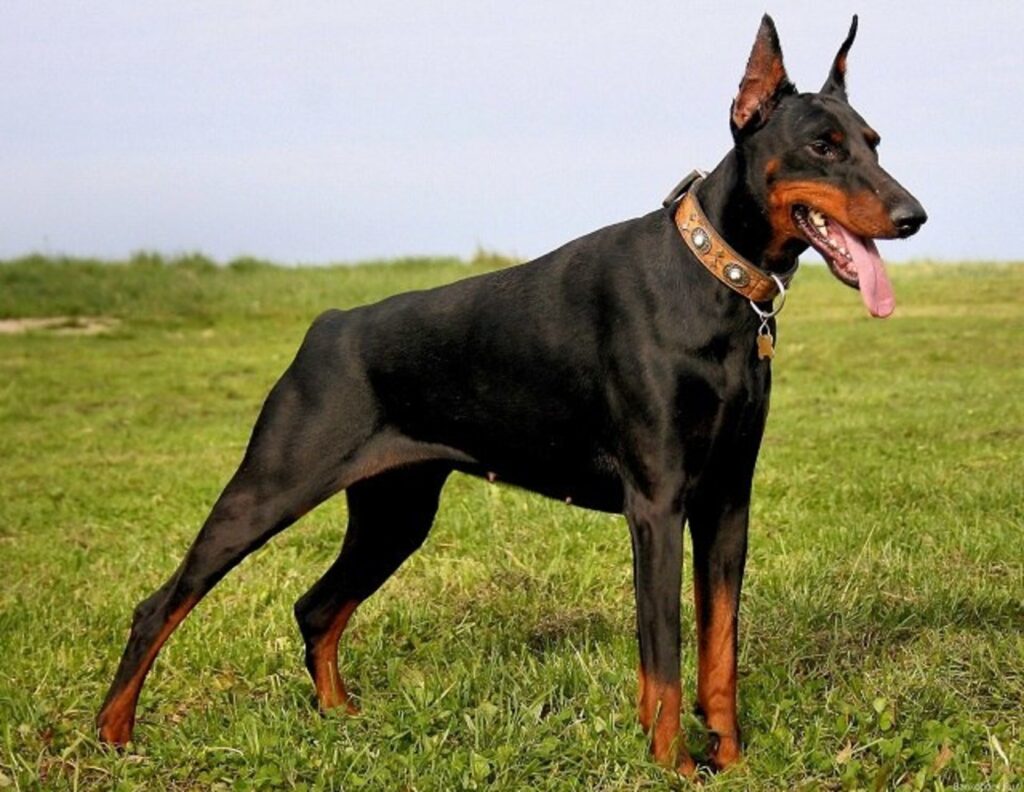
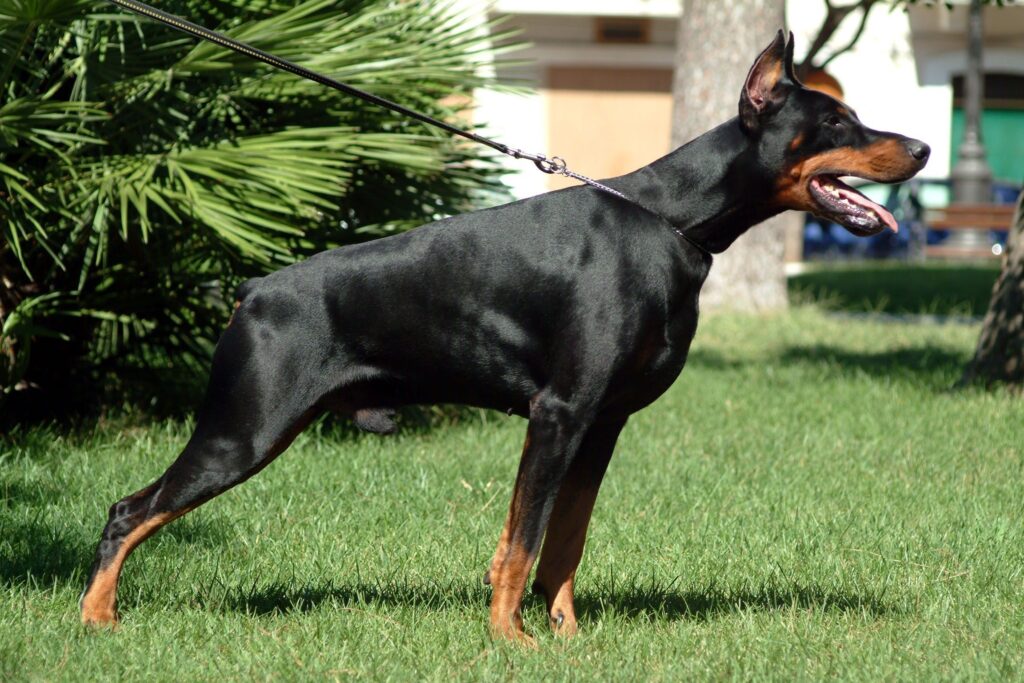
The Dobermann is the epitome of athleticism and elegance. It is a medium to large-sized dog with a muscular but "dry" build. There is nothing superfluous about it - every line of the body speaks of strength and speed. The Dobermann's silhouette should be practically square (especially in males), with a proud posture.
Head and Muzzle
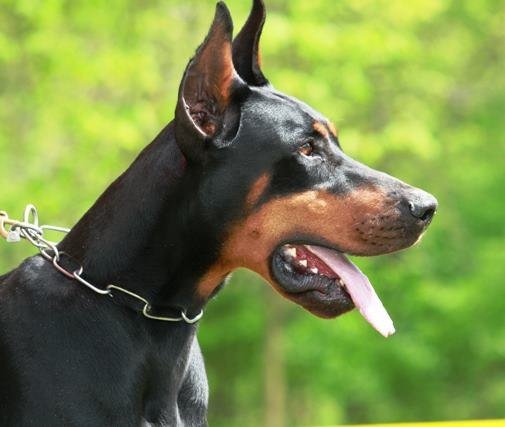
The Dobermann's head is strong and muscular, shaped like a blunt wedge when viewed from above. The stop (transition from forehead to muzzle) is well-defined. The muzzle is quite broad. The lips are dry, clinging tightly to strong jaws with a perfect scissor bite. The nose is broad, with large nostrils; the colour depends on the coat (black on black dogs, brown on brown). The eyes are medium-sized, oval-shaped, and dark (the darker, the better). The gaze is lively, intelligent, and self-assured.
Ears and Tail: Cropping and Docking
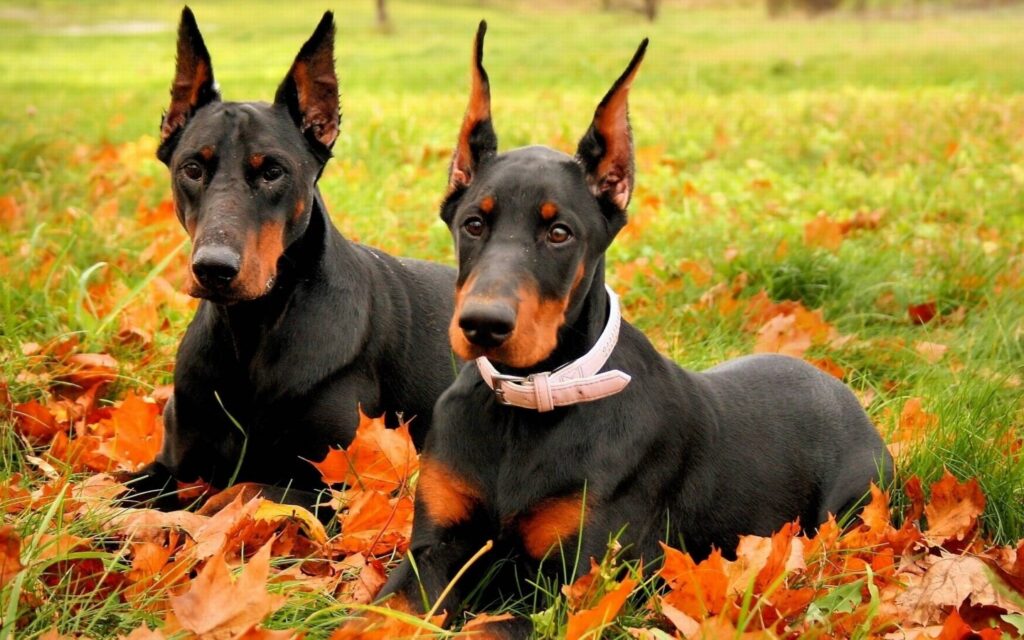
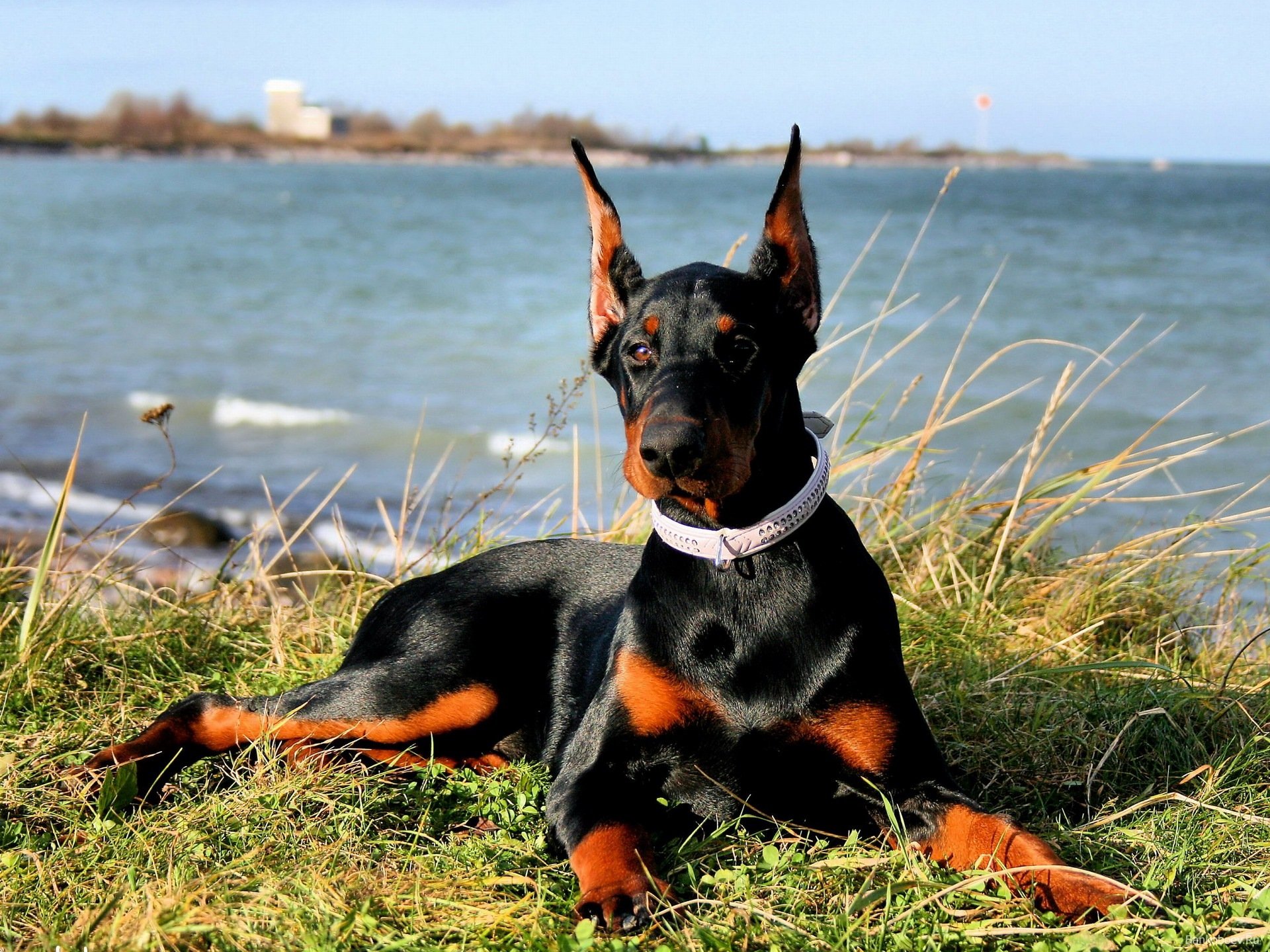
Historically, Dobermanns had their ears and tails cropped (cut). The tail was docked very short (leaving 2–3 vertebrae), and the ears were shaped to stand upright. This was done for practical reasons - to ensure the dog had no vulnerable points when working (guarding, fighting). Today, ear cropping and tail docking are banned by law in the UK and many European countries, including Germany, the breed's homeland, and are considered inhumane. The trend towards the "natural" look is growing.
Natural ears: medium-sized, set high, hanging close to the cheeks.
Natural tail: long and sabre-shaped.
Because of this, the appearance of the modern Dobermann can differ greatly depending on the country and the breeder's decision. The "natural" Dobermann looks less formidable but loses none of its elegance.
Body and Limbs
The neck is long, muscular, with a beautiful arch. The back is straight, short, quite broad, and sturdy. The chest is deep and wide enough, oval-shaped. The belly is elegantly tucked up, creating a beautiful underline. The limbs are straight, parallel, with well-developed musculature. The paws are compact, "cat-like," with arched toes.
Dobermann Coat and Colour
The coat is one of the Dobermann's distinctive features. It is short, harsh, dense, and close-lying, with no undercoat. This makes grooming minimal but also leaves the dog vulnerable to cold.
The FCI standard recognises only two main colours:
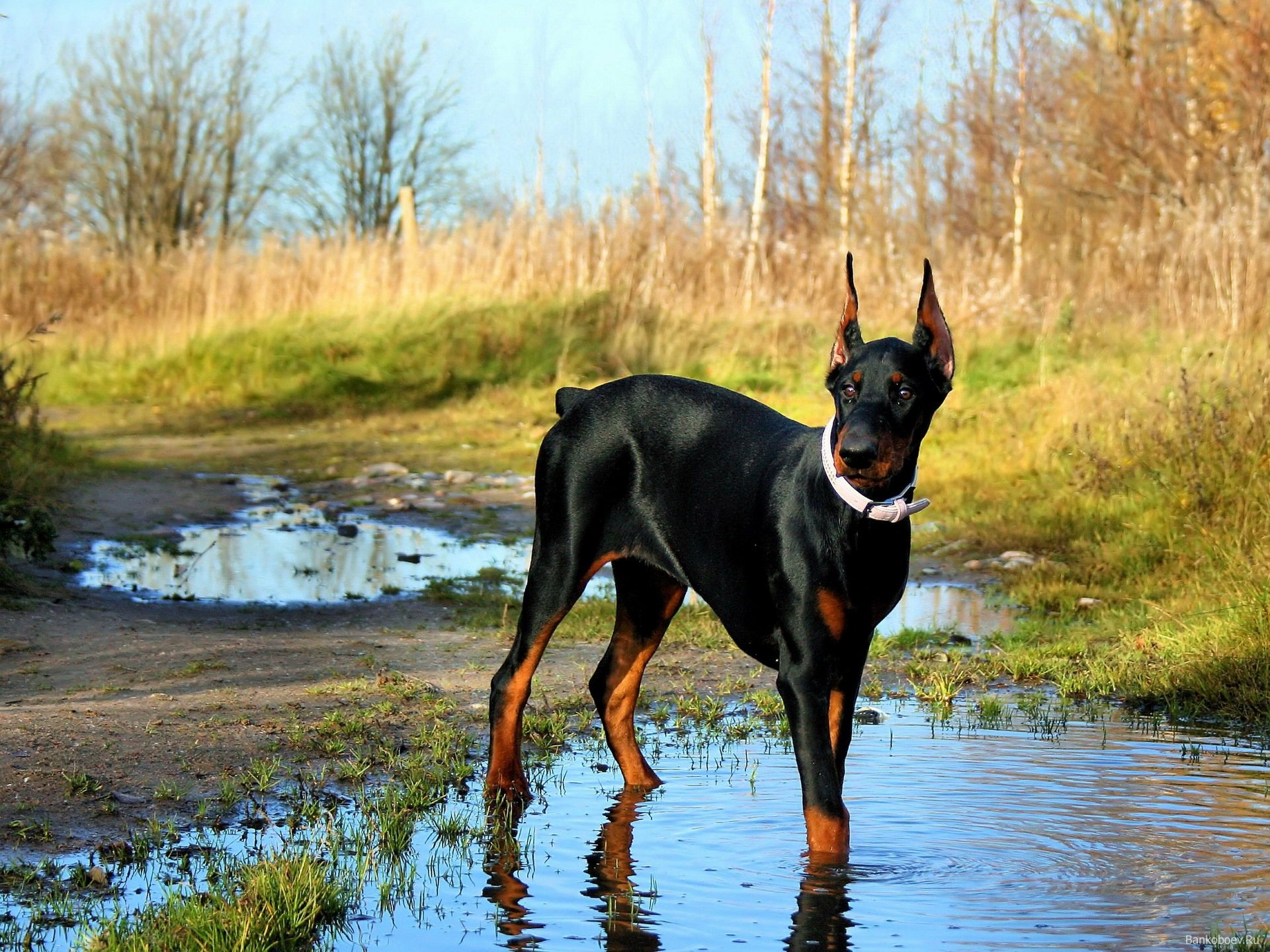
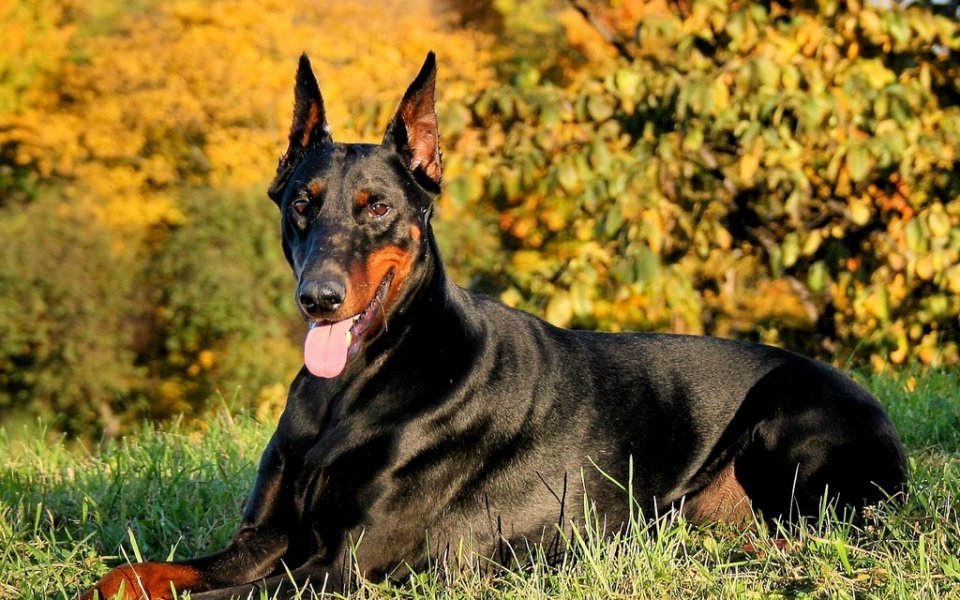
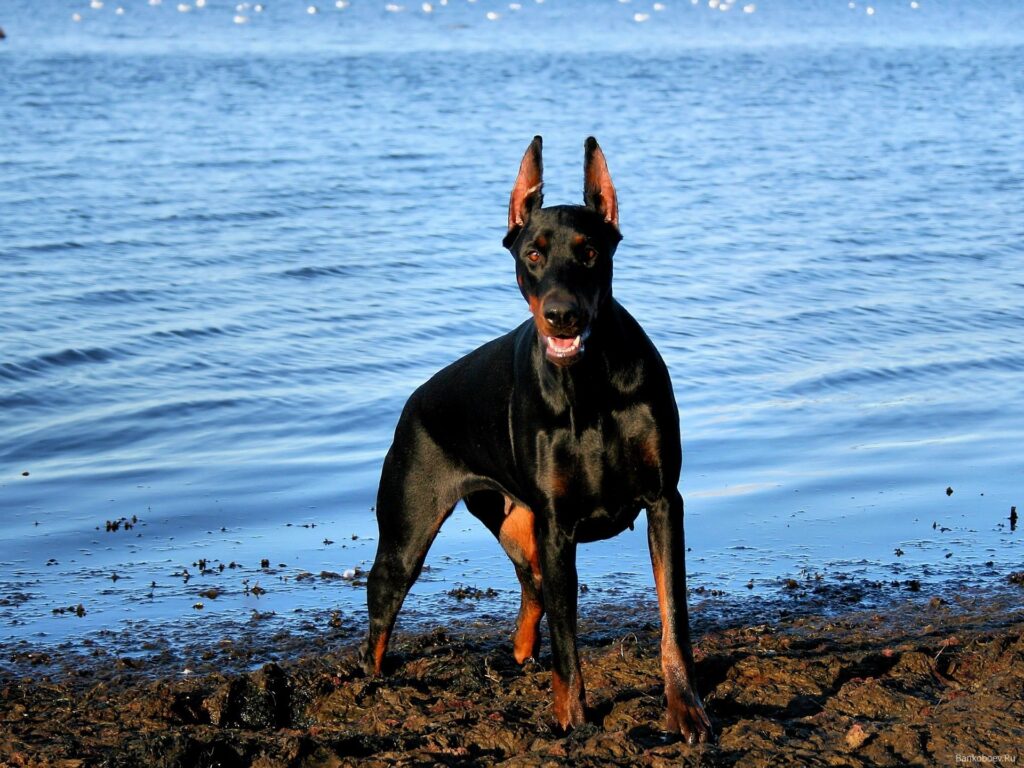
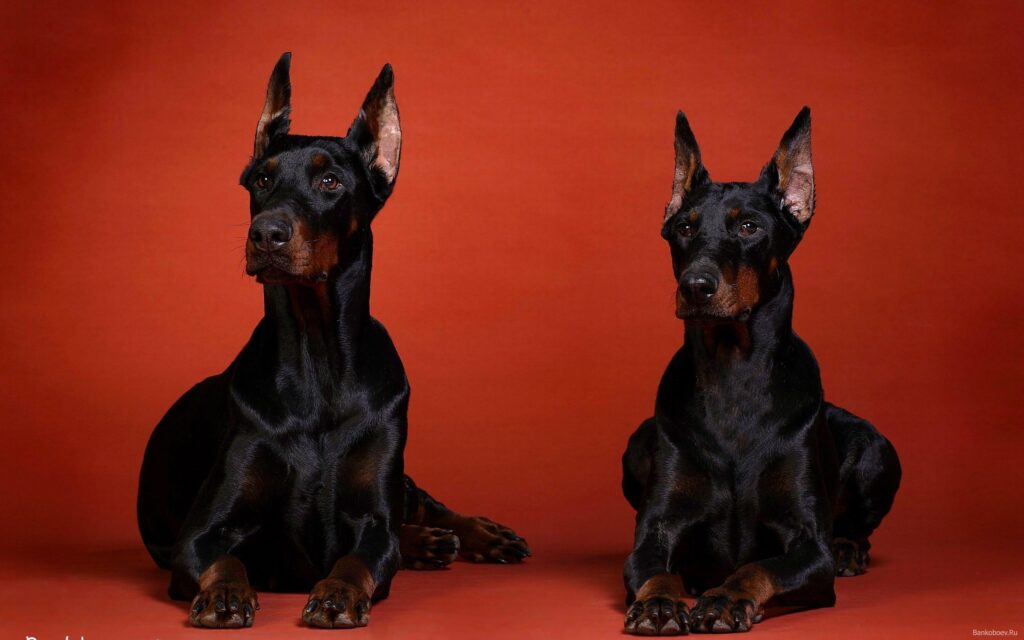
Black with rust-red tan markings.
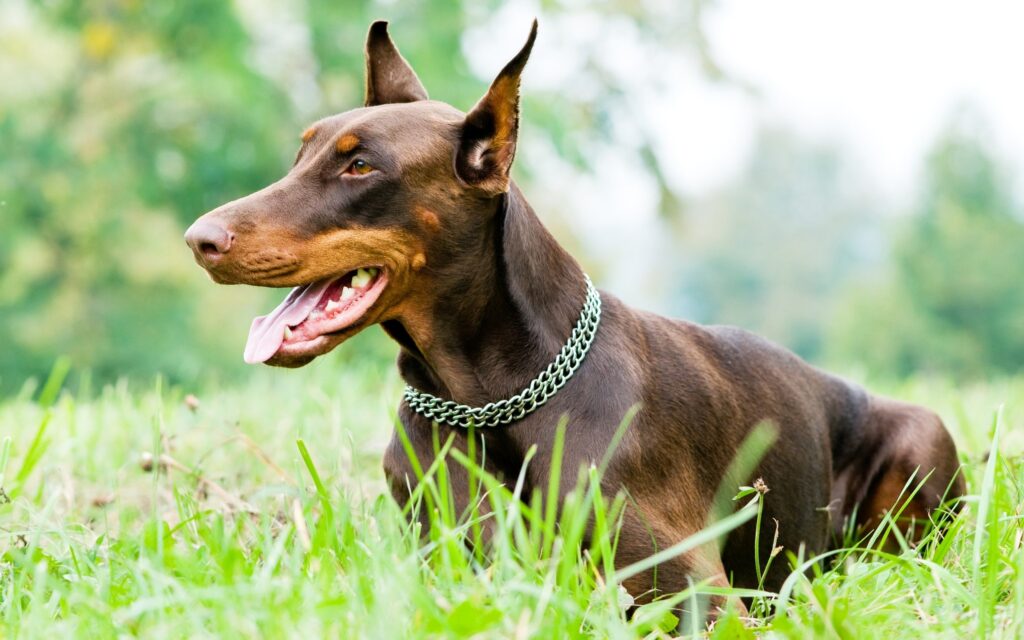
Brown (or dark brown) with rust-red tan markings.
The tan markings must be clearly defined and located in strictly designated areas: on the muzzle, cheeks, above the eyes, on the throat, on the chest (two spots), on the legs, and under the tail.
There are also "dilute" colours, such as blue (faded black) and Isabella (faded brown, "fawn"). These are not recognised by the FCI standard and are often associated with a genetic disorder - Color Dilution Alopecia (CDA), which leads to skin and coat problems. A "white" (actually cream) Dobermann also exists - this is a partial albino, which carries serious health issues and is not recognised by any serious kennel organisation.
Character: Temperament and Behaviour
The Dobermann's character is a complex blend of opposites. They are decisive and self-confident dogs, strong-willed, and with a firm nature. Yet, they are also extraordinarily devoted to people, focused on their owner, and willing to follow all their commands. This is a classic "one-person dog" or one-family dog.
Intelligence and Sensitivity
Dobermanns rank among the most intelligent dog breeds. They grasp commands instantly and are capable of complex situation analysis and independent decision-making (which can sometimes complicate training). However, their intelligence is paired with high sensitivity. A Dobermann keenly senses its owner's mood and does not tolerate shouting, roughness, or unfair punishment well. They are "Velcro dogs" who want to be next to the family 24/7 and suffer from loneliness and neglect.
Guard Instinct
The Dobermann has a well-developed protective and guarding instinct. He is always alert, monitoring his territory and "pack" members. He will never allow his owner or family to be harmed and is ready for a desperate defence of his property. At the same time, a properly trained Dobermann is peaceable and friendly outside his territory. He won't seek conflict first, but in the face of a real threat or aggression from other dogs or strangers, he will be able to stand up for himself and his own. Their fearlessness, strength, and courage will always help them secure victory.
Dobermanns and Children
A Dobermann raised alongside children usually treats them well and can become a brave, bold protector and playmate. However, they are large, powerful dogs. Even when playing, they can accidentally knock over a small child. Therefore, all interaction should take place under adult suprvisin. It is also important to teach children to respect the dog's personal space.
Interacting with Other Animals
Socialisation with other animals must be early and consistent. Dobermanns can get along with other dogs and cats, especially if raised together. However, males may exhibit aggression towards dogs of the same sex. Small animals (rodents, birds) may be perceived as prey due to their hunting instinct (which, although subdued, is present).
Training and Socialisation
Dobermann training is a mandatory requirement, not an option. Due to their intelligence, strength, and protective instincts, an unruly Dobermann can be dangerous. This breed is categorically not recommended for novices or people with a weak disposition.
Early Socialisation
Early socialisation (from 3 to 16 weeks) is critically important for the Dobermann. They should be neither timid nor aggressive. The puppy needs to be introduced to different people, sounds, places, and transport. Take the puppy out more often for walks in crowded areas and do not forbid interaction with other well-behaved dogs. You must ensure that the adult dog will react appropriately to any situation.
Training Methods
To begin training, a trusting relationship must exist between you and the dog. You must assume the dominant position, but not through force or cruelty, rather through confidence, consistency, and authority. The Dobermann must regard you as the leader.
They respond brilliantly to positive reinforcement methods (treats, praise, play). Roughness or physical punishment can break a Dobermann's sensitive psyche or, conversely, provoke aggressive retaliation. Training must be consistent, fair, and engaging. These dogs quickly become bored with monotonous repetition.
Sports and Work
Dobermanns are exceptionally gifted dogs. They become professionals in any field. Sports such as Agility, Obedience, Coursing, and working disciplines (e.g., IPO/Schutzhund - protection work, where they can legally fulfil their instincts under control) are ideally suited to them. The tendency for tracking is in their blood - they make excellent assistants for police and rescue workers, unlike many traditional hunting breeds such as the Bohemian Wirehaired Pointing Griffon or Spinone Italiano.
Pros and Cons of the Breed
The decision to get a Dobermann must be extremely well-considered. This is not a dog you can take "for show" and neglect its needs.
Pros and Cons of the Breed · 7
✅ Pros
❌ Cons
High intelligence, learns quickly.
Requires an experienced owner, not for novices.
Boundless devotion to the family, a "Velcro dog."
Serious health problems (especially DCM), high vet bills.
Excellent guard and protector.
High need for physical and mental exercise.
Minimal coat care, no "doggy" odour.
Tendency towards dominance and stubbornness if sensing owner weakness.
Elegant, athletic appearance.
Does not cope well with loneliness, prone to separation anxiety.
Energetic partner for sports and active recreation.
Does not tolerate cold well, requires coats in winter.
Potential aggression towards other dogs (especially of the same sex).
Care and Maintenance
At first glance, Dobermann care seems straightforward, but there are important nuances related to their short coat and high energy levels.
Grooming (Coat Care)
Grooming the Dobermann's coat is minimal. Their short hair does not require trimming. Brushing the dog once a week with a rubber mitt or a natural bristle brush is enough to remove dead hairs and give the coat a shine. Frequent washing is not recommended - it disrupts the skin's natural oil balance. A full wash with shampoo is only necessary for heavy soiling (1–2 times a year). To keep the coat clean after a walk, simply wipe it down with a damp terry towel.
It is also important to regularly:
Trim nails: approximately every 2–3 weeks, if they are not worn down on asphalt.
Clean ears: inspect weekly and clean with a specialised lotion as needed.
Brush teeth: 2–3 times a week with dog-specific toothpaste.
Clean eyes: as needed with chamomile infusion or a clean cotton pad moistened with water.
Living Conditions and Weather Vulnerability
Due to the lack of an undercoat, Dobermanns are absolutely unsuited to living outdoors in a kennel. They are strictly house or flat dogs. They are very sensitive to cold - they absolutely need a warm coat for winter walks. In summer, conversely, there is a risk of overheating, especially for black-coated dogs. Always carry water with you and never leave the dog in a car.
Physical Exercise
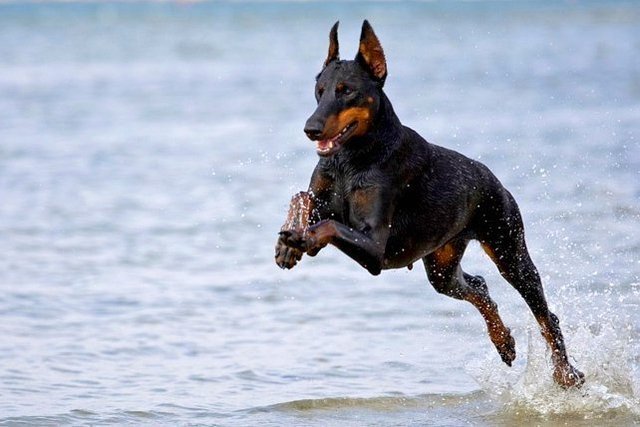
This is a key aspect of Dobermann ownership. They are very active and energetic dogs who need not only physical but also mental stimulation. A routine walk "on the lead" twice a day is catastrophically insufficient for them. A Dobermann requires:
At least 2 hours of active exercise per day.
The opportunity to run freely off-leash (in a secure area).
If a Dobermann does not receive enough exercise, their pent-up energy will find an outlet in destructive behaviour (chewed furniture, barking, aggression).
Nutrition
Nutrition: Key Recommendations
Health and risks
Health: Common Ailments and Prevention
Frequently Asked Questions (FAQs) about the Breed · 5
Is it true that Dobermanns are malicious and aggressive?
No. This is a myth amplified by cinema. A Dobermann, by standard, should be neither timid nor aggressive. He is a self-confident protector. His "aggression" is a controlled protective instinct. He will not attack without cause, but he will defend his owner without hesitation in the event of a real threat. Dobermanns become aggressive due to improper upbringing, lack of socialisation, or poor genetics.
Do Dobermanns get along with children?
Yes, Dobermanns raised in a family with children are usually very patient, gentle, and protective of them. They can be excellent nannies. However, they are large, powerful dogs. Any games must take place under adult suprvisin, and children need to be taught how to interact with the dog.
Can a Dobermann be kept in a flat?
Yes, on one condition: you must provide the dog with a sufficient level of physical and mental exercise. In a flat, a Dobermann is calm and sleeps a lot if he has been "exercised." But if he is bored, he will tear the place apart. They hate the cold and cannot live outside.
Is ear cropping and tail docking mandatory?
No. It is banned in most countries worldwide, including the UK. It is purely a cosmetic procedure that carries no health benefit for the dog and is painful. A "natural" Dobermann with hanging ears and a long tail is the same Dobermann, with the same character and intelligence.
How long do Dobermanns live?
The average lifespan is 10–13 years, but sadly, due to the high prevalence of DCM (cardiomyopathy), many dogs die suddenly at 6–9 years old. Regular heart examinations are a vital necesary for this breed.
Video About the Breed
FAQ
Is it true that Dobermanns often have heart problems?
Yes — dilated cardiomyopathy affects over half of the breed and can appear suddenly. Annual cardiac screening (Holter + echo) from age 2 saves lives.
Is a Dobermann suitable for a beginner?
Rather not — it is a sensitive, energetic and powerful breed that needs experience, early socialisation and consistency.
Is the Dobermann aggressive?
The modern Dobermann is well-balanced and devoted to the family; aggression is the result of poor breeding or upbringing, not the breed norm.