

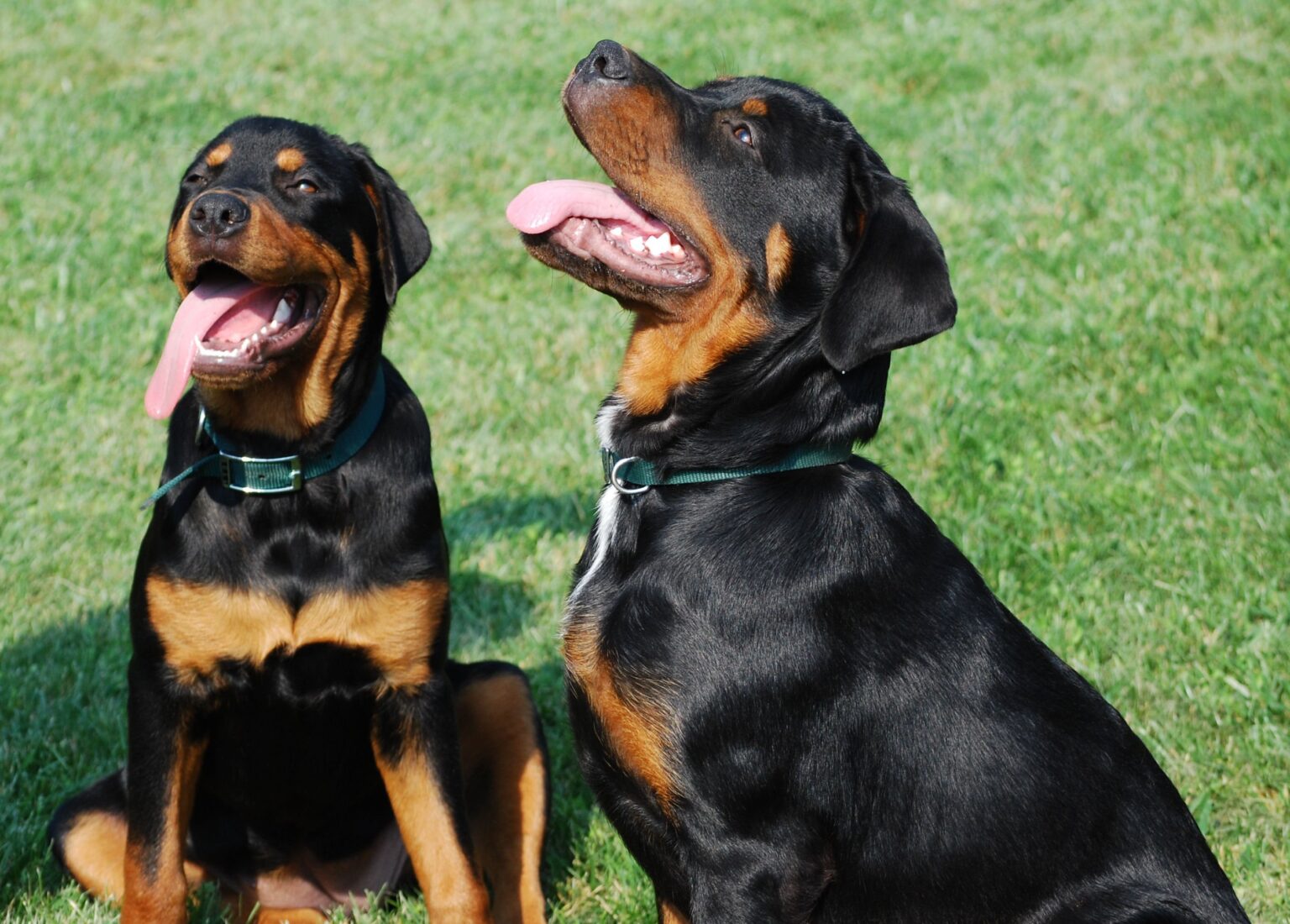
| Height | 56–69 cm |
| Weight | 35–60 kg |
| Lifespan | 8–10 years |
| FCI group | 2 · molossoids |
| Origin | Germany |
Exact ratings
Common health issues
Nutrition
The Rottweiler is one of the most well-known and recognisable dog breeds globally. Historically, they were resilient working dogs, but today many people choose them as devoted family pets and companions. Their powerful build and distinctive black-and-tan colouring are unmistakable. This detailed overview of the Rottweiler breed has been prepared by the team at Tvaryny to help you understand all the nuances of keeping this magnificent dog. Although Rottweilers can be stubborn, making training challenging for beginners, they are, by nature, incredibly loyal, balanced, and affectionate dogs. With the right upbringing, they become wonderful family members and adore children. What your dog grows into – a formidable guard or a gentle friend – depends entirely on you and your approach to their upbringing.
Rottweiler: Key Breed Characteristics
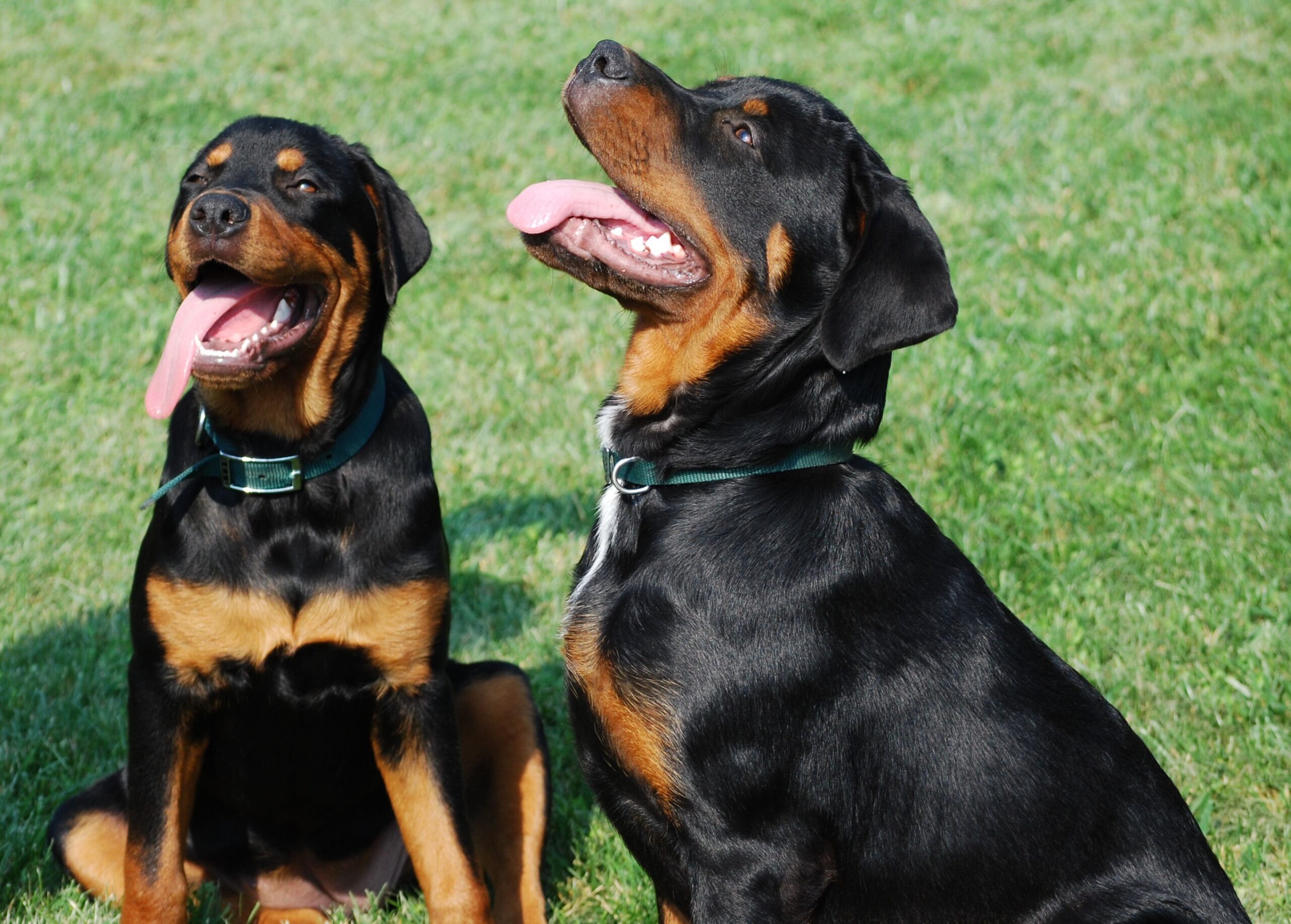
| Breed Name | Rottweiler |
| Country of Origin | Germany |
| FCI Classification | Group 2 (Pinscher and Schnauzer, Molossoid, Swiss Mountain and Cattle Dogs), Section 2.1 (Molossoid, Mastiff type) |
| Lifespan | 9–10 years |
| Height at Withers (males) | 61–68 cm |
| Height at Withers (females) | 56–63 cm |
| Weight (males) | approx. 50 kg |
| Weight (females) | approx. 42 kg |
| Temperament | Balanced, self-assured, obedient, courageous, loyal, with a natural guarding instinct |
| Exercise Needs | High |
| Tendency to Shed | Medium |
| Grooming Needs | Low |
History of the Rottweiler Breed
The history of the Rottweiler dates back to the Roman Empire. Its ancestors are believed to be Molosser-type dogs that accompanied Roman legions during their campaigns across the Alps. The primary task of these dogs was to herd and guard cattle, which served as a “living food supply” for the army. After the empire’s collapse, many of these dogs remained in southern Germany, where they interbred with local breeds.
The breed got its name from the German town of Rottweil, which in the Middle Ages was a major trading centre, renowned for its livestock markets. Here, these dogs, which became known as “Rottweil butcher dogs” (Rottweiler Metzgerhund), became indispensable assistants to butchers and farmers. They not only herded flocks but also protected them from predators and thieves. Legend has it that butchers returning from the market with their earnings would tie their purses of money around the necks of their Rottweilers, completely confident in the safety of their earnings. No robber dared to approach such a “safe”.
With the advent of railways in the late 19th century, the need for driving cattle over long distances disappeared, and the breed faced extinction. However, in the early 20th century, enthusiasts drew attention to the outstanding working qualities of the Rottweiler. In 1901, a significant incident occurred in Hamburg when a police officer used a Rottweiler to disperse a crowd of rebellious sailors, instantly restoring the breed’s popularity. Soon after, Rottweilers began to be officially used as police and service dogs. The first breed standard was drawn up in 1914. Interestingly, in the Soviet Union, these dogs were even used to protect domesticated moose from poachers, which speaks to their versatility and reliability.
What a Rottweiler Looks Like: Breed Standard and Appearance
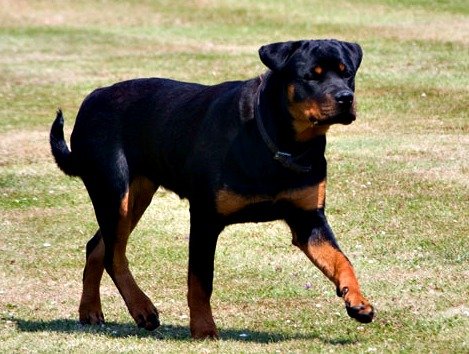
The Rottweiler is a medium to large-sized dog, stocky and powerful, yet elegant and harmoniously built. Its appearance exudes strength, endurance, and confidence.
- Head: Medium length, broad between the ears. Forehead moderately arched. The stop (transition from forehead to muzzle) is well-defined.
- Muzzle: Neither elongated nor shortened. Jaws strong and wide, with a scissor bite (42 teeth). Lips black, tightly fitting.
- Eyes: Medium-sized, almond-shaped, dark brown. The expression of the eyes is calm, confident, and watchful.
- Ears: Pendant, medium-sized, triangular. Set high and wide, which visually broadens the cranial part of the head.
- Body: Back straight, strong, and muscular. Chest broad, deep, and voluminous, with a well-developed forechest. Abdomen slightly tucked up.
- Tail: In its natural state, horizontal, continuing the line of the back. Historically, tails were often docked, but today this is prohibited in most countries, and a natural tail is the standard.
- Limbs: Straight, parallel, with powerful bone structure and well-defined musculature. Paws round, compact, with hard pads and short black claws.
- Coat: Consists of medium-length outer coat and dense undercoat. The coat is coarse, straight, and lies close to the body.
- Colour: Classic black with clearly defined, rich reddish-brown markings. The markings are located on the cheeks, muzzle, under the eyes, on the underside of the neck, chest, limbs, and under the base of the tail.
Rottweiler Character and Temperament
Behind the formidable appearance of a Rottweiler lies a balanced and calm character. They are brave, fearless, and exceptionally self-assured dogs. They are vigilant, attentive, and possess an innate protective instinct. Within their family circle, a Rottweiler is a gentle and affectionate friend who becomes deeply attached to their people. They often choose one family member as “their” primary owner, whom they obey implicitly, but they love and respect everyone else too.
Rottweilers are cautious and reserved towards strangers. They are not prone to unwarranted aggression but are always ready to defend their territory and family if they perceive a real threat. Therefore, it’s not advisable to leave strangers alone with the dog without a proper introduction. Rottweilers get along wonderfully with children, especially if they grow up together. They are patient and can be a fantastic playmate and reliable guardian for a child. However, it’s important to explain to children how to behave around a large dog to avoid accidental injuries.
These dogs aren’t particularly noisy, barking mostly when there’s a good reason. Their confidence and calm demeanour make them similar to serious guard dogs like the Bullmastiff, although the Rottweiler is generally more energetic and active.
Pros and Cons of the Rottweiler Breed
| Advantages (Pros) | Disadvantages (Cons) |
|---|---|
| Outstanding guardian and protector. Innate instinct to guard territory and family. | Tendency to dominate. Requires a strong, confident, and consistent owner. |
| High intelligence and trainability. Easily learns commands with the right approach. | Requires early and prolonged socialisation. Without it, may become overly suspicious of strangers. |
| Loyalty and affection towards their family. Very gentle and loving with “their” people. | High demands for physical exercise. Not suitable for inactive individuals. |
| Low maintenance for coat care. Does not require complex grooming. | Predisposition to certain genetic diseases (dysplasia, heart problems). |
| Balanced and calm temperament (with proper upbringing). | Not the best choice for a novice owner. Can be stubborn and test boundaries. |
| Gets along well with children in the family. | Sheds heavily seasonally. Requires more frequent brushing during these periods. |
Training, Raising, and Socialisation
Rottweilers are extremely intelligent dogs who learn quickly. However, their intelligence is combined with a certain stubbornness and a tendency to dominate. The key to successful training is building a relationship based on mutual respect, not fear. The owner should be an unquestioning leader for the Rottweiler – calm, confident, and consistent. Training methods based on positive reinforcement (praise, treats) work significantly more effectively than harshness and punishment, which can cause a defensive reaction or stubbornness in the dog.
Socialisation is the most crucial aspect of raising a Rottweiler. It should begin as early as possible, from puppyhood. Introduce your puppy to various people (adults, children), other animals, sounds, places, and situations. This will help them grow up confident, calm, and respond appropriately to new stimuli, rather than showing fear or aggression. Thanks to their high intelligence and willingness to work, Rottweilers excel in various canine sports, such as obedience and protection work. Their energy and intelligence levels are often compared to breeds like the Doberman Pinscher or the German Boxer.
Health and Common Rottweiler Ailments
Rottweiler Feeding Specifics
Rottweiler Care
The Rottweiler is a fairly low-maintenance breed when it comes to grooming. Their short, coarse coat doesn’t require daily brushing. Brushing your dog 1-2 times a week with a rubber brush or a deshedding tool is usually sufficient to remove dead hairs. During seasonal shedding (spring and autumn), you should brush them more frequently.
- Bathing: Bathe your Rottweiler with shampoo only when necessary, no more than 2-3 times a year, to avoid damaging the protective layer of their skin. After a muddy walk, simply wiping their paws and belly with a damp towel is enough.
- Ears and Eyes: Regularly check their ears for dirt and inflammation. Clean them using a special ear cleaning solution. Eyes should be clear, without excessive discharge.
- Claws: If their claws don’t wear down naturally on pavement, they’ll need to be trimmed with large dog clippers approximately once a month.
- Housing: A Rottweiler can live in a flat, provided they get sufficient and lengthy daily walks (at least 2 hours a day). An ideal setup would be a detached house with a well-fenced garden. However, this breed is not suited for year-round tethering or kennel confinement, as they require close contact with their family.
Interesting Facts About Rottweilers
- The Rottie Rumble: Rottweilers make a unique sound, similar to a soft rumble or purr, when they are happy and relaxed. Novices often confuse it with a growl, but it’s a sign of contentment.
- Heroic Hounds: Rottweilers were among the search and rescue dogs who worked in the aftermath of the 9/11 attacks on the World Trade Centre in 2001, helping to locate people under the rubble.
- Versatile Workers: Thanks to their intelligence and stamina, Rottweilers are not only used as guard and police dogs but also as guide dogs, therapy dogs, and participants in various canine sports.
- Slow to Mature: Rottweilers remain “puppies at heart” for quite a long time. They reach full physical maturity around 2 years of age, and psychological maturity sometimes only by 3 years old.
Frequently Asked Questions About the Breed (FAQ)
Is a Rottweiler suitable for an inexperienced owner?
Generally, no. A Rottweiler needs a confident, experienced owner who can establish themselves as a leader and manage their strength and potential stubbornness. A novice might struggle with their training and socialisation, which could lead to behavioural issues.
How do Rottweilers get along with other animals?
With proper and early socialisation, Rottweilers can live peacefully with other dogs and even cats, especially if they are raised together. However, they may exhibit dominance towards dogs of the same sex.
Can you keep a Rottweiler in a flat?
Yes, it’s possible, but only if the dog receives daily, long, and intensive physical and mental exercise. Without sufficient activity, a Rottweiler may become bored and display destructive behaviour.
Do Rottweilers shed a lot?
They have moderate shedding throughout the year and two intense seasonal shedding periods in spring and autumn. During these times, they need to be brushed more frequently. For comparison, their grooming needs are significantly less than long-haired breeds but more than smooth-coated hunting dogs like the Redbone Coonhound.
Are Rottweilers inherently aggressive or mean dogs?
No. This is a myth perpetuated by irresponsible owners and the media. A properly raised and socialised Rottweiler is a balanced, calm, and reliable dog. Aggression is a consequence of poor upbringing, lack of socialisation, or improper handling.
Video about the breed
- Fearless, dependable guardian
- Devoted and calm in the family
- Intelligent, trainable
- Confident, well-balanced
- Raised risk of bone cancer
- Joint dysplasia
- Needs experience and socialisation
- Short lifespan (8–10)
| Dobermann | German Shepherd | Bernese Mountain Dog | |
|---|---|---|---|
| Height | 63–72 cm | 55–65 cm | 58–70 cm |
| Energy | 4.5 | 4.5 | 3 |
| Apartment | 2.5 | 2.5 | 2.5 |
| Beginners | 2.5 | 3 | 4 |
Is the Rottweiler dangerous?
How long do Rottweilers live?
Can a Rottweiler live in a family with children?
FCI Standard No. 147 · The Kennel Club
For apartments · For kids · For beginners · Active · Smartest · Hypoallergenic · All rankings →