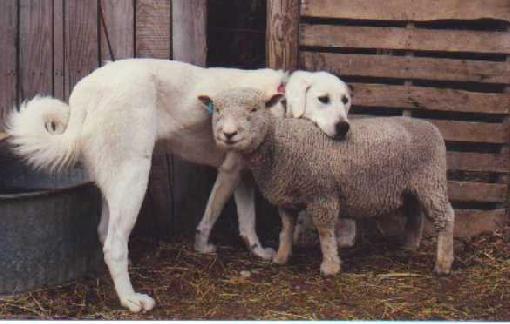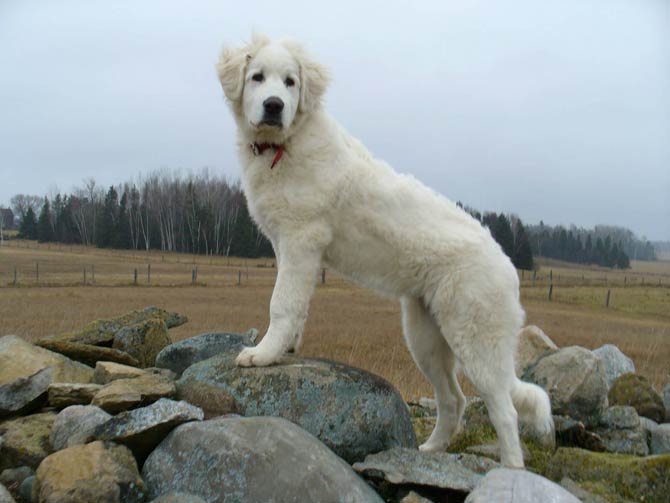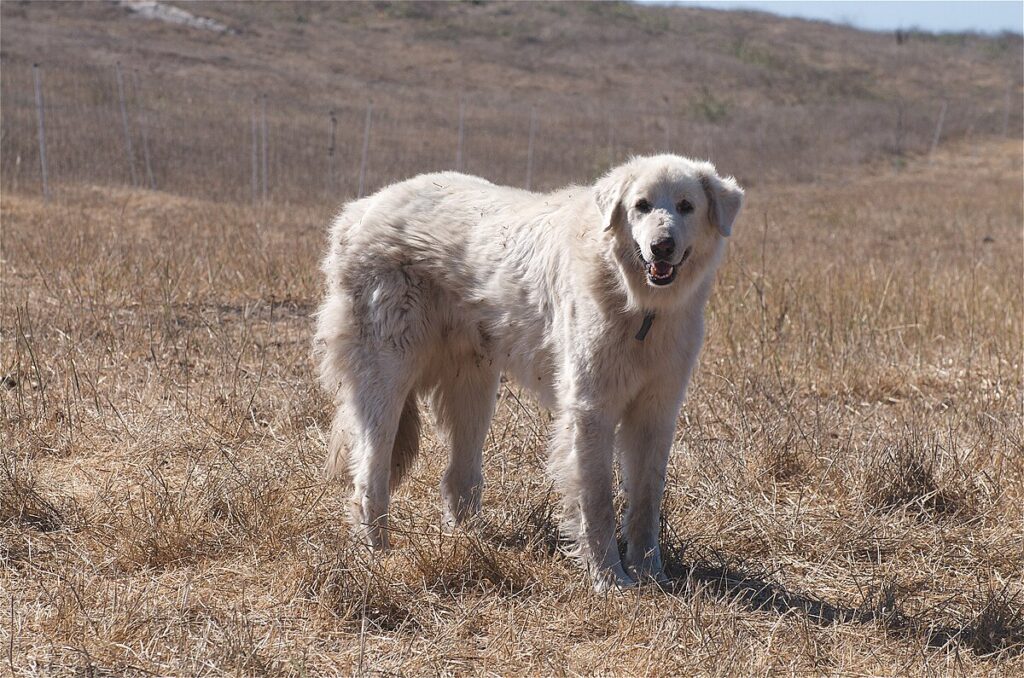
The Akbash (Akbash Dog) is a white Turkish flock-guardian from western Anatolia. Its name literally means "white head", setting it against the Karabash, the "black head". It is not a herding dog that steers the movement of a flock: the Akbash lives inside the flock and intercepts outside threats, which is why it needs an owner prepared for a dog that makes its own decisions. The breed is also unusual in one respect rare among landrace dogs — there are field records with numbers: American sheep producers who took on Akbash dogs against coyotes filled in questionnaires, and those tables can still be read today. More breeds in the Tvaryny catalogue.
Akbash: a detailed overview and breed characteristics
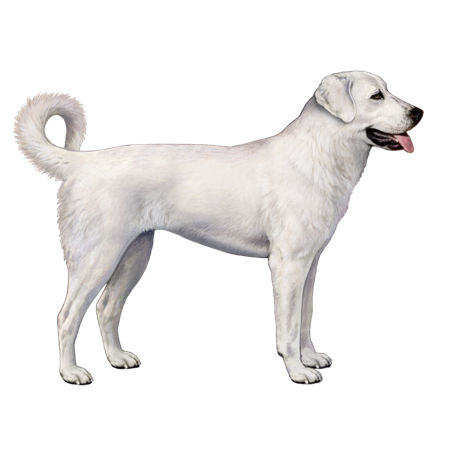
Akbash: a detailed overview and breed characteristics · 8
| Country of origin | Turkey (Eskişehir, Afyon, Polatlı, Sivrihisar — per the Turkish state register) |
|---|---|
| Purpose | Guarding the flock and the homestead ("sürü koruma ve bekçilik" in the register) |
| Status in registries | A separate breed in the UKC (since 1 January 1998) and in the Turkish state register of native breeds (since 9 July 2006); it has no FCI standard of its own |
| Height at withers (males) | 76–86 cm under the UKC standard; 63–81 cm (mean 71.2) by Turkish field measurement |
| Height at withers (females) | 71–81 cm under the UKC standard; 59–71 cm (mean 65.9) by Turkish field measurement |
| Weight (males) | The UKC gives no range but a single average — 120 pounds (≈54 kg); the Turkish register gives 40–60 kg |
| Weight (females) | UKC: average 90 pounds (≈41 kg); Turkish register: 35–45 kg |
| Maturity | 2–3 years; females mature earlier than males (both sources agree) |
Where the breed boundary runs: why registries count differently
This is the central question of the page, and the honest answer is neither "the Akbash is a separate breed" nor "the Akbash is a variety of the Anatolian", but a list of who draws the line where. Different schemes produce different lists, and none of them is mistaken: they simply answer different questions.
- United Kennel Club (USA). Recognised the Akbash Dog as a separate breed on 1 January 1998 and places it in the Guardian Dog Group; the standard in force is dated 1 April 1998. In its preamble the UKC states plainly that recognition followed the fieldwork of the Americans David and Judy Nelson, who studied these dogs in Turkey from the 1970s.
- The Turkish state. The Akbash was entered on the list of native breeds and lines as a separate annex (Ek-32) to communiqué No. 2006/32, published in the Resmî Gazete on 9 July 2006, issue No. 26223. The register is kept by the ministry of agriculture; in the same document, immediately alongside, stands Malya — a sheep, not a dog, which tells you this is a general register of genetic resources rather than a canine nomenclature. Earlier, in 2002, the Turkish Standards Institution issued a separate breed standard (TS 12891).
- The Turkish kennel federation (KIF). Keeps the Akbash on its list of national breeds separately from the Kangal, the Aksaray Malaklı and the Turkish hounds, and describes it as the Turkish version of the white flock dogs of southern and eastern Europe.
- The FCI. Here the Akbash has no entry and never had one. Until 2018, FCI standard No. 331 was called "Anatolian Shepherd Dog" and lumped the Kangal, the Akbash and the other Turkish guardian types into a single breed. In 2018 the FCI changed the name and issued a new standard: the version in force, No. 331 of 15 June 2018, is called "Kangal Çoban Köpeği". In the FCI's Group 2 breed list Turkey today appears with exactly one entry — the Kangal; neither the Akbash nor even the former name "Anatolian Shepherd Dog" is on that list. So for the FCI the white Turkish dog has not lost a slot of its own — it never had one, and the shared slot now carries the name of a different regional type.
- American practice in the 1980s. Here the line ran somewhere else entirely. An article on the Anatolian Shepherd Dog in the journal Rangelands for April 1982 lists the Akbash simply as a colour variant of the Anatolian: "Other color variants may include buff or white (Akbash — 'white head')". White Turkish dogs were then registered in the United States as Anatolians, and part of today's confusion comes straight from there.
The Turkish registration entry of 2006 contains a separate line under genetics: "scientific studies have proved that Kangal and Akbash dogs differ from one another". The status of that sentence is worth understanding: it is a claim made by a regulatory document, and it names no particular study. A document asserting that something has been proved is not itself the proof. But the work it most likely rests on can be found — and it should be read together with its sample size.
A master's thesis carried out at the Middle East Technical University (METU) in 2005 under the supervision of Professor İnci Togan read 585 base pairs of the mitochondrial DNA control region in 105 Kangal and 9 Akbash dogs. The result does separate the two groups, and separates them neatly: Kangals carry a rare haplogroup D, found only in Scandinavian (36% of samples), Turkish (20%), Portuguese (20%) dogs and in a single Spanish one — and it is entirely absent from the Akbash samples. By the same sequences Kangals proved closer to Scandinavian and south-west Asian dogs, and Akbash dogs closer to European and East Asian ones. A separate study using 100 microsatellite markers likewise found a statistically significant difference between Kangal and Akbash.
Nine dogs is few, and mitochondrial DNA shows only the maternal line, so caution is in order here. But the more interesting point is another one: by body build the two breeds do not differ. Turkish animal scientists who measured 59 Akbash dogs concluded that in body measurements the Akbash bears a "very close resemblance" to the Kangal and the Kars shepherd dog — the only difference found was in body length, shorter in the Akbash, that is a more compact frame. So the markers separate these breeds and the centimetres do not. Both results are correct; they simply answer different questions.
The practical conclusion for a reader is simple. If you are shown a pedigree, look at which organisation issued it: in a UKC document the Akbash will be an Akbash, in an FCI document the white Turkish dog has no column at all, and in Turkish paperwork everything depends on whether it is the ministry's register, the TSE standard, or the kennel federation's catalogue. These systems are not arguing with one another — they are simply not about the same thing.
What an Akbash actually weighs: three sets of figures that need not agree
The Akbash's size is a good illustration of how non-existent ranges are born. One thing deserves attention here: the UKC standard gives no weight range at all. It names two averages — 120 pounds for a male and 90 pounds for a female in good condition — and adds that weight should be in proportion to height. A pair of averages is not a range; stretch them into a single interval and you get a number that appears in no document and describes neither sex.
| Source | Height at withers | Weight | What was actually measured |
|---|---|---|---|
| UKC standard, 1998 revision | males 30–34 inches = 76–86 cm; females 28–32 = 71–81 cm | average 120 pounds (≈54 kg) for a male, 90 pounds (≈41 kg) for a female | a breeding requirement for the American population; weight given as two averages, not an interval |
| TSE standard, TS 12891, 2002 | males 60–85 cm, females 50–75 cm | males 45–65 kg, females 35–55 kg | a Turkish normative standard: wide permissible limits, not an observed spread |
| Turkish state register, 2006 | males 63–81 (mean 71.21) cm; females 59–71 (65.89) cm | males 40–60 kg, females 35–45 kg | measured adult dogs, condensed into a registration entry |
| Animal-science survey, 59 dogs, 2006–2009 | 75.3 ± 0.59 cm across the whole sample | 44.9 ± 0.80 kg on average | field measurement of dogs aged 2–10 in four provinces |
The interesting thing about this table is not the disagreement but its direction. The lower bound of the UKC standard for males (76 cm) lies above the mean height of Turkish dogs (71.2 cm by the register and 75.9 by field measurement). The American standard, in other words, describes a noticeably larger animal than the one measured in the breed's homeland. Neither side is wrong: a standard is a requirement for breeding within a particular population, a register is a snapshot of the dogs that actually walk beside flocks, and the TSE normative standard sets a wide corridor of the permissible. Before calling anyone's figure "wrong", it is worth asking what it measured.
And one more observation a buyer should know. The UKC standard says that "gender differences can be striking in this breed". Field measurement of 59 Turkish Akbash dogs did not confirm it: for none of the traits measured was the difference between males and females statistically significant, and by live weight the females actually returned a slightly higher mean — 45.2 kg against 44.9 for males. A different, geographic difference did turn up instead: dogs from Afyon (40.6 kg) and Manisa (40.3 kg) proved appreciably smaller than dogs from Eskişehir (48.8 kg) and Ankara (45.4 kg). In Turkey, then, "the size of an Akbash" depends more on the province than on the sex.
The same survey also answers the practical question of when the dog stops growing: by measurement Akbash dogs reach adult size at about two years, with only minor growth afterwards. That fits what both the UKC and the Turkish register call full maturity at 2–3 years — the body, in other words, gets there before the head does.
The Akbash at work: what the American surveys showed
This is the most valuable part of what is known about the breed at all, and at the same time the part where it is easiest to attribute somebody else's numbers to the Akbash. So it matters to see which study the Akbash dogs were actually in, and which they were not.
A survey of producers in the USA and Canada (Green and Woodruff, 1988). Researchers at the U.S. Sheep Experiment Station of the Department of Agriculture mailed 948 questionnaires between January and August 1986 and received 399 written replies reporting on 763 dogs across 47 states and 7 Canadian provinces. Of those, 62 were Akbash — the fourth largest group after Great Pyrenees (437), Komondors (138) and Anatolians (56). Every owner rated every dog separately.
The Akbash at work: what the American surveys showed · 12
| Owners' rating | Akbash (n = 62) | All 763 dogs |
|---|---|---|
| Very effective against predators | 69% | 71% |
| Somewhat effective | 22% | 21% |
| Not effective | 9% | 8% |
| An economic asset | 71% | 82% |
| Break-even | 12% | 9% |
| A liability | 12% | 9% |
| Aggressive to predators | 100% | 95% |
| Aggressive to other dogs | 92% | 74% |
| Stays with the sheep "mostly" | 71% | 55% |
| Injured sheep | 20% | 14% |
| Bit a person | 6% | 7% |
| Major behavioural problems | 15% | 13% |
The portrait that reads out of this table is not the promotional one. In overall success the Akbash did not differ statistically from Great Pyrenees, Komondors, Anatolians or Maremmas — the authors state plainly that no particular breed was rated more highly. What the Akbash did turn out to be is the most aggressive in both directions at once: every single owner without exception described them as aggressive to predators, and 92% as aggressive to other dogs, appreciably above the sample average. And that is not free: Akbash dogs injured sheep in 20% of cases against 7% for Great Pyrenees (the authors note separately that fewer Pyrenees injured livestock than Komondors, Akbash or Anatolians). People, on the other hand, they bit less often than average — 6% against 7%, and appreciably less often than Komondors.
One more line deserves attention: the share of owners calling the dog an economic asset is the lowest of the large groups for the Akbash — 71% against 82–84% for the others. Together with the highest attachment to the flock (71% stay with the sheep "mostly") this adds up to a coherent picture: the dog takes its job very seriously indeed, and some of that seriousness lands on the wrong recipient.
How much livestock this saves (Colorado, 1986 and 1993). The second study — a survey by Andelt and Hopper published in 2000 — measured not breeds but outcomes. Over seven years the number of Colorado producers using dogs grew from about 25 to more than 159, and the share of sheep under canine protection from about 7% to about 68%. Producers without dogs lost 5.9 times the proportion of lambs to predators in 1986, and 2.1 times the proportion in 1993. Of the 160 producers using dogs, 84% rated their performance excellent or good, 13% fair and 3% poor. In that sample the Akbash was the second most common breed: of 176 producers, 83 used Great Pyrenees, 34 used Akbash, 15 Komondors, 3 Anatolians, and 41 used several breeds at once.
And now for what is not in these numbers. The most detailed record of attrition among flock dogs is the 1986 work of Lorenz, Coppinger and Sutherland, which followed 449 dogs in 31 states over 1978–1983. Of these, 216 were lost: more than half to accidents (124), a third to culling for behaviour (72), and only 20 to disease. Among the accidents, 40 dogs disappeared, 38 were hit by vehicles, 17 were shot and 11 poisoned. Of the 72 culled, 44 had injured or killed livestock. The semi-annual mortality rate before 30 months was 13%, falling to about 5% afterwards — the main risk, in other words, falls in the first two and a half years. But there were no Akbash dogs in that cohort at all: it consisted of 120 Turkish Anatolian Shepherd Dogs, 74 Shar Planinetz, 56 Maremmas, 12 Castro Laboreiros, 183 crosses and 4 Tibetan Mastiffs. These figures therefore describe flock dogs in general, not the Akbash, and carrying them over to the breed would be a substitution.
Interesting facts about the breed
- The breed's name is simply a description: akbaş is Turkish for "white head", as against karabaş, "black head".
- The UKC standard makes a special provision for cropped ears: on a dog brought from Turkey they are not held against it, on a domestic-bred dog they are a disqualification.
- In Turkey flock dogs are fitted with iron-spiked collars — protection for the neck against wolves.
- In 1980 Akbash Dogs entered the U.S. Department of Agriculture's Predator Control Program — and it is thanks to that that the breed has field statistics at all.
- Black whiskers and black eyelashes are each separate grounds for disqualification under the UKC standard.