US
Tvaryny › Dogs › Korean Jindo
Group 5 · primitive types · Korea

Korean Jindo

A native spitz from Korea's Jindo Island and a rare case of a breed with a statute of its own: the state heritage register records it as the natural monument «진도의 진도개», and a dedicated act still in force governs its protection. Clever, reserved, strikingly clean and deeply attached to its own person — but independent, with a strong hunting instinct, so it needs an experienced owner and a solid fence.
Height
males 50–55 cm, bitches 45–50 cm
Weight
males 18–23 kg, bitches 15–19 kg
Lifespan
14–15 years
FCI group
5 · primitive types
Korean Jindo
Photos: 8

Breed ratings

Family Kids Beginners Training Energy Health Shedding Drooling Barking Apartment Weather Prey drive
Exact ratings · 12
Family 3.5 Kids 3.0 Beginners 2.0 Training 3.0 Energy 4.0 Health 4.0 Shedding 3.5 Drooling 1.5 Barking 2.5 Apartment 2.5 Weather 4.0 Prey drive 4.0
Pros
Exceptional devotion to its own person
Naturally clean — the standard says outright that the dog keeps itself clean
Sharp and independent at solving problems
Guarding qualities with a moderate tendency to bark
Modest appetite and undemanding about conditions
Cons
Independent and self-directed — not a novice's dog
Strong hunting instinct — a risk to cats and poultry
Not fond of other animals, males especially
Needs a solid fence — inclined to find a way out
Heavy seasonal shedding twice a year
Size
Compatibility
Apartment · with caveats Kids · with caveats Cats · not suitable Other dogs · with caveats Beginners · not suitable

The Korean Jindo, or Korea Jindo Dog, is a native spitz from Jindo Island off the southwestern tip of the Korean peninsula. It is one of the few cases where "national breed" means not rhetoric but a legal regime: the Jindo holds natural-monument status in the state heritage register and has a statute of its own, still in force today. The standard describes a hunting dog expected to show agility, strength, alertness and dignity — and records, in the same breath, traits that sit badly with city life: a very strong hunting instinct and little fondness for other animals. What follows is what the primary documents say: the standard, the state register and peer-reviewed research. Find out more at Tvaryny.

Korean Jindo: quick overview and characteristics
Korean Jindo
Korean Jindo: quick overview and characteristics · 10
Country of originRepublic of Korea (Jindo Island)
FCI classificationStandard No. 334; Group 5 (Spitz and primitive types), Section 5 (Asian Spitz and related breeds), without working trial
Utilization per the standardHunting dog
Height at withers (males)50–55 cm, ideal 53–54 cm
Height at withers (bitches)45–50 cm, ideal 48–49 cm
Weight (males)18–23 kg
Weight (bitches)15–19 kg
ProportionsHeight at withers to length of body = 10 : 10.5
Coat typeDouble: stiff outer coat, soft dense undercoat
Life expectancy14–15 years according to the American Kennel Club

A breed with a statute of its own

Most of the world's "national breeds" rest on club tradition and tourist leaflets. The Jindo is the exception. Its protection is written into state documents, and those documents can be read.

In the register of the Korea Heritage Service the breed is entered as a Natural Monument (천연기념물) under the name «진도의 진도개» / 珍島의 珍島犬 — literally "the Jindo of Jindo ISLAND". That detail is usually lost in retelling: what is protected is not the breed at large but a place-bound population. The designation date in the register is 7 December 1962. Historically the designation carried the number 53, and it is in that form — "Natural Monument No. 53" — that most reference works cite it; the register entry itself is today named by its name rather than by a number.

The register also gives the size of the protected stock: 500 registered animals, with a note that this means Jindos kept within Jindo County and registered as conforming to the standard type. The monument is administered by Jindo County, and the location given is Jindo-eup on the main island of Jindo. This is not an abstract honorific but a counted population with a named custodian.

The register entry names two legal pillars outright: «한국진도개 보호ㆍ육성법» — the Act on the Protection and Breeding of the Korean Jindo Dog, that is, a statute devoted to a single dog breed — and «자연유산의 보존 및 활용에 관한 법률», the general Act on the Preservation and Utilization of Natural Heritage. The first of these is still in force: the National Law Information Center lists it as Act No. 20309 of 13 February 2024, effective from 17 May 2024.

The practical upshot for a reader outside Korea is simple: a Jindo living on the island and a Jindo living anywhere else stand in different legal positions. An island dog is part of a registered natural monument, and its movement is governed by the county administration. A dog off the island is no longer covered by that instrument. This is the root of the contradictory claims that circulate on forums — some sources speak of a strict ban on taking the breed out, others of perfectly legal export. These are different regimes and different periods, not mutual contradiction.

What the Korean Jindo looks like: a detailed description
What the Korean Jindo looks like: a detailed description

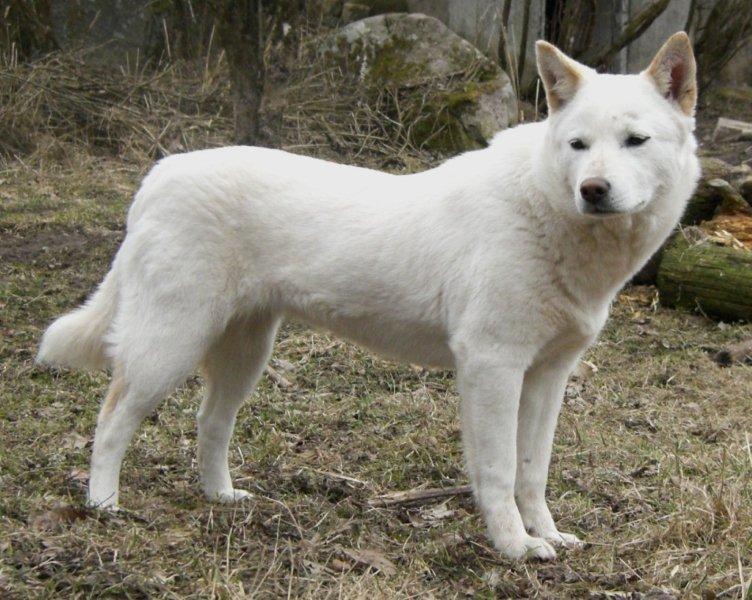
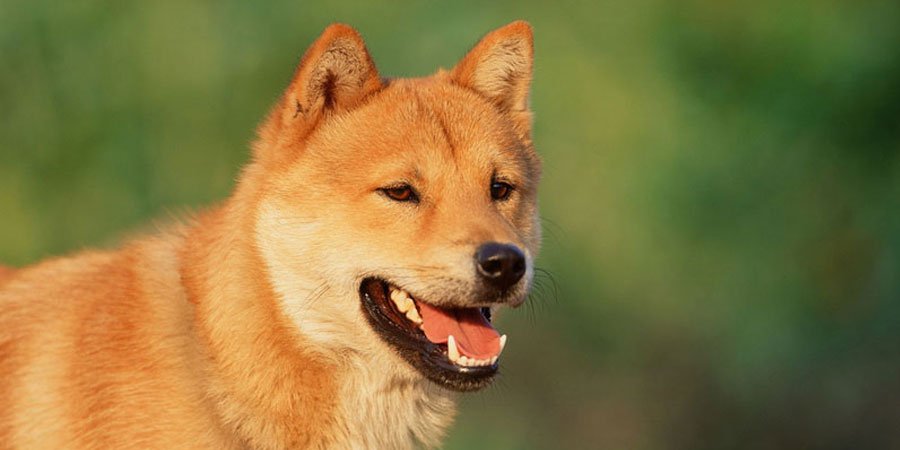
The Korean Jindo is a well-proportioned medium-sized dog that the standard sums up in four words: agility, strength, alertness and dignity. It resembles other Asian spitz-type breeds, and an untrained eye readily confuses it with its relatives — with the smaller Shiba Inu, say, or the considerably larger Akita Inu. The Jindo has anatomical features of its own, however, and it is here that two primary documents diverge in an interesting way.

Size: keep the sexes apart

The standard gives separate ranges for males and bitches, and merging them into one is a common error in breed profiles. Males: 50–55 cm at the withers, ideal 53–54 cm, weight 18–23 kg. Bitches: 45–50 cm, ideal 48–49 cm, weight 15–19 kg. The ratio of height at withers to length of body is 10 : 10.5, so the body is slightly longer than the dog is tall.

One more thing worth knowing: the same organisation may publish two different sets of measurements. The American Kennel Club reprints the standard verbatim, yet its own breed page carries noticeably narrower figures in a different system of units. It is this overlay that produces the nonsensical "combined" ranges found across the web, where the lower bound comes from one set and the upper bound from another. The figures above are from the standard.

Body types

In Korea itself two body types of Jindo are traditionally distinguished, plus a third, intermediate one:

  • Tonggol: the more muscular, stocky type. Depth of chest roughly equals half the height at the withers.
  • Hudu: the finer, lighter type. Slightly longer in the leg, with a less massive head and body. Built for speed.
  • Gakgol: the intermediate type, combining the body length of the Hudu with the chest depth of the Tonggol.

Head and eyes: two documents, two viewpoints

This is where descriptions of the breed most often go wrong. The FCI standard says the head in general forms a blunt triangle when viewed FROM ABOVE. The Korean state register says the head and face form an octagon when viewed FROM THE FRONT. This is not a contradiction — these are two different viewpoints, which is exactly why the phrase "octagonal from above", widespread in breed profiles, matches neither document.

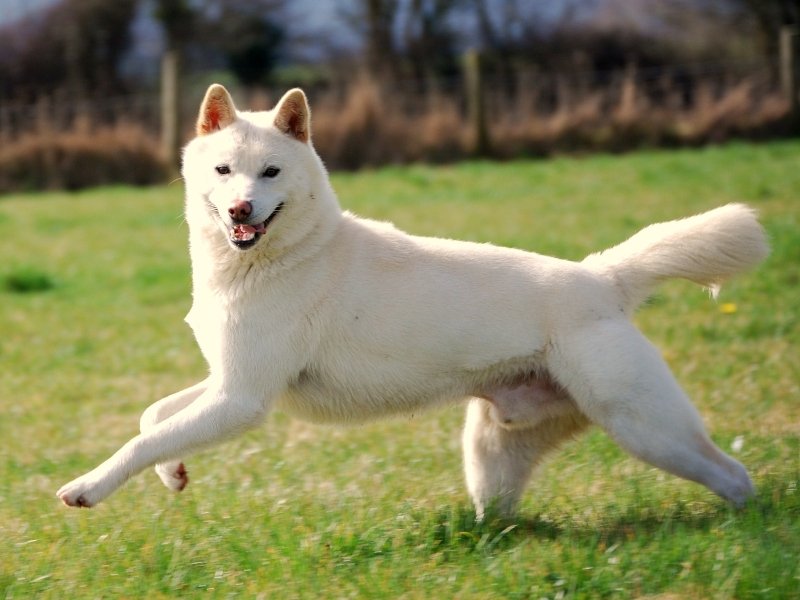
On the eyes, though, the documents genuinely disagree. FCI standard: eyes dark brown, rather small in proportion to the head, almond in shape and very lively, with the outer corners slanted towards the ears. State register: eyes triangular, deep yellow or grey. On the nose the two are closer: the standard requires black, permitting flesh color in a white dog; the register says the nose is mostly black, sometimes pale pink. Both describe the ears as triangular, thick, perfectly erect and pointing slightly forward. The tail is sickle-shaped or rolled, its tip touching the back or the flank, though the standard considers excessive curling undesirable; a dropping or short tail counts as a fault.

Body, limbs and movement

The standard calls for a strong, straight back and a well-muscled loin, taut, lean and narrower than the rib cage. The chest is strong and moderately deep but not too broad: its deepest point reaches just above the elbow, though level with the elbow is acceptable too. Ribs are well sprung, the belly drawn up. Forelegs are straight and parallel, the shoulder strong and well laid back, elbows close to the body. The feet get a phrase of their own — "cat feet": toes rather short, roundish, compact and tight, pads thick and well cushioned, with black nails preferred. The hindquarters are moderately angulated and, seen from behind, stand straight and parallel.

The gait the standard calls powerful and steady: the back stays firm and level in motion, the dog trots with its head carried high, and as speed increases the head drops almost to shoulder level. This is no small matter for a puppy buyer — a choppy or stilted gait is named a fault outright. The state register adds a note the standard will not give you: it describes the Jindo's overall impression as gentle, on a firm, well-set jaw.

Coat and color

The coat is double. The undercoat is soft, dense and lighter in color; the outer coat is stiff and stands somewhat off the body. Hair is shorter on the head, legs and ears, longer on the neck, withers, back and rump, and longest on the tail and the back of the thighs.

The standard recognizes six colors — not five, as is often written, because black and black-and-tan are listed separately in it:

  • Red fawn (Hwanggu): a golden-red tone, like the color of dried wheat.
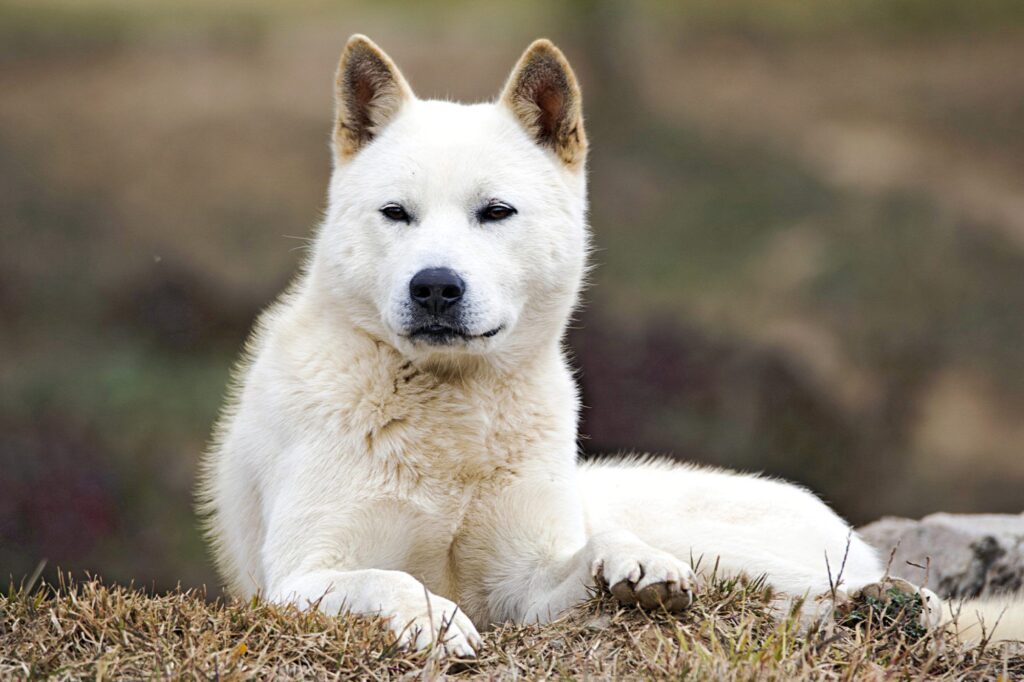
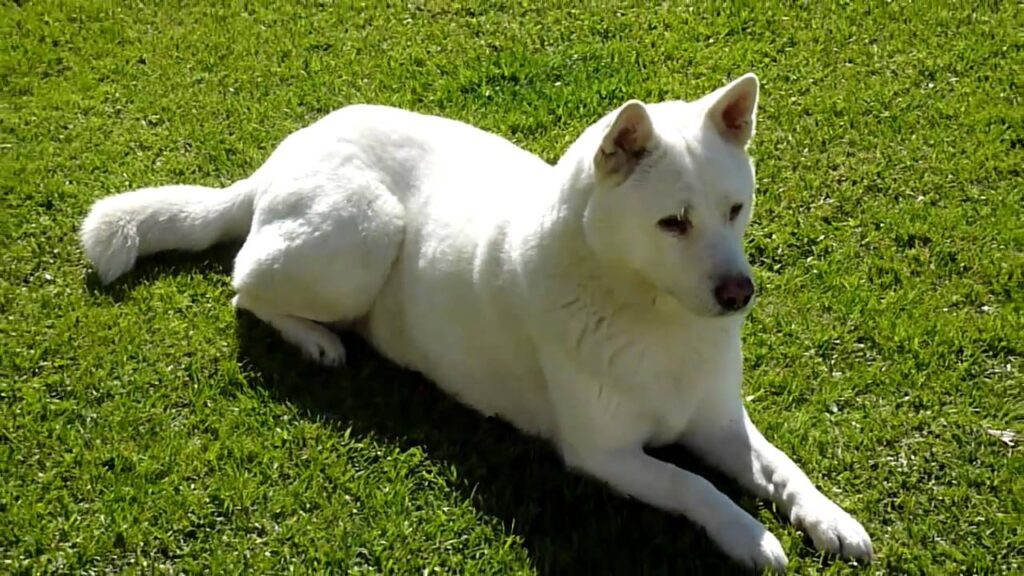
  • White (Baekgu): in fact closer to ivory or pale cream; the ear tips may carry a yellowish cast.
  • Black: solid black; it stands as a separate entry in the standard's list.
  • Black and tan: a black ground with tan markings above the eyes, on the cheeks and on the legs.
  • Wolf grey (Jaegu): a mixture of grey, white and black hairs.
  • Brindle (Hogu): a striped pattern on a lighter ground.

Faults and disqualifications. The standard counts as faults insufficient muscle, bones too thick or too fine, a level bite, non-erect ears, a dropping or short tail, overangulation, straight, cow or barrel hocks, a long or short coat, and a choppy or stilted gait. Disqualifying are aggressiveness or excessive shyness, any dog clearly showing physical or behavioral abnormalities, oversize and undersize, undershot and overshot bites, a "doggy bitch or bitchy dog", more than 3 missing teeth, lack of pigment and albinism. Dewclaws are to be removed except in countries where removal is forbidden by law.

What an owner survey showed

The Jindo's behavior has not only been described — it has been measured. The College of Veterinary Medicine at Seoul National University published a study in the Journal of Veterinary Science (2010) on problem behavior in the breed and its bearing on relinquishment. 189 completed owner questionnaires were analyzed.

The results deserve careful reading, because they are easy to twist in either direction. Some form of behavior problem was reported in 151 dogs out of 189 (79.9%), with 38 (20.1%) showing none. But of those 151, the great majority — 139 (92.1%) — showed only one problem, and just 12 dogs (7.9%) showed two at once. The breakdown by type was:

  • excessive excitability — 46.8%;
  • excessive vocalization — 30.2%;
  • inappropriate elimination — 17.3%;
  • destructive behavior — 4.3%;
  • aggressive behavior — 1.4%.

So the breed's commonest "problem" is not aggression but a surplus of excitement, and the rarest of those listed is aggression itself. A separate finding: relinquishment of Jindos was not significantly associated with behavior problems — even though in dogs generally that is the single greatest risk factor for ending up in a shelter. The authors suggest improper raising, lack of socialization and too few training classes lie behind the problems, and that owner education can improve matters. One caveat for the reader: this is a survey of owners, not a clinical examination, so it measures what owners consider a problem.

The Jindo in culture: stories worth telling apart

An unusually dense layer of loyalty stories surrounds the Jindo. Some have documentary support and some do not, and the most useful thing to do for a reader is to keep them separate.

  • What is documented: the homing ability is not folklore. The state heritage register names it as a breed trait — a Jindo that finds itself far from where it lived is marked by a tendency to return there. The FCI standard independently notes the dog's "good sense of direction".
  • What is retold: the best-known illustration of that trait is the story of a bitch named Baekgu, sold in 1993 to a new owner 300 km from home; seven months later the exhausted dog is said to have returned to her first owner, and a monument was raised to her. The story circulates in Korea as a symbol of the breed's loyalty; we pass it on as what it is, a story.
  • What is retold, and what the standard says: there is an account that the Korean army tried to use Jindos as service dogs and that the experiment failed because the dogs obeyed only their first handler. Interestingly, the FCI standard itself disagrees: it states that the Jindo readily accepts a new master, while not forgetting the previous one.
  • A legend the register also calls one: the tale of the dogs of Jindo barking in 1592 towards the quarter from which Japanese ships arrived the next day. The state register introduces it with the words "a story is also handed down" — that is, it marks it as a tale itself.
  • An everyday observation: most Jindos avoid water, swim reluctantly and may refuse to go out in heavy rain; some step carefully around puddles. This comes from owners, not from a breed document.
  • One name, two breeds: the loudest modern episodes of "canine diplomacy" on the Korean peninsula involve not only the Jindo but also the Poongsan, another Korean native breed. They are different breeds with different histories, and in the 2009 genetic comparison they behave differently: the significant reduction in heterozygosity was recorded in the Poongsan, not the Jindo.
History: three accounts and not one proven

Precision matters here, because this is exactly the point at which most breed profiles speak more confidently than their sources allow.

Korea's state register lists three accounts of the breed's arrival — and marks each of them with the Korean word "설", meaning hypothesis, not established fact:

  • a trading vessel from the southern Chinese Song state was wrecked near Jindo, and the dogs came ashore from it;
  • during the Goryeo period, in the Sambyeolcho revolt, Mongol army dogs were left behind on the island and became the founders of the breed;
  • in the early Joseon period dogs were brought from Mongolia to guard the county's military horse ranch.

Immediately after the list the register adds a caveat that usually vanishes in retelling: "no clear historical record survives, so the origin cannot be determined with certainty". It then offers its own reading — that these are more likely descendants of Stone Age dogs whose bloodline was preserved by the island's separation from the mainland.

The FCI standard weights the same question differently in its historical summary. It too begins by noting that there is no written record of the origin, but it goes on to say that among the various theories the main accepted one is that the Jindo is indigenous to Korea, well preserved on the island because of the transport difficulties of the day. So the Mongol account, which many websites present as "the most popular theory", is one of three hypotheses in one primary document and loses out to indigenous origin in the other. The standard also records the local names of the breed: Jindo-kae and Jindo-kyon, where kae and kyon are Korean words for dog.

From the distant past comes the best-known local tale, which the register itself relates — and relates explicitly as a tale, with the words "a story is also handed down". During the Imjin War of 1592 all the dogs of Jindo are said to have barked together, facing one direction; the next day numerous Japanese ships appeared from exactly that quarter. The register does not present this as a documented episode, and neither do we.

From more recent history a few further threads trail after the breed, which we pass on in the form in which they circulate, without raising them to the status of documents: that the breed's popularization was helped by corporate support for canine research from Samsung, and that in 1988 Jindos marched in the opening ceremony of the Summer Olympic Games in Seoul. Outside its homeland the breed remains uncommon: the American Kennel Club keeps it in the Foundation Stock Service, a register for breeds that have not completed full recognition; in the club's own data the year of recognition stands at zero and no group is assigned.

Character and temperament: the loyalty of one master

Korean Jindo — Character and temperament: the loyalty of one master

If the Jindo's character had to be put in a single word, that word would be loyalty. The standard states it plainly: the dog is "extremely faithful to his master". The trait makes them resemble the Japanese Kishu Ken, likewise known for being selective in their attachments.

But here the standard adds a sentence that contradicts the most widespread folklore about the breed. Verbatim: the Jindo is "a one-man dog", he readily accepts a new master, yet never forgets his attachment towards the former master who raised him from puppyhood. So the claim that a Jindo will never accept anyone else is refuted not by someone's opinion but by the text of the standard itself. That matters to anyone considering an adult dog from a foster home.

Key traits of character:

  • Hunting instinct: the standard calls it "very strong" and puts it first in the section on behavior. The state register adds the explanation: the Jindo's sense of smell and hearing are very keen, which is what makes it suited to hunting. On sighting a squirrel, a cat or a bird, a Jindo can switch to pursuit in an instant.
  • Boldness and judgment together: the standard describes the dog as bold and brave yet at the same time alert and careful, "not tempted easily". This is not recklessness — it is a readiness to assess.
  • With other animals: the standard puts it carefully but unambiguously — on the whole the Jindo "is not fond of other animals, especially males". Same-sex tension is a described property, not an exception.
  • Cleanliness and a modest appetite: another sentence straight from the standard — the Jindo "keeps himself clean and eats sparingly". The almost feline tidiness owners write about is confirmed in the breed document.
  • Sense of direction: the standard notes separately that the dog "has a good sense of direction". The state register goes further and names as a breed trait the very tendency to return to the place where the dog lived, even after ending up far away from it.

Training and socialization: a challenge for the owner

Korean Jindo — Training and socialization: a challenge for the owner

Bringing up a Jindo is a test of patience and consistency. These dogs work poorly "for food" if they see no point in the command or do not respect the person giving it. Harsh methods, physical punishment and shouting are contraindicated: a Jindo will withdraw or push back. What is needed is firmness, consistency and fairness — in that order.

The decisive factor is early socialization. A puppy needs introducing to different people, sounds, traffic and other animals as early as possible. Skip that stage and the Jindo's natural mistrust can harden into timidity or excessive reactivity to anything new. The Seoul survey points to where to look first: the commonest owner complaint is excessive excitability, so work on self-control and settling should start before work on complex commands.

A separate word on same-sex tension. Since the standard names a lack of fondness for other animals, and males in particular, as a property of the breed, keeping two males together should be planned with open eyes rather than on the assumption that they will "sort it out". Early socialization reduces the sharpness; it does not cancel the trait.

Pros and cons of the breed

Pros (+)Cons (-)
Exceptional devotion to its own personInclined to find a way out — needs a high fence
Naturally clean; the standard says outright that the dog keeps itself cleanHeavy seasonal shedding twice a year
Sharp and independent at solving problemsNot fond of other animals, males especially
Excellent guarding qualities with a moderate tendency to barkHard for a novice: works with those it respects
Modest appetite and undemanding about conditionsStrong hunting instinct — a risk to cats and poultry

Housing and grooming

Korean Jindo — Housing and grooming

The Korean Jindo is an active dog, and what suits it best is a house with a large, well-fenced yard. The fence should be no lower than 1.8–2 meters: these dogs jump well and are good at finding a way out. Flat living is possible only with long, demanding walks two or three times a day.

Coat care

The Jindo's coat is self-cleaning: dirt simply falls away once dry, so frequent bathing is unnecessary and even harmful, since it strips the protective oils. Wash the dog only when it is heavily soiled or has developed an odour.

The main point of grooming is the seasonal shed. Twice a year, in spring and autumn, Jindos shed the undercoat, and the volume of hair in the house can surprise an unprepared owner. During that period the dog needs daily brushing with a slicker or a deshedding tool; the rest of the year, once or twice a week is enough.

Hygiene

Beyond the coat, the routine is standard: tooth brushing to prevent tartar, checking and cleaning the ears, and trimming the nails. The last matters especially if the dog runs on soft ground and the nails do not wear down naturally. Since the standard disqualifies dogs with more than three missing teeth, dental condition also carries formal weight in breeding stock.

Nutrition

Feeding: what is particular about the diet

Health and risks

Jindo genetics: what has been read in the breed's DNA

The Jindo is one of the few native breeds whose genome has been sequenced in full and published in a peer-reviewed journal. That is unusual, and it gives this breed page something most profiles do not have.

The whole genome. The Korea Research Institute of Bioscience and Biotechnology (KRIBB, Daejeon) published the Jindo genome sequence in DNA Research (2012) at an average coverage of 45×. Comparison with the reference boxer genome yielded 4,675,437 single nucleotide polymorphisms, of which 3,346,058 were novel, along with 71,642 indels and 8131 structural variations. Within coding sequences, 339 non-synonymous SNPs and 3 indels were found. The authors single out the TCOF1 locus: 3 non-synonymous SNPs and a 26-base-pair deletion occur there, which in their view may bear on the difference in cranio-facial morphology between Jindo and boxer. In the olfactory receptor gene family they found 2 unique genes and 236 genes carrying non-synonymous homozygous SNPs likely to affect the sense of smell. The mitochondrial genome and Jindo-specific mtDNA genotypes were determined as well. An important caveat: this is the reading of one dog, so it describes an individual genome rather than the variation of the whole breed.

What determines size. The journal Animals (2021) published a genome-wide association study on 757 Jindos using 118,879 markers. Genomic heritability came out at 0.33 for height and 0.28 for body weight — meaning heredity accounts for roughly a third of the variation in these traits, with the rest down to rearing and conditions. Significant markers were found for four traits: 10 for height, 6 for length, 13 for the length-to-height ratio and 11 for weight. Among candidate genes the authors name HHIP, LCORL and NCAPG for height, IGF1 and FGFR3 for length, DLK1 and EFEMP1 for the ratio, and PTPN2, IGF1 and RASAL2 for weight. The practical sense for an owner: spread in size within the breed is expected and partly heritable, not a sign of a "wrong" dog.

Diversity within the breed. Work from Konkuk University in Genes & Genetic Systems (2009) compared microsatellite markers across five breeds in South Korea: Poongsan, Jindo, German Shepherd, Beagle and Greyhound. Expected heterozygosity was high across all of them, ranging from 0.71 to 0.85. The mean polymorphism information content was highest precisely in the Jindo (0.82) and the Poongsan (0.81), followed by the Beagle (0.74), Greyhound (0.72) and German Shepherd (0.66). Accumulated exclusion power for parentage testing came to 0.9999 for Jindo, Poongsan and Beagle. Notably, the significant reduction in heterozygosity caused by non-random mating was recorded in the Poongsan and the Greyhound — not in the Jindo. The picture of the breed as heavily inbred through island isolation is not supported by these data.

Place among East Asian breeds. An earlier study in the Journal of Heredity (2001) analyzed 8 microsatellite loci in 213 animals from 11 native East Asian populations. Expected heterozygosity ranged from 0.310 to 0.718 with a mean of 0.580; the highest diversity was shown by the Korean native dogs and the lowest by the Shiba. All populations except the Kishu and the Akita deviated from Hardy–Weinberg equilibrium at more than one locus, and after correction for multiple testing the deviations remained significant in 7 of the 11 populations.

Hereditary mutations across three Korean breeds. Recent work from Konkuk University in the Journal of Veterinary Science (2025) analyzed whole genomes from 32 individuals of three native Korean breeds — DongGyeongi, Sapsaree and Jindo — and developed PCR typing methods for the mutations found. Four variants were identified: in the T gene (bobtail phenotype), SLC2A9 (urolithiasis), BTBD17 (abortion) and MLPH (coat color dilution). Their distribution proved uneven: the mutant BTBD17 allele was present in all three breeds at a frequency of 0.33; MLPH was found only in DongGyeongi (0.18) and Sapsaree (0.20); while T and SLC2A9 were specific to DongGyeongi (0.20 and 0.18 respectively). In this sample, then, the Jindo carried only one of the four variants. The sample per breed is small, so these frequencies describe the sample rather than the breed at large.

Health and typical conditions

Frequently asked questions about the breed (FAQ) · 6

Is it true that a Jindo will not accept a new owner?

The FCI standard says the opposite: the Jindo is "a one-man dog", but he readily accepts a new master, while never forgetting his attachment to the one who raised him from puppyhood. So an adult Jindo from a foster home can perfectly well bond with a new person.

Is the Jindo suitable for a family with children?

Jindos can get on well with the children of their own family if they have grown up together, but they do not tolerate rough handling. Children should be taught not to disturb the dog while it eats or sleeps. Leaving a Jindo alone with very young children is not recommended.

Do these dogs bark a lot?

On the whole no — they give voice mainly when there is a real threat. That said, 30.2% of owners in the Seoul survey reported excessive vocalization, so complete quiet cannot be promised.

Can a Jindo be kept in an apartment?

In theory yes, thanks to their cleanliness. In practice it is difficult because of their need for exercise. If you are not prepared for long, active walks two or three times a day, the idea is best dropped.

Is the Korean Jindo healthy?

We do not offer an assessment we are not prepared to stand behind. No large breed surveys with disease frequencies have been published for the Jindo, so any claim of "robust health" would rest on a gap in the data. What to watch above all is the thyroid, the skin and the eyes.

Can a Jindo be taken off Jindo Island?

Dogs on the island are part of a registered natural monument administered by Jindo County, and their movement is governed by a dedicated statute on the protection and breeding of the breed. Off the island a dog is no longer covered by that instrument. The question about a particular dog is therefore one for the county administration rather than the breeder.

Video about the breed

FAQ

Is it true that a Jindo will not accept a new owner?
The FCI standard says the opposite: the Jindo is «a one-man dog», but he readily accepts a new master, while never forgetting his attachment to the one who raised him from puppyhood.
Is the Korean Jindo suitable for a novice?
No — this is an independent primitive dog with a strong hunting instinct; it calls for experience, consistency and a secure fence.
Is the Korean Jindo healthy?
We do not offer an assessment we are not prepared to stand behind: no large breed surveys with disease frequencies have been published for the Jindo. What to watch is the thyroid, the skin and the eyes.

Similar breeds

Sources
  • FCI Standard No. 334 «Korea Jindo Dog» (published 09.11.2004, document 13.07.2005)
  • Korea Heritage Service, entry «진도의 진도개»
  • National Law Information Centre of Korea, «한국진도개 보호ㆍ육성법»
  • American Kennel Club, Foundation Stock Service
  • Kim RN et al., DNA Research 2012
  • Kim YM et al., J Vet Sci 2010
  • Sheet S et al., Animals 2021
  • Kang BT et al., Genes Genet Syst 2009
  • Kim KS et al., J Hered 2001
  • Kang M et al., J Vet Sci 2025