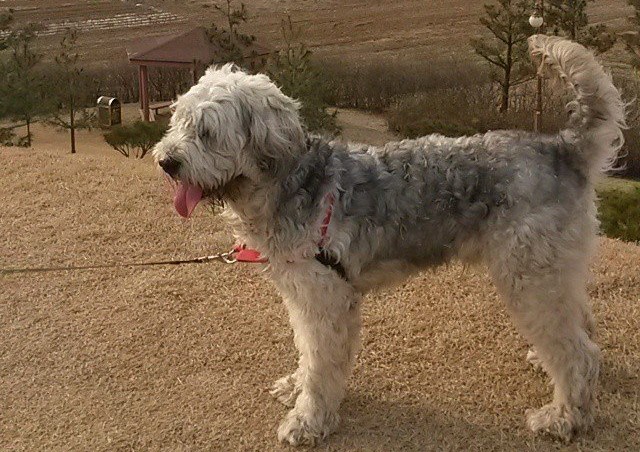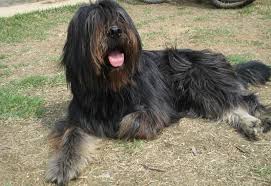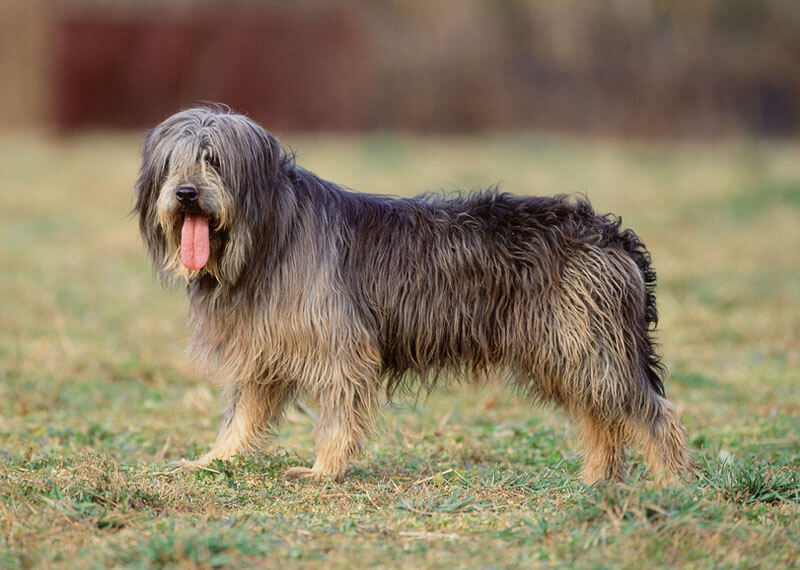
The Sapsali, or Sapsaree (Sapsali / Sapsaree / 삽살개), is a shaggy Korean dog with a rare combination going for it: state protection status, a documented population bottleneck, and about two dozen modern research papers done on the breed itself. The state listed it in the register of natural monuments as the “Sapsaree of Gyeongsan,” not “the Sapsaree breed” — and that one distinction explains most of what gets written about it wrong. More breed profiles on Tvaryny.
Sapsali (Sapsaree): the breed in brief
Sapsali (Sapsaree): the breed in brief · 9
| Origin | Republic of Korea; the protected nucleus is the city of Gyeongsan, North Gyeongsang Province |
|---|---|
| Status | natural monument “Sapsaree of Gyeongsan” (경산의 삽살개), record 368 of the state register, dated March 10, 1992 |
| Holder of record | the Korean Sapsaree Foundation (한국삽살개재단); administrator — the city of Gyeongsan |
| Recognition by federations | the breed is absent from the lists of the FCI, the AKC (including its FSS program) and the UKC; since 2019 the Foundation has been seeking FCI recognition |
| Coat | long and short — both forms within the breed |
| Color | cheong (gray-blue), hwang (red-yellow), baek (white), baduk (parti-colored) |
| Height at the withers | males 54–63 cm, females 51–60 cm as described by the Foundation (measured dogs are shorter — see the size section) |
| Weight | males 22–30 kg, females 17–28 kg as described by the Foundation |
| Modern roles | companion, guard, assistance dog in therapy, “sentry” at heritage sites |
Two rows deserve attention of their own. The coat comes long and short — both forms are legitimate within the breed, and in the largest measured sample almost half were short-coated. And height is listed separately by sex: one combined range is wrong here, because it quietly swallows the females.
A natural monument: what the state actually designated

The record in the Republic of Korea’s state heritage register reads “경산의 삽살개” — “the Sapsaree of Gyeongsan”; the same agency’s English-language card calls it Sapsari Dog of Gyeongsan. Category: 천연기념물, natural monument. Date in the register: March 10, 1992. Holder of record: the Korean Sapsaree Foundation; administrator: the city of Gyeongsan.
Three things that retellings fuse into one.
- This is not a “national treasure.” “국보” (national treasure) and “보물” (treasure) are conferred under the cultural heritage act, and only on material heritage; natural monuments fall under a separate act. A living population of dogs cannot enter the national treasure register at all — different registers, not synonyms.
- What is designated is not “the breed” but a population in a place. The tie to Gyeongsan is no accident: the agency’s standing guidance on naming natural heritage prescribes exactly the order “self-government unit + proper name.” The register also states the scope: “the proper number of head is 400, the registered number is 200,” with a note that this covers Sapsarees kept within the city of Gyeongsan and registered as meeting the standard.
- The record number is a historical reference today. On November 19, 2021 the heritage agency announced it was dropping numbers from the designation of national treasures, treasures, historic sites, and natural monuments: the phrase “designation number” was struck from the subordinate legislation and the administrative forms. The number 368 is still the key the state database returns the record under — its “revoked” field reads “no” — and the Foundation uses it too. But the name comes first here, not the number.
Two other local dog breeds hold natural-monument status in Korea: the Jindo (record 53) and the Gyeongju Donggyeongi (record 540). All three records are in force. About its neighbor in the register we have written separately — the Korean Jindo Dog.
The date has a muddle of its own. The state database and the English-language card both give March 10, 1992. The government livestock institute gives March 7. A regional encyclopedia names March 10 — then, in the same breath, cites a newspaper report of the designation dated March 8, a day earlier than its own date. We take the date from the register and name the discrepancy instead of picking the convenient one.
Can a Sapsaree be taken out of the country?
Popular texts offer two mutually exclusive statements here — “export is strictly forbidden” and “Sapsarees are sold all over the world” — and each has a document behind it.
Since May 17, 2024, designated natural monuments in Korea have been protected by a separate Act on the Conservation and Use of Natural Heritage (passed March 21, 2023; the 1992 designation moved under it automatically by the transitional provisions). Its article 20 is headed “Prohibition on the export of natural monuments” and opens unambiguously: a natural monument may not be exported or taken out of the country. The exceptions are narrow: by permission of the head of the heritage agency, on condition of return within two years, and only for display abroad in a cultural exchange or for scientific research. Export of animals bred at a designated facility for research or exhibition is allowed separately. Article 34 adds a “keeping zone” — taking an animal outside it needs the provincial governor’s permission.
Meanwhile the Foundation openly describes the overseas side of its work: the breed’s first showing abroad in Washington in 2007, mascot duty at a Korean festival in Los Angeles in 2011, a cooperation agreement with that festival’s organizers, and a network of dog placements — to several US states, plus Poland, Australia, and Singapore.
The two documents don’t contradict each other once you see what the ban attaches to. The act forbids exporting a “natural monument,” defined as an object designated and published in the prescribed manner; the register in turn limits the designation to the registered head in Gyeongsan. So the checkable version runs: a Sapsaree registered in Gyeongsan as a designated natural monument may not be exported, other than by permission of the agency for display or research with return within two years. Where the line falls for the rest of the dogs of the breed does not follow from the available documents — worth bearing in mind when reading any categorical statement in either direction.
How many Sapsarees there really are
The most common figure in popular texts is “more than three thousand.” It exists, it has an author and a date, and it is almost always quoted without either.
| Source | What it says |
|---|---|
| The state register, scope-of-protection field | 200 head registered, the proper number 400 (dogs within Gyeongsan, registered as conforming to the standard) |
| The same register record, descriptive text | “has lately grown to about 500” |
| A 2010 paper on body measurements | “about 3,000 individuals, including about six hundred at the breed’s research institute” — no source given |
| Papers of 2016 and 2019 | “about 4,000, including 500 at the institute” |
| The institute’s pedigree (the paper on effective population size) | 1,082 living dogs; a pedigree tree of 8,264 records, 13 generations, 1989–2009 |
Three conclusions follow. First, “more than 3,000” is a 2010 figure, and later papers already give about four thousand. Second, 8,264 (or 8,256 in another paper) is not a head count but a cumulative pedigree over twelve to thirteen generations; anyone quoting it as a count of living dogs is off by an order of magnitude. Third, the register’s figure is the smallest because it measures something else: not every Sapsaree in the country, but the designated population in Gyeongsan.
Tellingly, one and the same register record gives two numbers within itself — 200/400 in a structured field and “about 500” in the descriptive text. We quote both.
How the breed came to the brink of extinction
The state register describes it this way: the Sapsaree, an ordinary sight in every village, dropped sharply in number after 1940, under Japanese rule — Japan turned dogs into a source of hides for the war and killed them in large numbers — and came to the brink of extinction.
The event is real, and it leaves a primary trace. A 2018 peer-reviewed paper on the history of veterinary medicine, about rabies in colonial Korea, says it directly: on its reading the domestic dog population had been falling ever since dog hides began to be requisitioned as war material in the 1930s, and the Government-General considered it possible to obtain in Korea an average of 100,000–150,000 hides a year, at most up to 500,000. That estimate comes from a 1943 publication of the Government-General’s forest experiment station on Korean dogs and their fur.
🔴 Here is where the commonest error about this breed hides. In the document this is an estimate of procurement capacity — how many hides it would have been possible to obtain from all the dogs of Korea. In the retellings it turned into the number of Sapsarees killed per year. Two different statements, and not a single figure changes in the process.
Which gives a check. The same paper cites the Government-General’s veterinary statistics: the total dog count in Korea fell from 1,391,147 head in 1934 to 868,342 in 1940, roughly 38 % — and that is all breeds and all causes together. Against it, “a million and a half Korean native dogs killed” exceeds the country’s entire dog population as of 1940, while the English version “100,000–500,000 Sapsarees every year” would over seven years give between 700,000 and three and a half million Sapsarees alone — against a nationwide maximum of 1.39 million dogs of all breeds.
So here is how we put it: the requisitioning of dog hides as war material is documented, the fall in the dog population is documented, and the number of Sapsarees killed is documented nowhere. Telling, too, that the historical paper just cited, whose author read the 1943 publication, never mentions the Sapsaree once in all thirty-four pages.
One more detail breaks the convenient symmetry. It is often written that the Japanese authorities wiped out Korean native dogs in general. In fact the three breeds’ fates diverged: the Government-General designated the Jindo a natural monument in 1938, which the literature names as the reason it survived; the Donggyeongi declined for a quite different reason — tailless dogs were held “unlucky”; and the Sapsaree, in the breed foundation’s own words, was hit precisely because of its long coat and usable hide. This is not one story told about three breeds, but three different stories.
The revival: who, when and from how many dogs
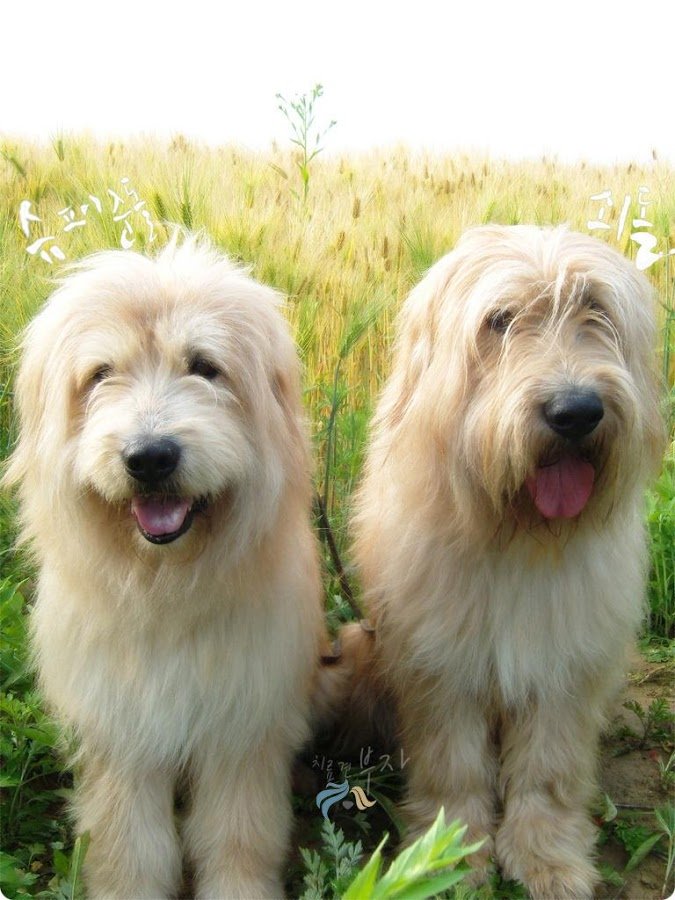
Popular accounts make a typical mistake here: they credit the start of the program to one person, the best known one. The state register puts it briefly and in the plural: in the late 1960s professors of Kyungpook National University collected and took into safekeeping about thirty Sapsarees. The regional encyclopedia names names: professors Tak Yeon-bin and Kim Hwa-sik raised the money for the collecting and the research; 52 dogs were judged pure, and 30 of them were gathered. Ha Sung-jin — academic supervisor and patron to both — later took the work over and kept the dogs on his farm near Daegu. Ha Ji-hong, the man the breed is associated with today, is his son.
⭐ Why every date in this story floats — there is an answer, and it is documented. The regional encyclopedia says it plainly: Ha Sung-jin kept the dogs from 1970 to 1984, but had no clear intention of breeding from them, and no records survive. Fourteen years with no studbook — that is why the modern pedigree begins only in 1989, and why every retelling dates the collecting, the return, and the founder count differently.
The real number of founders of the modern population is eight, not thirty. Not our reconstruction: Ha Ji-hong writes it himself in his own peer-reviewed article — “in 1986 eight individuals resembling the Sapsaree in color and build were collected around the country by local enthusiasts of the breed in Daegu”; the same number comes from the government livestock institute (in the spring of 1985 there were only eight of them on his father’s farm) and from the regional encyclopedia. A genetic paper of 2019 repeats it thus: “in 1986 the Sapsaree population was restored from eight individuals selected for their resemblance to the original breed — by color and body shape.”
The two “thirties” here are a trap: about thirty were gathered at the turn of the 1960s and 70s, and about thirty was the number again by 1989, this time starting from eight. The formula “from 30 to more than 3,000” is wrong at its base: the counting starts from eight. And the words “selected for their resemblance in color and build” are worth attention: the founders were chosen by appearance, not by proven descent.
…and what those studies get credited with
A great deal is written about the Sapsaree, and almost always approximately. Let us set the common claims against what stands in the papers.
…and what those studies get credited with · 6
| “Sapsaree DNA is so unique that scientists use it to study dog migration in Asia” | Sapsaree genomes really were used to reconstruct the history of Asia’s dogs — and that is exactly why we know it stands apart from the other Korean breeds not through an immaculate Korean antiquity but through a large West Eurasian component: 40.4 % against 5.5 % in the Jindo. |
| “It differs sharply from the other Korean breeds” | It does, but the direction is the opposite of the expected: the Jindo and the Donggyeongi pull toward South Chinese and Vietnamese dogs, the Sapsaree toward the North Chinese dog and the Tibetan Mastiff, with the largest haplotype overlap with the German Shepherd of any Asian breed. And that distinctness does not hold on every axis of the analysis. |
| “The breed was restored from thirty dogs, so the gene pool is poor” | There were eight founders, not thirty. And the measured heterozygosity is the highest of the eight breeds compared, albeit on a different chip. The bottleneck shows not there but in effective population size: 5,381–5,699 → 1,126–1,265 → 64–75 at five hundred, a hundred and five generations. Different measures, not to be confused. |
| “The Sapsaree is an unchanged breed more than a thousand years old” | The earliest the geneticists offer is divergence from the other Korean breeds 2,000–11,000 years ago, and that is about populations, not a breed. The regional encyclopedia says plainly that documentary material proving descent from the Silla period has not been confirmed. |
| “The breed’s temperament has been fixed by selection” | In the same population the heritability of body measurements is high (0.32–0.55), while the heritability of the seven behavior traits assessed runs from 0.00 to 0.16. Appearance is under selection; behavior practically is not. |
| “Sapsarees are prone to cherry eye, distichiasis and entropion” | In the largest ophthalmic survey of the breed — 547 dogs — cherry eye and distichiasis were not recorded once, while entropion occurred in three dogs, that is in 0.5 %. The most frequent findings were quite different, and absent from popular descriptions. |
The name “sapsali”: what it means
The state register gives the meaning directly: 삽살개 is “a dog whose name means ‘the hound that drives away ghosts and misfortune’; the name itself is a native Korean word, and the dog appears often in songs, folk tales and paintings.”
That wording is worth taking literally, because it makes two separate statements: that the name is natively Korean, not borrowed, and that a dog under this name shows up in the song, oral, and painting traditions. Both belong to the register, and we relay them as its position.
The earliest dated attestation of the name leads not to spirits but to the coat. In the Hunmong jahoe — Choe Se-jin’s character dictionary, published in 1527 (訓蒙字會) — the vernacular form sapsalgahi stands beside the character for “dog,” with the Chinese equivalent 絡絲狗, “a dog of tangled threads.” So the oldest written explanation of the name is a description of the coat. That does not refute the register’s meaning, but it shows why we give no morpheme-by-morpheme parsing of the name: that belongs to later interpretation, not to the earliest record.
What a Sapsaree looks like
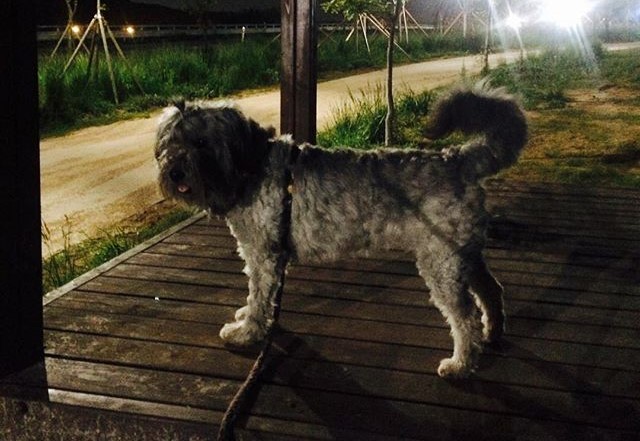
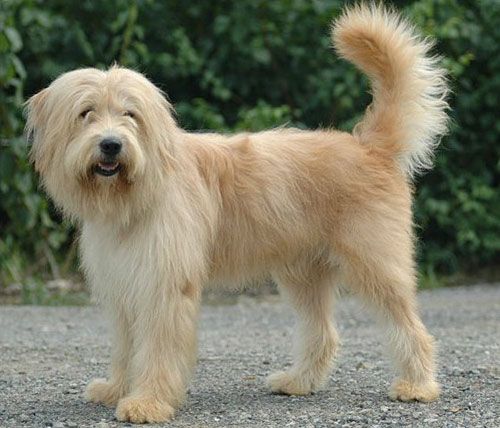
The description in the state register is short and remarkably concrete: the whole body is covered with long hair; the eyes are not visible behind the coat; the ears drop, the muzzle comparatively blunt rather than pointed as in the Jindo; the tail carried up, the head large, and in appearance the dog resembles a lion.
The Foundation’s description adds what the register lacks: the coat comes long and short, and the size is stated as “a medium and large dog.” A short-coated Sapsaree is not a crossbred or a fault but a full form of the breed. In a sample of 114 dogs there were 61 long-coated and 53 short-coated; in a sample of 378 the split also came out about 60 to 40, though that paper labels the two groups differently in its methods and its results.
⚠️ Two widespread details need correcting. First: the Sapsaree is often called wavy-coated. The one paper that counted coat structure — 882 dogs, three categories (straight, wavy, curly) — found 69 % straight-coated. Second: a tail curled in a ring over the back is presented as the breed’s silhouette, whereas the Foundation’s description makes something else the norm — “thick and long, freely extended in an arc” — and calls a tail curled along the spine a variant seen in some individuals.
Other details of the Foundation’s description that rarely reach translations: ears “mostly of drop form, but individuals with prick or semi-prick ears do occur”; eyes moderately large and round, mostly brown, with low frequency yellow and jade; canines large and well developed, the bite mostly normal; back straight, loin tucked up. In general impression the Sapsaree resembles an Old English Sheepdog, and its coat is closer in work to the dense fur of a Chow Chow than to a medium-sized herding breed’s.
Color. The Foundation’s description lists four base colors:
- cheong (청, “blue”) — black-gray with a steel cast; together with red this is the most numerous color;
- hwang (황, red-yellow) — from pale sandy to a deep red;
- baek (백, white) — occurs at low frequency;
- baduk (바둑, parti-color) — spotted, also rare.
⚠️ The Foundation’s description sets no hierarchy between solid and parti-colored dogs — it acknowledges a diversity of colors and notes which occur more often. The claim that solid dogs are “rated more highly” is not in the standard. Worth knowing, too, that the Foundation’s English page lists chocolate among the rare colors, which appears in no Korean list, while the measured samples divide them more finely still: in the paper on 547 dogs the colors fall into five groups (blue 236, red 240, white 37, red-and-white 18 and chestnut 16), and in the paper on 882 dogs into four.
One more correction, important for anyone choosing a puppy: the nose leather is not always dark. The Foundation calls it black, glossy and moderately large, occasionally dark brown — and in white Sapsarees often pink.
⚠️ Of “blue” Sapsarees it is often written that their color comes from a pigment dilution gene. A variant of such a gene (MLPH) has indeed been found in Korean native dogs, and in the Sapsaree its frequency came to 0.20 — but this rests on only five fully read genomes, and the authors themselves distanced it from color word for word: “no cases of coat color dilution or of the associated skin inflammation have been reported in these Korean breeds. This suggests that color dilution depends on more than the MLPH mutation alone.” Korean popular sources describe the mechanism quite differently and far more simply: puppies are born very dark and with age white guard hairs mix into the coat — that mixing of black with white gives the “blue” cheongsapsaree, while the dark red hwangsapsaree gradually lightens. So it is graying rather than pigment dilution.
Size: why the figures differ from source to source
This is a case where showing the disagreement is more honest than giving one “correct” number. We found seven sets — and no two coincide completely. Three were published by one and the same organization.
Size: why the figures differ from source to source · 7
| Source | Height at the withers | Weight |
|---|---|---|
| The Foundation, Korean breed-description page | males 54–63 cm, females 51–60 cm | males 22–30 kg, females 17–28 kg |
| The Foundation, Korean “group and size” page | males 55–63 cm, females 52–60 cm | males 22–30 kg, females 20–28 kg |
| The Foundation, English-language “Standard Description” page | males 52–60 cm, females 50–58 cm | males 24–32 kg, females 18–26 kg |
| The state livestock institute | males 50–58 cm, females 48–55 cm | publishes no weights |
| The state heritage register, record description | male 51 cm, female 49 cm — a single value, not a range | publishes no weights |
| 882 dogs measured, a 2010 paper | mean 52.1 cm (males 53.4; females 51.1) | mean 20.5 kg |
| 378 dogs measured, a 2024 paper | mean 55.18 cm, from 50.00 to 64.50 (both sexes together) | weight not measured |
The discrepancies are of different kinds, and worth telling apart. The register’s pair “51 and 49” is most probably a typical value rather than a boundary. But three tables from one foundation are already a classic source of the “fused” ranges in reference books: the lower bound from one page, the upper from another, and both “from the official site.” The two Korean tables were available at the same time, while the English-language one — the only one the Foundation calls the standard — differs most from both and even describes the breed as “medium,” whereas the Korean page says “a medium and large dog.”
The main point, though, is elsewhere: the numbers that used to stand in our card (males 50–58 cm, females 48–55 cm, 18–28 and 16–24 kg) match none of these documents, and they are too small. Their origin can be traced: the introduction to a 2024 genetic paper has a sentence about males “from 20 to 23 inches” and a weight “from 40 to 62 pounds,” and females “up to 22 inches” and “from 35 to 55 pounds.” Converted, that gives exactly 50–58 cm and 18–28 kg. But that sentence cites a 2019 genetic paper — which says something quite different: “they are of medium body size (54–62 cm in height),” with no inches, no pounds and no split by sex. So the citation contradicts the source it refers to, while the source agrees with the Foundation.
The tape measure supplies the check. In the sample of 378 dogs the measured maximum is 64.5 cm, so the card’s previous ceiling of 58 cm cut off the upper part of the real population; while the minimum across both sexes together is exactly 50.0 cm, so “48 cm for females” is below anything ever measured. At the same time the means sit near the lower edge of the described range: the mean male in the sample of 882 dogs is 53.4 cm against a stated minimum of 54. The practical conclusion for the reader: a typical Sapsaree is closer to the bottom of the standard than to the top — but dogs of nearly 64 cm exist, and they did not fit into the old card.
So the card on this page now carries the set from the Korean breed-description page, and necessarily split by sex: it is the only one that covers the measured data from both ends. On weight, keep in mind that two small 2026 feeding papers (18 dogs each) gave mean adult weights of 28.63 and 23.49 kg — so the top of the stated range is a typical large male, not a record.
What Sapsarees do in Korea today
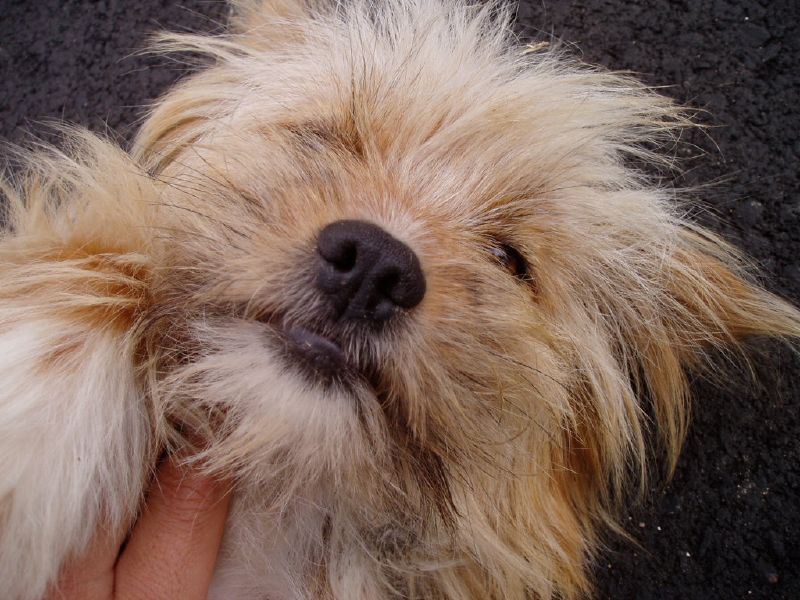
This part rarely reaches foreign descriptions, and it is what explains why the breed could be held on to at all after 1986.
- Dokdo island. Since 1998 the Foundation has kept “sentry” dogs on the island; by its own account this is already the ninth generation of that line.
- Heritage sentries. In 2014–2016 twenty trained Sapsarees served at sixteen temples, among them Jeondeungsa on Ganghwa.
- Assistance dogs in therapy. Since 1999 the Foundation has picked its most sociable dogs for work in care institutions, homes for the elderly, and rehabilitation centers; since 2021 it has worked with one psychiatric clinic — Daedong Hospital in Daegu. Not “an ever wider practice in Korea’s hospitals,” but twenty years of work in social institutions plus one medical partner.
- Outside Korea. The first showing abroad was in Washington in 2007; in 2011 the breed was the mascot of a Korean festival in Los Angeles; since 2019 the Foundation has taken part in shows under FCI auspices in pursuit of international recognition.
On the therapy side, the strength of the evidence is worth knowing too — and here the Foundation behaves more honestly than most, because it lists the studies it relies on along with their samples. And the samples are very small: five patients in a 2021 program, six children (three in the test group and three in the control) in a study of 2000, fourteen patients in another. That is grounds for saying the direction exists and has cautious positive results — not that its effectiveness is proven.
Cloning: what was actually done
The Sapsaree is one of the few breeds cloned with conservation stated outright as the goal, and the result was published with full numbers. The nucleus donor was a nine-year-old male; oocytes came from 38 donors. 309 cloned embryos were transferred to fifteen recipient bitches; two proved pregnant, each giving birth to a single puppy weighing 530 g — a yield of about 0.65 %. One of the two puppies died: it was injured by its surrogate mother. Both matched the nucleus donor genetically, while their mitochondrial DNA came from the oocyte donors.
Two details make this work more interesting than simply “the breed was cloned.”
The first. The authors note that the surviving clone “apparently showed signs of hip dysplasia… and this had also been found in the somatic cell donor dog,” adding: “although we cannot explain the reasons for this, it indicates that a genetic problem rather than the cloning procedure itself or an epigenetic modification may be responsible.” Three hedges in two sentences — and at the same time one more independent hint that the hips are a subject in this breed.
Second. The work incidentally confirmed a breed feature often quoted as an “interesting fact”: the Sapsaree’s color changes naturally from puppyhood to adulthood. The clones’ coats differed from the donor’s at first and gradually came to match as they matured. The clones served as an unintended control.
One clarification, because people always ask: this work came from a group at Seoul National University, and it has not been retracted. The papers from that same lab that were retracted concerned human embryonic stem cells, not dogs.
Interesting facts about the Sapsaree
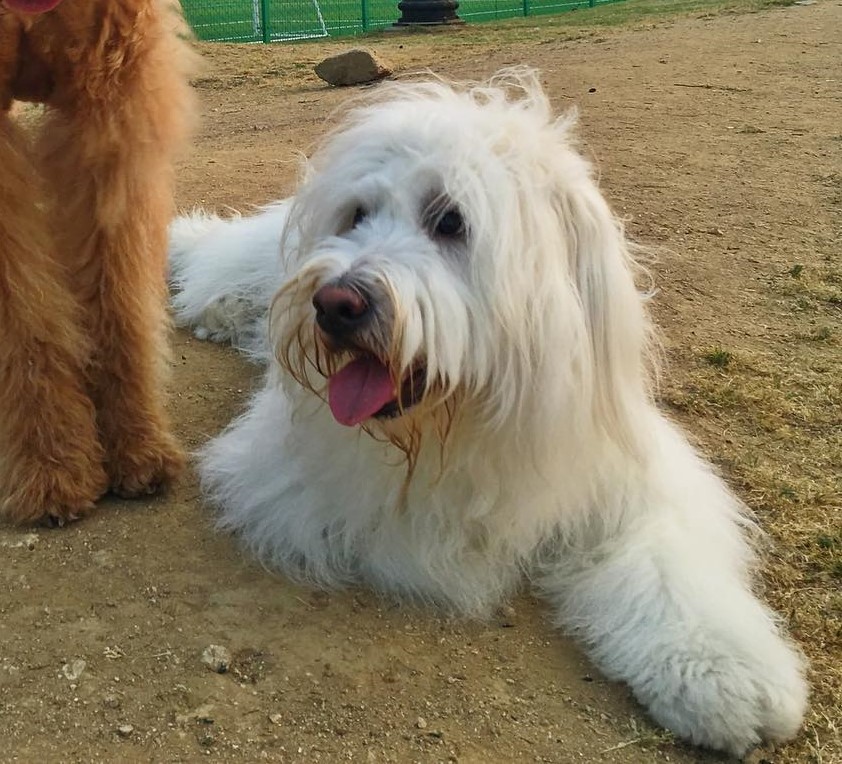
- A dog named by a place. What stands in the state register is not “the Sapsaree breed” but “the Sapsaree of Gyeongsan”: the protected thing is the population of one particular city, as the agency’s naming guidance requires.
- It resembles someone other than you would think. By whole genomes its closest relatives are not the Korean neighbors but the North Chinese native dog and the Tibetan Mastiff; its West Eurasian share is 40.4 %.
- A short coat is a Sapsaree too. The Foundation’s description lists both forms, and in the sample of 114 dogs examined there were 61 of one and 53 of the other.
- The oldest record of the name speaks of the coat. A dictionary of 1527 gives the vernacular form of the name with the Chinese equivalent “a dog of tangled threads.”
- The color changes with age — recorded not in a retelling but in the cloning paper, where the clones’ coats “arrived” at the donor’s color as they matured.
- A breed with a post. Since 1998 Sapsarees have served as “sentries” on the island of Dokdo; in 2014–2016 twenty dogs served at sixteen temples.
- It was the mascot of a world championship. Sarbi, the mascot of the 2011 World Championships in Athletics in Daegu, was drawn from a Sapsaree.
- Rarity does not make it an exception. Its survival story brings the Sapsaree close to the Rampur Greyhound — also a national asset that nearly vanished; and in how hard it is to obtain outside its homeland it recalls the Sage Koochee.