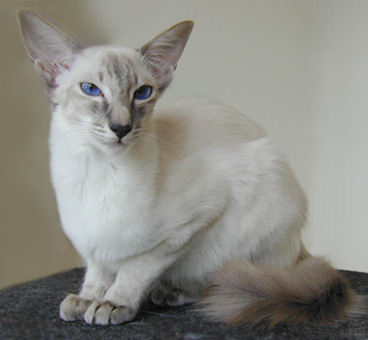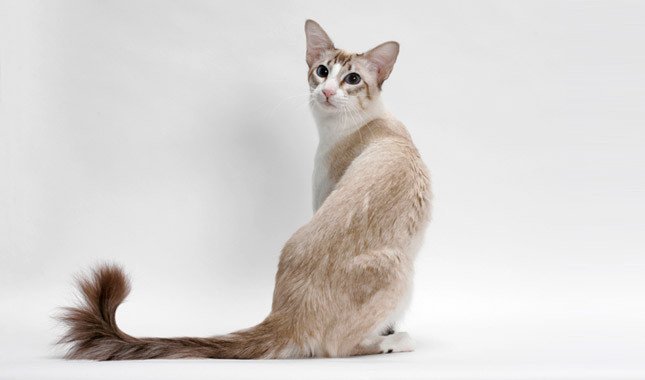
The Balinese, also known as the Balinese cat, isn't just a separate breed but essentially a long-haired version of the well-known Siamese cat. This elegant breed arose from a natural genetic mutation that gifted Siamese cats with a luxurious long coat. Its exquisite appearance, reminiscent of the graceful dancers from the island of Bali (hence the name) – a grace it shares with other elegant breeds such as the Turkish Angora – and its extraordinary focus on human companionship make Balinese cats increasingly popular pets. If your home often echoes with loud and melodious miaowing (as Balinese cats are known for their "chattiness" and don't mind a natter, even with themselves), remember to provide them with a warm atmosphere – both literally (they are sensitive to cold and draughts due to their lack of an undercoat) and figuratively (they need a great deal of attention and love). You can find out more about this and other fascinating cat breeds on Tvaryny.
Balinese Cat: A Brief Breed Overview
Balinese Cat: A Brief Breed Overview · 14
| Characteristic | Description |
|---|---|
| Origin | United States of America |
| Time of Origin | 1940s–1950s (targeted breeding); CFA recognition – 1970 |
| Other Names | Balinese, Long-haired Siamese (obsolete) |
| Lifespan | 9–15 years (average 12–14, but can live up to 18–20 years with good care) |
| Size | Medium |
| Weight | Males: 3.5–6 kg Females: 2.5–4.5 kg |
| Height at Withers | Around 25–30 cm |
| Coat | Semi-long, silky, without an undercoat |
| Colour | Colourpoint (seal point, blue point, chocolate point, lilac point, as well as red point, cream point, tortie point, lynx point in some associations) |
| Eyes | Almond-shaped, bright blue, set obliquely |
| Temperament | Active, intelligent, inquisitive, gentle, devoted, "chatty", requires attention |
| Care | Moderate (brushing 1–2 times a week, dental care, warm environment) |
| Compatibility with Children | Good, provided children are gentle |
| Compatibility with Other Animals | Good, especially if raised together |
Interesting Facts About Balinese Cats
- Dancing Grace: The name "Balinese" was given to the breed by Helen Smith not because of its geographical origin (the breed was developed in the USA), but because of the extraordinary grace and fluid movements of these cats, which reminded her of exotic dancers from the island of Bali.
- "Long-haired Siamese": The original name for the breed was precisely this, but it was changed to the more elegant and melodious "Balinese".
- Javanese – Sibling or Not?: The CFA distinguishes Balinese with point colourings different from the classic four (seal, blue, chocolate, lilac) as a separate breed – the Javanese. The name is also "island-themed" and related to Bali (Java is a neighbouring island). However, most other feline organisations consider Javanese cats simply a colour variation of the Balinese breed.
- “Hypoallergenic” is a myth: How much allergen a cat produces varies far more from one individual animal to another than from breed to breed. If you have an allergy, spend time with the particular cat you are taking home and make the decision together with an allergist — the breed guarantees nothing.
- Born White: Like Siamese kittens, Balinese are born completely white. The characteristic dark markings (points) only begin to appear a few days or weeks after birth. This is due to temperature-sensitive albinism: the gene responsible for colour is activated only at lower temperatures, so cooler parts of the body (ears, face, paws, tail) become darker.
- Blue-Eyed Beauties: All purebred Balinese cats have expressive almond-shaped eyes of a deep blue colour. This is also linked to the colourpoint gene.