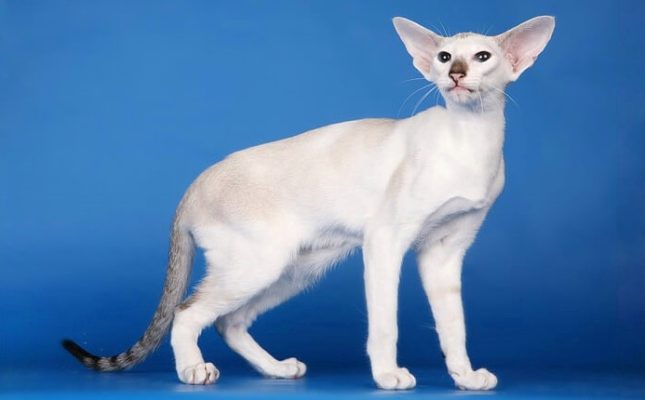
A dainty white-spotted Siamese-Oriental with a loud heart — sociable and people-dependent: clever, energetic, affectionate and extroverted. The Seychellois is a rare British breed of the Siamese-Oriental group (white-spotted point), in short- and semi-long-haired varieties; extremely sociable and attached, it demands attention, contact and active play, though its voice is softer than the Siamese's.
KidsDogsOther catsBeginners · with caveatsTime alone · not suitable
The Seychellois cat is an elegant, graceful, and exceptionally sociable member of the feline world, belonging to the Siamese-Oriental group. This is a relatively rare breed, developed in Great Britain, captivating owners with its striking colouration (a white cat with coloured markings on the head and tail) and a lively, energetic temperament. Seychellois are not cats that will happily doze on the sofa all day; they demand attention, companionship, and active play. This pet strives to be a full-fledged family member and the centre of attention, blessed with high intelligence, incredible curiosity, and a playful, almost kitten-like, behaviour throughout its life. Despite its exotic appearance and active nature, with proper care, the Seychellois cat generally enjoys robust health and doesn't require overly complicated grooming, especially the shorthaired variety. However, their most defining characteristic is an immense need for social interaction, making them entirely unsuitable for individuals who spend a lot of time away from home and are not prepared to give their pet sufficient attention; you can find out more about this on Tvaryny.
Seychellois Cat: A Brief Breed Overview
Name (FIFe Code)
Pattern Description
Permitted Patches (excluding head and tail)
Septième (Seventh) - code 01
“Van” pattern. Maximum amount of white. Colour only on the head (ears + mask) and tail.
1–2 small patches on the body are allowed.
Huitième (Eighth) - code 02
Colour on the head, tail, and paws.
Clearly defined patches on the paws (not extending above the knee/elbow) and/or small patches on the body are allowed.
Neuvième (Ninth) - code 03
Colour on the head, tail, and larger patches on the paws and body. The least amount of white among Seychellois variations.
Larger, clearly defined patches on the body and paws are allowed.
Interesting Facts About Seychellois Cats
Inspiration, Not Origin: Despite the name, the breed was developed in Great Britain, not the Seychelles Islands. The name merely pays tribute to the description of cats from the islands that inspired the breed's founder.
Three Levels of White: The Seychellois colouration has three officially recognised FIFe variations (Septième, Huitième, Neuvième), which differ in the amount of white and the placement of coloured patches.
Sister to Siamese: In the FIFe classification, Seychellois cats (SYL/SYS) are considered a sister breed to Siamese (SIA), Balinese (BAL), Oriental Shorthair (OSH), and Oriental Longhair (OLH) cats, sharing with them the standard for body type, head, and character.
Always Blue Eyes: Like Siamese cats, Seychellois eyes must always be an intense blue colour. This is linked to the gene for pointed colouration.
"Naked" Longhairs? The longhaired Seychellois variation (SYS) has long fur but is almost devoid of an undercoat. This makes their coat less prone to matting than many other longhaired breeds, and it lies closer to the body.
Names of Variations: The names of the colour variations – Septième (seventh), Huitième (eighth), Neuvième (ninth) – are quite unusual for cat standards and originate from French.
Dog-like Character? Due to their high intelligence, trainability, loyalty, and need for companionship, Seychellois (like other members of the Siamese-Oriental group) are sometimes compared to dogs in terms of character.
History of the Seychellois Cat Breed
The history of the Seychellois cat breed is rather unusual and romantic, although it is not directly linked to the import of cats from the Seychelles islands themselves. The breed was created in Great Britain in the 1980s thanks to the enthusiasm and imagination of breeder Pat Turner. Her inspiration came from an article about cats living on the Seychelles islands in the Indian Ocean. The article described local cats with a characteristic coat pattern: predominantly white with coloured patches on the head, tail, and sometimes on the paws – the classic Van or Seychellois pattern.
Enchanted by this description, Pat Turner decided to recreate this type of cat, but based on the elegant physique and character of cats from the Siamese-Oriental group. Her goal was to develop a cat that would combine the refinement and grace of Siamese cats and their close relatives, Oriental Shorthairs, with a unique bicolour (two-coloured) pointed pattern.
To implement her breeding programme, Pat Turner crossed Siamese cats with bicolour Persian cats, and also used Oriental cats to establish the desired body and head type. The main task was to introduce the white spotting gene (S) into the gene pool of the Siamese-Oriental group and to obtain animals with the characteristic distribution of coloured patches on a white background.
The result was cats with the typical Siamese and Oriental physique – a long, slender body, wedge-shaped head, large ears, and blue eyes – but with a white coat and coloured markings on the "points" (head, tail, and sometimes paws). The breed was named "Seychellois" in honour of its source of inspiration.
Initially, Seychellois cats were not recognised as a separate breed by many feline organisations. They were often considered merely a colour variation of Siamese or Oriental cats (bicolour points). However, thanks to the persistence of breeders, particularly in Great Britain and Europe, the breed began to gain recognition.
The Fédération Internationale Féline (FIFe) recognised Seychellois cats in 2005, classifying them as a separate breed within the Siamese-Oriental group. FIFe distinguishes two variations: the Seychellois Shorthair (SYL) and the Seychellois Longhair/Semi-longhair (SYS). It's important to note that the Seychellois Longhair under the FIFe standard actually corresponds to a Balinese cat (a longhaired Siamese) with Seychellois colouring, while the shorthaired version is akin to a Siamese/Oriental cat with the same pattern. Other major organisations, such as the GCCF (Great Britain) or the CFA (USA), may have a different approach, often registering such cats as Siamese or Orientals with the corresponding colouration.
Today, Seychellois cats remain a fairly rare breed, valued for their elegant appearance, vibrant character, and unique coat pattern.
What a Seychellois Cat Looks Like: Standard and Colour Variations
The appearance of the Seychellois cat fully conforms to the standards of the Siamese-Oriental group, with the exception of its unique colouring. This is a cat of medium size, but with a long, slender, flexible, and muscular body that appears very elegant and graceful. There should be no hint of heaviness or stockiness.
Body: Long, tubular, with well-developed but not coarse musculature. Shoulders and hips continue the lines of the body without protruding. The belly line is tucked up.
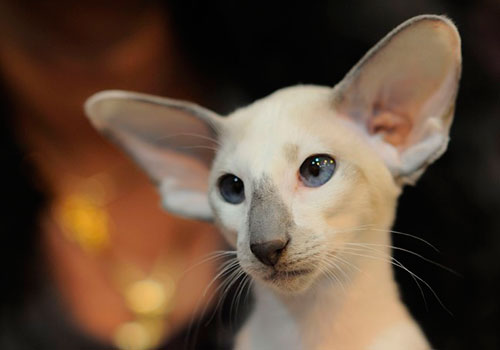
Head: Wedge-shaped, medium-sized, and in proportion to the body. The wedge starts from the tip of the nose and extends straight to the tips of the ears, forming a triangle. The profile is straight (a "Roman nose"), without a "stop" or break. The skull is slightly convex. The muzzle is narrow and refined, with a strong chin that forms a vertical line with the tip of the nose.
Ears:Very large, wide at the base, and pointed at the tips, continuing the lines of the head's wedge. They appear as an extension of the sides of the head's triangle.
Eyes: Almond-shaped, medium-sized, set slightly slanted ("oriental" slant), harmonising with the lines of the head's wedge. The eye colour is an intense, vivid blue. The richer the colour, the better.
Neck: Long, slender, and elegant.
Limbs: Long, slender, and proportionate to the body. The hind legs are slightly longer than the front legs. The paws are small and oval.
Tail: Very long, thin at the base, gradually tapering to a pointed tip (whip-like). In the longhaired variety (SYS), the tail is covered with long, flowing hair, forming a "plume" or "feather."
Coat:
Shorthair (SYL): Very short, fine, glossy, and lies close to the body. Almost no undercoat. Silky to the touch.
Longhair/Semi-longhair (SYS): Fine, silky, flowing, of medium length on the body, longer on the neck (forming a slight ruff) and on the tail (a bushy plume). Also practically without an undercoat, so it's not as prone to matting as in other longhaired breeds.
Colouration: This is the breed's key feature. The Seychellois cat is a white cat with coloured pointed markings. Colour is only permitted on certain areas: a mask on the head (which does not merge with the ears), the ears, the tail, and sometimes small patches on the paws or body. The main body must be pure white. The colours of the markings can vary, as in Siamese cats:
Seal point - dark brown
Blue point - blue-grey
Chocolate point - milky chocolate
Lilac point - pinkish-grey
Red point - red
Cream point - cream
Cinnamon point - warm brown (cinnamon colour)
Fawn point - warm light beige
These colours can also appear in tabby variations (striped markings - tabby point) or tortoiseshell (tortie point).
Variations of the Seychellois Pattern:
According to the FIFe standard, there are three colour codes for Seychellois cats, indicating the amount of white and the distribution of patches (although the visual difference may not always be distinct):
Name (FIFe Code)
Pattern Description
Permitted Patches (excluding head and tail)
Septième (Seventh) - code 01
“Van” pattern. Maximum amount of white. Colour only on the head (ears + mask) and tail.
1–2 small patches on the body are allowed.
Huitième (Eighth) - code 02
Colour on the head, tail, and paws.
Clearly defined patches on the paws (not extending above the knee/elbow) and/or small patches on the body are allowed.
Neuvième (Ninth) - code 03
Colour on the head, tail, and larger patches on the paws and body. The least amount of white among Seychellois variations.
Larger, clearly defined patches on the body and paws are allowed.
Regardless of the variation, the eyes must always be vivid blue.
Character of the Seychellois Cat: Temperament and Behaviour of an Elegant Extrovert
The character of the Seychellois cat is a vivid reflection of its Siamese-Oriental heritage. These are extremely energetic, intelligent, inquisitive, and sociable animals that adore being the centre of attention. They are entirely unsuited to being an independent 'cat that walks by itself,' preferring close companionship. Seychellois become deeply attached to their people and strive to participate in all aspects of their lives.
High Activity and Playfulness: Seychellois are perpetual kittens. They are very agile, nimble, and love to run, jump, and climb. They require daily active play and physical exercise to burn off energy. Providing them with toys, climbing frames, tunnels, and tall cat trees is essential. They retain their playfulness well into old age.
Sociability and "Chattiness": Like their Siamese ancestors, Seychellois are very "talkative". They have a wide range of vocalisations – from gentle purring and quiet "conversations" to quite loud and demanding sounds, which they use to express their desires, greet people, complain, or simply comment on what's happening around them. They expect you to talk back to them.
Intelligence and Trainability: These are highly intelligent cats. They learn quickly, easily grasp house rules (if they want to), and can learn to open doors, cupboards, fetch toys, and perform tricks. Their minds need constant stimulation, so interactive toys and puzzle games are highly recommended.
Affection and Loyalty: Seychellois are very human-oriented. They form strong bonds with their owners, often choosing one "favourite" person in the family whom they will follow around like a shadow. They need a lot of affection, attention, and physical contact. They do not tolerate loneliness well and can suffer from it, which sometimes leads to destructive behaviour or depression.
Inquisitiveness: No event in the house will escape their notice. They will investigate every bag, box, and open cupboard. They love to watch what's happening outside the window.
Attitude Towards Children and Other Animals: With proper early socialisation, Seychellois cats usually get along well with children, especially older ones who understand how to handle an animal and are willing to participate in active games. They can also establish good relationships with other cats and friendly dogs, especially if they have a similar energy level. However, their need to be the centre of attention can sometimes lead to jealousy.
Demanding Nature: Due to their high need for social interaction and activity, Seychellois can seem quite demanding. They won't sit quietly if they are bored or want your attention – they will definitely let you know with their voice or actions.
The Seychellois cat is an ideal companion for active people or families who are prepared to devote a lot of time and attention to their pet, and who appreciate its intelligence, playfulness, and deep affection.
Training and Socialising a Seychellois Cat
Training and socialising a Seychellois cat is an exciting process, as you are dealing with one of the most intelligent and communicative cat breeds. Their high intelligence and desire to interact with humans make them very receptive to training, but their energy and sometimes stubborn nature require the right approach.
Key Aspects of Upbringing:
Early Socialisation: Start socialising your kitten as early as possible. Introduce it to different people, sounds, objects, and other animals (under supervision). This will help raise a confident, rather than a timid or aggressive, cat.
Positive Reinforcement: Seychellois respond best to positive reinforcement methods. Use treats, praise, and affection to encourage desired behaviour. Clicker training can be very effective with this breed. Avoid punishment and shouting – this can frighten the cat, destroy trust, and provoke stress or retaliatory aggression.
Teaching Commands and Tricks: Thanks to their intelligence, Seychellois can easily learn to come when called, sit, give a paw, and fetch toys. Short, regular training sessions in the form of play will be most effective. Don't forget the reward!
Establishing Rules: Be consistent in setting rules (e.g., no jumping on the table, no scratching furniture). If the cat does something undesirable, gently redirect its attention to an allowed alternative (a toy, scratching post). Use a clear "No" or "Don't," but without aggression.
Channelling Energy: To prevent boredom and destructive behaviour, provide your Seychellois with enough physical and mental stimulation. Regular play with a "fishing rod" toy, a laser pointer (always end the game with a "catch" - a toy), balls, interactive feeders, and puzzle toys will help direct their energy appropriately.
Acclimatising to Grooming Procedures: From a young age, accustom your kitten to combing (especially longhaired ones), ear and tooth inspections, and claw trimming. Do this calmly, gradually, and by offering treats.
"Chattiness": Remember that Seychellois are very vocal. Do not try to completely stop them from "talking" – it's part of their nature. Learn to understand their signals and respond to them. However, if meowing becomes excessively demanding, ensure all the cat's needs are met (food, water, clean litter tray, play, attention), and do not encourage unwanted vocalisation with attention.
The most important things in raising a Seychellois are patience, consistency, love, and a willingness to devote plenty of time and attention to it. A grateful cat will reward you with deep affection and become a wonderful companion.
Pros and Cons of the Seychellois Cat Breed
Pros and Cons of the Seychellois Cat Breed · 7
Pros (+)
Cons (-)
Elegant and exotic appearance: Unique colouring, graceful physique, blue eyes.
High need for attention and companionship: Not suitable for busy people, tolerates loneliness poorly.
High intelligence and trainability: Learns tricks easily, understands rules.
Very "talkative": Can be loud and insistent in their demands.
Very active and playful character: Always ready for games, brings life to the home.
High need for activity and stimulation: Requires many games, toys, space for movement; can become bored and exhibit destructive behaviour.
Deep affection and loyalty: Forms a strong bond with the owner, very affectionate.
Possible tendency towards jealousy: May demand to be the sole favourite or share owner's attention poorly.
Relatively easy coat care (especially SYL): Short coat requires minimal grooming, long coat is not prone to severe matting.
Possible hereditary diseases: Requires careful choice of breeder and attention to health (PRA, HCM, amyloidosis, etc.).
Gets along well with children and other animals (with socialisation): Can become a wonderful family pet.
Rare breed: Can be difficult to find a kitten, higher price.
Longevity: With proper care, they live quite long (13–15+ years).
Can be stubborn: Sometimes shows independence in training.
Caring for a Seychellois Cat: Maintaining Beauty and Health
Nutrition
Feeding a Seychellois Cat: Energy for Elegance
Health and risks
Health of the Seychellois Cat: Potential Problems and Prevention
Frequently Asked Questions About the Seychellois Cat Breed (FAQ) · 7
Are Seychellois cats suitable for people who work a lot? No, they are decidedly unsuitable. Seychellois have a very high need for human attention and companionship. They do not tolerate prolonged loneliness well and can suffer from it, leading to stress, depression, or destructive behaviour. They need an owner who is prepared to dedicate a lot of time to them.
Do Seychellois cats shed a lot? Shorthaired Seychellois (SYL) shed moderately; their short coat without an undercoat doesn't cause major problems. Longhaired Seychellois (SYS) shed more, especially seasonally, but due to the lack of a dense undercoat, their fur tangles less than that of other longhaired breeds. Regular brushing helps to control shedding.
Are Seychellois cats noisy? Yes, Seychellois, like most cats of the Siamese-Oriental group, are very "talkative". They use their voice to communicate with their owners, express their needs, and convey emotions. If you value peace and quiet, this breed may not be for you.
Is caring for a Seychellois cat difficult? Grooming a shorthaired Seychellois is minimal (brushing once a week). A longhaired one needs regular combing (2–3 times a week). The main difficulty lies not so much in grooming, but in the necessity to provide sufficient attention, play, and mental stimulation.
Can a Seychellois cat be kept with other animals? Yes, with proper and early socialisation, Seychellois usually get along well with other cats (especially equally active ones) and friendly dogs. However, they can be jealous and demand the lion's share of their owner's attention.
What are the main health problems in Seychellois cats? As members of the Siamese-Oriental group, they may be prone to Progressive Retinal Atrophy (PRA), Hypertrophic Cardiomyopathy (HCM), amyloidosis, asthma, and dental problems. It is important to choose a kitten from a responsible breeder who conducts health testing.
How does a Seychellois cat differ from a Siamese or Oriental cat? The main difference is the colouration. A Seychellois cat is effectively a Siamese or Oriental cat (depending on coat length and organisation standard) with the white spotting gene, which creates a characteristic pattern (white body with coloured markings on the head, tail, and sometimes paws/body). Their body type, head shape, character, and eye colour (blue) are shared.
FAQ
What is the Seychellois cat?
It is a white-spotted (bi- or tricolour) pointed cat of the Siamese-Oriental group, developed in Great Britain; any bicolour Balinese or Siamese of this type is considered Seychellois. It comes short- and long-haired.
Is the Seychellois cat noisy?
It is talkative, like all Siamese-Orientals, but has a softer, quieter voice than the classic Siamese; talking is its way of being closer to a person.
Can the Seychellois cat be left alone?
Not advisable — a very people-oriented breed that copes poorly with solitude; it needs attention, play and company, so it is better to keep a pair or be at home.