

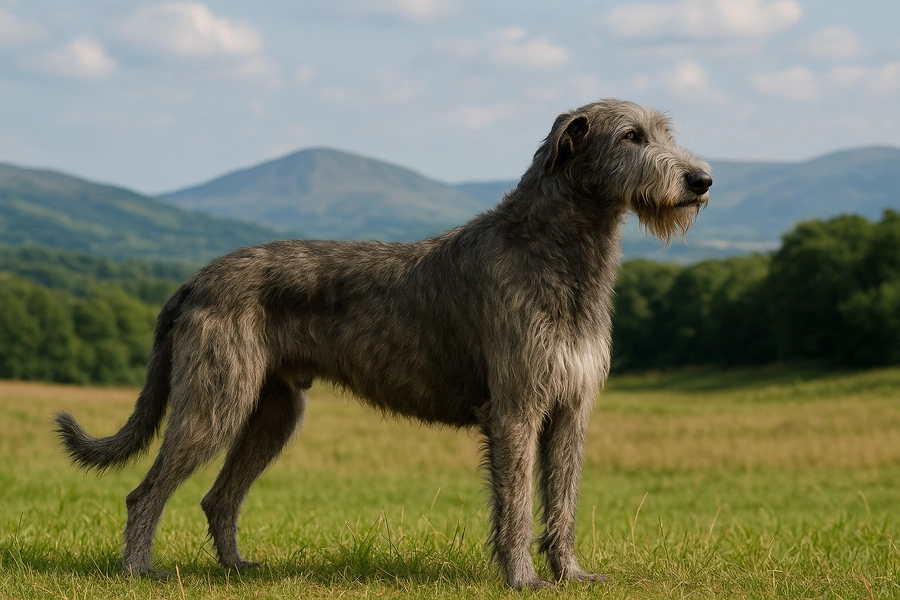
| Height | 71–90 cm |
| Weight | 40–69 kg |
| Lifespan | median 9.9 years |
| FCI group | 10 · sighthounds |
| Origin | Ireland |
Exact ratings
Common health issues
Nutrition
The Irish Wolfhound is the largest and tallest of the sighthounds — that is exactly how the current FCI standard No. 160 describes him, with no embellishment. But the most interesting thing about this breed is not its height. The wolfhound you see today is a dog reassembled in the second half of the 19th century, at a point when all that remained of the old Irish wolf dog were scattered lines and arguments over whether it had ever existed as a breed at all. The man who took the work on refused to claim that he held an unbroken ancient bloodline in his hands. That does not diminish the wolfhound — it makes its history far more honest than the legend. Find out more on Tvaryny.
History: the year 391, the Irish laws and the end of the hunt
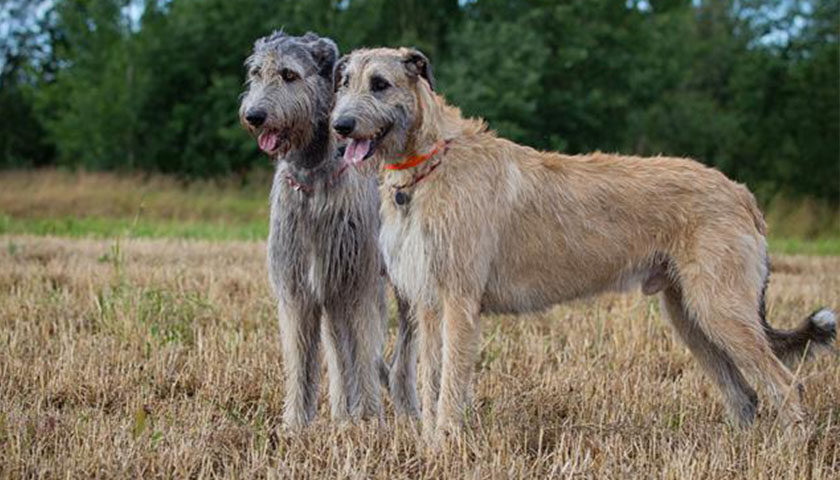
The FCI standard dates the first written mention of the breed to the year 391 AD. It refers to a letter from the Roman consul Quintus Aurelius Symmachus, thanking a correspondent for a gift — seven Irish dogs (in the Latin text canes Scotici, the dogs of the Scoti, that is, of the Irish) that caused a genuine sensation in Rome: all Rome, he wrote, viewed them with wonder. They were kept for fighting big game in the arenas. One caveat is worth making straight away: the letter attests that dogs of exceptional size were brought from Ireland to Rome. It does not attest that they were wolfhounds in the modern sense — identifying the ancient Irish cú with today’s breed belongs to breed tradition, not to documented pedigree.
From the Irish laws that predate the Christianisation of the island comes another detail, and a remarkably specific one. Only kings and the nobility could keep the great Irish hound, and the number of dogs depended directly on the owner’s standing. The filid — the professional class of saga-makers, who belonged to the lesser nobility — were entitled to two hounds. Owners of that rank were not in short supply: the island was divided into fifths, each with its own king, and within them there were something like a hundred and fifty smaller kingdoms. The dog here was not a whim but a codified marker of status, on a par with weapons or land.
Their work was equally concrete. The FCI standard puts it drily: until the end of the 17th century, Irish Wolfhounds were used in Ireland to hunt the wolf, the wild boar and the deer. What followed is what ruined the breed. The wolf disappeared from Ireland over the course of the 18th century, the great forests were felled, and hunting with heavy sighthounds lost its purpose. A breed kept for centuries for its work found itself without work — and began to dissolve. As early as 1652 Oliver Cromwell had issued a declaration forbidding the export of these dogs from Ireland, precisely because they were becoming scarce while the wolves were still there: the ban was meant to keep enough hounds in the country. A century and a half later there were neither wolves nor hounds in sufficient numbers.
What Captain Graham actually did
George Augustus Graham was a Scot, born in 1833, who lived at Rednock House near Dursley in Gloucestershire. He came to the Irish Wolfhound by way of the Scottish Deerhound: he collected Deerhound pedigrees (he gathered over eight hundred of them and published them in 1894) and it was through them that he became interested in the old Irish wolf dog. In 1859, at twenty-six, he bought his first Irish Wolfhound, named Faust — and devoted the rest of his life to the breed. He died on 21 October, aged seventy-six, at Rednock.
The most valuable thing in this story is what Graham wrote himself. In a monograph compiled in August 1879 he sets out his position with no romanticism whatsoever: he does not claim to possess the breed in its original integrity. And, further on, plainly about method: enough true blood remained, in his view, to rebuild the old breed — by means of analogous crosses — in its proper form. In 1885 he described the plan more frankly still: the members of the Irish Wolfhound Club hope to obtain a dog that will have the size and power of the Great Dane combined with the appearance and beauty of the Deerhound. The reconstruction of the breed was, in other words, a deliberate engineering project, and its author made no secret of it.
The foundation of the programme was the Deerhound, chiefly of the Glengarry lines: Graham considered it the Irish Wolfhound in everything but size and substance. Height and bone came from the Great Dane — and it is worth noting that Graham never used a Dane himself; instead he took the descendants of such crosses, largely from the Earl of Caledon, who used a harlequin Dane called Earl of Warwick, and he also took his own bitches to the dog Scythian, a son of the Dane Cedric the Saxon. There were other infusions, which Graham never concealed: a Borzoi (the dam of his own dog Keildar, born in 1863, was part Borzoi) and one Tibetan Mastiff named Wolf. It was from that Tibetan and the bitch Tara that two bitches were born on 16 June 1892 — Vandal and Nookoo — who stand in the pedigree of every modern Irish Wolfhound.
After that things moved quickly. In 1879 the Irish Kennel Club gave the breed its own classes for the first time at its Dublin show. In 1885 the Irish Wolfhound Club was founded — the Kennel Chronicle reported it at the end of March. The following year Graham, together with Colonel J. R. Garnier, drew up the Standard of Points, which the club adopted and the Kennel Club recognised. Just how fine the line between the breeds was in those years can be seen from the show catalogues: some of the dogs that first entered the ring as Irish Wolfhounds had previously been shown as Deerhounds, and a few had littermates that remained Deerhounds.
What does this change for an owner? In practice, not much, but what it does change matters. The modern wolfhound is a breed with a very narrow base, assembled from a handful of lines within the working life of a single generation of breeders. That is where both its appearance and part of its medical trouble come from — more on which below.
Appearance and standard: figures to be read separately for dog and bitch
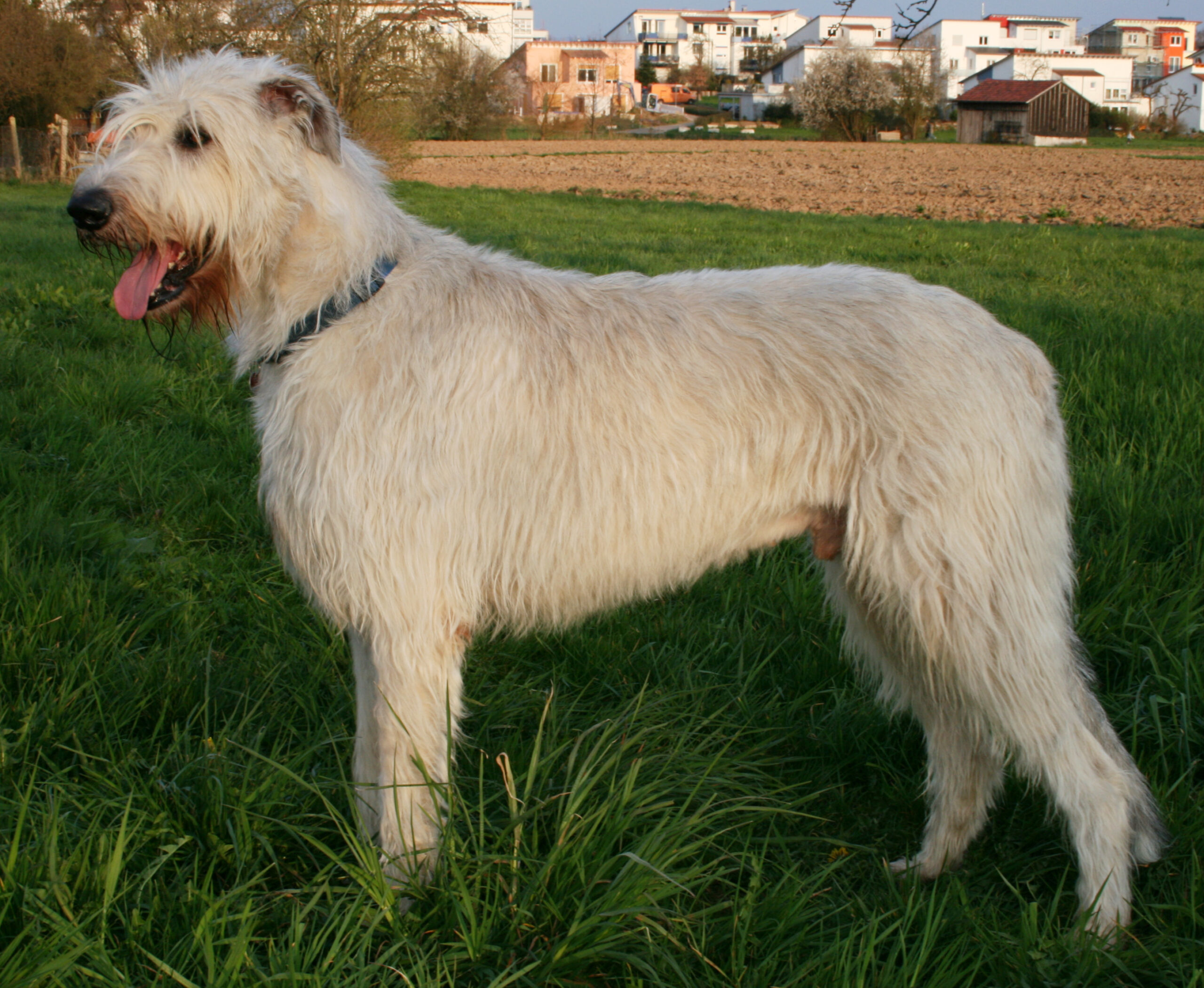
The current edition of FCI standard No. 160 is dated 17 April 2026 and places the breed in group 10, Sighthounds, section 2, Rough-haired Sighthounds, without a working trial. The description opens with the formula the largest and tallest of the sighthounds: a rough-coated hound of great size and commanding appearance, very muscular and strong, yet gracefully built. The head is long and level, carried high; the ears are small, rose-shaped, set high; the chest very deep, the belly well drawn up; the back rather long than short and longer than the height at the withers. The movement should be easy and active — this is a sighthound, not a heavyweight.
| Criterion (FCI standard No. 160) | Dogs | Bitches |
|---|---|---|
| Desired minimum height | 79 cm | 71 cm |
| Minimum expected weight | 54.5 kg at a height of 79 cm | 40.5 kg at a height of 71 cm |
| Breeding objective | a minimum average height of 86 cm | not stated separately |
| Coat | Rough and hard on the body, legs and head; especially wiry over the eyes and on the beard | The same |
| Ears | Small, rose-shaped, set high | The same |
Two points deserve attention. First, the weight in the standard is tied to height, and the text notes separately that it should increase in proportion as the height increases — so a minimum of 54.5 kg does not describe an adult dog of 86 cm, it only sets the floor for the smallest permissible one. Second, 86 cm is not an ideal for an individual dog; it is a breeding objective formulated in the standard, a minimum average height for males.
Colour is the point where the standards diverge and where breed texts most often go wrong. The FCI recognises seven colours: grey, brindle, red, black, pure white, fawn and wheaten. The British Kennel Club lists the same ones and adds an eighth — steel grey — noting that any other colour or combination is unacceptable. White markings, under the FCI, are permitted only on the forechest, on the toes (not the whole foot) and on the tip of the tail.
The minimums diverge as well. The American Kennel Club sets a minimum of 32 inches (about 81 cm) and 120 pounds (about 54.4 kg) for dogs, and 30 inches (about 76 cm) and 105 pounds (about 47.6 kg) for bitches — that is, it puts the bar for bitches higher than either the FCI or the British standard. The sentence a wolfhound stands at least 71 cm is therefore correct only with a note saying under which standard.
One clause of the current edition deserves the attention of anyone choosing a puppy. The standard states outright that a smaller, lighter parallel type, the so-called sporting type, is not accepted and does not correspond to the breed standard. Among the faults it names specifically are a chest that is too narrow or too broad, weak hindquarters and a general lack of muscle, a short body, turned-out feet, large ears lying against the face, and a nose or lips of any colour other than black. Aggressive or excessively timid dogs are disqualified.
Character: a formula written into the standard itself
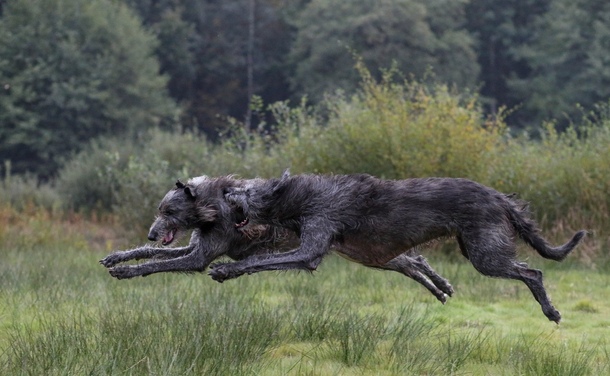
The phrase a lamb at home and a lion in the chase is usually presented as an old Irish proverb. In fact it stands in the text of the FCI standard itself, in the section on behaviour and temperament, alongside the wording: a gentle, kind, loyal hound with a friendly attitude towards people and other dogs, a faithful companion. This is a rare case in which a breed’s character is fixed not by breeders’ lore but by a normative document — and in which it matches what owners actually see.
- Children. The wolfhound’s tolerance of children has entered breed descriptions as the norm, and the standard confirms it. The problem here is not character but physics: a dog that weighs more than an adult human knocks a child off its feet with one turn of the body or sweep of the tail, without even noticing. The adult in the room is needed not to control the dog but to control the space.
- Guarding. This is not a guarding breed, and trying to make one of it is a mistake. The wolfhound rarely barks and is friendly to strangers; its only weapon is its appearance. If what you need is a guardian of territory, look towards breeds intended for it, for example the Moscow Watchdog.
- Other animals. With dogs the wolfhound usually gets on. But it is a sighthound, and the chase instinct is switched on by movement, not by a decision: a cat that runs and a cat lying next to it on the sofa are two different objects to it. Plenty of wolfhounds live peacefully with the household cat; the fact that a dog gets on with its own cat says nothing about someone else’s cat in the street.
Upbringing: why the voice matters more than the lead
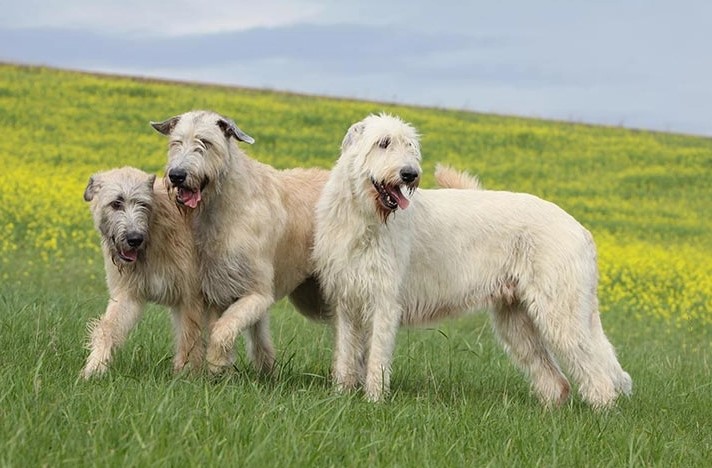
Training an Irish Wolfhound bears little resemblance to work with the service breeds. These dogs will not carry out a command a hundred times over simply because that is how it is done. What works is patience, consistency and exclusively positive reinforcement; roughness and shouting produce the opposite result — the dog shuts down and stops offering behaviour. Wolfhounds mature slowly, and inside a seventy-kilogram body a puppy who finds it hard to concentrate on anything dull lives on for a long time.
There is one practical conclusion here, and it is a hard one: voice control is a question of safety, not of convenience. An adult male may weigh more than his owner, and holding him physically during a sudden lunge is impossible — neither on the lead nor by the collar. Calm walking at heel without tension and a flawless recall are therefore worked on not at some later date but first, while the dog still weighs less than you. This applies to the recall above all: a sighthound’s hunting instinct switches on instantly and at a distance, and at that moment only the skill drilled hundreds of times in calm conditions will work.
The second practical point is socialising the dog to the vet. A giant dog that is afraid of being handled becomes an insoluble problem at six, when he has to be taken in every year for echocardiography and 24-hour ECG monitoring. Getting him used to examination, restraint, nail clipping and lying quietly on his side is worth doing from the first months — this is not cosmetic, it is part of the health protocol for this particular breed.
Keeping: space, the rate of growth and a soft bed
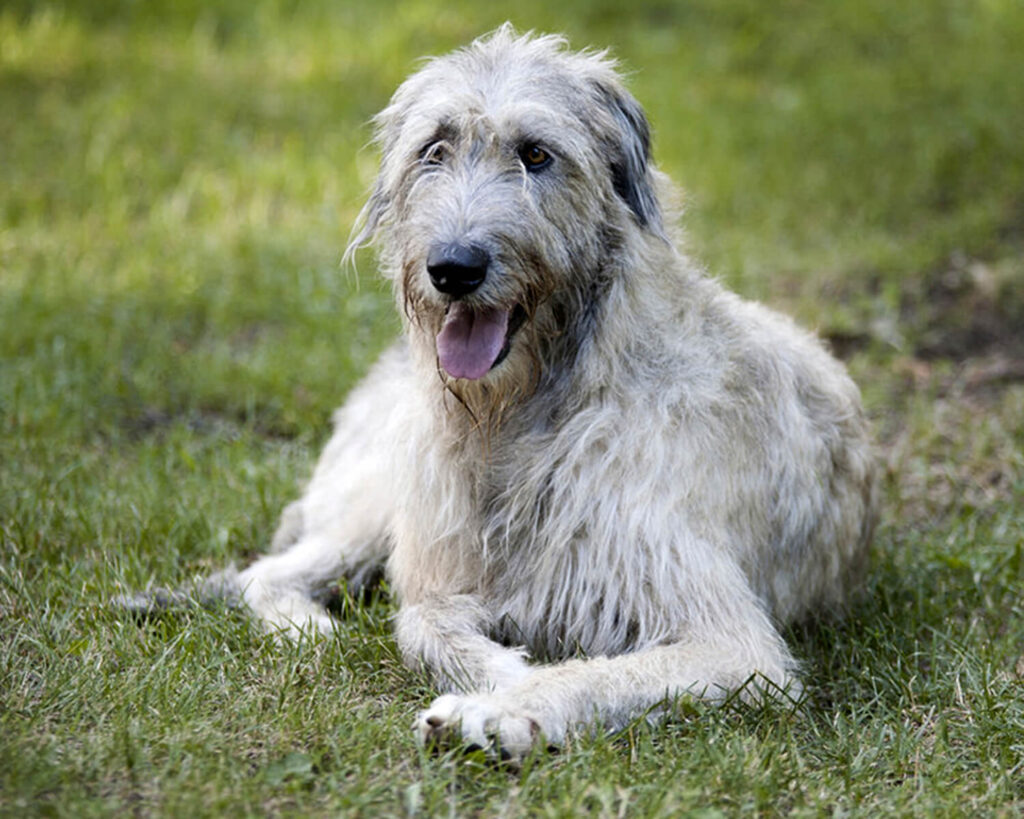
The paradox of the wolfhound is that indoors he takes up remarkably little room — he simply lies down. The problem is not square metres as such but geometry: the dog needs somewhere to stretch out to his full length, needs wide passageways, and needs a route by which he can be led or carried out if he falls ill. Stairs with no lift in a block of flats are not an inconvenience but a scenario you will have to play out on the worst day.
Exercise and growth
Unlike small active breeds such as the Rat Terrier, which need constant movement, an adult wolfhound is content with long quiet walks and the chance to run flat out in a fenced area. A puppy needs the opposite — limits. Jumping, running on slippery floors, long forced walks and games to the point of exhaustion are contraindicated before the age of one: bones and joints grow too fast and the growth plates are vulnerable in this period. This is that rare case in which less really does mean better.
Coat
The harsh wiry coat is undemanding: a metal comb and a brush once or twice a week, plus stripping every few months — plucking out the dead hair so that the coat does not mat and keeps the texture described in the standard. A wolfhound is bathed rarely, only when needed: washing and drying a dog of this size is an operation, not a domestic trifle. The beard and the hair above the eyes, where water and food collect, need separate attention.
Where the dog sleeps
A thick, soft bed is not a luxury but prevention. Because of their weight, wolfhounds that sleep on hard surfaces readily develop elbow bursae and hygromas — firm swellings on the pressure points, which then take a long time and a good deal of reluctance to treat. A thick mattress in the place where the dog actually sleeps (rather than where you would like him to sleep) removes most of the problem.
Feeding a giant
How long an Irish Wolfhound lives
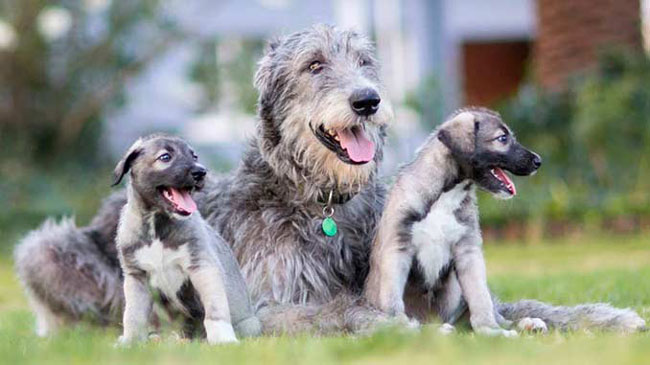
This is the central subject of the page, and there is no point in softening it. The Irish Wolfhound is one of the shortest-lived dog breeds, and that is recorded not on breed forums but in the peer-reviewed literature — in three independent ways.
- Swedish insurance data. In a study of more than 350,000 insured dogs over 1995–2000 (Egenvall et al., Acta Veterinaria Scandinavica, 2005), survival to ten years was 75% or more in Labradors, Golden Retrievers, miniature and toy Poodles and miniature Dachshunds — and it was lowest precisely in Irish Wolfhounds: 91% died before reaching ten. That is the worst figure of any breed in that sample.
- The breed literature review. Urfer, Gaillard and Steiger (The Veterinary Quarterly, 2007) brought the published estimates together and showed that the mean lifespan of Irish Wolfhounds varies across sources from 4.95 to 8.75 years, with many of the studies biased by right-censored data.
- British data on 584,734 dogs. In the work of McMillan et al. (Scientific Reports, 2024), median survival was calculated by the Kaplan–Meier method for 155 breeds. For the Irish Wolfhound it came to 9.9 years (95% CI 9.2–11.0) against 12.0 years for crossbreeds, with a relative risk of death of 1.53 (95% CI 1.34–1.75). For comparison within the same dataset: Deerhound 10.5 years, Great Dane 10.6, Mastiff 9.0.
The figures differ because the methods differ: an insurance database counts the proportion dead by a fixed age, a review aggregates means from samples of uneven quality, and the British study builds a survival curve that takes account of dogs still alive. A single figure that we would be prepared to put our name to as the lifespan of the breed is one we do not give. But all three approaches say the same thing in concert: the wolfhound lives noticeably less long than the average dog, and even the most favourable of the estimates places it in the tail of the distribution — beside the Mastiff, below the Deerhound and the Great Dane.
What they die of is documented too. A cardiological study of the breed (Post et al., Journal of Veterinary Cardiology, 2026) states explicitly that heart disease is the second most common cause of death in Irish Wolfhound populations and accounts for 15.27% of cases. Everything written in the section below, therefore, is not a list of possible risks but a description of what actually happens to this breed.
Health: what is documented and what is screened for
Who the Irish Wolfhound suits, and who it does not
This is a breed with a very narrow circle of its own people — and that is not a matter of a difficult character, but of the fact that the wolfhound’s demands lie somewhere other than where people usually look for them.
- It will suit someone who wants a quiet, unconfrontational, almost silent dog in the house and is ready for long calm walks instead of sport and competition.
- It will suit someone who has a fenced area or access to one: a sighthound needs to run flat out from time to time, and that cannot be done on a lead.
- It will suit someone who knowingly accepts the short life and the regular cardiac examinations as part of the bargain, rather than as an unpleasant surprise in the sixth year.
- It will not suit someone who needs a guard: the wolfhound is not intended for it, and retraining will not work.
- It will not suit someone counting on quick obedience: the breed matures slowly, and rough pressure has the opposite effect.
- It will not suit someone without the practical means to transport and carry a dog of that weight — from the car to a flat with no lift.
What in the breed stories can be checked against sources
- The mascot of the Irish Guards is a documented history with dates. The Irish Guards regiment was formed in 1900. At a general meeting of the Irish Wolfhound Club on 15 October 1901 it was decided to present the regiment with a dog — to make the breed recognisable and so secure its revival. On 8 January 1902 Lieutenant-Colonel A. J. Cooper accepted the gift on behalf of the battalion. The dog was chosen at a special competition at the Kennel Club show in the Crystal Palace in 1902, from eight entrants, and Graham himself judged it. The winner was the dog Rajah of Kidnal, born on 24 May 1900 — in the regiment he was given the name Brian Boru, after the Irish king. Ever since, the regimental mascot has been an Irish Wolfhound, in the charge of a soldier holding the rank of Drummer, and it is the dog that leads the regiment on every parade.
- The export ban of 1652. Oliver Cromwell’s declaration did indeed forbid taking wolfhounds out of Ireland, and the motive was utilitarian: the dogs were becoming scarce while the wolves remained, so enough hounds had to be kept within the country.
- Status as a national symbol. The current FCI standard explicitly calls the Irish Wolfhound a living symbol of Irish culture, one of the five official symbols of Ireland, to which the country’s government has granted heritage status. That is the wording of the standard itself, not a piece of folklore.
- Wolfhounds that had been shown as Deerhounds. At the first shows, some of the dogs entered as Irish Wolfhounds had previously competed in the Deerhound ring, and a few had littermates that stayed Deerhounds. This is not a curiosity but direct evidence of how close the two breeds were at the moment of reconstruction.
- Gelert is a legend, not breed history. The dog of the Welsh tale of Gelert is traditionally depicted as an Irish Wolfhound, and breed texts repeat it. The tale itself belongs to Welsh folklore and has no bearing on the documented history of the breed.
- A soft bed is not sentimentality. The tendency of wolfhounds to develop elbow bursae and hygromas when they sleep on hard surfaces has long been known to owners and breeders; it is one of the few domestic details that genuinely changes a dog’s quality of life.
What to ask the breeder
Video about the breed
- A gentle “gentle giant”
- Calm and devoted
- Quiet, rarely barks
- Patient with children
- A very short life (median 9.9 years)
- Heart disease (DCM)
- A risk of gastric torsion
- Needs plenty of space
| Deerhound | Great Dane | St. Bernard | |
|---|---|---|---|
| Height | 71–81 cm | 71–86 cm | 65–90 cm |
| Energy | 3.5 | 3 | 2.5 |
| Apartment | 2 | 2 | 2 |
| Beginners | 3 | 3 | 2.5 |
How long do Irish Wolfhounds live?
Can a wolfhound be kept in a flat?
What health checks does this breed specifically need?
Is the Wolfhound good with children?
Is the wolfhound really the tallest breed in the world?
Is the Irish Wolfhound hard to train?
FCI Standard No. 160 (ed. 17 April 2026) · The Kennel Club · AKC · peer-reviewed sources cited in the text
For apartments · For kids · For beginners · Active · Smartest · Hypoallergenic · All rankings →