

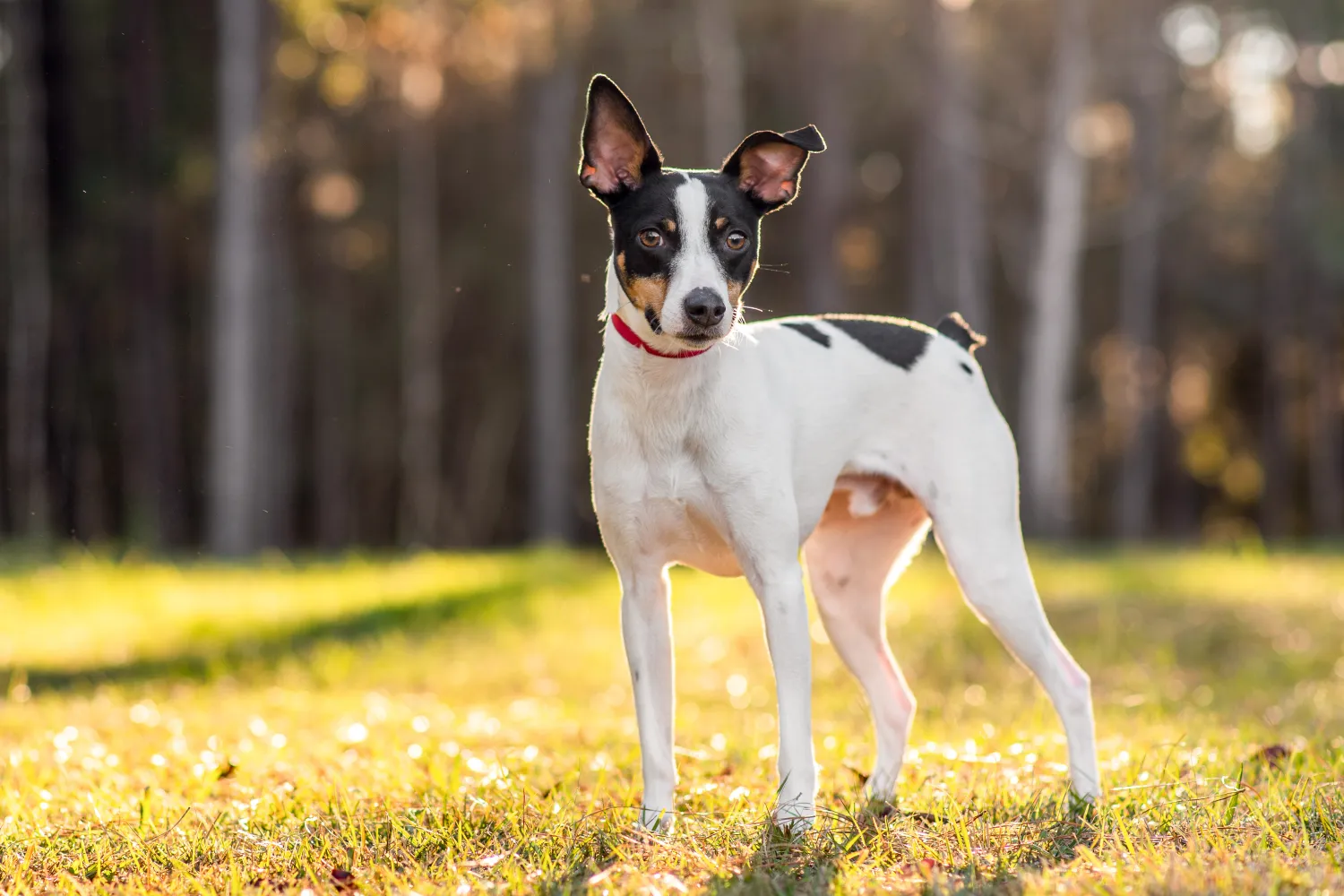
| Height | 25.4–45.7 cm (10–18 in) |
| Weight | 4.5–11.3 kg |
| Lifespan | 12–18 years |
| FCI group | not recognised by the FCI (recognised by UKC/AKC) |
| Origin | USA |
Exact ratings
Common health issues
Nutrition
The Rat Terrier is an American farm terrier bred for one specific job: to destroy rodents about the holding, both underground and above it, and still be an easy dog to live with in the evening. It is one of the few breeds whose official name states the trade outright. Today the Rat Terrier exists in two size varieties, has two American standards — the AKC’s and the UKC’s — and does not appear in the FCI nomenclature. Below we set out what those standards actually say, what separates the Rat Terrier from the Teddy Roosevelt Terrier and the American Hairless Terrier, and which examinations the national breed club requires of its breeders. Find out more at Tvaryny.
History of the Breed
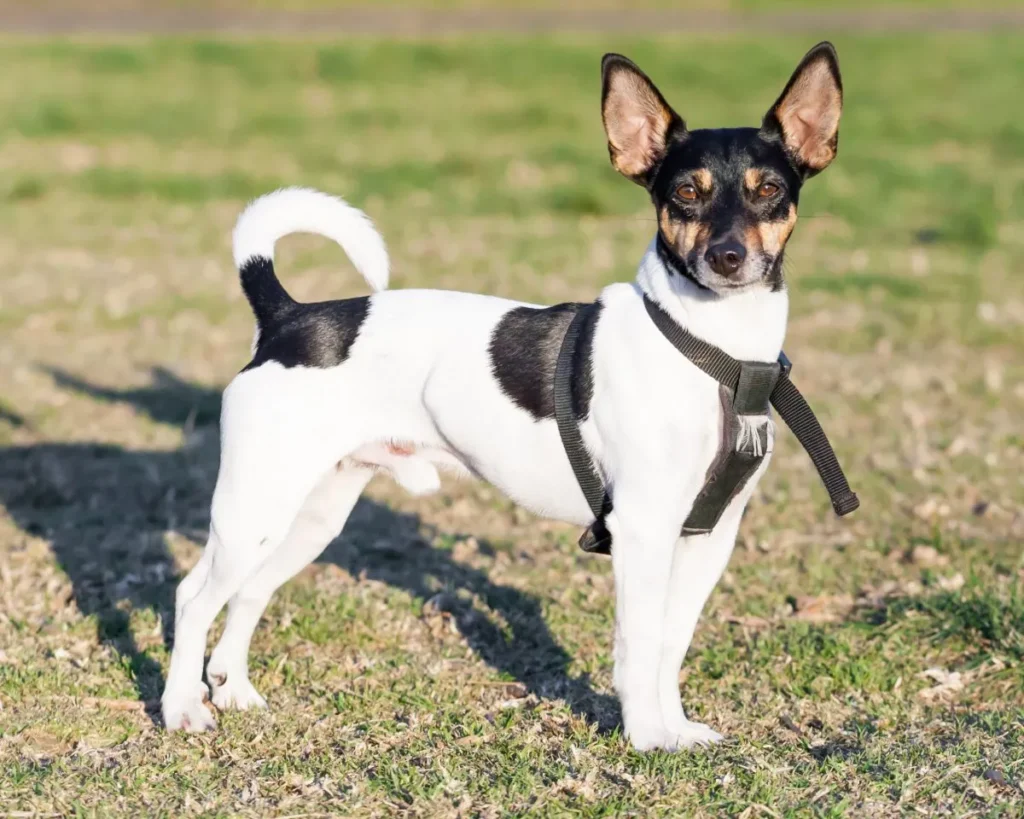
The history of this breed is a classic example of the American dream. It was shaped not in the show ring but in the field, where a dog was expected to be maximally efficient. The historical note in the UKC standard (revision of 1 January 2004) presents the Rat Terrier as an American breed descended from terriers brought over by English miners and other working-class immigrants. Among the probable components the same document names the Smooth Fox Terrier, the Manchester Terrier and the now-extinct White English Terrier. Later, Italian Greyhound and Whippet blood was added for speed, and Beagle blood to improve scenting. In its note on the related Teddy Roosevelt Terrier, the AKC adds the Bull Terrier to that same list.
The work they were kept for came in two kinds. The first was domestic: mice and rats in the barn, the granary, the henhouse. The second was a gambling matter: the UKC states plainly that betting on such a dog’s ability to kill rats was a favourite pastime of their owners, and the AKC, in its note on the American Hairless Terrier, recalls the notorious “rat pits” where spectators wagered on how many rats their terrier would take. It is from this milieu that the best-known figure associated with the breed comes.
The figure of “2,501 rats in seven hours” is repeated by dozens of sources. It is worth knowing where it came from. The English-language Wikipedia points to Bonnie Wilcox and Chris Walkowicz’s book The Atlas of Dog Breeds of the World (1995), and in that retelling the episode is a contest in England in which a terrier — with no breed specified — took 2,501 rats in seven hours, an average of one rat every ten seconds. The episode is therefore placed in England, at a time when the American breed did not yet exist. The AKC itself retells the same story differently: it was said that a fierce barnyard Feist dispatched 2,500 rats in a single day. We give it as a story that travels from book to book in different wordings, not as the documented record of any identified Rat Terrier.
The most popular legend, the one about the name, deserves the same caution. The AKC words it thus: it is said that President Theodore Roosevelt, who adored his Feist named Skip, coined the name Rat Terrier. The UKC is more restrained in its standard: the breed was popularised by President Teddy Roosevelt, who often hunted with his Rat Terriers. In other words, both registries that manage the breed present the Roosevelt connection as lore rather than as documentation. What is beyond doubt is that the name describes the dog’s original purpose exactly.
Through the 1920s and 1930s the Rat Terrier was an ordinary presence on American family farms. With the arrival of chemical pest control and the industrialisation of agriculture, demand for a ratter fell and the breed’s popularity declined, only to revive as a family dog at the end of the twentieth century. For perspective: the trade the Rat Terrier was bred for is far older than the breed itself. The oldest known record of a ratting dog concerns a dog called Hatch, whose remains were raised from the Mary Rose, Henry VIII’s flagship, sunk in 1545 and lifted in 1982. He is thought to have been a mongrel taken aboard precisely to deal with rats.
Recognition: UKC, AKC and Why There Is No FCI
The Rat Terrier is managed by two American registries, and each took its own route.
- The UKC (United Kennel Club) recognised the Rat Terrier on 1 January 1999. The standard in force is the revision of 1 January 2004, and the breed sits in the terrier group.
- The AKC (American Kennel Club) moved to full recognition in stages: from 1 January 2006 Rat Terriers were admitted to companion events (obedience, agility, rally); from 1 September 2006 to earthdog tests; from 30 June 2010 the breed competed in the Miscellaneous class; in July 2012 the Rat Terrier Club of America became the official parent club; the AKC dates full recognition in the Terrier Group to 2013. The Rat Terrier is the AKC’s 178th breed.
- The FCI does not manage the Rat Terrier: the breed appears in the Fédération Cynologique Internationale nomenclature neither among the definitively recognised breeds nor among the provisionally recognised ones. This is not a judgement on the breed but a consequence of structure: the AKC and the UKC are not national canine organisations within the FCI.
An interesting contrast: other national ratting terriers are in the FCI nomenclature — the Brazilian Terrier, the Ratonero Bodeguero Andaluz (no. 371), the Gos Rater Valencià (no. 370), the Prazsky Krysarik (no. 363). So the matter is not a “disrespect for ratters” but registry geography. The practical consequence for an owner in Europe: a Rat Terrier with an AKC or UKC pedigree has no access to FCI-system shows, and its papers must be sought outside the chain Europe is used to.
Appearance and Breed Standards
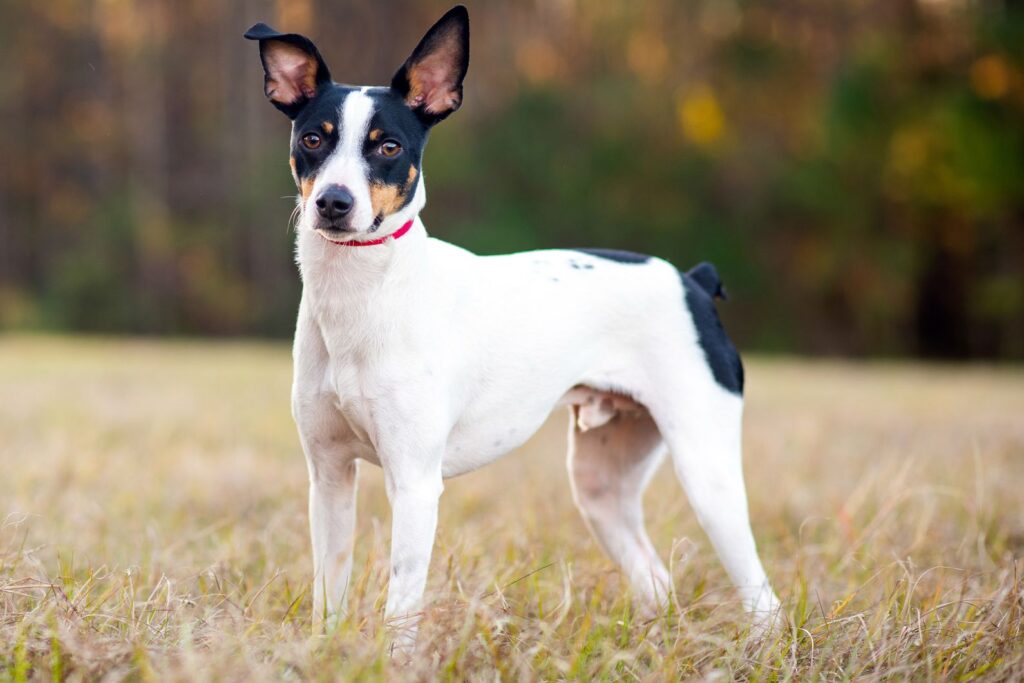
The Rat Terrier is a sturdy, compact dog with a smooth coat and an intelligent expression. They look athletic but not coarse. The AKC standard (approved 11 November 2009, effective from 1 July 2010) describes the breed as a sturdy, compact, small-to-medium parti-coloured dog giving the appearance of elegance and fitness and denoting speed, power and balance. The standard also states separately that honourable scars, and a couple of broken or missing canines or incisors, are not to be penalised: this is the wording of a working breed’s standard, not an ornamental one’s.
The chief feature of the exterior is the two size varieties, and in both registries the boundary between them runs at thirteen inches at the withers.
| Parameter | Miniature variety | Standard variety |
|---|---|---|
| Height at withers per AKC | at least 10 and no more than 13 inches (25.4-33 cm) | over 13 and up to and including 18 inches (33-45.7 cm) |
| Height at withers per UKC | not exceeding 13 inches (up to 33 cm), no lower limit set | over 13 and not exceeding 18 inches (33-45.7 cm) |
| Coat type | Short, dense, close-lying, glossy | Short, dense, close-lying, glossy |
| Weight | The AKC gives a single range for the whole breed: 10-25 lb (4.5-11.3 kg) | The UKC sets no weight and writes that it varies with the size of the individual dog |
| Life expectancy | 12-18 years (AKC reference data) | 12-18 years (AKC reference data) |
Three details of this table are worth reading carefully, because they are the source of most of the errors that circulate online.
- Only the AKC has a lower limit. A dog over six months that falls short of 10 inches or exceeds 18 is disqualified under the AKC standard. The UKC sets no lower limit at all, and places a height above 19 inches (48.3 cm) among the faults rather than the disqualifications.
- The sexes are not separated. Neither the AKC nor the UKC gives separate ranges for dogs and bitches — unlike most breeds, the same scale is written here for both.
- Weight is not tied to variety. The widely repeated “4-8 kg for the miniature and 8-12 kg for the standard” comes from neither standard: the UKC deliberately declines to give a figure, and the AKC gives one range for the breed.
Body format is described with differing precision. The AKC says the dog is slightly longer than tall, and that short legs are a serious fault. The UKC sets a number: the desired ratio of body length (from prosternum to point of buttocks) to height at the withers is 10:9. Then comes the sentence that draws the line with an entire separate breed: a short-legged dog whose proportions deviate significantly from 10:9 lacks type and is to be disqualified.
The head forms a blunt wedge, both in profile and from the front. The ears are V-shaped, set on the outer edge of the skull. They may be erect, semi-erect with tipped ends, or button ears, and the standard gives no preference to any of these; what matters is that both ears match in shape and carriage when the dog is alert. A rose ear in an alert dog is a fault. Cropped ears are a disqualification under the AKC, drop ears under the UKC. The UKC adds a caveat of its own: ear carriage may not settle until maturity, so dogs under a year are not penalised for such variation.
The eyes are small, oval, obliquely and widely set; colour ranges from the darkest brown to hazel in accordance with the coat. Here the AKC standard is particularly strict: any blue in the eye is a disqualification, and grey eyes are admissible only in blue and blue-fawn dogs, being a serious fault in others. Bite: scissors is preferred, level is acceptable; the UKC places missing teeth, overshot and undershot bites among the faults.
The AKC standard permits three tail forms with no preference: traditionally docked between the second and third vertebra, a natural bobtail, or a natural long tail tapering to the hock. Length carries no weight in judging. Since 2004 the UKC has carried an explicit note: because docking of tails and ears is banned in a number of countries, no dog may be penalised at any UKC event for a full tail and natural ears.
Coat Colour: What Is Allowed and What Disqualifies
Rat Terrier colour really is variable, but not unlimited, and this is where buyers receive the most misinformation. The AKC’s baseline requirement is any variation of the pied pattern, that is, comparatively large patches of one or more colours in combination with white. Acceptable colours — with or without tan points — are predominantly black, plus chocolate, red, apricot, blue, fawn, tan, lemon and white. Speckling, ticking and marbling are common, though excessive ticking is undesirable; sabling and “pencilling” on the toes are allowed, as are badger markings. A “black mask” on a dog with no black in its coat is a serious fault.
The key point about white is worded more precisely than the usual “white is always the base colour”. The standard only requires that white be present, and sets a minimum: a patch or stripe with white or pink skin beneath it, wider than one inch (2.5 cm). Less than one inch of white at its widest is a disqualification. Between 10 and 90 per cent white on the body is considered desirable, but all patterns — spots, patches, splashes — count equally, with no preference among them. The solid white “extreme piebald” with only mottled skin is provided for separately.
And here is the full list of disqualifications. Under the AKC: height under 10 or over 18 inches in a dog older than six months; any blue in the eye; cropped ears; total genetic hairlessness; any suggestion of a broken or wavy coat; solid colours other than white; bi-colours without white or with a white patch narrower than an inch; brindle or merle pattern. Under the UKC the list is longer still: cryptorchidism, viciousness or extreme shyness, unilateral or bilateral deafness, albinism, short legs breaking the 10:9 proportion, drop ears, wire or broken coat, long coat, brindle, merle, absence of white, and a bi-colour in which neither colour is white.
Merle in the Rat Terrier: Why Both Registries Disqualify It
This is probably the most important section of the whole article for a prospective buyer. Merle Rat Terriers are offered for sale — sometimes under names such as “marbled” or “blue merle” — and presented as a rarity. In fact merle is disqualified in both registries that manage the breed: in the AKC and in the UKC alike. Such a dog cannot be shown in either ring.
The reason is not aesthetic. Merle is not simply a pattern but the action of a single gene. In 2006 researchers at Texas A&M University showed that merle is caused by the insertion of a short interspersed element (a SINE retrotransposon) into the SILV (PMEL17) gene, and that it is inherited autosomally with incomplete dominance. The same work notes that dogs with one and with two copies of merle display a wide range of auditory and ophthalmological abnormalities resembling human Waardenburg syndrome (Clark et al., PNAS, 2006).
Just how wide was measured in 2009. A team at Louisiana State University tested hearing by brainstem auditory evoked response (BAER) in 153 merle dogs of various breeds and matched the results to genotype.
| Genotype | Deaf in one ear | Deaf in both ears |
|---|---|---|
| All merles together | 4.6% | 4.6% |
| Single merle (Mm) | 2.7% | 0.9% |
| Double merle (MM) | 10% | 15% |
Source: Strain et al., Journal of Veterinary Internal Medicine, 2009. The difference between the rows is statistically significant: dogs homozygous for the merle allele were deaf significantly more often than heterozygotes. No association with sex or eye colour was found in that work.
A double merle arises in one specific case — when two merle dogs are mated. Under ordinary Mendelian segregation a quarter of such a litter carries two copies of the allele. For the buyer a simple rule follows: if a breeder offers a merle Rat Terrier, you are dealing with a dog outside the standard of both registries; and if the pedigree contains a merle-to-merle mating, ask for a BAER test result for every puppy. It is no accident that the Rat Terrier Club of America keeps BAER on its list of optional examinations, and that the UKC goes as far as placing unilateral and bilateral deafness among the disqualifications.
Character and Temperament: More Than Just a Hunter

Many people confuse this breed with other small terriers, but the Rat Terrier has a unique set of traits. The temperament paragraph in the AKC standard is short and telling: keenly observant, devoted, full of energy, yet easily trained and obedient to command. Then comes a detail that matters for life with other dogs: the Rat Terrier is a non-sparring breed, meaning such dogs are not set against one another in the ring as some terriers are. Broadly he is friendly towards other dogs but may be reserved with strangers. The standard does not treat submissiveness as a fault, whereas overt aggression and excessive shyness are penalised. The UKC describes this as a “dual personality”: a fearless, tenacious hunter with seemingly inexhaustible energy — and at the same time an unusually friendly companion who gets along well with children, other dogs and even cats.
This really is a dog with an on/off switch. Outdoors he is a tireless athlete, ready to chase a ball for hours, but at home they love to curl up on the sofa beside their owner. The AKC calls the Rat Terrier one of the calmest of the terriers — while immediately adding that these are nonetheless high-energy dogs that need exercise, daily walks and plenty of company.
- Intelligence: They are extremely clever and learn quickly, but can be stubborn.
- Socialisation: They get on well with other dogs if raised together. However, because of a strong prey drive, small animals (gophers, hamsters, rats) will always be regarded as quarry.
- Relationship with people: This is a very human-oriented breed. They sense their owner’s mood intuitively; the AKC describes them as unusually sensitive and intuitive dogs that work for praise.
- Freedom on walks: The AKC is unequivocal — a Rat Terrier should not be let off the lead outside a fenced area, because most will not resist chasing a strange cat or a squirrel.
On popularity: by AKC registration statistics the Rat Terrier ranked 81st of 210 breeds in 2024 and 84th in 2025. So it is neither a rarity in the USA nor a mass breed.
Working Qualities and Training
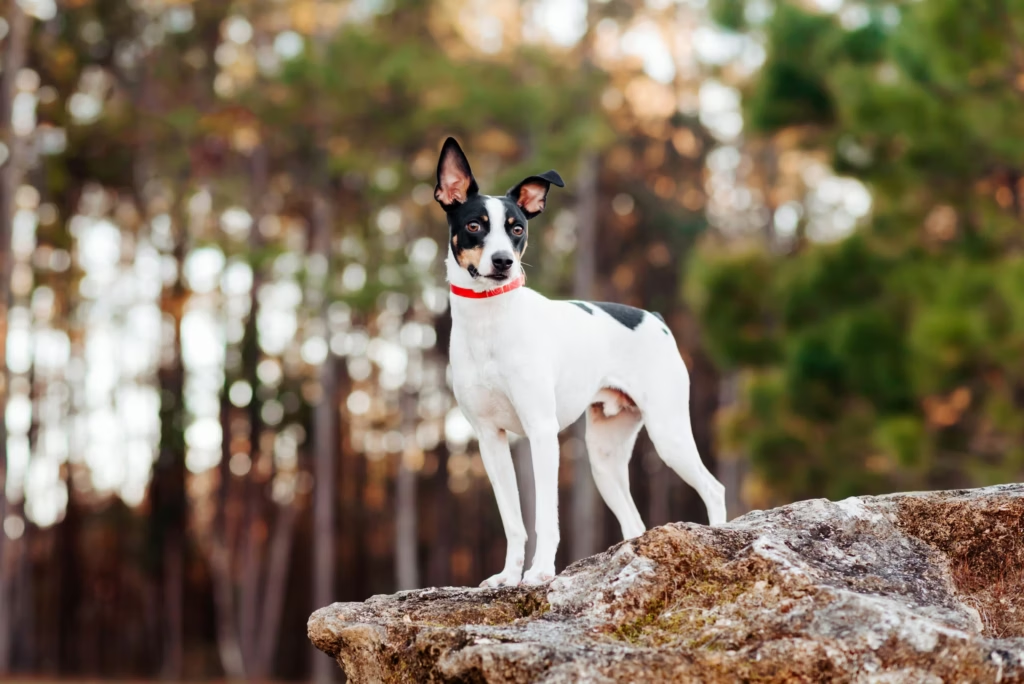
The Rat Terrier is an all-purpose soldier. The AKC standard sums up his purpose in one phrase: a multipurpose companion dog capable of hunting rodents and vermin above and below ground and of coursing small game. His hunting instincts are strong, but they work differently from those of narrowly specialised breeds. For example, while the Estonian Hound is built for a prolonged pursuit of game by scent and with voice, the Rat Terrier works “by eye” and “by nose” over short distances, attacking prey in burrows or on the surface in a flash. He will not run a hare down for miles; his task is to find and neutralise here and now.
This is not a declaration: both registries record that the work continues. The UKC writes in its standard that many Rat Terriers are still used as ratters and squirrel hunters, especially in the American South. The AKC admitted the breed to earthdog tests from 1 September 2006, and to companion events (obedience, agility, rally) from 1 January 2006. Both standards require working condition literally: dogs are shown in firm, muscular trim, and the UKC places obesity among the faults of conformation on a par with excessive height.
As for guarding qualities, the Rat Terrier is an excellent “alarm”. They are vigilant and brave. Of course, physically they will not stop an intruder the way a powerful Moscow Watchdog would, but no rustle by the door will go unnoticed. Their job is to warn the owner, and at that they excel.
Training specifics
Training this breed is a pleasure if you have found the right approach. They will not tolerate drilling or roughness; the AKC states outright that the breed is unusually sensitive and intuitive, lives on its owner’s approval and responds quickly to positive methods. The best method is positive reinforcement (treats, play, praise). Bear the following in mind:
- Short sessions: Rat Terriers grow bored quickly with monotonous repetition.
- Early socialisation: Introduce the puppy to different people, sounds and surfaces as early as possible; the AKC recommends puppy classes as a standard part of raising one.
- Instinct control: Pay particular attention to the “Come” and “Leave it” commands, since at the sight of a squirrel the dog may “go deaf”.
- Sport as an outlet: the breed does well in agility, obedience and rally — and is officially eligible for them with the AKC.
Care and Maintenance
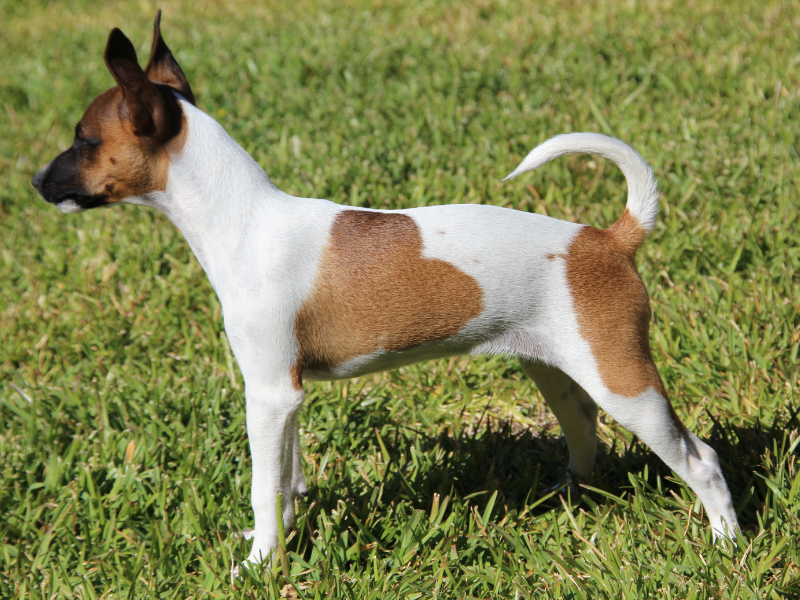
This breed suits anyone unwilling to spend hours on grooming. The Rat Terrier’s coat is short, dense and close-lying, so it needs minimal care — the AKC’s grooming section fits into a few lines.
- Brushing: Once a week with a soft brush or a rubber mitt is enough to remove dead hair. The breed sheds seasonally, and for that period the AKC advises switching to a shedding tool or a rubber curry brush.
- Bathing: About once a month or less often, depending on the dog’s way of life. Washing too often can dry out the skin.
- Nails: Trim at least once a month — overgrown nails are painful for the dog. If the nails wear down on tarmac, the interval can be longer.
- Ears: Check weekly and remove excess wax and dirt, which can cause inflammation.
- Teeth: The AKC advises daily brushing with a canine toothpaste. Regular brushing helps avoid the tartar to which small terriers are prone.
- Whiskers are not trimmed: both standards explicitly forbid removing the vibrissae. A small thing, but it sets the preparation of a Rat Terrier apart from that of many show breeds.
A separate word on cold. The coat the standards describe is short and close-lying, without any reserve of insulation; this is a breed developed to work in the warm climate of the American South. In winter they absolutely need clothing for walks, and kennel life outdoors is unsuitable for a Rat Terrier for a further reason — this is a markedly social breed that copes badly with isolation from people.
Nutrition: Key Recommendations
Health and Genetic Predispositions
Comparing the Rat Terrier with Similar Breeds
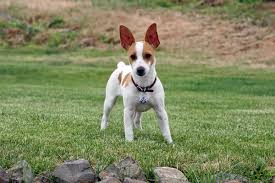
Prospective owners often hesitate between several terrier breeds. To make the choice easier, it is worth understanding the key differences. For instance, comparing with a popular relative, the Jack Russell Terrier is usually more insistent and noisy and demands still more experience in raising, whereas the Rat Terrier has a somewhat softer character — and, unlike a number of terriers, is judged a non-sparring breed.
The Teddy Roosevelt Terrier: not a “variety” but a separate breed
The confusion is greatest here, and it has a documented explanation. According to the AKC’s historical note, the Teddy Roosevelt Terrier was at first a variety of the Rat Terrier: the short-legged dogs were called “type B”, the long-legged ones “type A”. Through the 1990s breeders worked to separate them into two breeds, and on 1 January 1999 the UKC recognised both — on one and the same day. The short-legged variety was named in honour of President Theodore Roosevelt.
The practical consequence of that separation is written straight into the standard: the UKC disqualifies a short-legged Rat Terrier whose proportions deviate significantly from the 10:9 ratio. In other words, a “short-legged Rat Terrier” does not exist as a variant in the UKC system — it is already another breed. And the differences multiply from there.
| Feature | Rat Terrier | Teddy Roosevelt Terrier |
|---|---|---|
| Format | Body-to-height ratio 10:9; short legs are a UKC disqualification | Short-legged, rectangular in outline — that is precisely the mark of the breed |
| Height per UKC | Miniature up to 13 inches, standard 13-18 inches | From 8 to 12 inches (20.3-30.5 cm); a fault below 7 or above 13 inches in an adult |
| Status with the AKC | Full recognition, Terrier Group, 2013 | Foundation Stock Service since August 2016, assigned to the Terrier Group; earthdog tests since 8 August 2016 |
| AKC-recommended tests | Patellas, hips, heart, PLL DNA | Patellas, heart, PLL DNA, chondrodystrophy DNA |
| Merle | Disqualification under the AKC and the UKC | Disqualification under the UKC |
The most interesting line of this table is the last test. Chondrodystrophy — the shortening of the limbs — is determined in dogs by an FGF4 retrogene on chromosome 12. The work of Brown et al. (PNAS, 2017) showed that the same retrogene gives an odds ratio of 51.23 (95% confidence interval 46.69-56.20) for intervertebral disc disease. Put simply: the trait that makes the Teddy short-legged and the trait that raises the risk of back trouble are one and the same genetic event. For the Rat Terrier, CDDY/IVDD sits on the club’s “infrequent but worth watching” list; for the Teddy, the corresponding DNA test is already among the AKC’s recommendations. The UKC standard for the Teddy (revision of 2 January 2023) adds two further details: the breed matures slowly, up to two or three years, and the standard gives its expected life span as 15-16 years.
The Toy Fox Terrier: a shared ancestor, not a descent
Another close relative is the Toy Fox Terrier. The widespread claim that the Toy Fox Terrier “split off from Rat Terriers as a smaller, ornamental version” does not match the way the AKC itself describes the breed’s origin. On its account, the Toy Fox Terrier was created in the early twentieth century by American Smooth Fox Terrier breeders, who crossed the smallest puppies with toy breeds — the Chihuahua, the Italian Greyhound, the Miniature Pinscher; the breed was fixed in the 1930s, and in 2003 the AKC recognised it as its 148th breed, placing it in the Toy Group. The Rat Terrier and the Toy Fox Terrier do share an ancestor — the Smooth Fox Terrier — but that is a shared ancestor, not the descent of one breed from the other.
What they genuinely share is the genetics of the eye. In the Gould et al. work cited above (2011), both the Rat Terrier and the Toy Fox Terrier appear among the breeds in which homozygous, clinically affected PLL dogs carrying the same ADAMTS17 mutation were found. And in the AKC’s recommendations for the Toy Fox Terrier the PLL DNA test also appears — alongside patellas and the thyroid.
The American Hairless Terrier: here the descent is direct
It is also worth mentioning the American Hairless Terrier. This breed really did arise from Rat Terriers, and the event is documented to the year and the town. In 1972, in Trout, Louisiana, a hairless puppy was born in a litter of mid-sized Rat Terriers to normally coated parents. Edwin and Willie Scott named the bitch Josephine; from her and her descendants a separate breed grew. The AKC entered the American Hairless Terrier into the Foundation Stock Service in October 2011, and full recognition followed in January 2016.
Two details are worth knowing before treating the hairless variant as “the Rat Terrier for allergy sufferers”. First, hairless puppies are born with a so-called birth coat that falls out within a few weeks. Second, although the AKC does class the breed among dogs for allergy sufferers, it clarifies itself that they neither shed nor carry fleas, but they do shed skin cells. So the absence of a coat removes some, not all, sources of allergens, and the decision is better tested in practice than taken from a category in a directory. The symmetrical detail on the Rat Terrier’s side: its own AKC standard places total genetic hairlessness among the disqualifications — a hairless puppy in a Rat Terrier litter is by definition outside the standard of its own breed.
| Characteristic | Rat Terrier | Jack Russell Terrier | Toy Fox Terrier |
|---|---|---|---|
| Energy level | High but manageable | Very high, explosive | Medium/High |
| Attitude to strangers | Wary | Friendly or aggressive | Friendly |
| Tendency to bark | Moderate | High | High |
| Training requirement | Medium | Very high | Medium |
| PLL DNA test in AKC recommendations | Yes | Yes (the AKC lists it for the Russell Terrier; the Jack Russell is one of the three breeds in which the ADAMTS17 mutation was first described) | Yes |
Pros and Cons of the Breed
Advantages
- Compact size, convenient for a flat and for travel.
- High intelligence and trainability.
- The upper bound of the AKC’s reference life expectancy is high — a range of 12-18 years.
- Easy coat care.
- Almost no specific “doggy” smell.
- A transparent screening programme: the club’s mandatory tests are published by name, so a breeder is easy to check.
Disadvantages
- High energy level — they need active walks.
- The hunting instinct can create problems with other small animals.
- A tendency to dig holes in the garden (it is in their blood).
- They can be wary of strangers, which calls for socialisation.
- The breed is outside the FCI system — for a European owner this limits show and breeding routes.
- Merle puppies offered as a “rarity” are in fact disqualified by both registries.
Interesting Facts About the Breed
- Celebrity owners: Besides Theodore Roosevelt, admirers of the breed included the writer William Faulkner and many Hollywood stars of the last century.
- Natural bobtails: the AKC standard accepts a naturally short tail on the same footing as a docked one and a naturally long one, and tail length carries no weight in judging.
- Honourable scars are not a fault: the standard expressly allows scars and even a couple of broken or missing canines or incisors — the traces of a working past.
- A founding breed: the American Hairless Terrier descends from the Rat Terrier — the only hairless breed to have arisen in the USA.
Frequently Asked Questions (FAQ)
Is the Rat Terrier suitable for a family with children?
Yes, it is an excellent choice for families with school-age children. They are playful and patient. With toddlers, however, care is needed — the dog dislikes rough handling and may snap if hurt.
Do they shed a lot?
Shedding is moderate and seasonal. This is not the dog whose hair will fly about the flat in clouds, but the short, sharp hairs can work their way into furniture upholstery.
Can a Rat Terrier live outdoors in a kennel?
Categorically not. The coat is short and close-lying, without any reserve of insulation, so they feel the cold badly. Besides, this is a social breed that suffers without human contact. In winter they absolutely need clothing for walks.
How do they cope with being alone?
Rat Terriers can be left at home alone if they are accustomed to it. However, if left for long without toys or activity, they may find their own entertainment — chewing shoes or furniture, for instance.
What should you ask a breeder for?
The results of the club’s four mandatory examinations for both parents: heart, hips, patellas and the PLL DNA test. If there is merle in the pedigree, ask additionally for the BAER hearing test result.
Video About the Breed
- Sharp, easy to train, devoted
- Compact, suits a flat and a novice
- Short coat — minimal grooming
- An affectionate family companion and a watchdog “doorbell”
- A transparent list of the breed club's mandatory examinations
- Keeps a strong hunting instinct (rodents)
- Prone to barking and digging
- Needs exercise and activity
- Feels the cold in winter (short close-lying coat)
- Outside the FCI system — limited show routes in Europe
| American Hairless Terrier | Jack Russell Terrier | Toy Fox Terrier | |
|---|---|---|---|
| Height | 30–41 cm | 25–30 cm | 22–29 cm |
| Energy | 4 | 4.5 | 4 |
| Apartment | 4.5 | 3.5 | 4.5 |
| Beginners | 4 | 3 | 4 |
What was the Rat Terrier bred for?
How long does the Rat Terrier live?
Is the Rat Terrier recognised by the FCI?
Do merle Rat Terriers exist?
How does the Rat Terrier differ from the Teddy Roosevelt Terrier?
AKC standard (approved 2009, effective 2010) and UKC standard (rev. 2004) · Rat Terrier Club of America health statement (2025) · FCI nomenclature · OMIA, PubMed
For apartments · For kids · For beginners · Active · Smartest · Hypoallergenic · All rankings →