A bearded Istrian master of the blood trail — hardy and persistent: keen, gentle with the family, vocal and tireless. The Istrian Coarse-haired Hound is a unique Croatian breed from Istria with a rough “bearded” coat; a specialised working dog that excels on the blood trail, yet surprisingly gentle and affectionate with children at home — but not suited to the role of an urban companion.
Apartment · not suitableKidsCats · not suitableOther dogsBeginners · with caveats
The Istrian Coarse-haired Hound (Croatian: Istarski oštrodlaki gonič) is a unique hunting breed originating from the Istrian peninsula in Croatia. This dog is the very embodiment of stamina, determination, and hunting drive. It has a sturdy build, excellent health, and a distinctive loud voice that is highly valued by hunters. Versatile in its application, it works brilliantly on a cold trail and can hunt both independently and in a pack. It is important to note right away that this is a specialised working dog, completely unsuitable for the role of a 'lapdog' or a companion for city strolls. Compared to its smooth-haired relative, it is distinguished by its greater stubbornness and independence. We will tell you more about the features of this ancient breed, its history, and care requirements in this article. Read more about it on Tvaryny.
Although this breed has ancient roots, it remains little known outside its homeland and among a small circle of European hunters. Its coarse, bristle-like coat is not just for show but provides functional protection from bad weather and thorny bushes, making it the ideal partner for hunting in challenging terrain.
Key Information About the Breed
Key Information About the Breed · 8
Breed Name
Istrian Coarse-haired Hound
Country of Origin
Croatia (Istrian peninsula)
FCI Classification
Group 6 (Scent hounds and related breeds), Section 1.2 (Medium-sized hounds). Standard No. 152.
Lifespan
12–15 years
Height at Withers (FCI standard)
Males and females: 46–58 cm (ideal height for males 52 cm, for females 50 cm)
Weight
16–24 kg (depends on height and condition)
Temperament
Calm, balanced, yet a passionate and persistent hunter.
Use
Hunting hare, fox, and wild boar. Works well on a cold trail.
Interesting Facts About the Breed
In its homeland, Croatia, the Istrian Hound is a national treasure and part of the cultural heritage.
The coarse-haired and smooth-haired Istrian Hounds are considered two independent breeds, and crossing them with each other is forbidden by the standard to preserve the purity of the lines.
Despite their "stern" appearance due to their shaggy eyebrows, these dogs are not at all aggressive towards people and have a balanced temperament.
The name "Hound" fully describes its method of work: the dog "hunts" the game with its voice, letting the hunter know its location and direction of movement.
An image of the Istrian Hound can be found on Croatian postage stamps, which underscores its importance to the country.
History of the Istrian Coarse-haired Hound
The history of the Istrian hounds stretches back to ancient times and is closely intertwined with the history of the Balkan peninsula. It is believed that their ancestors were ancient Egyptian hounds brought to Europe by Phoenician traders. These dogs formed the basis for many European hound breeds. Wall paintings and frescoes in Croatia dating back to the 14th-15th centuries depict dogs that are very similar to modern Istrian hounds, which attests to the antiquity of this breed group.
However, the deliberate development of the coarse-haired variety began much later. In the mid-19th century, Croatian cynologists and hunters decided to improve some of the working qualities of the existing Istrian Shorthaired Hound. The main goal was to produce a dog with a louder and lower-pitched voice, which is extremely important when hunting in dense forests and rugged terrain. To achieve this, the smooth-haired Istrians were crossed with French wire-haired griffons, most likely the Grand Griffon Vendéen. This infusion of blood not only changed the voice but also gave the new dog a coarse, protective coat.
The first written records of the breed appeared in the 1860s. The breed endured difficult times during both World Wars, when its population was on the verge of extinction. Thanks to the efforts of enthusiasts, the breed was saved. Official recognition by the Fédération Cynologique Internationale (FCI) took place in 1948, and the first standard was published in 1969, solidifying its status as an original Croatian breed.
Standard and Appearance of the Istrian Coarse-haired Hound
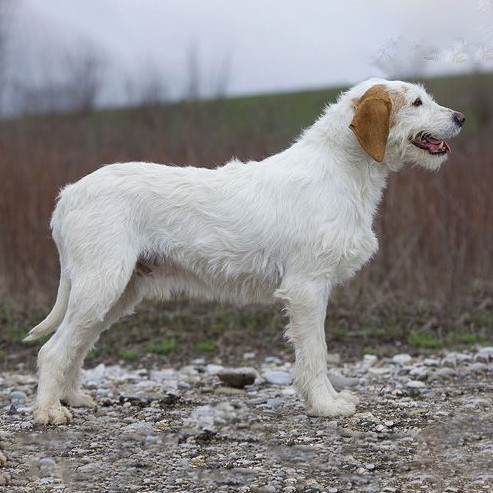
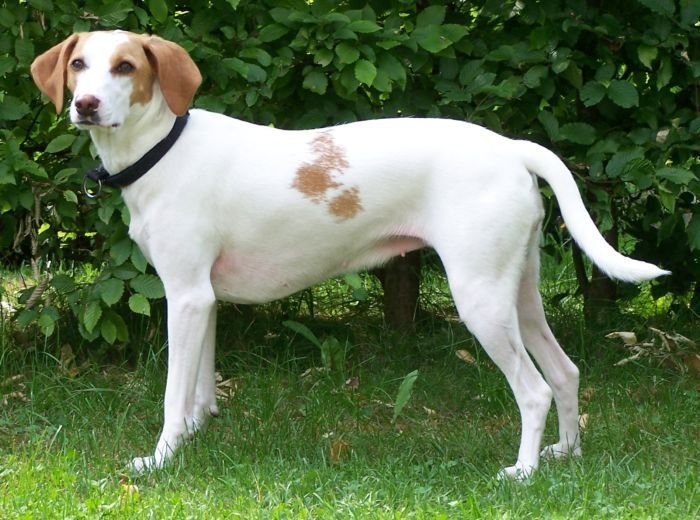
The Istrian Coarse-haired Hound is a dog of noble appearance, with a sturdy but not heavy build, which indicates its purpose as a tireless runner. Its appearance is entirely consistent with its functional purpose.
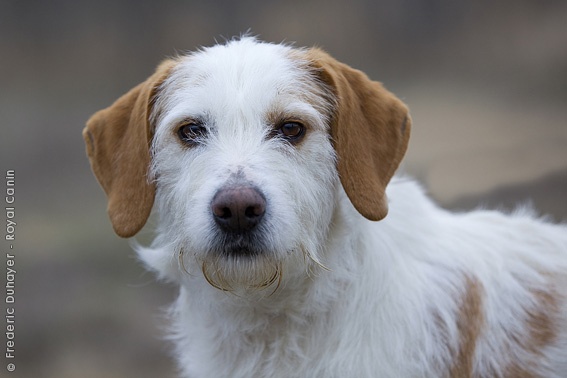
Head: Elongated but proportionate to the body. The skull is slightly domed. The stop is a smooth but noticeable transition from forehead to muzzle. The muzzle is strong and rectangular, with characteristic "whiskers" and thick, shaggy eyebrows that give the dog a serious, even slightly stern expression.
Nose: The nose pad is large, black or dark brown, with well-developed nostrils.
Eyes: Large, oval in shape, dark brown in colour. The gaze is calm, intelligent, and serious.
Ears: Set not too high, close to the cheeks. They are of medium length, thin, widening towards the middle and tapering to the tips, lying flat against the head.
Body: The back is straight and strong. The loins are short and muscular. The chest is deep and wide, providing ample room for the lungs. The belly is slightly tucked up.
Tail: Thick at the base, gradually tapering to the end. The dog carries it low, with a slight upward curve, in the shape of a sabre. When moving, the tail is carried at back level.
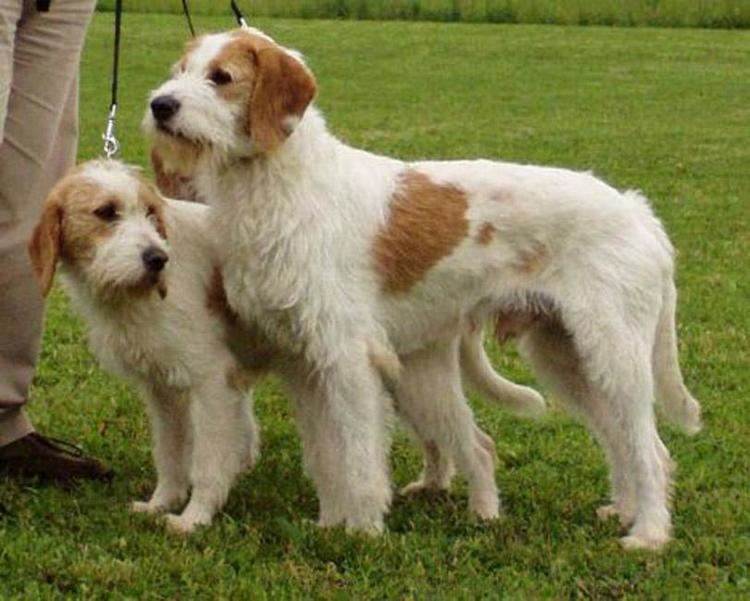
Coat: The main distinguishing feature of the breed. The coat is harsh, wiry, 5–10 cm long, dull, and does not lie flat against the body. Underneath, there is a short, dense undercoat, especially noticeable in winter. On the face, the hair forms eyebrows and a beard.
Colour: The main background is a snowy white. On it are patches of orange or yellowish-red. The patches can be of various sizes, sometimes so large that they form a saddle. On the head, there are usually patches covering the ears. Ticking on the white background is permissible but should not be too dense.
Character and Temperament of the Istrian Coarse-haired Hound
The character of this dog is a combination of two extremes. In a domestic setting, after a hunt or a long walk, he is a calm and balanced dog. He is not prone to unnecessary fuss and can sleep peacefully in his corner for hours. However, as soon as he gets into a field or a forest, a passionate and tireless hunter awakens in him.
Key temperament traits:
Persistence and stubbornness. This is not a flaw but a professional quality. A dog that is pursuing game must be stubborn to not give up the trail. This same trait makes basic training, unrelated to hunting, more difficult. He will perform a command not because he wants to please, but because he sees a purpose in it.
Independence. The Istrian is accustomed to making decisions on his own while at a distance from the hunter. Therefore, do not expect unquestioning obedience in everything.
Devotion to the hunter-owner. He is not a family dog in the classic sense. He chooses one "leader" — his master, with whom he works. He is calm towards other family members but without special affection.
Strong hunting instinct. Any small animal (cat, squirrel, neighbour's chicken) is perceived as potential prey. Therefore, walks in the city are only possible on a strong lead.
Voice. The Istrian has a powerful, ringing, melodious voice (a bay), which he actively uses while pursuing game. In a domestic setting, he is not noisy but may voice his opinion if something on the property catches his attention.
Pros and Cons of the Breed
Before getting such a specific dog, it is worth soberly assessing all its advantages and disadvantages, which are two sides of the same coin — its hunting purpose.
Pros
Cons
Outstanding hunting qualities. Tireless, driven, with an excellent nose and voice.
Not suitable as a companion dog. This is a working tool, not a family member for games.
Robust health. Health is generally robust, but no breed-wide list of hereditary diseases has been compiled — “not described” means “not studied”, not “not there”.
Extremely high need for physical activity. Regular walks are not enough.
Low-maintenance care. The coat does not require complicated grooming.
Stubbornness and difficulty with basic training. Requires an experienced owner.
High stamina. Capable of working for hours in difficult conditions.
Very strong hunting instinct. Dangerous to other small animals, does not get along with cats.
Calm temperament at home. Does not create chaos in the house if its needs are met.
Not suitable for apartment living. Needs space and a rural lifestyle.
Training and Socialisation
Training the Istrian should be aimed at developing and reinforcing his hunting skills. You should not try to turn him into a service dog to perform general obedience commands — this will be a waste of time and nerves for both the owner and the dog. The approach to him requires patience, consistency, and an understanding of hound psychology. Yelling and physical punishment are completely unacceptable — they will only increase his stubbornness and can destroy trust.
Training should be based on positive reinforcement and encouraging natural instincts. Socialisation should begin as early as possible, but with the understanding that full "acceptance" of cats and other small animals will likely not be achieved. Working with a professional hound trainer will be the best solution. A similar approach to training is applied to other working hounds, such as the Bosnian Coarse-haired Hound or the Italian hounds — the Shorthaired Segugio Italiano and its rough-haired relative.
Care and Upkeep of the Istrian Coarse-haired Hound
Proper care for this breed is not so much about salon treatments as it is about creating appropriate living conditions that satisfy its natural needs.
Living Conditions
Absolutely not suitable for an apartment. The Istrian Hound needs space. The ideal place for him would be a private house with a large, securely fenced yard. The fence must be high and strong, as the dog, upon catching an interesting scent, can easily dig its way under or jump a low fence. It is best to keep him in a kennel with an insulated doghouse rather than in the house, so as not to suppress his working instincts.
Physical Exercise
This is a key aspect of ownership. This dog needs at least 2–3 hours of active exercise every day. And these are not calm walks on a lead. He needs to run, preferably over rugged terrain, where he can use his nose. The best exercise is regular hunting. If the dog is not used for its intended purpose, it becomes unhappy and may develop destructive behaviour (barking, damaging property, attempts to escape).
Coat Care
The harsh coat does not require complicated care. It is enough to brush it once or twice a week with a hard brush or a metal comb to remove dead hair and dirt. The dog should only be bathed when absolutely necessary, as frequent washing disrupts the natural oily layer that protects the skin. After each hunt, the skin, paws, and ears must be thoroughly checked for ticks, cuts, and foreign objects (thorns, seeds).
Nutrition
Feeding the Istrian Coarse-haired Hound
Health and risks
Health and Typical Ailments
Frequently Asked Questions About the Breed (FAQ)
Is the Istrian Coarse-haired Hound suitable for a family with children?
No, this is a poor choice. This dog is not a nanny or a playmate. He is tolerant of children he grew up with but will not show any special interest in them. His strong character and work-oriented nature make him not the best option for a family pet.
How much does an Istrian Coarse-haired Hound puppy cost?
This is a rare breed, and it is very difficult to find a puppy outside of Croatia or the neighbouring Balkan countries. The price will depend on the pedigree, the working qualities of the parents, and the reputation of the breeder. The breed is mainly bred by hunters for hunters, so a sale "for the sofa" is unlikely. Keeping the animal for its whole life always outweighs what you pay at the start, and that is the figure worth thinking about first.
Does the Istrian Hound shed a lot?
Shedding is moderate and seasonal (spring and autumn). Its harsh coat does not scatter all over the house like the fur of smooth-haired breeds, but rather gets caught in the top layer. Regular brushing helps to keep this process under control.
How does the coarse-haired Istrian differ from the smooth-haired one, apart from the coat?
Besides the obvious difference in coat type, there are differences in temperament. The coarse-haired hound is considered calmer and more balanced, but at the same time more stubborn and independent than its smooth-haired relative. It also typically has a louder and lower-pitched voice, which is why it was bred.
Video about the breed
FAQ
What can the Istrian Coarse-haired Hound do?
A versatile working dog: it excels on the blood trail of wounded game and can hunt both alone and in a pack, with a characteristic loud voice.
Is the Istrian Coarse-haired Hound good at home?
Yes — despite its working drive it is surprisingly gentle, calm and affectionate with children at home; but it is a specialised working dog, unsuited to the role of an urban companion.
How does it differ from the shorthaired?
The main difference is the coat: the coarse-haired has a rough coat with a “beard” that protects better in thorny thickets; in colour and character the breeds are close.