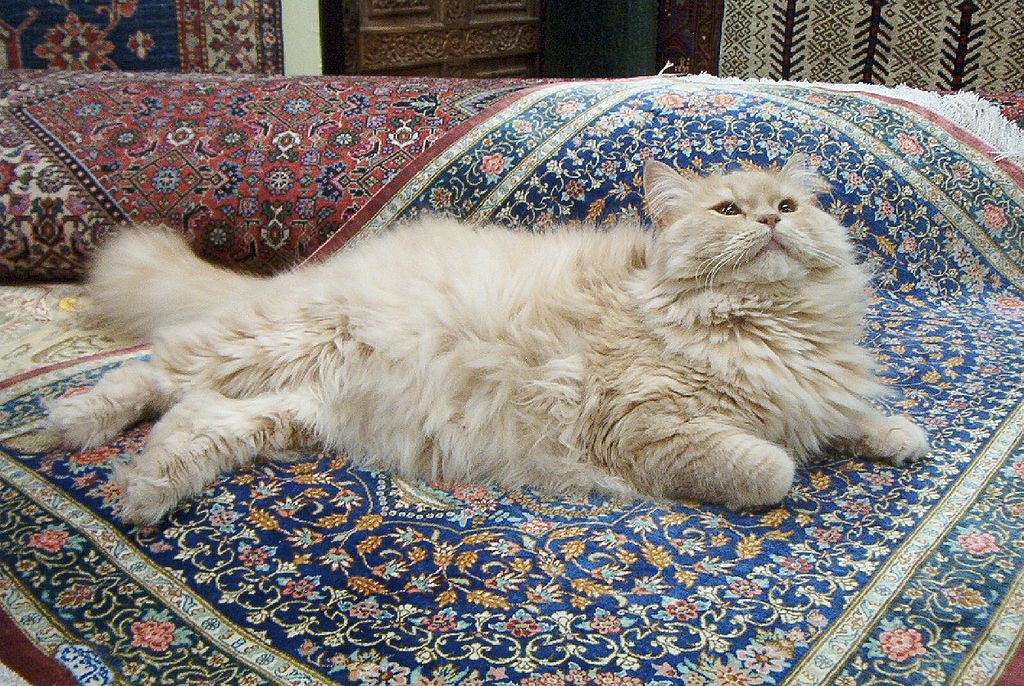
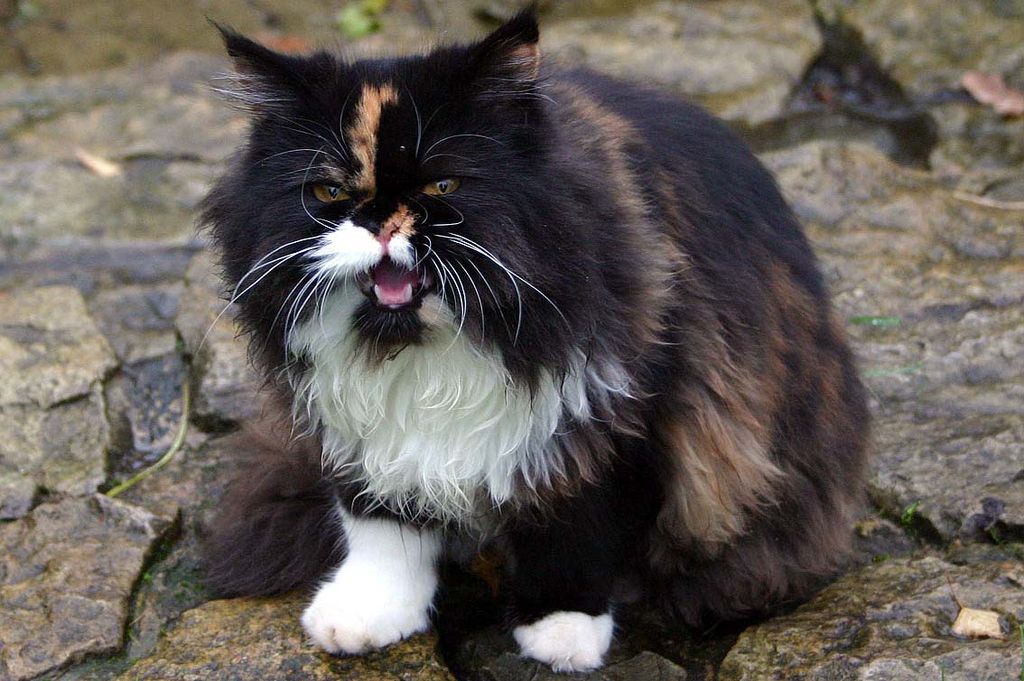
Iran (Persia), developed in Great Britain and the USA
Persian Cat
A luxurious couch aristocrat from a doll's world — calm and gentle: mild, quiet, balanced and devoted. The Persian is one of the oldest and best-known breeds, with a long dense coat and a flat face; it is quiet, low-energy and a boundlessly affectionate “couch” companion, but its lavish coat needs daily care and its flat build needs attention to the eyes and breathing.
KidsDogsOther catsBeginnersTime alone · with caveats
The Persian cat is the epitome of feline aristocracy and tranquillity. This world-renowned breed traces its origins to enigmatic Asia, while its modern, somewhat extreme appearance has been shaped by years of dedicated work from European, particularly British, breeders. You can find out more on Tvaryny. Persians are not merely beautiful; they are exceptionally gentle family pets, though they do have demanding care requirements. To ensure your fluffy companion stays comfortable and healthy, you'll need to dedicate daily time to grooming their luxurious coat, specific feeding, and, of course, affectionate interaction. Their gentle nature with children, quiet, almost imperceptible voice, and refined, delicate behaviour more than compensate for the effort involved, making the Persian cat an ideal companion for peaceful homes.
Persian Cat: Key Breed Characteristics
Persian Cat: Key Breed Characteristics · 14
Characteristic
Details
Origin
Iran (Persia), developed in Great Britain and the USA
Calm, gentle, phlegmatic, devoted, not overly active.
Grooming Needs
Very high (daily combing, care for eyes and nasal folds).
Activity Level
Low
Compatibility with Children
Good, provided children handle them gently.
Compatibility with Other Animals
Good, especially with non-aggressive animals.
Interesting Facts About Persian Cats
Royal Favourites: Persian cats were a favourite of many famous personalities, including Queen Victoria, Marilyn Monroe, and Freddie Mercury.
Movie Stars: Persians often appear in films and advertisements due to their striking appearance and calm nature. One of the most famous cinematic Persians is Mr. Bigglesworth, Dr. Evil's cat from the Austin Powers films (although a Sphynx cat played the role, the character was a Persian before cryogenic freezing). A Persian named Snowbell was also one of the main characters in the film "Stuart Little."
Different Muzzle Types: There are two main types of Persians based on muzzle shape: "doll-face" (classic, with a less flat muzzle) and "peke-face" (extreme, with a very flat muzzle). The extreme type dominates at shows, but the classic type is considered healthier.
Most Popular Breed: For many decades, the Persian cat was one of the most popular cat breeds in the world, although its popularity has somewhat declined recently due to high grooming demands and the emergence of other interesting breeds.
"The Lazy Person's Persian": The Exotic Shorthair breed was developed from Persians. They have the same build and temperament as Persians but a short, plush coat that doesn't require such meticulous grooming. They are often called "the lazy person's Persian."
Not Jumpers: Unlike many other cats, Persians are not particularly fond of jumping and climbing high places. They prefer to stay on the floor or low furniture.
Detailed History of the Persian Cat Breed
The history of the Persian cat is shrouded in mystery and legend, but it is widely accepted that its ancestors came from the region of Persia (modern-day Iran) and neighbouring Turkey (Angora cats). The first long-haired cats arrived in Europe as early as the 16th-17th centuries, thanks to the Italian traveller Pietro della Valle, who brought them to Italy around 1620. Almost simultaneously, the French naturalist Nicolas-Claude Fabri de Peiresc imported similar long-haired cats from Angora (Turkey) to France. These cats quickly gained popularity among European aristocracy due to their exotic appearance and luxurious fur.
However, the modern Persian cat differs significantly from its historical ancestors. The true development of the breed took place in Great Britain at the end of the 19th century. British breeders began targeted selective breeding, crossing cats imported from the East to achieve a more massive build, a rounder head, and an even denser and longer coat. Persian cats were first presented at an exhibition in the Crystal Palace in London in 1871, organised by Harrison Weir, "the father of the cat fancy." It was then that the official breed standards began to be formed.
An important stage in the breed's development was the emergence of the so-called "extreme" type of Persian in the USA in the mid-20th century. American breeders aimed for an even flatter face (the "peke-face," by analogy with the Pekingese dog), a very small nose situated between large, round eyes. This type quickly became dominant at shows, although it also led to a number of specific health problems. At the same time, the "classic" or "traditional" type of Persian (doll-face), with a less flattened face, which many consider healthier, was preserved.
Further selective breeding led to a vast array of colours in Persian cats. Chinchillas (silver and golden), smokes, bicolours, and tabbies of various patterns were developed. A distinct line of development was the creation of colourpoint Persians by crossbreeding with Siamese cats – this is how Himalayan cats emerged, considered a variation of the Persian breed in many cat fancy associations. Additionally, the Exotic Shorthair breed was developed from Persians, sharing the same build and temperament but with a short, plush coat.
What a Persian Cat Looks Like: Detailed Appearance
The Persian cat is a breed impossible to confuse with any other, thanks to its distinctive appearance. It is a cat of medium to large size, with a massive, stocky body on short, thick legs. The chest is broad, the back is level, and the musculature is well-developed. This cobby build gives the Persian a solid and somewhat ponderous look.
The head of a Persian cat is one of the breed's most defining features. It is large, round, and massive, with a broad skull. The forehead is domed. Cheeks are full and well-developed. The chin is strong and broad.
The muzzle is short and broad. The nose is very short, wide, with a "stop" (a sharp indentation between the forehead and nose) located between the eyes. In the extreme type, the nose can be almost flat, creating the characteristic "doll-like" facial expression. In the classic type, the muzzle is slightly longer, and the nose is less snub.
The eyes are large, round, set wide apart, and very expressive. Their colour is rich and corresponds to the coat colour. Copper or dark orange eyes are most common. In white Persians, eyes can be blue or odd-eyed (one blue, one copper). Chinchilla and golden Persians have emerald green or blue-green eyes. Colourpoints (Himalayans) have deep blue eyes.
The ears are small, with rounded tips, set wide apart and low on the head, tilting slightly forward. They are densely covered with fur, often with tufts of hair inside.
The neck is short and thick, emphasising the massiveness of the head.
The legs are short, thick, and straight. Front paws have five toes, rear paws have four. Paws are large, round, compact, with tufts of fur between the toes.
The tail is short, thick at the base, proportionate to the body, and without kinks. It is abundantly covered with long fur, forming a lush "plume."
The coat is the Persian cat's main adornment and, at the same time, its main upkeep challenge. It is very long (up to 10–15 cm), dense, silky, with an abundant, soft undercoat that stands away from the body. The fur forms a magnificent ruff around the neck and shoulders, and "trousers" on the hind legs. The texture of the coat can vary slightly depending on the colour, but it should always be glossy and not prone to matting.
The colours of Persian cats are extremely diverse and are divided into several groups: solids (white, black, blue, red, cream, chocolate, lilac), tortoiseshells, smokes, chinchillas (silver and golden), shaded, tabbies (classic, mackerel, spotted), particolours (bicolours, harlequins, vans), and colourpoints (Himalayans). Each colour has its own clear standards.
Character Traits of the Persian Cat
The Persian cat is known for its exceptionally calm, gentle, and affectionate nature. It is a true phlegmatic in the feline world. They are not prone to boisterous games, dashing about the flat, or jumping on cupboards. Persians prefer to calmly observe what is happening or drowse on their favourite sofa or armchair.
Devotion and Attachment: Despite their reserve, Persian cats become very attached to their owners. They are not intrusive but appreciate human attention and company. A Persian will happily sit nearby or on its owner's lap, purring softly. They often choose one family member as their primary "person," to whom they show particular affection.
Voice: Persian cats have a quiet, melodious, and pleasant voice. They rarely meow without reason, using their voice only to draw attention to their needs (e.g., to ask for food or a cuddle).
Attitude towards Strangers: Persians are usually reserved, sometimes even indifferent, towards strangers. They will not show aggression, nor will they immediately rush to make friends. They need time to get used to a new person.
Compatibility with Children: Thanks to their patient and non-aggressive nature, Persian cats get along well with children, especially if the children are taught to respect the animal and not cause it pain. A Persian is more likely to walk away and hide than to extend its claws in response to overly persistent attention. However, active games with small children are not for them.
Compatibility with Other Animals: Persians usually coexist peacefully with other cats and dogs, especially if they have grown up together. Their calm temperament helps to avoid conflicts. They are not prone to dominance or fighting for territory.
Intelligence and Training: Persian cats are quite intelligent but not overly inclined towards active learning or performing commands. It is difficult to interest them in lively games or tricks. However, they quickly learn house rules and are easily litter-trained.
Need for Attention: Although calm, Persians require daily attention and affection from their owners. If left alone for long periods, they can become lonely. It's important to dedicate time for interaction and cuddles to make the cat feel loved.
Overall, the Persian cat is an ideal choice for people who value peace and quiet and are looking for a gentle, devoted companion ready to spend evenings purring peacefully on their lap.
Training and Socialisation of the Persian Cat
When discussing the training of a Persian cat, it's important to understand its temperament. Persians are not the type of cats that will enthusiastically perform commands or jump through hoops. Their natural phlegmatic disposition, calm nature, and moderate activity levels make them less inclined to classic trick-oriented training.
However, this does not mean Persians cannot be trained. They are intelligent and quickly learn basic house rules:
Litter tray training: Usually straightforward. It's important to choose a suitably sized tray (large enough) with low sides (especially for kittens) and a litter that the cat likes.
Scratching post training: To save your furniture, it's important to show your kitten where it can sharpen its claws from an early age. Offer various types of scratching posts (vertical, horizontal, cardboard) to find one it prefers.
Grooming training: As mentioned, this is a key aspect of raising a Persian. Start procedures (combing, checking ears and eyes) from a young age, keeping them short, positive, and regular.
Correcting unwanted behaviour: If the cat does something undesirable (e.g., scratches the sofa), use gentle correction methods – a loud sound ("No!", a clap of the hands) or redirecting attention to an approved object (scratching post, toy). Physical punishment is unacceptable and ineffective.
Socialisation: Socialisation is important for any cat, and Persians are no exception. Although naturally calm, early socialisation will help them grow into confident and well-balanced adults.
Introducing to people: From an early age, introduce the kitten to different people (various ages, genders) so it doesn't fear strangers.
Introducing to other animals: If you have other pets or plan to get them, introduce them gradually and under supervision. The calm nature of Persians usually facilitates peaceful coexistence.
Acclimatising to sounds and environments: Accustom the kitten to common household sounds (vacuum cleaner, hairdryer, television) so it isn't frightened by them as an adult.
Remember, the most important things in raising a Persian cat are patience, consistency, and positive reinforcement. They respond better to affection and praise than to severity.
Pros and Cons of the Persian Cat Breed
Before getting a Persian cat, it's important to weigh all the advantages and disadvantages of this breed to understand if it's the right fit for you.
Pros and Cons of the Persian Cat Breed · 8
Pros (+)
Cons (-)
Gentle and affectionate nature: Very calm, loving, and devoted companions.
Very high grooming demands: Require daily combing; otherwise, the fur quickly mats.
Calm temperament: Ideal for people who prefer peace and quiet. Not prone to destructive behaviour.
Prone to health problems: Brachycephalic syndrome (breathing), eye problems (tearing), dental problems, Polycystic Kidney Disease (PKD), HCM.
Good with children and other animals: Their non-confrontational nature promotes peaceful coexistence.
Requires daily care for eyes and nasal folds: Due to tearing and facial structure.
Quiet voice: Rarely and softly meow.
Low activity level: Not suitable for people looking for an active, playful cat. Prone to obesity.
Striking appearance: Luxurious long fur and a cute "doll-face" make them very attractive.
High cost of upkeep: Quality food, regular grooming (possibly professional), and veterinary care can be significant expenses.
Adapts well to living in a flat: Do not require much space for activity.
Tolerates heat poorly: Due to thick fur and breathing problems.
Possible feeding difficulties: May require special bowls and food due to their flat faces.
Not for allergy sufferers: Long fur and saliva can be potent allergens.
How to Care for a Persian Cat's Luxurious Coat
Grooming a Persian cat's coat is a daily necessity and the main aspect of keeping this breed. Their long, dense fur with a thick undercoat mats very easily and forms tangles if not combed regularly. Insufficient grooming can lead not only to an unkempt appearance but also to serious skin problems (dermatitis, irritation) and discomfort for the animal.
Main steps for daily coat care:
Combing with a metal comb with wide teeth: Start by gently combing through all the fur to untangle small knots and remove dead hairs. Move in the direction of hair growth.
Combing with a fine-toothed comb: Go over the coat again, paying special attention to the undercoat. This will help remove more dead hairs and fluff up the fur.
Using a slicker brush: Gently use a slicker brush to remove remaining undercoat, especially during moulting season. Do not press too hard to avoid scratching the skin.
Dealing with problem areas: Pay special attention to areas where mats form most often: behind the ears, under the armpits, on the belly, and on the "trousers." If a mat has already formed and cannot be combed out, carefully cut it along the direction of hair growth with a special de-matting tool or blunt-ended scissors, or consult a professional groomer. Never try to cut out a mat close to the skin with ordinary scissors – there is a high risk of injuring the animal.
Final brushing with a natural bristle brush: This will help smooth the fur, add shine, and remove any remaining loose hairs from the surface.
Bathing: Persian cats are generally clean and do not require frequent bathing, especially if they do not go outside. However, occasional bathing (once every 1–3 months or as needed) helps to keep their coat clean, healthy, and shiny. Use only special shampoos and conditioners for long-haired cats. After bathing, the coat must be thoroughly dried with a towel and then a hairdryer (on a low temperature and power setting), while simultaneously combing to prevent mats from forming in the wet fur.
Clipping: Some Persian owners, especially during warmer months or if they struggle with daily combing, resort to clipping. The most popular clip is the "lion cut," where the fur on the body is cut short, while the fur on the head, paws, and tail is left long. Clipping is best left to a professional groomer.
Grooming Tool · 7
Grooming Tool
Purpose
Frequency of Use
Metal comb (wide/fine teeth)
Detangling, removing dead hair and undercoat
Daily
Slicker brush
Removing undercoat, especially during moulting
1–3 times a week (gently)
Natural bristle brush
Smoothing fur, adding shine
Daily (final step)
De-matting tool / Blunt-ended scissors
Safely removing mats
As needed
Shampoo for long-haired cats
Cleaning fur and skin
Once every 1–3 months
Conditioner/balsam
Easing combing, anti-static effect
After each wash
Towel, hairdryer
Drying fur after bathing
After each wash
Important: Accustom your kitten to grooming procedures from an early age so they become a familiar and pleasant part of its life. Carry out procedures calmly, speaking gently to the cat and rewarding it with treats for its patience.
Nutrition
Feeding Your Persian Cat: Key Recommendations
Health and risks
Persian Cat Health: Common Diseases and Prevention
Frequently Asked Questions about the Persian Cat Breed (FAQ) · 7
Do Persian cats shed a lot?
Yes, a great deal. Persian cats have long, dense fur with a plentiful undercoat that requires daily brushing to control shedding and prevent matting. Shedding is particularly heavy seasonally (in spring and autumn).
Are Persian cats suitable for living in a flat?
Yes, ideally suited. They are calm, not overly active cats that feel perfectly comfortable in confined spaces. They do not require outdoor access and are usually exclusively indoor pets.
Do Persian cats need to be bathed?
Although Persians are quite clean, occasional bathing (once every 1–3 months) helps to keep their long fur clean and in good condition. Use special shampoos and conditioners for long-haired cats and thoroughly dry the fur with a hairdryer after bathing.
Do Persian cats cause allergies?
Yes, they can. Although allergies are caused not by the fur itself but by the Fel d 1 protein found in cats' saliva, urine, and sebaceous glands, the long fur of Persians can accumulate more allergens. Persians are not considered a hypoallergenic breed.
How long do Persian cats live?
The average lifespan of a Persian cat is 12–17 years, but with good care, proper nutrition, and timely veterinary attention, they can live even longer.
Are Persian cats expensive?
The cost of a Persian kitten can vary depending on its pedigree, type (classic or extreme), colour, and the cattery's reputation. In addition to the cost of the kitten itself, you need to consider the ongoing expenses of upkeep (quality food, litter, grooming, veterinary services), which can be quite high.
Do Persian cats need to be clipped?
Clipping is not mandatory but can be beneficial, especially in hot weather or if the owner struggles with daily combing. Clipping makes grooming easier and prevents matting. It is best to entrust this procedure to a professional groomer.
FAQ
Is the Persian hard to care for?
Yes — it is the breed with the most demanding care: the long dense coat must be brushed daily, or it mats; because of the flat face, daily wiping of the eyes from tearing is also needed.
What are the main health concerns in Persians?
Above all polycystic kidney disease (PKD) — a hereditary disease that responsible breeders test the parents for; because of the flat (brachycephalic) build, breathing problems, tearing and entropion also occur.
Is the Persian good for a family and a flat?
Very — a quiet, calm and affectionate “couch” cat, ideal for a flat and a calm family; it is low-energy, good with children, but needs daily grooming and attention to the eyes.