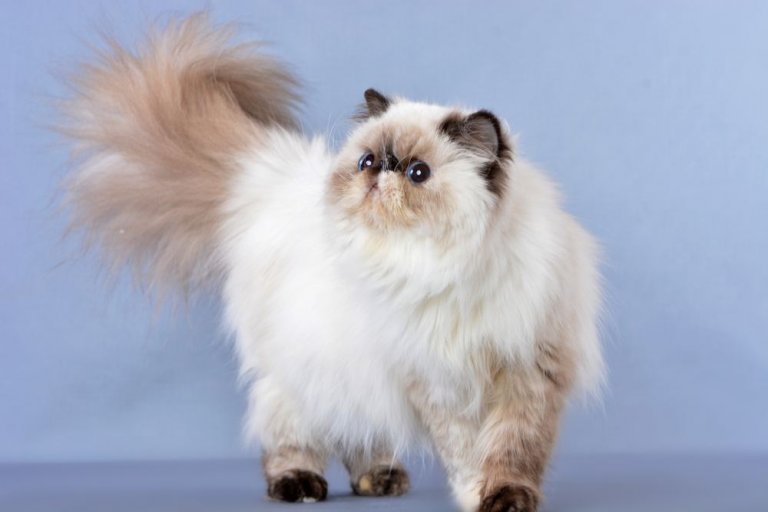
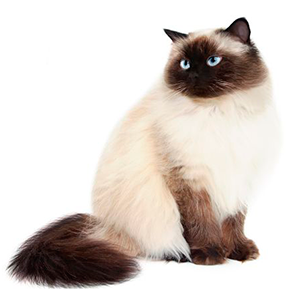
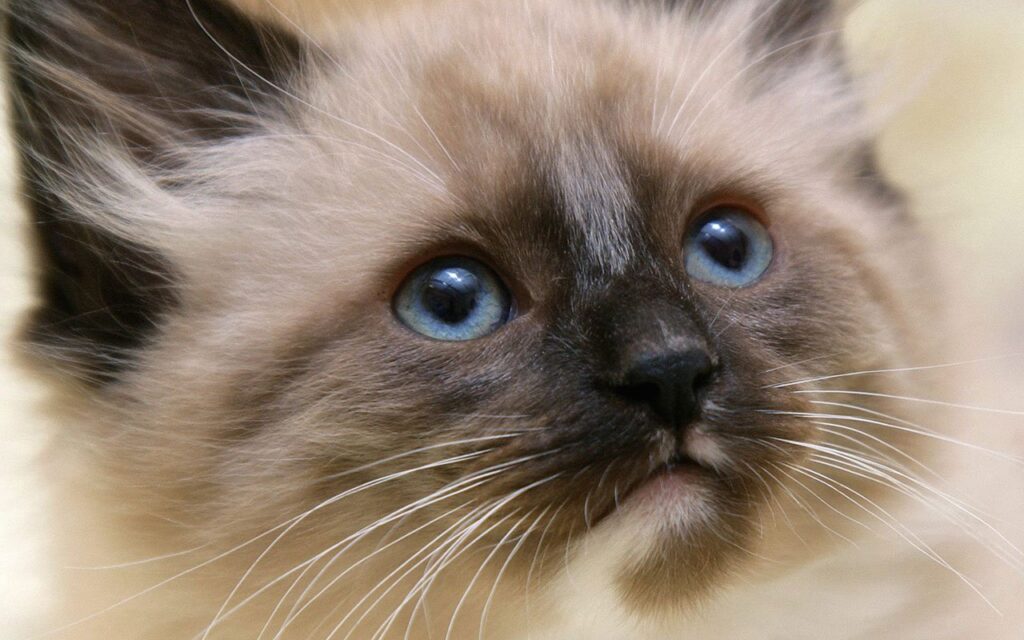
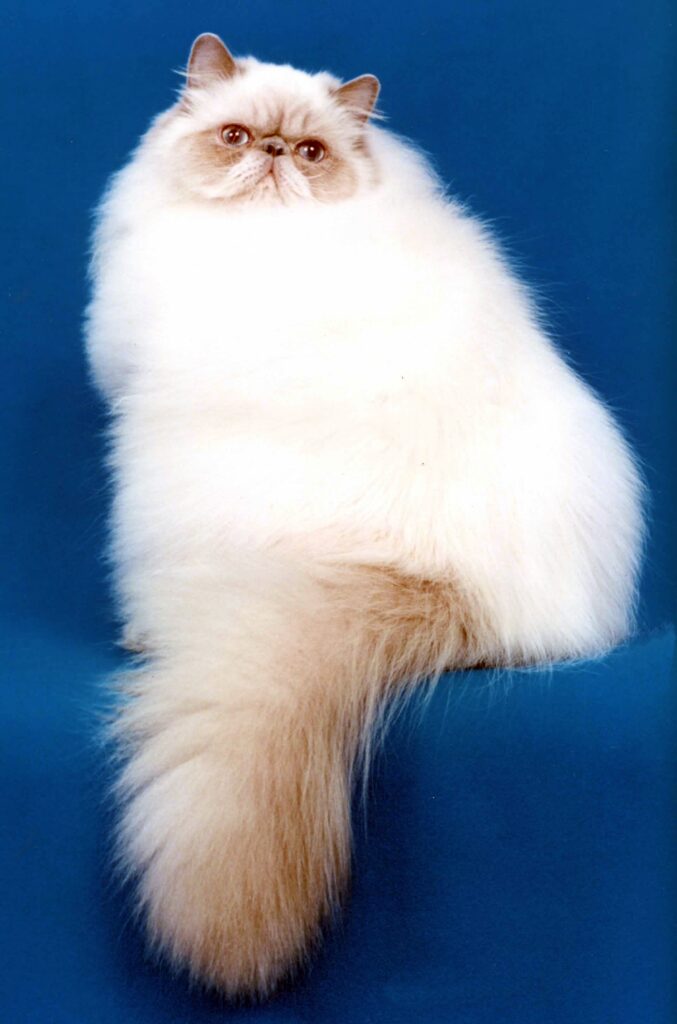
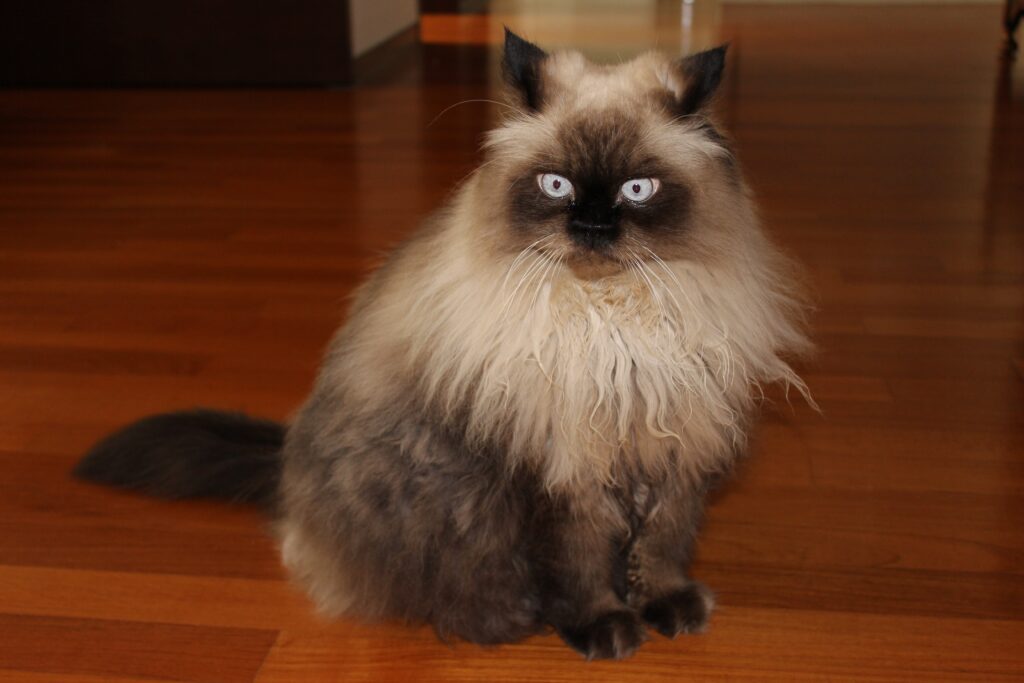
A blue-eyed Persian in a “Siamese mask” — luxurious and carefree: calm, gentle, quiet and devoted. The Himalayan is a Persian with colourpoint markings (darkened face, ears, paws and tail) and bright blue eyes; it combines the Persian's long dense coat and mild “couch” nature with a striking “Siamese” colour, so it needs daily grooming and attention to the flat face.
KidsDogsOther catsBeginnersTime alone · with caveats
The Himalayan cat, also known as the Colourpoint Persian, is a breed that truly captivates with its majestic presence and beauty. It’s a harmonious blend of the Persian cat's opulent long coat and sturdy build with the Siamese cat's charming colourpoint markings and striking blue eyes. This is a truly wonderful 'family' cat, boasting a calm, composed temperament, yet still more playful and curious than your typical Persian. Find out more about various cat breeds on Tvaryny.
Himalayans rarely raise their voices, preferring a quiet purr in the company of their beloved owners. They give the impression of attentive observers, peacefully watching the goings-on in the home, and are certainly not adverse to joining you for a spot of telly. However, their luxurious appearance demands considerable attention: daily grooming of their long fur is an absolute must, and the unique structure of their faces requires regular eye cleaning. Furthermore, owners should be prepared to use special products to help their pet pass hairballs.
Colouring: Colourpoint (various point options: seal, blue, chocolate, lilac, red/flame, cream, tortie, lynx) on a light body background
Eyes: Large, round, always bright blue
Care: Very high requirements (daily brushing, eye care)
Health: Prone to several diseases (PKD, issues due to brachycephaly, coat problems)
Interesting Facts About the Himalayan Cat
Man-Made Breed: Himalayans are not a natural breed but the result of deliberate crossing of Persian and Siamese cats by humans.
Named After a Rabbit: The breed is named not after mountains, but after the Himalayan rabbit, which has similar colourpoint markings.
Newton's Debutante: The first officially registered Himalayan kitten (in the USA) was named Newton's Debutante.
Breed or Variety?: The status of Himalayans is a subject of debate: some large feline organisations (CFA, GCCF) consider them a variety of the Persian breed, while others (TICA, ACFA) - a separate breed.
Always Blue Eyes: Regardless of the point colour, the eyes of a true Himalayan cat must always be blue - this is an inheritance from its Siamese ancestors.
Born White: Colourpoint colouring depends on temperature. Kittens are born completely white because the temperature in the mother's womb is uniform. The points (darker areas) appear on the colder parts of the body (ears, face, paws, tail) within the first few weeks of life.
Most Popular "Persian": At certain times, the Himalayan variety was the most popular among all Persian cats in CFA registrations.
Breed History
The emergence of the Himalayan cat is the result of dedicated and prolonged selective breeding, undertaken by enthusiasts in two countries - the UK and the USA - at approximately the same time. The ambition was clear: to create a cat with the luxurious long coat and massive build of a Persian, yet possessing the distinctive colourpoint markings (darker points on the face, ears, paws, and tail against a light body) and piercing blue eyes of a Siamese cat. Speaking of striking felines, you might also be interested in the sleek and captivating Bombay Cat.
The earliest documented attempts at crossing Persians and Siamese were made in the 1920s in Sweden, but serious work began in the 1930s in the USA. Dr. Clyde Keeler of Harvard University and breeder Virginia Cobb started experimental crosses to study the genetics of colourpoint inheritance. Their work laid the foundation for the future breed, revealing that the colourpoint gene is recessive.
After the Second World War, in the 1950s, efforts intensified. In the UK, Brian Stirling-Webb spent over ten years refining the breed. In the USA, Marguerita Goforth also achieved success, producing the first cat of the desired type, named "Princess Himalayan Hope." It was the work of these and other breeders that led to the breed's official recognition.
The name "Himalayan" was given not due to geographical origin, but by analogy with Himalayan rabbits and other animals that share a similar acromelanistic colouring (darker extremities on a lighter body).
Interestingly, the breed's status remains a subject of debate among feline organisations. The CFA (Cat Fanciers' Association) and GCCF (Governing Council of the Cat Fancy) consider Himalayans not as a separate breed, but as a variety (division) of the Persian breed with colourpoint markings. Meanwhile, TICA (The International Cat Association) and ACFA (American Cat Fanciers Association) recognise Himalayans as a distinct breed within the Persian group of breeds.
What a Himalayan Cat Looks Like: Breed Standard
The appearance of the Himalayan cat almost entirely conforms to the Persian breed standard, with the exception of two key points: coat colouring (colourpoint) and eye colour (always blue). It is a cat with a massive, low-slung body, luxurious long fur, and a characteristic flat face.
What a Himalayan Cat Looks Like: Breed Standard · 11
Body Part
Standard Description (based on CFA/TICA Persian Standard)
General Appearance
Medium to large cat, cobby type, with heavy boning and well-developed musculature. Gives the impression of strength and massiveness, but not fatness. Low-set on the legs. Overall appearance - rounded.
Head
Large, round, massive, with a broad skull. Set on a short, thick neck.
Muzzle
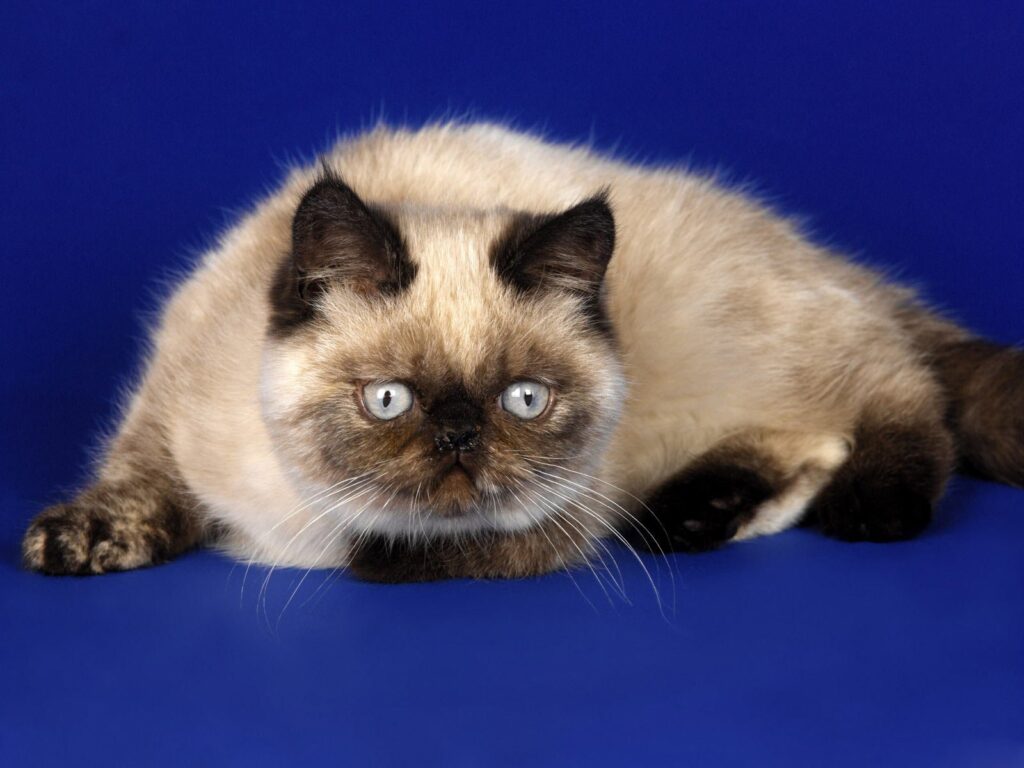
Round, full cheeks. - Nose short, broad, snub, with a distinct 'stop' (abrupt transition from forehead to nose) between the eyes. Important: variations exist from 'Peke-faced' (very extreme, flat) type to 'doll-face' (with a less pronounced stop and longer nose). The extreme type is associated with greater health problems.
Jaws / Chin
Jaws broad, powerful. Chin strong, well-developed, rounded, forming a smooth line with the muzzle. Correct bite is important.
Ears
Small, rounded at the tips, wide-set and low-set on the head, not disrupting the overall round contour of the head. Often with tufts of fur inside.
Eyes
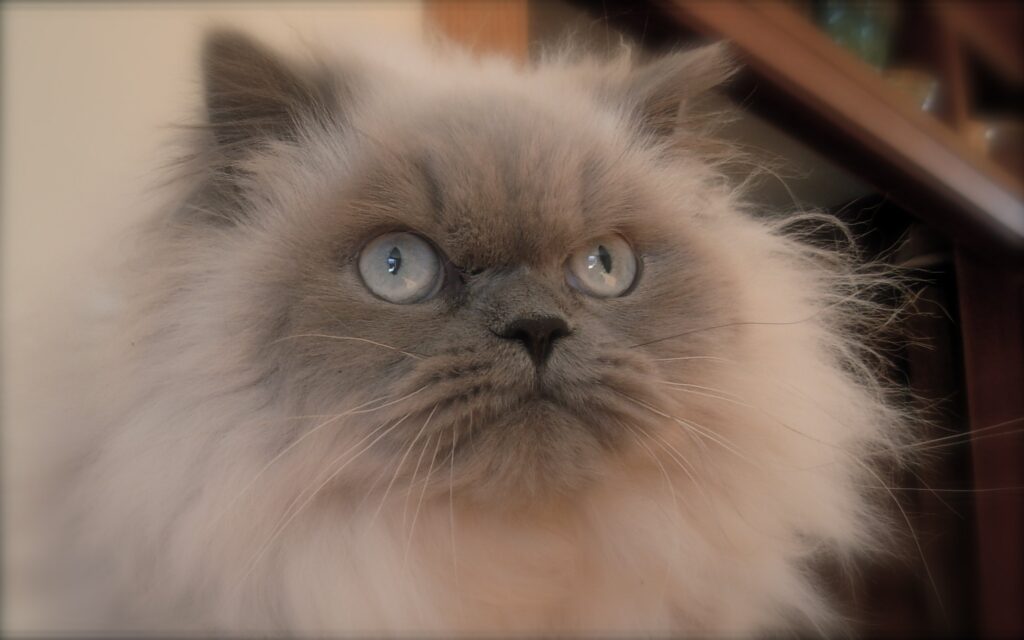
Large, round, expressive, wide-set. Colour - always bright, intense blue. Depth of colour is valued.
Body
Cobby type - short, massive, with a broad chest, massive shoulders and rump. Back short, level.
Limbs and Paws
Legs short, thick, strong. Paws large, round, firm. Tufts of fur between the toes are desirable.
Tail
Short, proportionate to the body, thick, without kinks. Covered with very dense, long fur ('plumage').
Coat
Very long, dense, silky, with an abundant, soft undercoat that creates volume. Covers the entire body, forming a lush ruff on the neck and chest, 'breeches' on the hind legs. Texture soft, not cottony.
Colouring
Colourpoint: body of a light, even shade (from white to cream/beige), with a clear contrast to darker, intensely coloured areas (points) on the face (mask), ears, paws, and tail. The mask should not extend over the entire head. Body colour may darken with age, but the contrast with the points should be maintained.
Recognised Point Colours:
Seal Point: Dark brown points on a light beige body.
Blue Point: Grey-blue points on a cool white/bluish body.
Chocolate Point: Warm milk-chocolate points on an ivory body.
Lilac Point: Frosted grey points with a pinkish hue on a white body.
Red Point / Flame Point: Bright orange-red points on a creamy-white body.
Cream Point: Delicate cream points on a white body.
Tortie Point: Tortoiseshell (patches of red/cream on the main point colour - seal, blue, chocolate, lilac) points.
Lynx Point: Tabby pattern (stripes) on the point areas of any of the listed colours.
Temperament: Character and Behaviour
The character of the Himalayan cat is a wonderful blend of the calm dignity of the Persian and the playful curiosity of the Siamese. They have inherited the gentle, sweet, and balanced disposition of their Persian ancestors, but are also somewhat more active and communicative.
Calm and Peaceful: Himalayans are generally quiet and unobtrusive cats. They appreciate a tranquil home environment, love comfort and cosiness. They rarely show aggression, coexisting well with other calm pets and children who know how to treat cats gently.
Loyal and Affectionate: They become deeply attached to their owners, needing attention and affection. They love to sit on laps, sleep nearby, and follow people around the house. They are sensitive to their owner's mood and can be a wonderful source of emotional support.
Moderately Playful: Unlike very placid Persians, Himalayans retain a certain playfulness, especially when young. They might happily chase a wand toy or a ball, but their games are usually not as boisterous or prolonged as those of Siamese cats.
Intelligent and Curious: They are quite clever and can learn simple rules or even tricks, especially with a tasty reward. They enjoy observing what's happening around them.
Dislike Loneliness: While they can quietly spend some time alone, prolonged absence of their owners can cause them stress. These are cats that thrive on human companionship.
Quiet Voice: Inheriting their voice from Persians, they typically meow softly and infrequently, unlike the vocal Siamese. However, they can 'talk' with quiet purrs or cooing sounds.
The Himalayan cat is an ideal choice for people seeking a calm, affectionate, and loyal companion who is ready to provide ample attention and the necessary care.
Training and Socialisation
Himalayan cats are intelligent and calm animals, which makes their upbringing and socialisation a relatively straightforward process, though it does demand patience and the right approach. They are not as stubborn as some other breeds and usually aim to please their owner.
Socialisation
As with any cat, early socialisation is important for a Himalayan. Introducing them to various people, sounds, and situations at a young age will help them grow into a confident and well-adjusted cat.
Acclimatisation to people: Encourage gentle interaction with guests to ensure the cat isn't overly shy.
Acclimatisation to children: Teach children to respect the cat's personal space, not to be too loud or intrusive. Himalayans are generally patient, but they dislike rough handling.
Acclimatisation to other animals: Introduce other household pets gradually and under supervision. Thanks to their calm nature, Himalayans often get along well with other cats and quiet dogs.
Acclimatisation to grooming: This is critically important! From day one, accustom your kitten to daily brushing, eye, ear, and teeth checks, and claw trimming. Make these procedures as positive as possible.
Training and Learning
Himalayan cats don't require complex training, but teaching basic rules of behaviour is essential.
Litter Tray and Scratching Post: They usually take to litter trays easily. It's important to keep them immaculately clean. Provide several sturdy scratching posts to encourage their use instead of furniture.
Positive Reinforcement: Use praise, affection, and small pieces of favourite treats to encourage desired behaviour. Himalayans respond well to affection.
Commands: They can be taught simple commands like "come," but don't expect them to perform complex tricks. They'd rather lie next to you than actively train.
Games: Encourage moderate playtime with wand toys and balls. This will help keep them fit and satisfy their need for movement.
The main thing in raising a Himalayan cat is patience, consistency, and gentleness. Punishments should be avoided; it's better to redirect undesirable behaviour and reward good behaviour.
Pros and Cons of the Breed
Advantages:
Exceptional Beauty: A combination of the Persian's luxurious coat and striking colourpoint markings with blue eyes.
Calm and Affectionate Nature: An ideal companion for quiet individuals and families.
Loyalty to Owners: Become very attached to their family, love to be close.
Quiet Voice: Won't bother you with loud meowing.
Get Along Well with Other Animals: Provided other household members are calm.
Moderate Playfulness: More active than Persians, but not hyperactive.
Disadvantages:
Very High Grooming Requirements: Need daily brushing and eye care.
Predisposition to Serious Health Problems: Brachycephaly, PKD, eye, dental, and coat issues. Potentially high vet bills.
Dislike Loneliness: Require a lot of attention and interaction.
Heat Sensitivity: Tolerate high temperatures poorly.
Prone to Weight Gain: Require dietary control.
Not Suitable for Very Active Families: Prefer a calm environment.
Cost: Like other pedigree cats, they can be expensive, especially from responsible breeders who test for PKD.
Himalayan Cat Coat Care: A Daily Ritual
The luxurious long and dense coat of the Himalayan cat is its calling card, but it's also the primary source of concern for its owner. Caring for it requires daily attention and patience to prevent matting and keep the fur clean and healthy.
Daily Brushing - A Must!
This is the most crucial aspect of grooming for a Himalayan. Skipping this procedure is not an option, otherwise, the fur quickly forms dense mats that are then very difficult (and sometimes impossible) to detangle without clipping.
Tools: You'll need several tools:
Metal comb with wide and fine teeth (greyhound comb): For detangling small knots and checking for mats.
Slicker brush: For removing dead undercoat. Use carefully to avoid scratching the skin.
Natural bristle brush: For final smoothing of the fur and adding shine.
Brushing Technique:
Start with the wide-toothed comb, gently working through the entire length of the fur, from roots to tips, paying special attention to areas where mats form most often (behind the ears, under the armpits, on the 'breeches', on the belly, near the base of the tail).
If you encounter a mat, don't pull. Try to gently tease it apart with your fingers or the tip of the comb. Special detangling sprays can be used. Large and dense mats may need to be carefully cut out with blunt-ended scissors or clippers (best entrusted to a professional groomer).
After the comb, use the slicker brush to remove loose fur, moving in the direction of hair growth.
Finish the procedure with the natural bristle brush.
Duration: Daily brushing takes 10–15 minutes.
Acclimatisation: Accustom your kitten to brushing from a young age, making the procedure enjoyable (praise, treats).
Bathing
Himalayan cats need to be bathed regularly, approximately once a month or every 6–8 weeks, to keep their coat clean and prevent excessive greasiness. Use quality shampoos and conditioners for long-haired cats. After bathing, thoroughly dry the fur with a towel and a hairdryer (on a low setting!), brushing simultaneously to avoid matting during drying.
Eye and Face Care
This is another daily ritual. Due to epiphora (excessive tearing), it is necessary to:
Daily wipe the corners of the eyes and tear stains with a cotton pad or a soft cloth moistened with a special eye lotion or warm boiled water.
Clean and dry the skin folds on the face to prevent irritation and infections.
Other Procedures
Claw Trimming: Every 2–3 weeks.
Ear Cleaning: Inspect ears weekly, clean as needed with a special lotion.
Dental Cleaning: Very important due to the predisposition to dental problems. It's desirable to brush their teeth several times a week with a special brush and toothpaste.
Procedure · 6
Procedure
Frequency
Necessity
Combing/Brushing
Daily
High (mat prevention)
Wiping eyes/folds
Daily
High (due to epiphora)
Bathing
Once every 1–2 months
Medium (cleanliness maintenance)
Claw trimming
Once every 2–3 weeks
Medium
Ear cleaning
Inspection - weekly, cleaning - as needed
Low / Medium
Dental cleaning
Several times a week
High (due to risk of dental problems)
Grooming a Himalayan cat is an integral part of their care, requiring time and responsibility, but it is the key to your pet's health and beauty.
Nutrition
Nutrition: Key Recommendations
Health and risks
Health: Typical Illnesses and Prevention
Frequently Asked Questions About the Breed (FAQ) · 6
Do Himalayan cats shed a lot? Yes, very much so. Their long, dense coat with an abundant undercoat requires daily brushing to prevent matting and reduce the amount of fur in the home.
Are Himalayan cats suitable for people with allergies? No, they are not suitable. They are not hypoallergenic. Their long fur can trap more allergens (Fel d 1 protein from saliva and skin), and intensive grooming can contribute to their spread.
Can a Himalayan cat live outdoors? Absolutely not. These are exclusively indoor cats. They are poorly adapted to temperature changes (especially heat), their long fur quickly gets dirty and matted, and their trusting nature makes them vulnerable to outdoor dangers. For a hardier outdoor cat, consider other breeds.
Which face type is better: "Peke-faced" or "doll-face"? From a health perspective, the "doll-face" type with less extreme brachycephaly is preferable, as such cats usually have fewer problems with breathing, eyes, and teeth. However, the show standard often favours the more extreme type.
Does the Himalayan cat differ from the Birman? Yes, significantly. Although both breeds have colourpoint markings and blue eyes, they have different body and coat types. The Birman has a semi-long coat without such a dense undercoat as the Himalayan, a sturdy but not as massive body, and characteristic white 'gloves' on its paws. The Himalayan cat is, essentially, a Persian with different colouring.
Do Himalayan cats need special food? Yes, foods for long-haired cats are often recommended to help control hairball formation. Diets to support dental health may also be beneficial. It's important to choose quality foods and control portions to avoid obesity.
How much does a Himalayan kitten cost? The price depends on the pedigree, kitten class (pet, breed, show), the cattery's reputation, and the parents' test results (especially for PKD). Budget for the running costs rather than the one-off sum: food, litter, routine check-ups and parasite treatment.
Video About the Breed
FAQ
Is the Himalayan a separate breed or a Persian variety?
It is essentially a Persian with colourpoint (“Siamese”) markings and blue eyes, produced by crossing the Persian with the Siamese; most registries consider it a colour variety of the Persian breed, so its build, nature and care are Persian.
Is the Himalayan hard to care for?
Yes — like the Persian, the long dense coat must be brushed daily, or it mats; because of the flat face, daily wiping of the eyes from tearing is also needed.
What is the Himalayan's character?
Calm, gentle and quiet like the Persian: a mild “couch” cat, low-energy, good with children and animals, that loves calm and cannot bear clamour.