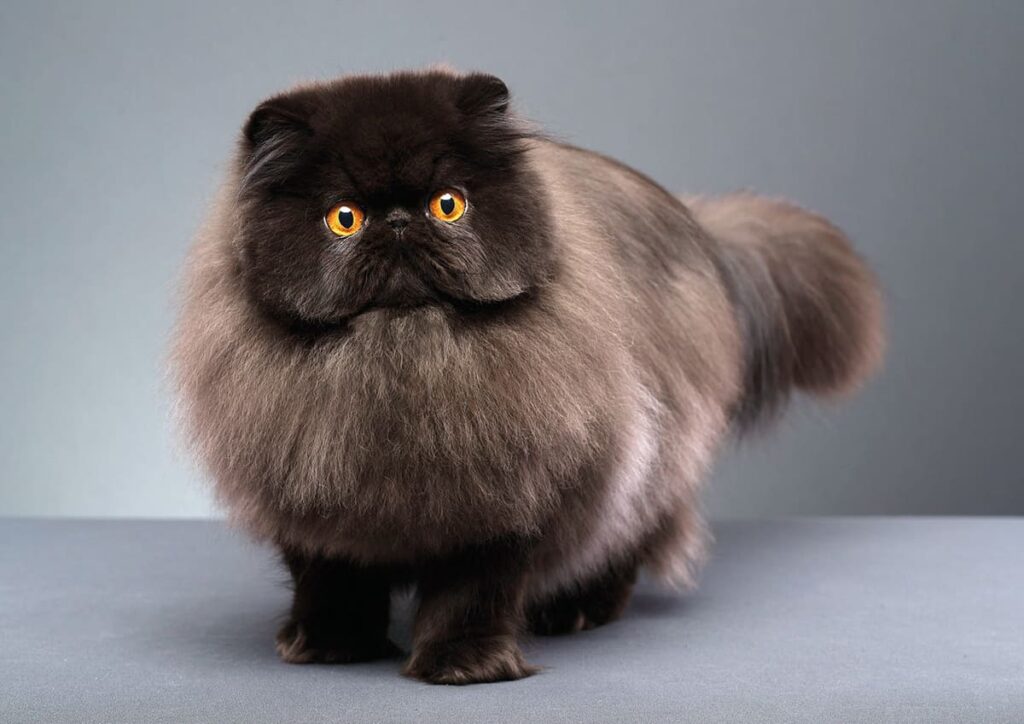
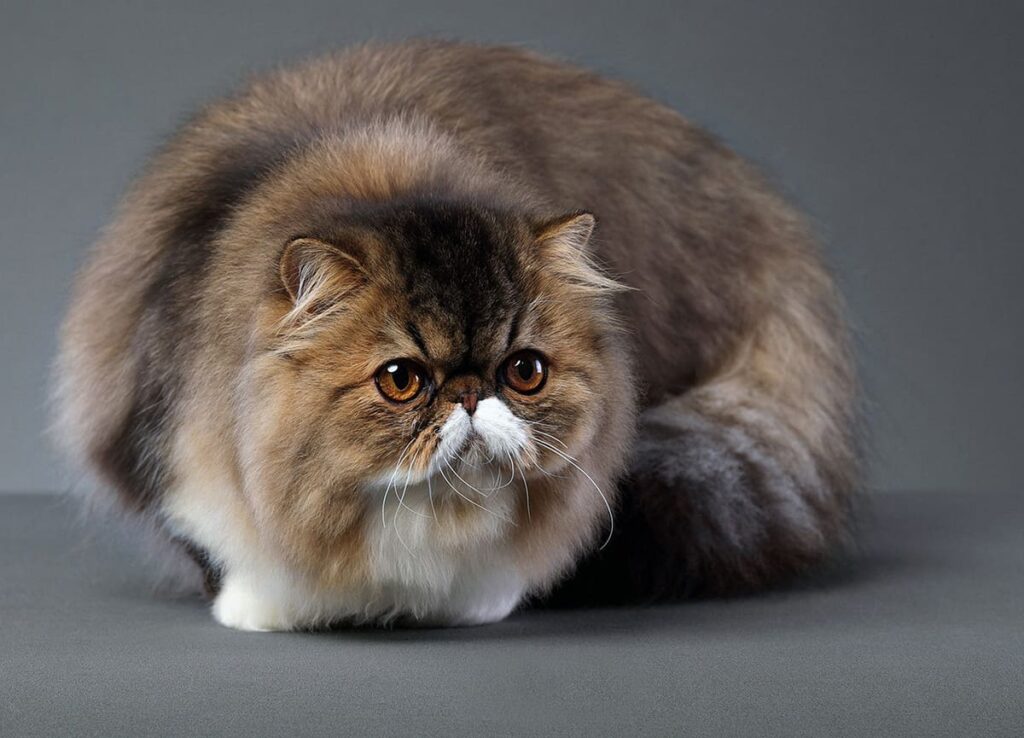
The long-haired brother of the Exotic — essentially a Persian with a carefree heart: calm, gentle, quiet and devoted. The Exotic Longhair is born in the same litters as the shorthaired Exotic but inherits a long, dense coat; in build, round face and mild “couch” nature it is a true Persian, so it needs daily grooming and attention to the flat face.
KidsDogsOther catsBeginnersTime alone · with caveats
If you're looking for a calm, incredibly affectionate, and indescribably sweet cat to be the perfect companion for a family spending time at home, the Exotic Longhair cat could be your dream come true. This fluffy beauty, a long-haired version of the exotic breed, combines the charm of the Persian cat with somewhat simpler (though still demanding) grooming needs, characteristic of the Exotic Shorthair. You can find out more about this on Tvaryny. Its balanced disposition, playful nature, and complete lack of aggression make it an excellent choice for families with children and other pets. Its amusing flat face, huge expressive eyes, and luxurious long coat will be a true adornment to your home for many years.
Exotic Longhair Cat: A Brief Breed Overview
Exotic Longhair Cat: A Brief Breed Overview · 11
Parameter
Characteristic
Origin
United States of America
Time of emergence
1950s (as a result of crossing Persians and American Shorthairs to create the Exotic Shorthair; the longhair gene appeared as recessive)
Breed status
Often not recognised as a separate breed, but as a long-haired variation of the Exotic Shorthair (TICA, WCF) or even classified as Persian (CFA)
Lifespan
12–15 years (sometimes longer with proper care)
Height at withers
Approximately 25–30 cm
Weight
Males: 4–6.5 kg, Females: 3–5.5 kg
Temperament
Calm, gentle, affectionate, playful, devoted, not overly vocal
Grooming needs
High (regular brushing of the coat)
Activity level
Moderate
Compatibility with children
High
Compatibility with other animals
High
Interesting Facts About the Exotic Longhair Cat
The "lazy man's Persian" in reverse: If the Exotic Shorthair is often called the "lazy man's Persian" due to its similar appearance but easier coat care, then the Exotic Longhair is, in essence, a "Persian born from Exotics," requiring the same meticulous grooming as a classic Persian.
Genetic surprise: The appearance of long-haired kittens in a litter of two shorthaired Exotics is only possible if both parents are carriers of the recessive longhair gene (L/l). If at least one parent has two dominant shorthair genes (L/L), all kittens will be shorthaired.
Unrecognised status: Despite its popularity, the breed still does not have a unified status across all feline organisations. This creates some confusion: in one organisation, a cat may be shown as a Persian, in another as a long-haired Exotic, and in a third as a non-standard variant of the Exotic Shorthair.
"Perpetual kitten": Thanks to their large round eyes, short nose, and round head, Exotic Longhair cats often retain a "baby-faced" expression throughout their lives.
Variety of colours: Like Persians, they can come in virtually any colour imaginable in the cat world, from classic solids to exotic colourpoints and bicolors.
History of the Exotic Longhair Cat's Origin
The history of the Exotic Longhair cat is inextricably linked to the history of its shorthaired relative. It all began in the 1950s in the USA, when Persian cat breeders decided to "improve" the American Shorthair breed by adding the silver colouration and more massive build of Persians. However, the results of the crossbreeding were unexpected: the kittens had the charming appearance of Persians (flat face, large eyes, sturdy build) but a short, dense, plush coat. These cats were initially called "Sterlings" due to their silver colour, but later, when other colour variations appeared, the breed was named the Exotic Shorthair. It was officially recognised in 1967.
However, genetics had a surprise in store. Since Persian cats carried the gene for long hair (recessive), this gene was passed on to the Exotics when crossed with American Shorthairs. When two Shorthair Exotics, both carriers of this recessive gene, were crossed, long-haired kittens could appear in the litter. Initially, such kittens were considered "non-standard" and excluded from Exotic Shorthair breeding programmes.
Over time, attitudes towards long-haired Exotics changed. Their charming appearance, combining features of the Persian and the Exotic, and their gentle nature won them admirers. However, their status remains somewhat undefined and depends on the feline organisation:
CFA (Cat Fanciers' Association): In the USA, Exotic Longhairs are often registered and shown as Persian cats. They fully meet the Persian breed standard.
TICA (The International Cat Association): TICA recognises the Exotic breed, which includes both shorthaired and long-haired variations. The Exotic Longhair competes in the same group as Persians.
FIFe (Fédération Internationale Féline) and WCF (World Cat Federation): These European organisations often consider long-haired Exotics as a variation of the Exotic Shorthair breed, rather than a separate breed or part of the Persian breed. They can participate in shows, but sometimes without the right to championship titles, although rules can change.
So, although the Exotic Longhair cat doesn't always have official status as a separate breed, it is a favourite of many due to its unique appearance and wonderful temperament, having inherited the best from its Persian and Exotic Shorthair ancestors.
What Does an Exotic Longhair Cat Look Like: Appearance and Standards
The Exotic Longhair cat is, in essence, a Persian with a shorthair gene that did not manifest, giving way to the recessive longhair gene. Therefore, its appearance is almost identical to that of a Persian cat and corresponds to its standard in most aspects, with the exception of some nuances in coat texture, which may not be as abundant and "cottony" as in some modern show Persians.
Head: Large, round, massive, with a broad skull. Forehead domed.
Muzzle: Short, broad, with a pronounced "stop" (the break between the forehead and nose). Cheeks full, round. Chin strong, well-developed. Whisker pads prominent.
Nose: Short, snub, broad, with open nostrils. Set between the eyes.
Eyes: Large, round, set wide apart, expressive. Giving the face a sweet, surprised expression. Eye colour should be intense and correspond to the coat colour (most often copper or dark orange, but also blue in colourpoints and white cats, green in chinchillas and silver varieties).
Ears: Small, with rounded tips, set wide apart and low on the head, tilting slightly forward. Desirably with thick tufts of fur inside.
Body: "Cobby" type – compact, sturdy, low-slung, with a broad chest and massive back. Well-developed musculature. Shoulders and rump massive.
Limbs: Short, thick, strong. Paws large, round, firm. Tufts of fur between the toes are desirable.
Tail: Short (proportional to the body), thick at the base, tapering slightly to a rounded tip. Covered in very dense and long fur, forming a "plume."
Coat: The main difference from the Exotic Shorthair – long, dense, soft, silky to the touch. It does not lie flat against the body but stands off, creating the impression of a fluffy cloud. It forms a luxurious ruff on the neck and chest, and a bushy plume on the tail. The texture may be slightly lighter than that of a classic Persian, but still requires thorough grooming.
Colours:Absolutely all possible colours and patterns recognised for the Persian breed are permitted. This includes solid (white, black, red, cream, blue, lilac), smoke, chinchilla, silver, golden, tabby (mackerel, classic, spotted), bicolor, tortoiseshell, colourpoint, and others.
Character of the Exotic Longhair Cat: Temperament and Behaviour
The temperament of the Exotic Longhair cat is one of its most appealing traits. It inherited the calm and gentle nature of its Persian ancestor but is often a bit more playful and inquisitive, similar to its Exotic Shorthair relative. This is an ideal companion cat that adores human company but is not intrusive.
Main character traits:
Gentleness and affection: These are true "lap cats." They love to sit next to their owner, purr, and receive affection. Their touch is soft, and their nature is compliant.
Calmness and balance: Exotic Longhairs are not prone to hyperactivity or destructive behaviour. They appreciate cosiness and a calm atmosphere in the home.
Playfulness: Although calm, they don't mind playing, especially at a young age. Short bursts of activity with a favourite toy (feather, ball) are followed by long rests. Their playfulness persists into adulthood but becomes less intense.
Inquisitiveness: They watch what is happening around them with interest but usually do so from a safe distance. Large eyes carefully follow the owner's every move.
Devotion: These cats become strongly attached to their people and do not tolerate prolonged loneliness well. They need daily attention and interaction. If you spend a lot of time away from home, you might consider another breed or get a companion for your Exotic.
Quiet voice: Like Persians, Exotic Longhairs have a soft, quiet voice and meow infrequently, only when they really need something (food, attention).
Friendliness: They get along wonderfully with children (provided the children are taught to handle animals carefully) and other pets, including dogs, if introduced correctly and gradually. Aggression is completely alien to them.
Sensitivity: They can be somewhat sensitive if shouted at or handled roughly. They respond well to affection and positive reinforcement.
Overall, the Exotic Longhair cat is the epitome of calmness and affection. It is ideally suited for people looking for a not-too-active, but very loving and devoted fluffy friend.
Training and Socialisation of the Exotic Longhair Cat
Source: bri-hanna.com
Although Exotic Longhair cats are known for their calm and somewhat phlegmatic temperament, they are quite intelligent and capable of learning, especially if approached correctly. Their natural inquisitiveness and affection for their owner can be a good foundation for training.
Key aspects of training and socialisation:
Early socialisation: It is very important for the kitten to get used to people, different sounds, touches, and grooming procedures from a young age. This will help raise a confident and calm cat that is not afraid of guests or vet visits.
Litter tray and scratching post training: Usually, there are no problems with this. Show the kitten where its toilet is and gently place it there after sleeping or eating. The scratching post should also be shown, and its use encouraged; catnip can be used to attract attention.
Positive reinforcement: Exotic Longhairs, like most cats, respond best to affection, praise, and treats. Never punish a cat physically or shout at it – this can cause fear, stress, and distrust. If the cat does something undesirable, it's better to redirect its attention to a toy or say a firm "No."
Teaching commands: Although they are not service dogs, Exotics can be taught simple commands like "Come" or "Sit," especially if using clicker training and tasty rewards. The main thing is patience and short, regular sessions. Don't expect immediate compliance, as it is still a cat that does what it deems necessary.
Interactive games: It's important to provide the cat with not only physical but also mental stimulation. Use interactive toys, "fishing rods," laser pointers (always end the game with a "catch" so as not to disappoint the hunter), and hide treats. This will help maintain its playfulness and intelligence.
Accustoming to grooming: As already mentioned, gradual and gentle accustoming to brushing, cleaning eyes, ears, and teeth from an early age is key to comfortable cohabitation.
Remember that the Exotic Longhair cat is a gentle companion, not a trick performer. The main goal of training and socialisation is to build a trusting relationship and teach the cat basic rules of behaviour in the home, so that your life together is harmonious and pleasant.
Pros and Cons of the Exotic Longhair Cat Breed
Like any breed, the Exotic Longhair cat has its advantages and disadvantages. It is important to weigh all the "pros" and "cons" before getting such a pet.
Pros and Cons of the Exotic Longhair Cat Breed · 7
Pros (+)
Cons (-)
Incredibly gentle and affectionate nature: An ideal companion cat, loves cuddles and sitting on laps.
High grooming requirements for the coat: Needs daily brushing to avoid matts.
Calm and balanced temperament: Not prone to destruction, well-suited for apartment living.
Predisposition to a number of diseases: Especially those related to brachycephalic structure (breathing, eyes) and hereditary conditions (PKD, HCM). Potentially high veterinary expenses.
High compatibility with children and other animals: Very patient and non-aggressive.
Requires daily eye care: Due to a tendency for excessive tearing.
Attractive appearance: Cute "baby" face and luxurious long coat.
Does not tolerate loneliness well: Needs attention and interaction with the owner. Not suitable for people who are constantly away from home.
Quiet voice: Will not disturb with loud meowing.
Prone to weight gain: Requires controlled feeding and moderate activity.
Moderate playfulness: Retains an interest in games but is not overly active.
Sensitive to heat: Due to breathing problems.
Devotion to family: Becomes strongly attached to its people.
Not a hypoallergenic breed: Long fur and saliva can cause allergies.
How to Care for the Luxurious Coat of an Exotic Longhair Cat
The long, dense, and soft coat of the Exotic Longhair cat is its main adornment, but it also requires the most attention and regular care. Without proper grooming, the coat quickly becomes tangled and matted, which not only spoils its appearance but can also cause discomfort and skin problems for the animal.
Basic coat care procedures:
Daily brushing: This is absolutely essential! Use a metal comb with both wide and fine teeth. Start with the wide teeth to work through any tangles, then switch to the fine teeth to remove dead hair and undercoat. Pay special attention to areas where matts form most often: behind the ears, on the "ruff," under the armpits, on the "trousers," and on the belly.
Using a slicker brush: After combing, you can gently go over the coat with a soft-tipped slicker brush to lift the fur and give it volume. But don't overdo it, to avoid damaging the guard hairs.
Dealing with matts: If a matt has already formed, don't try to pull it out with a comb – this is painful for the cat. Try to gently tease it apart with your fingers; you can use a special detangling spray. In extreme cases, if the matt is very dense, it will need to be carefully cut out with a special matt splitter or scissors with rounded ends, holding them parallel to the skin and protecting the skin with your fingers.
Bathing: Exotic Longhairs should be bathed as needed, usually once every 1–3 months, or if the animal is heavily soiled. Use only special shampoos for long-haired cats. Be sure to rinse the coat thoroughly to remove all shampoo. After washing, it is highly advisable to use a conditioner or balm – it makes brushing easier, reduces static, and nourishes the coat.
Drying: After bathing, thoroughly blot the coat with a towel (don't rub!). Then, the cat needs to be dried with a hairdryer on a low heat setting, simultaneously brushing the coat with a comb. Do not leave the cat with a wet coat, especially in a cool room, as it can catch a cold. Moreover, wet long fur tangles more easily.
Clipping (optional): Some owners resort to a hygienic clip (e.g., trimming the fur around the anal area) or even a full "lion cut" in the summer to ease grooming and help the cat cope with the heat. However, show animals are not permitted to be clipped.
Other aspects of care:
Eyes: As mentioned, they require daily cleaning of tear secretions using special lotions or simply warm boiled water.
Ears: Regularly (once a week or two) inspect the ear flaps. If there is dirt or wax, gently clean them with a cotton pad moistened with a special ear cleaning lotion. Do not use cotton buds!
Claws: Trim the claws with special clippers approximately every 2–4 weeks, cutting only the transparent tip and avoiding the pink part (quick).
Teeth: Regular brushing will help prevent dental problems.
Accustom the kitten to all grooming procedures (brushing, bathing, cleaning eyes and ears) from a young age, doing so gently and rewarding with treats. Then, the adult cat will perceive grooming as a normal part of life, not a stressful event.
Nutrition
Feeding the Exotic Longhair Cat: Key Recommendations
Health and risks
Health of the Exotic Longhair Cat: Common Diseases and Prevention
Frequently Asked Questions About the Exotic Longhair Cat Breed · 6
Does the Exotic Longhair cat shed a lot? Yes, they shed quite heavily, especially during seasonal moults (spring and autumn). Regular daily brushing helps to control the amount of fur in the home, but it won't be possible to eliminate it completely.
Are these cats suitable for people with allergies? No, the Exotic Longhair cat is not a hypoallergenic breed. Allergies are not caused by the fur itself, but by the Fel d 1 protein found in the cat's saliva, skin secretions, and urine. Long fur can trap more of these allergens. People with allergies should consider other breeds.
How much does an Exotic Longhair kitten cost? The price can vary significantly depending on pedigree, kitten class (pet, breed, show), cattery reputation, and region. Typically, pet-class kittens (domestic pets, without breeding rights) cost less than kittens for shows and breeding. Allow for transport if the litter is in another part of the country or abroad, plus a quiet settling-in period afterwards.
What is the difference between an Exotic Longhair and a Persian cat? Externally and in character, they are very similar. The main difference is their origin. The Exotic Longhair is born to Exotic Shorthair parents (who carry the longhair gene). Sometimes their coat may be slightly less dense and "cottony" than that of modern show Persians. In some feline organisations, they are classified as Persians altogether.
Can an Exotic Longhair cat be left alone for long periods? These cats are very human-oriented and do not tolerate loneliness well. If you regularly spend a lot of time away from home (more than 8–10 hours a day), this breed may not be suitable, or you should consider getting a second cat as a companion.
Do they require a lot of physical activity? No, this is a fairly calm breed with a moderate activity level. They need short play sessions daily to maintain fitness and mental stimulation, but they do not require as much space or exertion as more active breeds.
Conclusion
The Exotic Longhair cat is a charming, gentle, and calm companion that will bring much joy to a family prepared to give it attention and provide proper care. Its sweet, teddy-bear-like appearance and gentle nature make it a favourite with adults and children alike. However, potential owners should be prepared for daily meticulous grooming of its luxurious coat, regular eye cleaning, and careful attention to possible health problems inherited from its Persian ancestors. If you are looking for a devoted friend who will purr on your lap and offer warmth, and you are ready for responsible care, the Exotic Longhair cat could be the perfect choice.
FAQ
How does the Exotic Longhair differ from the Persian?
In practically nothing but origin: it is born in Exotic litters (Persian × American Shorthair) but, through a recessive gene, has a long coat; its build, round face, nature, care and health are Persian.
Is the Exotic Longhair hard to care for?
Yes — like the Persian, the long dense coat must be brushed daily, or it mats; because of the flat face, daily wiping of the eyes from tearing is also needed.
What is the Exotic Longhair's character?
Calm, gentle and quiet like the Persian: a mild “couch” cat, low-energy, good with children and animals, that loves calm and cannot bear clamour.