Group 2 (Pinscher and Schnauzer, Molossian, Swiss Mountain and Cattle Dogs), Section 3 · Switzerland, Entlebuch Valley
Entlebucher Mountain Dog
The smallest Swiss mountain dog with boundless devotion — lively and clever: agile, hard-working, brave and people-oriented. The Entlebucher Mountain Dog is the smallest of the four Swiss mountain dogs, a compact tricolour cattle drover; despite its size it is the embodiment of energy and brains, deeply attached to people and devoted to children, but it needs serious exercise.
Apartment · not suitableKidsCatsOther dogsBeginners · with caveats
The Entlebucher Mountain Dog (Entlebucher Sennenhund) is the smallest, but by no means the least energetic, member of the Swiss Mountain Dog family. These dogs, rarely found outside their native Switzerland, win hearts with their zest for life, intelligence, and boundless loyalty. Despite their compact size, they are the epitome of hard work and bravery, which makes them excellent companions for active people. They are quick, nimble, self-confident, and deeply attached to their owners, adoring all family members equally, especially children. To find out more about this unique breed, read on at Tvaryny.
Entlebucher Mountain Dog: A Brief Overview
Entlebucher Mountain Dog: A Brief Overview · 9
Characteristic
Value
Origin
Switzerland, Entlebuch Valley
Year of First Mention
1889
Year of Breed Recognition
1927
Life Expectancy
11–15 years
Height at Withers (males)
44–50 cm (up to 52 cm is permissible)
Height at Withers (females)
42–48 cm (up to 50 cm is permissible)
Weight
20–30 kg
FCI Group
Group 2 (Pinscher and Schnauzer, Molossian, Swiss Mountain and Cattle Dogs), Section 3
Working Trials
Not required
Interesting Facts About the Breed
Due to their lively disposition and expressive "smile", Entlebuchers are sometimes called the "Laughing Dog" (Lachender Hund).
Historically, they were used not only for herding cattle but also for pulling carts with milk and cheese from mountain farms to towns.
Their short stature and agility allowed Entlebuchers to dodge the kicks of the cows they were "driving" by nipping at their heels.
The Entlebucher Mountain Dog is the rarest of the four Swiss Mountain Dogs.
History of the Breed
The history of the Entlebucher Mountain Dog is closely tied to the alpine pastures of Switzerland, specifically the Entlebuch valley in the canton of Lucerne, which gave the breed its name. It is the smallest of the four types of Swiss Mountain Dogs, which also include the Appenzeller Sennenhund, the Bernese Mountain Dog, and the Greater Swiss Mountain Dog. For centuries, these dogs were indispensable helpers for shepherds: they were skilled at herding livestock, guarding farms and property, and used their ringing bark to alert their owners to the approach of strangers.
The breed was first mentioned under the name "Entlibucherhund" in 1889. However, for a long time, Entlebuchers were not distinguished from the very similar Appenzellers. The situation changed thanks to the efforts of Professor Albert Heim, a prominent geologist and a great admirer of Swiss breeds. In 1913, at an exhibition in Langenthal, he was shown four representatives of the breed with a naturally docked tail. It was thanks to Heim that they were recognised as an independent, fourth Sennenhund breed and entered into the Swiss Dog Stud Book (SHSB).
Despite official recognition, the breed's development was slow. It wasn't until 28 August 1926 that the Swiss Entlebucher Sennenhund Club was founded, and the first official breed standard was drafted in 1927. The breed remains quite rare outside its native country, although its outstanding working qualities, intelligence, and devoted character are gradually winning more and more admirers around the world.
What the Entlebucher Mountain Dog Looks Like: Appearance
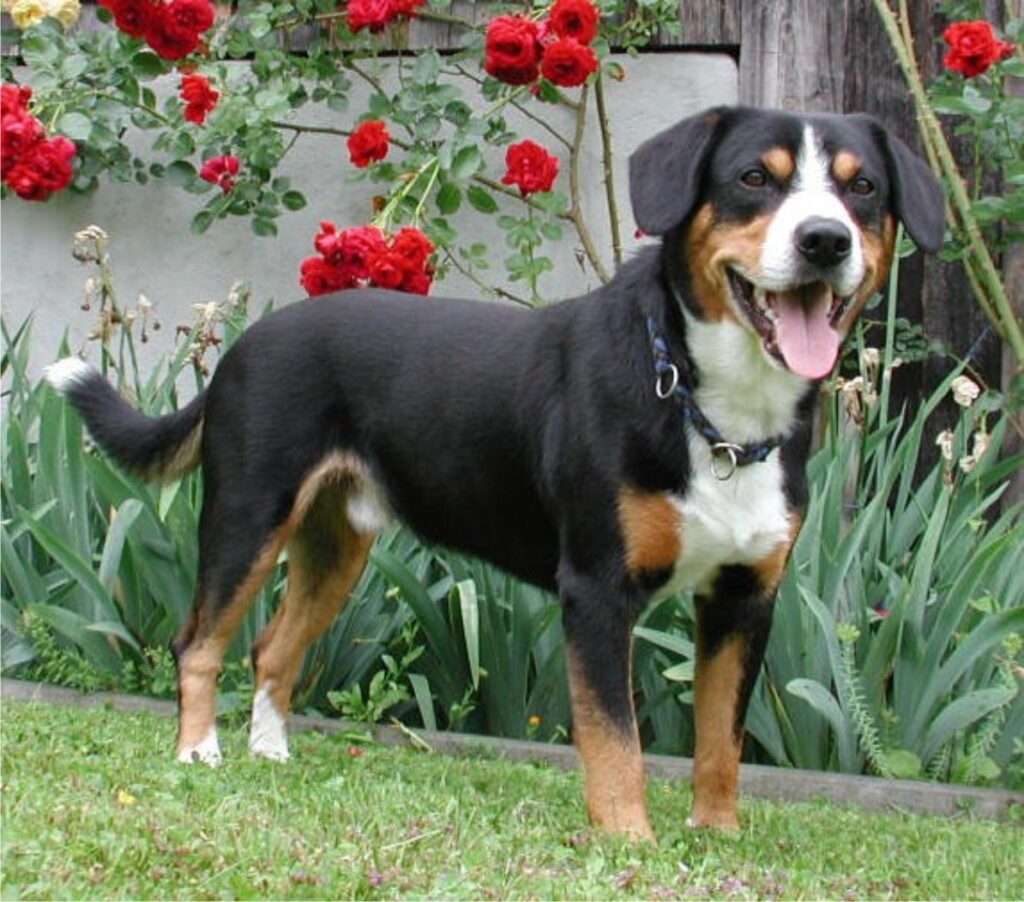
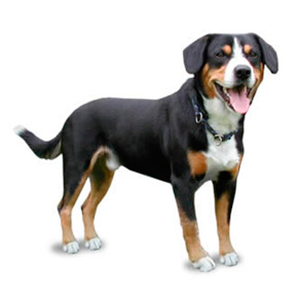
The Entlebucher Mountain Dog is a medium-sized dog with a compact, slightly elongated build and well-developed musculature. Its appearance radiates strength, agility, and endurance.
Head: Proportional to the body, it has a wedge shape. The skull is quite flat and wide, gradually tapering towards the muzzle. The stop (the transition from forehead to muzzle) is weakly defined.
Muzzle: Strong, well-defined, with a straight bridge. The nose is always black. The lips are tight-fitting and have black pigmentation.
Eyes: Fairly small and round, ranging from dark brown to hazel. Their expression is lively, attentive, and friendly. The eyelids are tight-fitting, with black rims.
Ears: Set high, not too large, and triangular with rounded tips. In a relaxed state, they hang close to the cheeks, and when excited, they rise slightly at the base and turn forwards.
Body: Solid, slightly elongated (the ratio of height at the withers to body length is approximately 8:10). The back is straight, broad, and strong. The chest is wide, deep, and oval-shaped.
Tail: Can be of two types: naturally long or born with a bobtail. A long tail hangs down in a relaxed state and can be raised to the level of the back when in motion.
Coat: Short, harsh to the touch, lying tight against the body, with a dense undercoat. The topcoat is shiny.
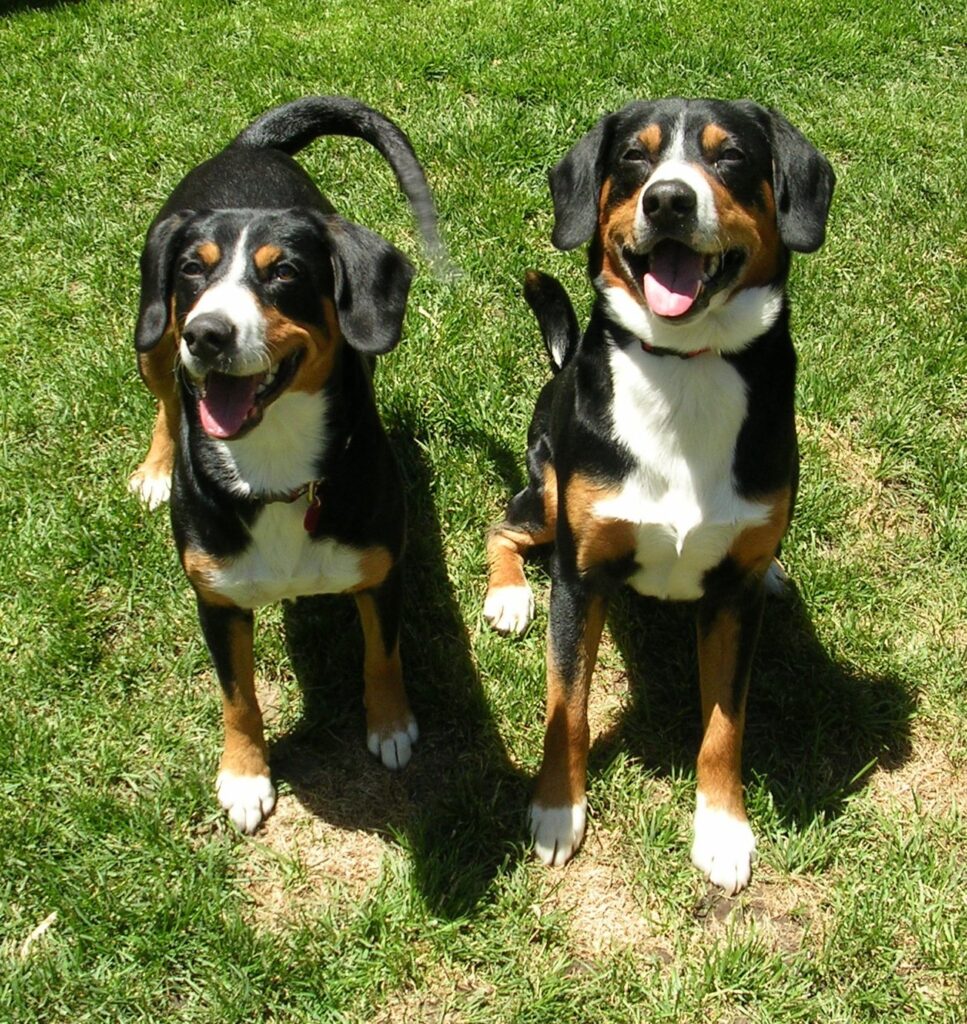
Colour: A characteristic tricolour. The main colour is a deep black with symmetrical, rich reddish-brown (tan) and pure white markings. The tan markings are located over the eyes, on the cheeks, on the sides of the muzzle, and on the legs. The white markings include a narrow blaze on the head, a patch on the chest, and white "socks" on the paws.
Character: Temperament and Behaviour
Entlebuchers are true "Velcro dogs". They are extremely people-oriented and strive to be full members of the family. This isn't a breed that will be happy living in an outdoor kennel or being left alone all day. Without constant contact with their owner, an Entlebucher can become nervous, unmanageable, and even destructive. It is essential for them to be involved in all family activities.
They are known for their lively, cheerful, and energetic temperament. They are self-confident and fearless dogs, which makes them excellent watchdogs. They are somewhat wary of strangers, always announcing their arrival with a loud bark, but without unjustified aggression. With their family members, Entlebuchers are incredibly affectionate and loyal. They get along wonderfully with children, becoming tireless playmates and reliable protectors. However, due to their energy, games with very young children should be supervised.
Thanks to their herding past, Entlebuchers have high intelligence and cleverness. They learn quickly but can sometimes show stubbornness and independence. This is not a breed that will blindly obey every command; they need an owner with a firm but fair hand. Unlike some terriers, such as the Lakeland Terrier, whose stubbornness is linked to their hunting instinct, the independence of the Entlebucher is a legacy of their ability to make decisions autonomously while working with a herd. The same can be said for the Greater Swiss Mountain Dog.
Training and Socialisation
Entlebucher Mountain Dogs are working dogs with a high energy level who require constant physical and mental stimulation. A bored Entlebucher is a destructive force in your home. They need daily, long walks (at least 1.5–2 hours), running, games, and activities.
Training these dogs can be both easy and challenging. On one hand, they are very smart and quickly grasp new commands. On the other hand, their innate stubbornness requires patience, consistency, and leadership from the owner. It's important to establish clear rules and boundaries from the very first days. The main principles of training are:
Early Socialisation: Introduce the puppy to different people, animals, sounds, and situations. This will help them grow into a confident and well-balanced dog.
Positive Reinforcement: Entlebuchers respond well to methods based on praise, treats, and games. Harshness and physical punishment can lead to a loss of trust and defiance.
Leadership: You must be the "pack leader" for your dog - calm, confident, and consistent. This doesn't mean dominance, but rather setting clear rules: the dog eats after you, doesn't go through the door first, and doesn't pull on the lead.
Mental Stimulation: These dogs need to "use their brains." Obedience training, agility, frisbee, and scent games are ideal activities.
Pros and Cons of the Breed
Pros and Cons of the Breed · 7
Pros
Cons
Boundless loyalty to the family
Needs constant attention, copes poorly with being left alone
High intelligence, learns easily
Prone to stubbornness and independence
Excellent watchdog, wary of strangers
Very noisy, may bark a lot
Very energetic, an active companion
Requires significant physical and mental exercise
Gets on well with children
Can be too rough in games with very small children
Easy to groom
Sheds heavily twice a year
Robust health
Prone to certain genetic diseases (HD, PRA)
How to Groom Their Coat
Grooming an Entlebucher is not complicated but requires regularity. Thanks to their mountain origins, these dogs are well-adapted to various weather conditions, but they feel most comfortable living in the house alongside their family.
Coat Care: The short, harsh coat needs to be brushed with a bristle brush or a rubber glove once or twice a week to remove dead hair and maintain its shine. During the seasonal moulting period (spring and autumn), the procedure should be done more frequently.
Bathing: You should only bathe the dog when necessary, as frequent washing can damage the skin's protective layer. Use specialised dog shampoos.
Dental Care: To prevent tartar buildup, it is recommended to brush the dog's teeth with a special toothpaste 2–3 times a week or give them dental chews.
Eye and Ear Care: Regularly check the eyes and ears. Eyes can be wiped with a damp cloth to remove any natural discharge. Ears should be cleaned once a month with a special lotion to prevent infections.
Claws: Trim the claws every 3–4 weeks if they are not naturally worn down during walks.
Nutrition
Diet: Key Recommendations
Health and risks
Entlebucher Mountain Dog Health: Common Ailments and Prevention
Frequently Asked Questions (FAQ) · 5
Is the Entlebucher suitable for apartment living? Yes, provided there is sufficient daily exercise (a minimum of 2 hours of active walks) and mental stimulation. Without this, the dog will get bored and may start to destroy things.
Does the Entlebucher Mountain Dog shed a lot? Yes, they have an intense seasonal moult twice a year. At other times, shedding is moderate.
How do Entlebuchers get on with other animals? With proper and early socialisation, they can get on well with other dogs and cats. However, their herding instinct may show up as an attempt to "herd" other pets.
Is this breed suitable for a first-time dog owner? It is not the best choice for a first dog. An Entlebucher needs an experienced owner who can handle its energy, stubbornness, and need for leadership. A novice owner might be overwhelmed by the training and exercise requirements.
How much does an Entlebucher Mountain Dog puppy cost? Due to the rarity of the breed, the price for puppies from responsible breeders can be quite high. The cost depends on the pedigree, the parents' titles, and the reputation of the kennel.
Video About the Breed
FAQ
How does the Entlebucher differ from the other Swiss mountain dogs?
It is the smallest of the four (alongside the Bernese, Appenzeller and Greater Swiss), compact and the most agile; a tricolour drover with very high energy.
Is the Entlebucher good for a family?
Very — it is boundlessly devoted, loves every family member equally and is devoted to children; but it needs serious exercise and cannot bear being alone, so not for a flat.
Is the breed suited to a novice?
More for experienced, active owners — a clever, energetic working dog with a herding instinct that needs plenty of exercise and consistent training.