Group 2 · pinschers, schnauzers, molossoids, mountain dogs · Switzerland
Appenzeller Sennenhund
A tricolour whirlwind of Swiss reliability — energetic and fearless: lively, clever, devoted and a watchful guard. The Appenzeller Mountain Dog is one of the four Swiss mountain dogs, an all-purpose drover and guard dog; cheerful and always ready for adventure, it is indispensable for active people but needs space, work and an experienced owner.
Apartment · not suitableKidsCats · with caveatsOther dogsBeginners · not suitable
The Appenzeller Sennenhund is not just a dog; it's a genuine whirlwind of energy, devotion, and Swiss dependability. These wonderful companion dogs are versatile working animals that have historically performed a multitude of tasks: from herding cattle and guarding pastures to hauling loads and protecting homesteads. Cheerful, sharp, and always up for an adventure, an Appenzeller will become an indispensable family member, especially for active people. You can find out more about this unique breed on Tvaryny.
This type of dog will feel most at home in a large country house with a spacious garden where it can run around and expend its endless energy. Unlike its more popular relative, the Bernese Mountain Dog, the Appenzeller doesn't have a long coat, which is a big plus: its grooming is much simpler and doesn't require a lot of time.
Appenzeller Sennenhund: Key Breed Information
Appenzeller Sennenhund: Key Breed Information · 10
Breed Name
Appenzeller Sennenhund
Country of Origin
Switzerland (Canton Appenzell)
FCI Classification
Group 2 (Pinschers and Schnauzers, Molossoid breeds, Swiss Mountain and Cattle Dogs), Section 3 (Swiss Mountain and Cattle Dogs)
Life Expectancy
12–15 years
Height (at the withers)
Males: 52–56 cm, Females: 50–54 cm (a deviation of +/- 2 cm is allowed)
Weight
22–32 kg
Temperament
Energetic, self-assured, fearless, clever, somewhat distrustful of strangers, devoted to family
Usage
Herding dog, guard dog, companion dog, rescue dog, sporting dog
Colour
Tricolour: main colour black or havana (brown) with symmetrical rust-red and white markings
Exercise Needs
Very high
Interesting Facts About the Breed
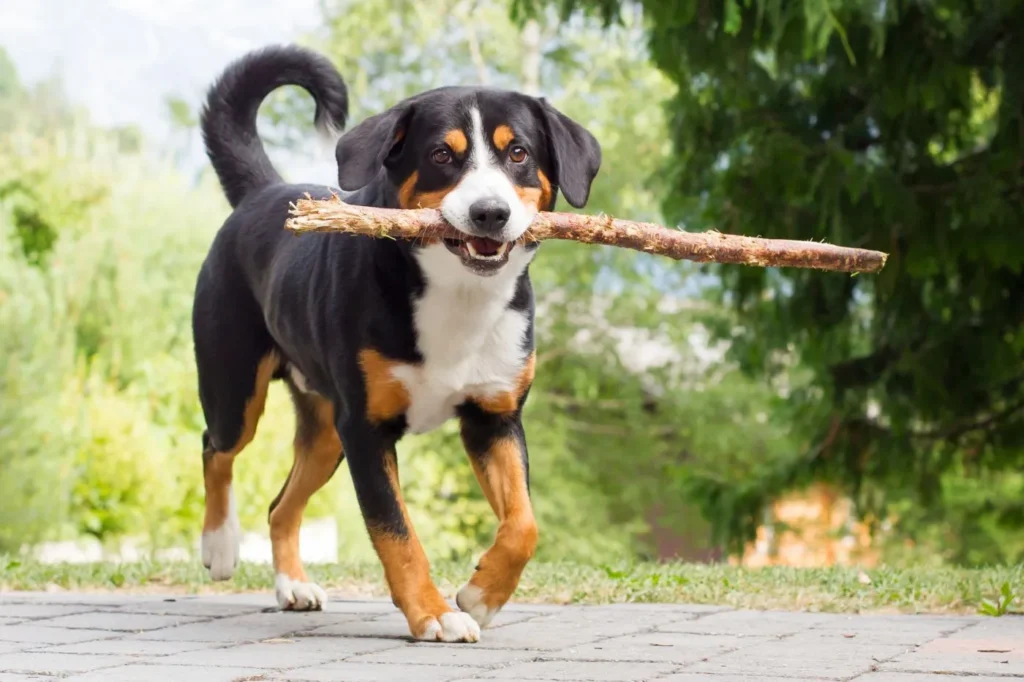
Unique Tail: The tightly curled tail ("post horn") is the breed's calling card. In the past, it was a way to distinguish one's dog from a distance on the pasture.
"Yodel" Instead of Barking: Appenzellers are known for their high-pitched, melodic, and very loud bark, which is sometimes compared to a Swiss yodel.
A Rare Breed: Despite its wonderful qualities, the Appenzeller Sennenhund remains a relatively rare breed outside of Switzerland and neighbouring countries.
Three-in-One: Historically, it was a versatile "three-in-one" dog: it herded cattle (often independently), guarded the home and property, and was also used to pull small loads (such as milk carts).
The Herding Nip: When herding cattle, Appenzellers use a special technique – they don't bark at the cows, but instead run up silently and quickly nip at their back legs, forcing them to move in the right direction.
History of the Appenzeller Sennenhund Breed
The history of the Appenzeller Sennenhund is closely linked to the alpine pastures of Switzerland, where these dogs were indispensable helpers to farmers for centuries. It's believed that they, like other Swiss Sennenhunds, are descendants of Molossian dogs brought to the Alps by the Romans. Over centuries, they developed in isolation, perfectly adapting to the harsh mountain conditions.
The first written mention describing this type of dog dates back to 1853 in the book "The Animal World of the Alps." They were described as "noisy, short-haired, multicoloured herding dogs of medium size," used for guarding farms and herding cattle.
A key figure in the establishment of the breed was the great enthusiast, Professor Albert Heim. At the end of the 19th century, he became concerned that with the development of other breeds, the unique Swiss dogs might disappear. In 1898, the Appenzeller was recognised as a distinct breed. Thanks to Heim's efforts, the "Appenzeller Sennenhund Club" was founded in 1906, with the goal of preserving and popularising the breed in its original form. It was he who, in 1914, drafted the first official breed standard, which, with minor changes, is still in effect today. The Fédération Cynologique Internationale (FCI) finally recognised the breed much later.
What the Appenzeller Sennenhund Looks Like: Standard and Appearance
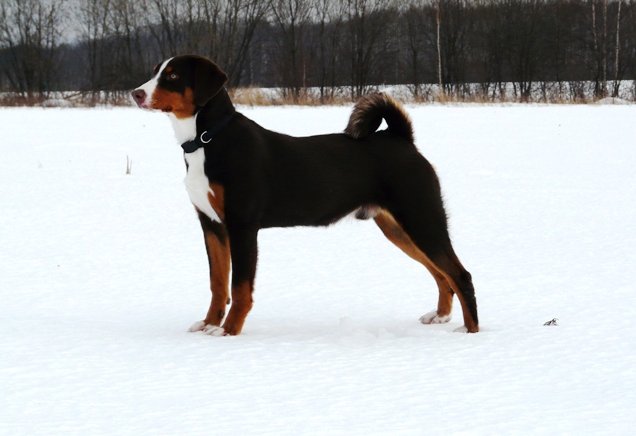
The Appenzeller is a harmoniously built, muscular, medium-sized dog of an almost square format. Its appearance radiates agility, strength, and confidence. One of the most characteristic features is the tightly curled tail, which dogs of this breed happily carry on their croup. This tail is often called a "post horn."
What the Appenzeller Sennenhund Looks Like: Standard and Appearance · 9
Body Part
Description According to FCI Standard
Head
Proportional to the body, wedge-shaped. The skull is flat and wide, with a barely noticeable furrow. The stop is well-defined but not abrupt.
Muzzle
Medium length, tapering gradually towards the nose. The nose bridge is straight. The nose is black (in black dogs) or dark brown (in havana dogs).
Eyes
Small, almond-shaped, with a lively and penetrating expression. Colour from dark brown to brown.
Ears
Set high, broad at the base. Hanging, triangular in shape with rounded tips. When calm, they lie close to the cheeks.
Body
Compact and sturdy. The back is straight and strong. The chest is broad, deep, and oval in shape.
Tail
Set high, of medium length, covered with dense hair. Characteristically curled into a tight ring ("post horn") and carried to the side over the croup.
Limbs
Strong, muscular, with sturdy bones. Straight and parallel when viewed from any side.
Coat
Double coat (Stockhaar). The outer coat is thick and shiny. The undercoat is dense, black, grey, or brown.
Colour
Tricolour. The main colour is black or havana (chocolate brown). Symmetrical rust-brown and white markings. A white blaze on the muzzle, a patch on the neck and chest, white "socks" on the paws, and a white tail tip.
Character and Temperament of the Appenzeller
The character of the Appenzeller Sennenhund is a unique blend of a working dog's traits and a loyal companion's devotion. They are very intelligent, brave, and energetic. This is not a lap dog; it needs a purpose in life and constant activity.
Family Devotion: Appenzellers form a very strong bond with their family. They often choose one person as "their" owner but love and protect all family members. They usually get along well with children they've grown up with, but their herding habit of nipping at heels needs to be controlled from a young age.
Guarding Qualities: This is one of the key characteristics of the breed. Appenzellers are very distrustful of strangers and will always warn of a guest's arrival with a loud, piercing bark. Their fearlessness makes them excellent, incorruptible guardians.
Energy and Intelligence: The energy level of this breed is extraordinarily high. They require not only physical but also intellectual stimulation. They learn quickly but get bored just as fast with monotonous tasks. Their sharp minds demand constant engagement through games, training, or work. Some terriers share a similar energy and cleverness, such as the Brazilian Terrier.
Compatibility with Other Animals: Socialisation must begin as early as possible. Due to their strong territorial and possessive instincts, they may be intolerant of other dogs, especially of the same sex. If an Appenzeller grows up with other pets, it usually accepts them as part of its "pack."
Pros and Cons of the Appenzeller Sennenhund Breed
Before getting such a dog, it's important to soberly assess all its advantages and disadvantages.
Pros and Cons of the Appenzeller Sennenhund Breed · 6
✅ Pros
❌ Cons
Exceptional Devotion: Forms a deep bond with its owner and family.
Extremely High Need for Activity: Unsuitable for inactive people and apartment living without proper exercise.
High Intelligence: Learns quickly and is capable of performing complex commands.
Tendency to Bark: Can be very noisy, which neighbours might not appreciate.
Excellent Guard Dog: Natural distrust of strangers and a loud bark make it an ideal watchdog.
Strong Distrust of Strangers: Requires intensive early socialisation to prevent excessive suspicion or aggression.
Robust Health: Considered one of the healthiest breeds with a small number of hereditary diseases.
Stubbornness: An intelligent dog can be independent in decision-making, requiring patient and consistent training.
Low Maintenance: Its short coat doesn't require complicated grooming.
Herding Instinct: May "herd" family members, especially children, by nipping at their legs.
Versatility: Suitable for sports (agility, obedience), herding work, and as an active companion.
Doesn't Cope Well with Being Alone: Due to its strong attachment to its family, it can suffer from separation anxiety.
Training and Raising an Appenzeller Sennenhund
Training an Appenzeller is an exciting but also challenging process. Their sharp minds allow them to grasp commands instantly, but their independence requires patience, consistency, and authority from the owner. The foundation of successful training is early socialisation and positive reinforcement.
Never use harshness or physical punishment. This can make the dog either fearful or, on the contrary, provoke aggression. They respond best to praise, play-based methods, and treats. From a young age, introduce the Appenzeller to various people, animals, sounds, and situations. This will help raise a well-balanced and confident dog that reacts appropriately to new circumstances.
Caring for and Keeping an Appenzeller
Caring for an Appenzeller Sennenhund is straightforward but requires attention to the key aspects of its life: physical activity and living conditions.
Grooming and Coat Care
The Appenzeller's coat is short and dense, with a thick undercoat. It doesn't require clipping or stripping. It's enough to brush the dog once or twice a week with a rubber brush or a comb with wide-set teeth to remove dead hair. During seasonal moulting (spring and autumn), this procedure should be done more often. Bathe the dog only when necessary. Also, regularly check and clean its ears and eyes to prevent infections. If its claws don't wear down naturally, they need to be trimmed.
Physical Exercise and Activity
This is the most important aspect of owning an Appenzeller. These dogs need at least 1.5–2 hours of intense physical exercise every day. A simple walk on a lead is just a warm-up for them. They need to run off-lead (in a safe place), play with a frisbee, or retrieve, and best of all, participate in dog sports like:
Agility
Flyball
Obedience
Herding trials
A bored Appenzeller that doesn't get enough exercise will quickly find something to do on its own: it will dig holes, chew furniture, or bark non-stop. A similar need for activity is found in some terriers, such as the elegant but energetic Manchester Terrier.
Nutrition
Feeding the Appenzeller Sennenhund: Key Recommendations
Health and risks
Health of the Appenzeller Sennenhund: Typical Diseases and Prevention
Frequently Asked Questions about the Appenzeller Sennenhund
Is the Appenzeller suitable for apartment living?
Highly undesirable. Theoretically, it's possible, but only if the owner is willing to dedicate 3–4 hours a day to intensive walks and training outdoors. This dog needs space. The ideal conditions are a private house with a securely fenced garden.
Do Appenzellers get along with children?
Yes, if they grow up together. An Appenzeller will be patient and protective of "its" children. However, due to its herding instincts, it may try to "herd" children by nipping at their heels. This behaviour must be corrected. Always supervise interactions between the dog and small children.
Do they shed a lot?
They have moderate shedding throughout the year and two intense moulting periods in the spring and autumn when they shed their undercoat. Regular brushing helps to keep this process under control.
Can an Appenzeller be left alone for long periods?
No. This is a very people-oriented breed. They don't cope well with loneliness and can develop destructive behaviour or separation anxiety if left alone for a whole day.
Video About the Breed
FAQ
How does the Appenzeller differ from the other Swiss mountain dogs?
It is the most energetic and agile of the four (alongside the Bernese, Entlebucher and Greater Swiss); an all-purpose drover with a very high need for work.
Is the Appenzeller suited to a flat?
Absolutely not — a whirlwind of energy that needs space, work and exercise; it is happiest in a large country house with a plot.
Is the breed suited to a novice?
No — a clever, energetic working dog, wary of strangers and with a herding instinct; it needs experience, a firm hand and plenty of activity.