

| Height | 34–38 cm |
| Weight | 16–18 kg |
| Lifespan | 12–14 years |
| FCI group | 6 · scenthounds |
| Origin | France (Gascony) |
Exact ratings
Common health issues
Nutrition
The Blue Gascony Basset (Basset Bleu de Gascogne) isn’t just a dog with a sad gaze and long ears; it’s an active hunting hound with a loud, melodious voice and a surprisingly pleasant family-friendly nature. Its aristocratic appearance, combining strength and elegance, conceals a devoted companion and an tireless tracker. Hailing from the historic region of Gascony in southwestern France, this breed has a centuries-old history and a unique set of qualities. Its tolerant attitude towards other pets and children, as well as a deep attachment to its owner, makes keeping this warm-hearted hound considerably easier. However, its natural curiosity and hunting bravery can often lead it to embark on solo “expeditions” and escape during walks, so vigilance is always a good idea. Read more about all the features of this charming breed on Tvaryny.
The Blue Gascony Basset is easy to care for and responds well to training with the right approach, while many typical breed-related ailments can be prevented with a careful and responsible attitude. This article will help you delve into the world of Bassets from Gascony and understand whether this “blue” aristocrat is the right fit for your family.
Blue Gascony Basset: Key Breed Information
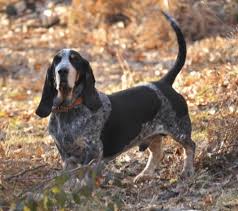
| Breed Name | Basset Bleu de Gascogne |
| Country of Origin | France |
| FCI Group | Group 6: Scent Hounds and Related Breeds. Section 1.3: Small Hounds. |
| Life Expectancy | 12–14 years |
| Height at Withers | 34–42 cm (as per FCI standard) |
| Weight | 16–20 kg |
| Temperament | Affectionate, cheerful, intelligent, slightly stubborn, sociable |
| Use | Hunting small game (hare, rabbit), companion dog |
| Coat Care | Minimal, weekly brushing |
| Activity Needs | High, requires daily long walks |
| Tendency to Bark | High (prone to baying rather than barking) |
| Compatibility with Children | Very good |
| Compatibility with Other Animals | Good, especially if raised together |
History of the Blue Gascony Basset
The history of the Basset Bleu de Gascogne is closely intertwined with the history of hunting in France and is a direct descendant of the majestic Grand Bleu de Gascogne. These dogs, known since the 14th century, were famous for their ability to hunt large game such as wolves and wild boar in packs. Count Gaston Fébus de Foix, the author of the famous “Book of the Hunt,” used them himself.
Over time, as hunting large game became less common and hunting smaller game on foot, such as hares and rabbits, gained popularity, there arose a need for a dog with the same excellent hunting qualities but that was slower and shorter in stature. Thus, through selective breeding and perhaps cross-breeding with other Basset-like breeds, the Basset emerged — a short-legged version of the great hound.
Unfortunately, at the end of the 19th century, with the decline in the popularity of traditional hunting, the breed was on the verge of complete extinction. Its revival is owed to the enthusiasm of one man, Alain Bourbon. In the early 20th century, he made incredible efforts to find surviving representatives of the breed and restore its population. Thanks to his work, a breed club was created in 1911, and it began its slow but steady comeback.
The Fédération Cynologique Internationale (FCI) officially recognised the breed standard on 24 January 1996. Today, the Basset Bleu de Gascogne is still a rare breed outside of France, but its popularity is growing among enthusiasts looking for not just a skilled hunter but a loyal family friend.
What the Blue Gascony Basset Looks Like: Breed Standard
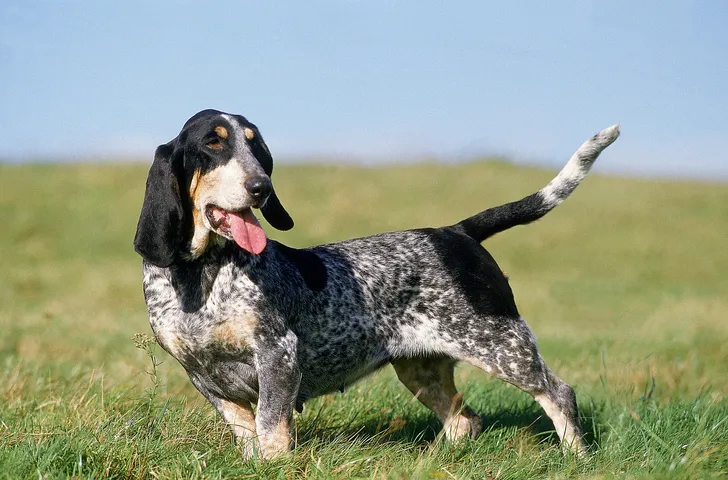
The Basset Bleu de Gascogne is a dog that harmoniously combines the traits of a typical Basset and the nobility of ancient French hounds. It gives the impression of a sturdy, long, yet agile and not overly heavy dog.
- General Appearance: A long body on short, sturdy legs. The dog should be well-balanced without any signs of clumsiness.
- Head: Long but not too broad. The skull is slightly domed with a prominent occipital bone. The stop from the forehead to the muzzle is smooth.
- Eyes: Oval-shaped, brown. The expression is gentle, a little sad and thoughtful, which is one of the breed’s hallmarks. The lower eyelid may be slightly droopy.
- Ears: Very long, thin, set low, below the eye line. They should be curled inwards and end in a pointed tip. According to the standard, ears pulled forward should extend beyond the tip of the nose.
- Body: The back is long and strong. The chest is broad and deep, well-developed.
- Tail: Sabre-shaped, quite thick at the base, tapering towards the end. When at rest, the dog carries it low; in motion, it is proudly raised.
- Coat and Colour: The coat is short, dense, and rough to the touch. The most unique feature is the colour, which gave the breed its name. It consists of black and white ticking (mottling), creating the effect of a blue-grey, “blue” shade. On this background, there may be black patches of various sizes. Tan markings are also characteristic above the eyes, on the cheeks, lips, the inside of the ears, and on the legs.
Character: Temperament and Behaviour of the Blue Gascony Basset
The character of the Basset Bleu de Gascogne is a wonderful combination of hunting passion and home comfort. This is a very affectionate and devoted dog that forms a strong bond with its family. It loves to be the centre of attention, participate in all family activities, and happily accepts hugs and ear scratches.
By nature, it is a social, “pack” animal. Therefore, Gascony Bassets do not handle long periods of solitude well. If you spend a lot of time away from home, this dog may suffer from separation anxiety, which will manifest in destructive behaviour and continuous baying. The presence of another dog in the home can significantly alleviate this problem.
At the same time, one should not forget its hunting roots. Like many other hounds, for example, the Beagle, the Basset Bleu de Gascogne has an independent and sometimes stubborn nature. If it catches a scent, its nose completely overrides its hearing. In such moments, it is practically impossible to call it back. That’s why walks off the lead in un-fenced areas are extremely dangerous. Its curiosity and instinct-following can lead it very far from home.
It treats strangers with a certain caution but without aggression. It is more likely to announce the arrival of guests with a loud voice than to show hostility. Its voice is a separate matter. It’s not a regular bark, but a deep, melodic, and very loud baying that can be heard from a great distance. This feature should be considered if you live in a flat with thin walls.
Compatibility with Children and Other Animals
The Basset Bleu de Gascogne is a wonderful companion for families with children. It is patient, friendly, and not prone to aggression. However, as with any breed, it’s important to teach children how to behave correctly with the dog: not to disturb it while it’s eating or sleeping, and not to pull its long ears and tail. Thanks to its calm temperament, it gets along well with older children who can participate in games and walks.
As for other pets, the situation is not so clear-cut. If raised from a young age with cats or other dogs, the Gascony Basset usually accepts them as members of its “pack.” Problems can arise with small animals such as rodents, rabbits, or birds. Its hunting instinct may take over, so it’s not wise to leave them alone without supervision.
Health of the Blue Gascony Basset: Typical Ailments and Prevention
Care and Upkeep of the Breed
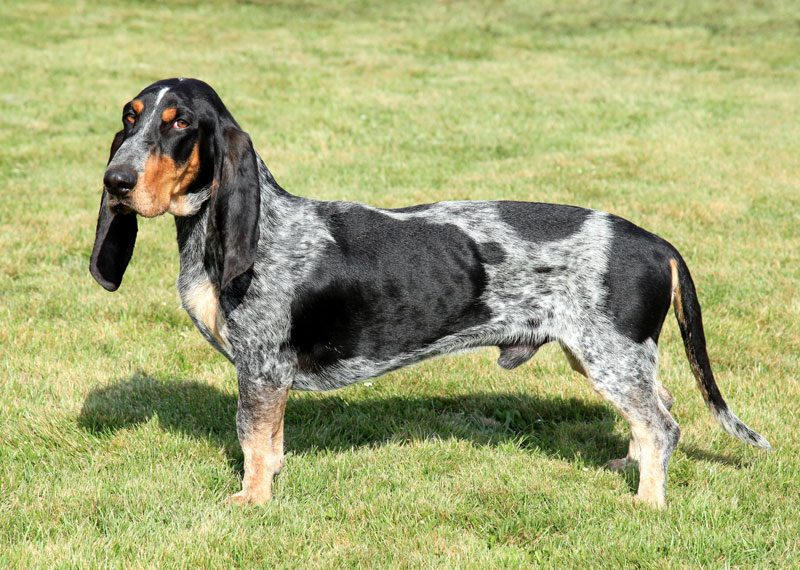
The Basset Bleu de Gascogne is a dog that doesn’t require complex care, but certain procedures should become a regular habit for the owner.
Grooming: Coat, Ear, and Claw Care
The short and dense coat of the Gascony Basset doesn’t require the services of a professional groomer. It’s enough to brush it once a week with a rubber brush or a grooming mitt to remove dead hairs and maintain the healthy appearance of the skin. During seasonal shedding (in spring and autumn), the procedure should be performed more often. You should only bathe the dog when necessary.
The ears need the most attention. They should be checked at least once a week for redness, dirt, or a foul odour. The inner surface of the earflap should be wiped with a special lotion recommended by a vet. This is the best prevention for otitis.
Claws need to be trimmed about once a month if they don’t wear down naturally during walks. Overly long claws can cause discomfort while walking and deform the paw.
Physical Exercise and Activity
Despite its short legs and somewhat lumbering appearance, the Basset Bleu de Gascogne is an energetic hunting dog that requires significant physical activity. It needs daily, long walks (at least 1–1.5 hours a day). This shouldn’t be a fast run but rather a leisurely but long walk during which the dog can sniff around to its heart’s content. For a hound, using its nose is just as important an exercise as physical activity.
The ideal place to keep such a dog is a house with a well-fenced garden where it can roam freely. The fence must be secure and high enough, as Bassets, despite their short legs, can be quite inventive in their attempts to escape if a certain scent interests them. You can also explore other breeds like the Grand Basset Griffon Vendéen, a fellow hound with a different coat type.
Training and Raising the Blue Gascony Basset
Training a Gascony Basset is a task that requires patience, consistency, and an understanding of hound psychology. They are intelligent dogs, but their independence and stubbornness can be a challenge for an inexperienced owner. They were bred to make their own decisions during a hunt, so blind obedience is not their strong suit. They will always ask themselves, “What’s in it for me?”
The key to success is positive reinforcement. Use treats, praise, and toys to encourage the dog to perform commands. Harsh methods, shouting, and physical punishment are absolutely unacceptable—they will only cause the dog to withdraw and lose trust in you. Training sessions should be short, interesting, and varied so as not to bore your pet.
The most important command for any hound is “Come!”. You need to start practising this command from an early age in a safe, enclosed area. But even a perfectly trained Basset can ignore it if its nose catches something extremely interesting. Therefore, never rely on 100% obedience in an open area. Just like their Basset Hound relatives, their scenting instinct is powerful.
Nutrition: How to Feed a Blue Gascony Basset Correctly
Pros and Cons of the Blue Gascony Basset Breed
| ✅ Pros | ❌ Cons |
|---|---|
| Incredibly affectionate and loyal character | Strong hunting instinct, tendency to escape |
| Gets along well with children and other dogs | Prone to loud and prolonged baying |
| Easy to groom | Stubbornness and independence in training |
| Striking and unusual appearance | Does not handle loneliness well |
| Relatively robust health | Prone to weight gain |
| Suitable for active people and families | Requires careful ear care |
Interesting Facts About the Breed
- “Blue” is an illusion. In reality, the coat of these dogs is not blue. The “blue” effect is created by dense black ticking on a white background, which from a distance looks like a blue-grey shade.
- Melodious Voice. The baying of the Basset Bleu de Gascogne is so distinctive and melodious that hunters could use it to determine the dog’s location and which stage of the hunt it was in.
- Relatives of the Basset Hound. Although they developed in different countries, the Basset Bleu de Gascogne shares ancestors with the more well-known Basset Hound. Both breeds originate from French hounds.
- A Dog for Hunting on Foot. Unlike their high-legged ancestors, which were accompanied on horseback, Bassets were bred specifically for hunters who moved on foot. Their speed allowed a person to keep up.
- A Rare Treasure. Even today, this breed remains quite rare. Finding a puppy outside of France can be a real challenge, but this makes each representative of the breed even more valuable. They are often confused with other Bassets, such as the Grand Basset Griffon Vendéen, which has a wiry coat.
Frequently Asked Questions About the Breed (FAQ)
Is the Basset Bleu de Gascogne suitable for living in a flat?
Theoretically, yes, but only if you can provide it with a sufficient number of daily, long, and interesting walks. However, it’s worth remembering its loud voice, which neighbours might not appreciate. The ideal option is still a private house with a fenced garden.
Does this breed shed a lot?
Shedding is moderate. It becomes more intense twice a year, in spring and autumn. Regular brushing during this period will help to control the amount of hair in the house.
Can the Gascony Basset be left alone for a long time?
It’s highly undesirable. These are very social dogs that suffer from loneliness. If you work a full day and no one is at home, this breed may not be right for you. Prolonged solitude can lead to destructive behaviour and constant baying.
Is it difficult to train the Basset Bleu de Gascogne?
They are intelligent but stubborn. Training requires patience, consistency, and a positive approach. This is not a breed that will unconditionally obey every command. They need motivation.
Do they need special physical exercise?
They don’t need intense long-distance running, but they do require long walks (a minimum of 1-1.5 hours per day) during which they can use their sense of smell. “Scent games” and searching for objects are great activities for them.
Video About the Breed
- Friendly, good with children and animals
- A hardy tracker with an excellent nose
- A loud, melodious voice on the trail
- Devoted, attached to its owner
- Very loud — "gives tongue" on the trail
- Inclined to independent "explorations" on a scent
- A long back — protect from strain (IVDD)
- Heat-loving — feels the cold in hard frost
| Basset Fauve de Bretagne | Grand Bleu de Gascogne | Basset Hound | |
|---|---|---|---|
| Height | 32–38 cm | 60–72 cm | 33–38 cm |
| Energy | 4 | 4.5 | 3 |
| Apartment | 3 | 1.5 | 3.5 |
| Beginners | 3.5 | 2 | 3.5 |
Why is the colour called "blue"?
Is the Basset Bleu de Gascogne good for a family?
Is the Basset Bleu de Gascogne noisy?
FCI Standard No. 35 · Société Centrale Canine
For apartments · For kids · For beginners · Active · Smartest · Hypoallergenic · All rankings →