Tvaryny ›
Dogs ›
Small Swiss Hound (Smooth-coated)
Group 6: Scent Hounds and Related Breeds. Section 1.3: Small Hounds. · Switzerland
Small Swiss Hound (Smooth-coated)
An elegant smooth-haired, short-legged hound of Switzerland — hardy and level-headed: hard-working, obedient, friendly and tenacious. The Small Swiss Hound (smooth-haired) is the compact variety of the Swiss Hound with a smooth coat in a variety of colours; a skilled tracker in the field and a calm, devoted companion at home.
Height
33–43 cm
Weight
8–15 kg
Lifespan
12–13 years
FCI group
Group 6: Scent Hounds and Related Breeds. Section 1.3: Small Hounds.
Apartment · with caveatsKidsCats · not suitableOther dogsBeginners · with caveats
The Smooth-coated Small Swiss Hound (Schweizer Niederlaufhund: Kurzhaarig) isn't merely a smaller version of its larger relative; it's a unique hunting dog whose history and character are closely intertwined with the mountainous landscapes of Switzerland. This compact yet resilient breed combines exceptional working qualities, loyalty, and a calm temperament, making it not only a skilled hunting companion but also a wonderful family pet. The smooth-coated variety stands out for its elegance and a diverse range of colours, each with its own story. In this article, we'll delve into the world of this remarkable animal, uncovering all the nuances of its character, care, and training. You can find more about it on Tvaryny.
They possess great working skills and a calm, obedient nature but also require consistent hunting practice or adequate physical and mental stimulation. This dog is a true bundle of energy that only reveals its full potential with an active lifestyle.
Smooth-coated Small Swiss Hound: Key Characteristics
Hunting small game (hare, fox, roe deer), companion dog
Interesting Facts About the Small Swiss Hound
The breed's name "Niederlaufhund" literally translates from German as "short-legged hound."
Each of the four coat colours was historically tied to a specific region of Switzerland, which helped hunters distinguish their dogs while out hunting.
Their melodic bay, often called a "song," is a characteristic feature of many hounds. It served to help hunters locate the dog from a great distance in a dense forest or in the mountains.
Despite their hunting purpose, more and more people in modern Europe are getting Small Swiss Hounds as companions for active recreation—hiking, running, and cycling.
Breed History
The history of the Small Swiss Hound, or as it's known in its homeland, the Schweizer Niederlaufhund, is inextricably linked to changes in Swiss hunting laws at the beginning of the 20th century. Before this, medium-sized Swiss Hounds such as the Bernese Hound, Jura Hound, Lucerne Hound, and Schwyz Hound were actively used for hunting various game in the Alpine cantons. However, from 1905, a system of limited hunting grounds was introduced, and the fast, long-legged hounds became less practical. They chased the game too quickly, driving it out of the permitted area.
A pressing need arose for a dog with the same excellent hunting qualities but a slower pace and better suited for working on smaller plots of land. Hunters and cynologists decided to create a short-legged version of the national hounds. To achieve this, they began deliberately crossing Swiss Hounds with Dachsbracke, which already had short legs and a calmer working tempo. The result of this selective breeding was a dog with an elongated body and short, yet strong limbs, which retained the excellent sense of smell, endurance, and hunting drive of its ancestors.
The "Schweizer Niederlaufhund" club was founded in 1905, and from then on, systematic work began on standardising the breed. Just like their larger counterparts, the small hounds were divided into four varieties based on coat colour, each corresponding to a specific geographical region of Switzerland. The Smooth-coated Small Swiss Hound is one of the two coat types (along with the Rough-haired) and is represented in all four colour variations.
Appearance: Standard and Varieties
Foto: Ilka Becker
The Small Swiss Hound is a dog of harmonious, albeit somewhat elongated, build. It gives the impression of a strong, resilient animal despite its small stature. Its appearance is entirely in line with its functional purpose: to hunt in difficult conditions, confidently follow a trail, and work tirelessly for many hours.
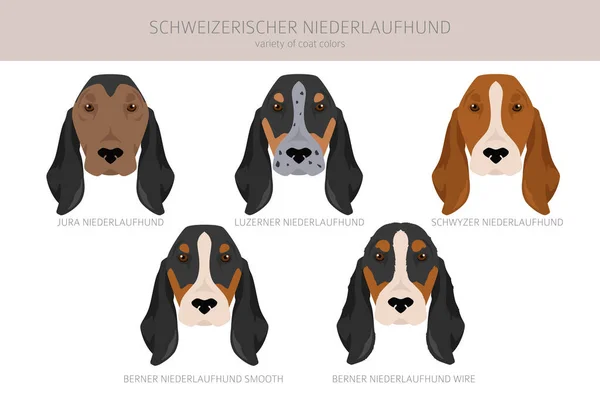
Head: Long, narrow, with clean lines. The skull is slightly domed. The stop is moderately defined.
Eyes: Oval-shaped, dark brown, with a lively and friendly expression.
Ears: Very long, set low, hanging, and soft to the touch. They are one of the most characteristic features of the breed.
Body: Rectangular, with a strong back and a deep, well-developed chest, providing ample space for the heart and lungs.
Limbs: Short, but very muscular and well-boned, allowing the dog to be stable on any terrain.
Tail: Medium length, set low. When at rest, it hangs down; in motion, it may be raised but doesn't curl over the back.
Coat: In the smooth-coated variety, the coat is short, dense, sleek, and shiny, with a light undercoat.
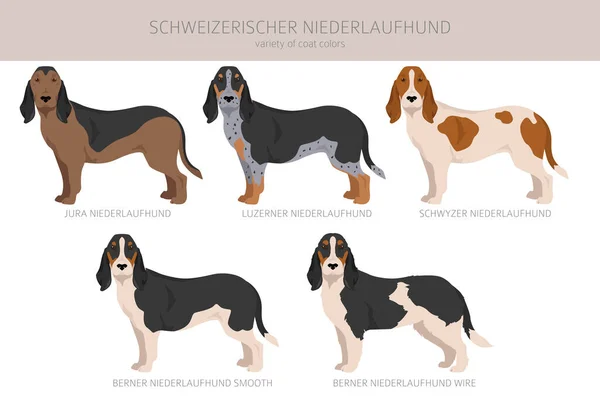
There are four main varieties of the Small Swiss Hound, which differ in colour and are named after the cantons of Switzerland:
1. Small Bernese Hound: Tricolour — a white base with large black patches and tan markings above the eyes, on the cheeks, and on the ears.
2. Small Jura Hound: Black with tan markings. It looks very similar to a miniature version of the Saint Hubert Hound.
3. Small Lucerne Hound: "Blue" colouring, created by a mixture of black and white hairs (ticking), with black patches or a black "saddle." This gives the coat a characteristic bluish tint.
4. Small Schwyz Hound: A white base with reddish-yellow or orange patches.
Character and Temperament
The Small Swiss Hound has a dual character. When hunting, it is a relentless, passionate, and independent tracker, capable of following a scent for hours, alerting the hunter with its loud, melodic bay. Its hunting instinct is incredibly strong, so it should not be let off the lead in unenclosed areas.
At home, this dog transforms into a calm, gentle, and extremely devoted companion. It forms a strong bond with its family and gets on well with children, provided they respect its personal space. Small Swiss Hounds are not prone to unprovoked aggression and are friendly towards people they know. They may be cautious with strangers but not hostile. They coexist well with other dogs, especially if raised together. However, due to their strong hunting instinct, it's not recommended to keep them with small domestic animals like cats, rodents, or birds.
Pros and Cons of the Small Swiss Hound
Pros and Cons of the Small Swiss Hound · 6
Pros
Cons
Excellent hunter. Its unparalleled sense of smell and stamina make it ideal for hunting small game.
Very strong hunting instinct. May run off if it catches a scent. Needs to be walked on a lead.
Loyal and gentle companion. Forms a strong bond with the family and is calm at home.
Requires high physical activity. Not suitable for inactive people or for living in a flat without sufficient exercise.
Good health. The absence of described hereditary disease is not the absence of risk — breeding animals are screened all the same.
Prone to ear infections. Long, floppy ears need regular care.
Easy coat care. The smooth-coated variety doesn't require complex grooming.
Can be stubborn during training. Like many hounds, it can be independent, which requires patience.
Gets on well with children and other dogs.
Not suitable for keeping with small animals.
Loud, melodic voice.
Prone to barking. This can be a problem for neighbours.
Training and Socialisation
The obedience and intelligence of Small Swiss Hounds contribute to effective training, but there are some nuances. They are clever dogs that learn commands quickly. However, like all hounds, they were bred for independent work, so they can show stubbornness and independence. Training must be consistent, patient, and based on positive reinforcement—praise and treats.
Early socialisation is critically important. A puppy needs to be introduced to different people, sounds, places, and other animals so that it grows into a confident and well-balanced dog. Special attention should be paid to the "come" command. Due to their strong hunting instinct, perfecting a flawless recall is a matter of safety for your pet.
Training is an essential condition for the well-being and happiness of the small "Swiss," as it's a breed built for an active life. Running on difficult terrain, long hikes, searching games, or participating in canine sports like nosework will help to channel its energy in the right direction.
Although the smooth-coated Niederlaufhund is very compact, it's not a dog that should be kept in a flat. Limiting a hound's space negatively affects its well-being and behaviour. An ideal home for it would be a house with a large, securely fenced garden where it can run freely. Long walks, sufficient physical exercise, and participation in hunting are the keys to its health and good mood.
Coat care for the smooth-coated variety is as simple as it gets. The dense, short coat is not prone to matting. Brushing it once a week with a rubber brush or grooming mitt is enough to remove dead hairs. Bathe the dog only when absolutely necessary, as frequent washing can disrupt the skin's natural protective layer. After hunting or walks in the countryside, it's important to thoroughly check the dog for ticks and other parasites.
The ears require special attention. Their long, floppy shape creates a favourable environment for the growth of bacteria and fungi. You must regularly, at least once a week, inspect the ear flaps and gently clean them with a special lotion. It's also important to monitor the condition of their nails and trim them in time if they don't wear down naturally.
Nutrition
Diet: Key Recommendations
Health and risks
Breed Health: Common Illnesses and Prevention
Frequently Asked Questions (FAQ) · 5
Is the Small Swiss Hound suitable for flat living? No, this is highly inadvisable. The dog needs space and daily intense physical exercise. Flat living is only possible if the owner is willing to dedicate several hours a day to active walks, runs, and games outdoors.
Does the smooth-coated variety shed a lot? Shedding is moderate and seasonal (in spring and autumn). Regular brushing will help control the amount of hair in the house.
Can this dog be left alone for long periods? Like many other dogs that are closely bonded with their families, Small Swiss Hounds do not cope well with long periods of solitude. They can suffer from separation anxiety, which manifests as destructive behaviour and continuous barking.
How noisy are they? They have a loud voice and are prone to barking, especially when they catch a scent or see something interesting. This is worth considering if you have sensitive neighbours.
Is it difficult to find a Small Swiss Hound puppy? Outside of Switzerland and neighbouring countries, the breed is quite rare. Finding a responsible breeder may require time and effort.
FAQ
What colours does the smooth-haired Small Swiss Hound come in?
The smooth-haired variety comes in several colour types — Schwyz (white-and-red), Bernese (tricolour), Jura (black-and-tan) and Lucerne ("blue" ticked); each has its own regional history.
Is this hound good for a family?
Yes — at home it is a calm, obedient and friendly dog, good with children; but it is loud and has a hunting instinct, so it needs exercise and scent work.
Why does the breed have short legs?
The short legs allow it to drive game more slowly and thoroughly in thick undergrowth and on restricted ground, where a high-legged hound would work too fast.