


| Height | no single figure: depends on the poodle variety — toy 24–28 cm, miniature 28–35 cm (FCI 172); cavalier 30–33 cm (AKC) |
| Weight | no single figure: cavalier 5.4–8 kg (FCI 136); FCI 172 sizes the poodle varieties by height, not weight |
| Lifespan | no reliable figure for the cross (cavalier ~10.5 years) |
| FCI group | not a breed (designer cross) |
| Origin | Australia / United Kingdom |
Exact ratings
Common health issues
Nutrition
The Cavapoo is one of the most sought-after small dogs in Britain, and one of the most widely misunderstood. Known in Australia and to many British owners as the Cavoodle, it is a deliberate cross between a Cavalier King Charles Spaniel and a Poodle, usually a miniature or a toy, and it has no breed standard, no studbook and no pedigree of its own. That single fact changes almost everything a prospective owner needs to know: what to expect from a litter, what health evidence to demand, and which British schemes will and will not help. Find out more on Tvaryny.
A cross, not a breed: what that actually means

A breed, in the sense used by the Royal Kennel Club or the Fédération Cynologique Internationale, is a closed population with a written standard, a registry recording ancestry across generations, and a governing body able to change the rules when evidence demands it. The Cavapoo has none of these: no standard describing the correct head, coat or size, no studbook, and no pedigree, because a pedigree is issued by a registry and no recognised registry issues one for this cross.
What does exist is the paperwork of the two parents. A Cavalier can be registered with the Royal Kennel Club and carry a pedigree; so can a Poodle. When somebody offers “a Cavapoo with papers”, the honest question is: papers for whom? A certificate from a private club that registers designer crosses for a fee records nothing beyond the seller’s claim about parentage. Registration documents and health results for the mother and father are the only paperwork here that carries weight.
None of this makes the Cavapoo a bad dog; it makes it an unregulated one, and quality control shifts onto the buyer, who usually does not know that it has.
Britain as the epicentre of the doodle boom
Deliberate Poodle crossing is usually traced to Australia, where guide-dog work in the 1980s produced the first Labradoodles, with smaller companion crosses following in the 1990s; the phenomenon then found its largest market in Britain. It began with the Labradoodle; its success inspired breeders to create smaller dogs suited to city flats, and the Cavapoo followed. Unlike working crosses such as the sporty Eurohound, bred exclusively for sled sports and speed, the Cavapoo was created for one purpose: companionship in a household.
The scale is not anecdotal. The Dogs Trust national survey, the largest of its kind in the country, found crossbreeds accounting for around 42 per cent of British dogs, with Cockapoos the most common named crossbreed at 5.8 per cent, Cavapoos at 1.5 per cent and Labradoodles at 1.3 per cent. Demand outstripped supply during the pandemic puppy surge, with figures from that period recording hundreds of prospective buyers per Cavapoo advertisement. A market in which several hundred people compete for one litter is one in which the buyer loses all leverage to ask awkward questions: the conditions that make this dog desirable are the conditions that make it hard to buy well.
Genetics of a first cross: why the litter is not uniform
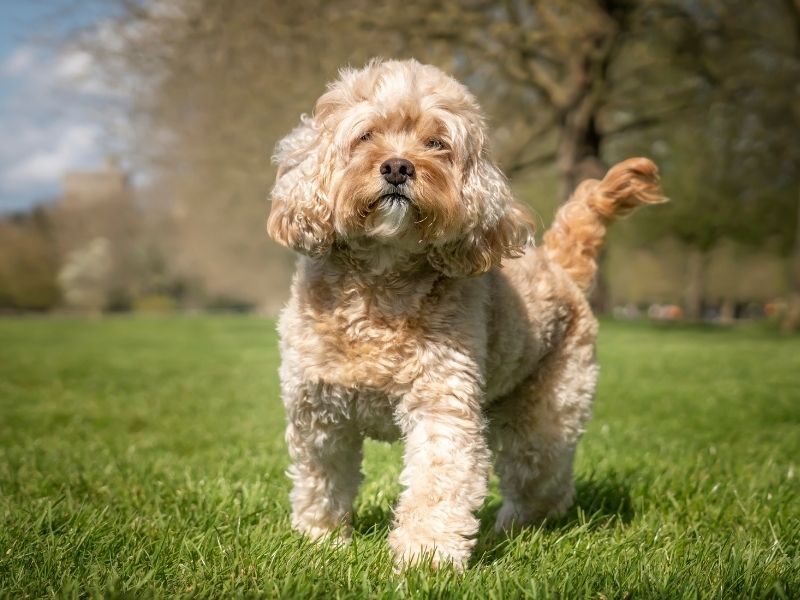
A first-generation cross, written F1, is a Cavalier bred to a Poodle. Every puppy carries one set of chromosomes from each parent, but the combination each receives is a lottery. That is why an F1 litter is visibly heterogeneous: some puppies curlier, some straighter, some with the longer Cavalier muzzle, some with a shorter Poodle-influenced face, and adult weights differing substantially. Photographs of a previous litter show what that pairing produced once; they do not predict this one.
Later generations carry a shorthand worth decoding. F1b usually means an F1 Cavapoo bred back to a Poodle, to push the coat towards curl; F2 means two Cavapoos bred together. Breeders use these labels inconsistently, and with no registry to audit them the same label can cover very different breeding histories.
Parent breeds
- Mum/Dad 1: Cavalier King Charles Spaniel – contributes compact size, silky coat texture and an unusually strong orientation towards people. It also contributes the two health problems that dominate the rest of this article.
- Mum/Dad 2: Miniature Poodle – contributes a quick, biddable mind, a curly coat that sheds less, and its own list of inherited conditions, several with DNA tests available.
| Characteristic | Description | Variability |
|---|---|---|
| Weight | No single figure exists for the cross | Cavalier standard 5.4–8 kg (FCI 136); FCI 172 sizes the poodle varieties by height, not weight, so the outcome depends on which poodle was used |
| Height | No single figure exists for the cross | Parent standards at the withers: toy poodle 24–28 cm, miniature poodle 28–35 cm (FCI 172); cavalier 30–33 cm (AKC). Littermates differ |
| Coat type | Wavy (fleece) or curly (wool) | Straight (hair) coats also occur, especially in F1 litters |
| Life span | No reliable Cavapoo-specific figure exists | Cavalier life expectancy in British veterinary records is about 10.5 years |
Coat types and colours
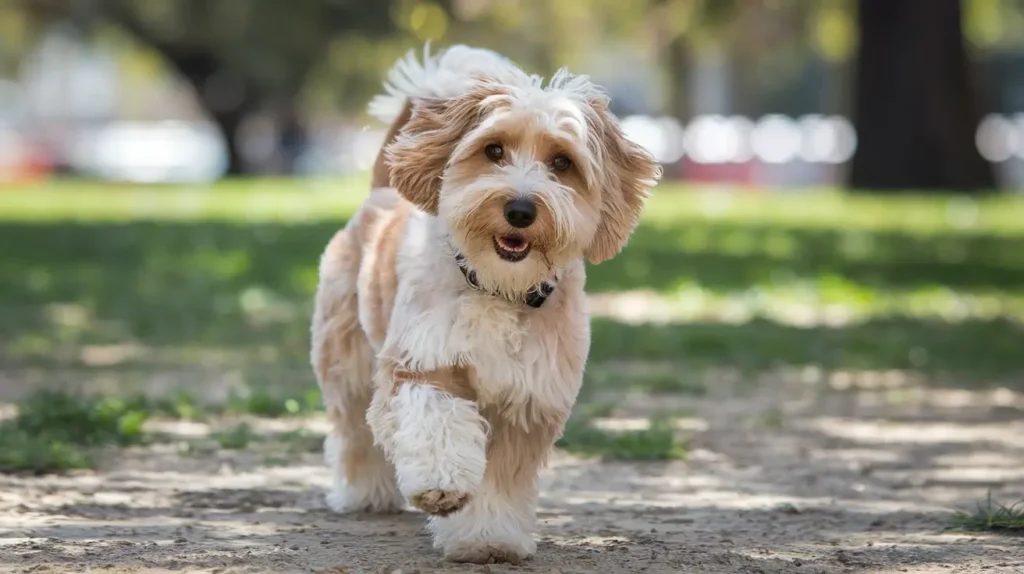
Coat is why most people choose this cross. Three broad types occur, and which one a puppy grows is not predictable at eight weeks: puppy coat is not adult coat, and the change comes between eight and eighteen months.
- Fleece coat: soft and wavy, the type most owners hope for. It still needs daily attention once the adult coat is in.
- Wool coat: denser and tightly curled, closer to the Poodle. It sheds least and mats fastest: a trade-off, not a bonus.
- Hair coat (smooth): occurs when Cavalier coat genes dominate. These dogs shed noticeably, and buyers who chose the cross to avoid shedding are the ones most often disappointed.
Colour palette: gold, ruby, black, white, Blenheim (white with chestnut markings), tricolour and parti-colour. Puppies are often born darker and lighten with age, an effect of the Poodle fading gene, and colour has no bearing on health, temperament or coat. The Doodle Trust, a British charity that rehomes Poodles and Poodle crosses and therefore sees the dogs whose coats did not turn out as promised, is blunt: coats vary widely, many of these dogs shed, and the assumption of a uniform non-shedding fleece is not supported by what arrives in rescue.
The hypoallergenic claim, examined properly
This is the claim that sells the cross and the one with least support. It rests on reasoning that breaks at the first link: Poodles shed less, therefore release less allergen, therefore a Poodle cross is safe for allergy sufferers.
The dominant dog allergen is a protein called Can f 1, produced in saliva and skin and distributed around a home on dander and hair. Research measuring Can f 1 in the hair and homes of breeds commonly marketed as hypoallergenic, against breeds that are not, found no basis for describing any breed as hypoallergenic; in some samples levels in the “hypoallergenic” breeds were higher rather than lower. A separate study compared dust from well over a hundred and fifty homes, households with so-called hypoallergenic dogs against the rest, under several competing definitions of which breeds counted. Under every definition, the difference disappeared.
The mechanism explains it. A dog that sheds less still produces saliva, licks itself and sheds skin cells: less hair fall removes one carrier of allergen, not the allergen. Add the coat lottery and the promise collapses, because an F1 Cavapoo may inherit a Cavalier-type coat that sheds freely.
British research has quantified how powerfully this belief drives purchases. A Royal Veterinary College survey of more than six thousand British puppy buyers found perceived hypoallergenicity cited as a reason for the choice by 47.1 per cent of designer crossbreed owners, against 7.86 per cent of purebred owners. Nearly half were buying an attribute the evidence does not support. Allergy is individual, not breed-determined: repeated contact with the dog you intend to buy tells you more than any label.
Character and temperament: the eternal puppy
What British behavioural research actually found
The belief that designer crosses are calmer, friendlier and better with children than their parent breeds has rested on almost nothing. Researchers at the Royal Veterinary College tested it directly using the Canine Behavioural Assessment and Research Questionnaire, an established owner-report instrument with twelve behavioural subscales, across 9,402 dogs: Cockapoos, Labradoodles and Cavapoos alongside Cocker Spaniels, Labrador Retrievers, Cavalier King Charles Spaniels and Poodles.
Across seventy-two comparisons, the designer crosses showed more undesirable behaviour than a parent breed in 44.4 per cent of comparisons, less in 9.7 per cent, and no detectable difference in the remaining 45.8 per cent. For the Cavapoo, differences appeared in twelve of twenty-four comparisons, and in eleven the Cavapoo scored worse. Against Cavaliers it scored higher for owner-directed, stranger-directed and dog-directed aggression, stranger-directed fear, non-social fear, dog-directed fear, separation-related problems and excitability, and better on one measure only, trainability. Against Poodles it scored worse on non-social fear, dog-directed fear and trainability.
Two cautions belong with these numbers. This is owner-reported data from a self-selected survey, and it cannot separate genetics from rearing: the same British programme showed designer crossbreed puppies were likelier to go to first-time owners, likelier to be bought without visiting the breeder’s premises, and less likely to be seen with their mother, each independently associated with later behaviour problems. What the study does establish is that the claim of behavioural superiority has no support and points the wrong way. The practical reading is not “avoid the Cavapoo” but: buy from a breeder who rears puppies indoors, assess the mother’s temperament, and train for separation from the first week.
Health: the honest version
The doodle dilemma study: what it did and did not show
The largest investigation into designer crossbreed health to date came from the Royal Veterinary College, published in PLOS One, comparing Cockapoos, Labradoodles and Cavapoos against their parent breeds, with 985 Cavapoos, 715 Cavaliers and 927 Poodles among 9,402 dogs.
The headline result was an absence of difference: of 342 disorder comparisons, 86.6 per cent showed no statistically significant difference between the crosses and their purebred progenitors. Where differences did emerge for the Cavapoo they ran both ways. Against the Cavalier, Cavapoos had lower odds of ophthalmological disorders, anal sac disorders, obesity and overgrown nails, and higher odds of vomiting, otitis externa and diarrhoea. Against the Poodle, lower odds of otitis externa, ophthalmological disorders and lameness, and higher odds of anal sac disorders, diarrhoea, dietary indiscretion and vomiting.
The limitation matters more than the findings, and the authors state it themselves: the dogs studied were under five years of age, so the burden in older members of these emerging populations remains unknown. Mitral valve disease is precisely the condition this design cannot see, because it declares itself at or after the age at which the study stopped looking. A study showing that young Cavapoos are no sicker than young Cavaliers is not evidence about the heart. Adjacent British work makes a further point: certificates from the BVA/Kennel Club/International Sheep Dog Society Eye Scheme showed Labradoodles with multifocal retinal dysplasia at a higher rate than either parent breed. Crossing can concentrate a problem as easily as dilute one.
The British schemes a Cavapoo owner can actually use
Most Cavapoo articles never write this section, because they assume an unrecognised cross is locked out of the formal screening system. It is not. The British schemes are run jointly by the British Veterinary Association and the Royal Kennel Club, and most are open to any dog.
The CM/SM Scheme: yes, it takes crossbreeds
The BVA/Kennel Club Chiari Malformation and Syringomyelia Scheme is open to all dogs, including crossbreeds, and the dog need not be registered with the Royal Kennel Club. That single fact means a Cavapoo can be formally assessed for the most serious condition it may have inherited, by the same expert panel that grades Cavaliers.
The dog is scanned by magnetic resonance imaging of the brain and upper cervical spinal cord at an approved centre, under general anaesthesia or deep sedation, because the patient must lie completely still for several minutes at a time. The images are assessed by two scrutineers from a BVA-appointed panel of neurologists and radiologists, who must agree a grading; if they cannot, a chief scrutineer decides. Results normally reach the submitting veterinary surgeon within about four weeks.
Two grades are issued. For Chiari-like malformation: grade 0 means the cerebellum has a rounded shape with a cerebrospinal fluid signal between the caudal cerebellar vermis and the foramen magnum; grade 1 means the cerebellum is indented by the supraoccipital bone but fluid signal remains; grade 2 means the vermis is impacted into or herniated through the foramen magnum. For syringomyelia: grade 0 is normal; grade 1 is central canal dilatation with an internal diameter of less than 2 mm; grade 2 is a dilatation of 2 mm or greater, a separate syrinx, or a pre-syrinx.
The age caveat is the part owners most often miss, and the scheme builds it into the certificate. Every grade carries a qualifying letter recording the dog’s age band at scanning: a for more than five years, b for three to five years, c for one to three years, and the rules state the grade is not valid without it. The minimum age for submission is one calendar year, there is no upper limit, and breeders are advised to determine the status of breeding stock at three years and again at five. The reason is biological: syringomyelia progresses through the first few years of life, so a clear scan at fourteen months is a far weaker statement than a clear scan at five years. A seller waving a “clear MRI” without telling you the dog’s age at scanning is telling you nothing.
Two administrative details matter. The dog must have permanent identification by microchip or tattoo, and because microchips distort the image of surrounding soft tissue, chips should sit no further forward than the shoulder blades. And for unregistered dogs no Estimated Breeding Value can be generated, since that depends on relatedness to registered dogs; the rules direct owners of such dogs, and of crossbreeds without an EBV scheme, to select on the CM/SM result itself.
The Cavalier Heart Scheme: for the parent, not the puppy
The Cavalier Heart Scheme was developed by the Kennel Club with the Veterinary Cardiovascular Society and is specific to the Cavalier. It is the most important document in the whole Cavapoo transaction, because it applies to the parent that brings the heart risk.
A dog is examined by an approved cardiologist and receives two grades. The first is a mitral murmur grade, from 0 through 1 and 2 to 3 or above, assigned by auscultation, with a louder murmur relative to the other heart sounds producing a higher grade. The second is a mitral valve prolapse grade measured from an echocardiographic examination, with more pronounced prolapse producing a higher grade. Combining the two produces a colour category. Green indicates the lowest risk of developing clinical mitral valve disease and of passing the condition on. Amber indicates higher risk: such a dog may be used cautiously for breeding, and only with a mate categorised green. Red means the dog should not be used for breeding at all.
Dogs must be at least eighteen months old to be assessed, and the scheme’s value comes from repetition: assessment at two, four and six years gives the fullest picture, and breeding stock should be re-tested every two years while it is bred from. A single result at eighteen months from a dog never re-tested tells you only that no murmur had appeared yet, which at that age is close to meaningless. Two things follow. This is the certificate to ask for when the Cavalier parent is described as “heart tested”; a vet listening to the heart at a routine consultation is not a Heart Scheme result. And participation is entirely voluntary: nothing in British law requires it.
Eyes, hips and elbows
The BVA/Royal Kennel Club/International Sheep Dog Society Eye Scheme is open to all dogs, pedigree and crossbreed alike, with no requirement to be registered with the club. Examinations are performed by an appointed panellist and, because several of the relevant conditions are progressive, certificates are current only for a limited period, so breeders re-test annually. The BVA Hip and Elbow Dysplasia Schemes are likewise open to crossbred dogs. A British Cavapoo owner therefore has access to expert-graded screening for eyes, hips, elbows and the brain and spinal cord, plus the heart scheme through the Cavalier parent. The system is not closed to this dog; almost nobody in the Cavapoo market asks it to open.
What the Royal Kennel Club does and does not do
The Kennel Club, which took the “royal” prefix around its hundred and fiftieth anniversary and has King Charles III as patron, does not recognise the Cavapoo as a breed. There is no standard, no place on the Breed Register, and no entry at breed shows including Crufts.
Less well known is that the club has registered crossbred dogs for more than fifty years through a separate route. The Activity Register is open to any dog of any ancestry, and a Cavapoo entered on it can compete in licensed obedience, agility, flyball, heelwork to music, rally, working trials and canicross; it cannot enter breed shows, field trials, gundog working tests or bloodhound trials. For an owner who wants to do something structured with a clever little dog, that is the whole point: the door to competition is open, the door to conformation is not.
The Assured Breeder Scheme is the other piece worth understanding. It applies to breeders of recognised breeds and sets required and recommended health tests breed by breed; for the Cavalier the heart scheme and eye testing sit among them, and DNA tests for episodic falling and for curly coat with dry eye run through the club’s own testing service. A Cavapoo breeder cannot be an assured breeder for the Cavapoo, because the Cavapoo is not a breed. But whoever owns the Cavalier parent could in principle have met the Cavalier requirements, and asking whether they have is a sharper question than asking whether the litter is “health tested”.
The law in Britain: Lucy’s Law and what sits behind it
Britain and Norway: two answers to the same question
On 10 October 2023 the Supreme Court of Norway gave judgment in case HR-2023-1901-A, brought by Animal Protection Norway against the Norwegian Kennel Club, the Norwegian Cavalier Club and individual breeders, with a parallel action on the English Bulldog. By a majority of three justices to two, the court held that continued breeding of the Cavalier violated section 25 of the Norwegian Animal Welfare Act, which requires that breeding promote characteristics giving robust, functional animals.
The half of that judgment usually left out of English-language coverage is the more interesting one. The same court concluded that continued breeding of the English Bulldog was not a violation, provided a specific breeding programme was followed. The court did not ban breeds; it divided them, judging one population capable of improvement under a defined programme and the other, on the evidence before it, not capable of being bred from lawfully as it stands. That is a far sharper finding than “Norway banned the Cavalier”, and it is why the case matters here: one of this cross’s two parent breeds has been held by a supreme court in a European country to be too compromised to breed from, and it is the parent that supplies the heart.
Britain took the other road: no court ruling, no statutory ban, but a dense layer of voluntary machinery, the Heart Scheme, the CM/SM Scheme, the Eye, Hip and Elbow Schemes, the Assured Breeder Scheme. Every one is optional, and every one reaches further than a ban would: the CM/SM Scheme in particular is open to the crossbred dog in a way a statutory breeding ban never could be.
Which approach works? Scandinavian experience with heart screening supplies the most useful evidence, and it is uncomfortable reading for both camps. Denmark introduced a mandatory scheme for its Cavaliers in 2002, run through the breed club and national kennel club, combining auscultation with echocardiography and issuing certificates of limited validity. It reduced the risk of murmurs in offspring, but only where both parents had been screened. Sweden ran a scheme based on auscultation alone; over six years the prevalence of murmurs moved from 52 per cent to 55 per cent, which is to say it achieved nothing.
Three lessons follow, and they transfer directly to the British Cavapoo market. A scheme that only listens to the heart does not work; echocardiography must be part of it, which is what the Heart Scheme’s MVP grade provides. A scheme applied to one parent does not work; both sides of the mating must be screened, which here means the Poodle as well as the Cavalier. And a voluntary scheme achieves nothing if buyers do not ask. Britain’s instruments are unusually good; the variable that decides whether they matter is whether the person handing over money insists on seeing the results.
Buying a Cavapoo in Britain: the questions that work
Care and maintenance
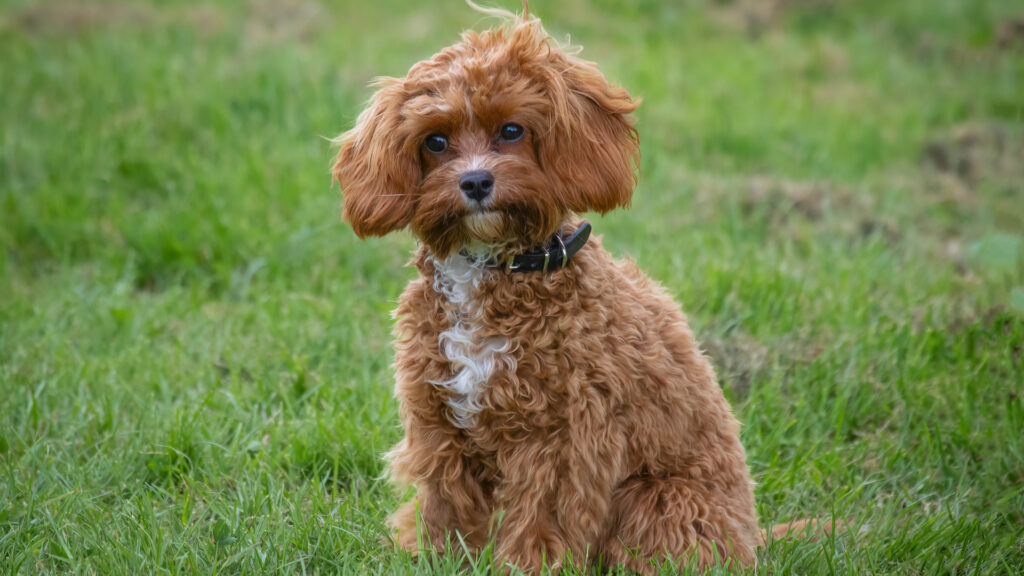
If you think “non-shedding” means “no maintenance”, you are mistaken. A shedding dog drops its dead coat on your carpet; a low-shedding dog keeps it in the live coat, where it tangles. That is why the curliest Cavapoos, marketed as most allergy-friendly, mat fastest. Matting is not cosmetic: a tight mat pulls on the skin, traps moisture and can cause painful inflammation underneath.
- Daily brushing: a slicker brush followed by a metal comb. The comb is the test; if it will not pass to the skin, the brush has only tidied the surface.
- Friction areas: behind the ears, under the collar, in the armpits and between the back legs. These mat first and are the areas owners skip.
- Professional grooming: every six to eight weeks, the rounded “teddy bear” trim being the popular choice. Take the puppy for short, positive salon visits before the adult coat arrives.
- Ears: pendulous, hairy ear canals in a damp British climate invite otitis externa, which the RVC data flagged as more common in Cavapoos than in either parent. Keep them dry and check weekly.
- Eye hygiene: tear staining is common in pale coats. Have persistent discharge examined rather than simply cleaned.
Exercise. The Cavapoo is energetic but not an endurance athlete. Forty to sixty minutes daily suits most adults: two walks plus play and scent work at home. Mental work tires this cross more efficiently than distance, and growing puppies should not be route-marched, because short, frequent outings protect joints in a dog already carrying patellar risk from both sides.
Feeding and weight. Many of these dogs have sensitive digestion, and the RVC comparisons recorded vomiting, diarrhoea and dietary indiscretion more often in Cavapoos than in one or both parent breeds. Feed a complete food formulated for small breeds, change diets gradually, and be disciplined about scraps. Weight is the one variable an owner fully controls: excess weight loads the stifles in a dog predisposed to patellar luxation and worsens the course of heart disease. Body condition scoring beats the scales, and your vet can score the dog at each visit.
Being left alone. Separation-related problems were among the areas where Cavapoos scored worse than Cavaliers in the British behavioural study, and are a common reason these dogs reach rescue. Treat separation as a skill taught deliberately, in seconds and then minutes, from the first week. Three to four hours suits a settled adult; a full working day is not a life this cross tolerates well.
Pros and cons
| Pros (+) | Cons (-) |
|---|---|
| Genuinely affectionate and people-oriented | Poorly suited to long periods alone; separation problems common |
| Often low-shedding, though never allergy-proof | Needs daily brushing and regular professional grooming |
| Quick to learn; scores well on trainability | British survey data show higher fear and aggression scores than the Cavalier |
| Compact and well suited to a flat | Size, coat and traits unpredictable in a first cross |
| Free of two Cavalier recessive diseases by virtue of the cross | Inherits heart and skull-shape risk that crossing does not dilute |
Common questions about the Cavapoo (FAQ)
Is the Cavapoo a recognised breed in the United Kingdom?
No. The Royal Kennel Club does not recognise the Cavapoo, so there is no breed standard, no Breed Register entry and no pedigree. The club does register crossbreeds on its Activity Register, which lets a Cavapoo compete in licensed agility, obedience, flyball, rally, heelwork to music, working trials and canicross, though not breed shows. Documents from private “designer breed” registries record only the seller’s claim.
Can a Cavapoo be scanned under the BVA and Kennel Club CM/SM Scheme?
Yes. The scheme is open to all dogs, including crossbreeds, and the dog need not be registered with the Royal Kennel Club. It must be at least one calendar year old and permanently identified; the scan is done under anaesthesia or deep sedation, and two BVA-appointed scrutineers grade the images. Because syringomyelia progresses over the first few years, the grade carries a letter recording the age band at scanning, and it is not valid without that letter. Results for unregistered dogs are not published, and no Estimated Breeding Value can be calculated for them.
What does Lucy’s Law mean when I buy a Cavapoo puppy?
Since 6 April 2020 in England, and from September 2021 in Wales, a puppy sold commercially must be sold by the person who bred it; dealers and pet shops are out of the chain. The 2018 licensing regulations separately state that a puppy may only be shown to a prospective purchaser together with its biological mother, and make breeding licensable where somebody breeds three or more litters in twelve months or advertises a business of selling dogs.
Are Cavapoos hypoallergenic?
No dog is. Research measuring the main dog allergen, Can f 1, in the hair and homes of breeds marketed as hypoallergenic found no support for the label, and a study of household dust found no difference under any definition tested. Some Cavapoos shed very little, which reduces one route by which allergen spreads, but the allergen comes mainly from saliva and skin. The Doodle Trust, a British Poodle-cross rescue charity, calls the claim a myth. If somebody in the household is allergic, spend time with the individual dog more than once before committing.
Do Cavapoos live longer than Cavaliers because they are crossbred?
Nobody knows, and the widely repeated figure of thirteen to fifteen years has no source: there is no Cavapoo registry and so no life-table data for the cross. British veterinary records analysed through VetCompass put Cavalier life expectancy at around 10.5 years. The largest study of designer crossbreed health looked only at dogs under five, younger than the age at which mitral valve disease usually declares itself, so it cannot answer the question either.
Does hybrid vigour protect a Cavapoo from Cavalier heart disease?
Not in the way the phrase implies. Crossing genuinely eliminates two Cavalier diseases inherited as simple recessives, episodic falling and curly coat with dry eye, because a Poodle cannot supply the second copy. Mitral valve disease is different: as a polygenic threshold trait, halving the Cavalier contribution shifts risk rather than removing it. Chiari-like malformation is tied to skull shape and travels with head type. Crossing reduces some probabilities; it does not repeal biology.
Which certificates should I insist on seeing for the parents?
From the Cavalier: a Heart Scheme certificate showing murmur grade, MVP grade and colour category, plus a CM/SM certificate with the age-qualifying letter. From the Poodle: DNA results for progressive rod-cone degeneration and von Willebrand’s disease. From both: current Eye Scheme certificates and an assessment of the patellas. Danish experience showed a benefit only where both parents were screened, which is why one certificate for one parent is not enough.
Are Cavapoos good with children?
Many are excellent family dogs, but the claim that the cross is inherently better with children than its parent breeds is not supported. In the Royal Veterinary College behavioural study, Cavapoos scored worse than Cavaliers on eight measures including owner-directed, stranger-directed and dog-directed aggression, fear and excitability. That is owner-reported data and cannot separate breeding from rearing, but temperament should be assessed dog by dog rather than assumed from the label.
How long can a Cavapoo be left alone?
Three to four hours suits a settled adult taught to cope with being alone. A standard office day is too long, and separation-related problems were one of the areas where Cavapoos scored worse than Cavaliers in British survey data. Build the skill from the first week, in short absences that lengthen gradually, and arrange midday cover if your working pattern requires it.
Video about the Cavapoo
- Very affectionate and sociable
- Often low-shedding (poodle heritage)
- Ideal for a flat and a novice
- Clever, easy to train
- Cannot bear being alone (separation anxiety)
- Curly coat needs regular grooming
- Traits unpredictable (a cross)
- Risk of inherited heart and eye defects
| Cavalier King Charles Spaniel | Poodle (toy) | Poodle (miniature) | |
|---|---|---|---|
| Height | 30–33 cm | 24–28 cm | 28–35 cm |
| Energy | 3 | 3.5 | 3.5 |
| Apartment | 4.5 | 4.5 | 4.5 |
| Beginners | 4 | 4 | 4 |
Is the Cavapoo a recognised breed in the United Kingdom?
Can a Cavapoo be scanned under the BVA and Kennel Club CM/SM Scheme?
What does Lucy’s Law mean when I buy a Cavapoo puppy?
Are Cavapoos hypoallergenic?
Do Cavapoos live longer than Cavaliers because they are crossbred?
Does hybrid vigour protect a Cavapoo from Cavalier heart disease?
Which certificates should I insist on seeing for the parents?
Are Cavapoos good with children?
How long can a Cavapoo be left alone?
Designer cross (cavalier × poodle) · vet sources on MVD/syringomyelia
For apartments · For kids · For beginners · Active · Smartest · Hypoallergenic · All rankings →