not a breed (sporting cross) · Scandinavia (Norway)
Eurohound
A sporting crossbred, not a breed: the Alaskan Husky is crossed with a pointing dog for sprint sled racing. Fast, clever, human-oriented and a workaholic — but without a written standard or a stud book, and therefore unpredictable within a litter. It needs kilometres of running, a cooling protocol of its own on dryland, and a vet who knows that a sporting dog's blood results read differently.
A wider genetic base: observed heterozygosity 15% higher and inbreeding at least five times lower than in registered breeds (Huson et al., 2010)
Cons
Extreme need for exercise — a flat suits only sporting owners
Bored and destructive without work
Strong running and chasing instinct
Traits vary within a litter: a sporting cross without a standard
A narrow thermal window: cold when standing still, overheating on dryland
Size
ToySmallMediumLargeGiant
Compatibility
Apartment · not suitableKids · with caveatsCats · not suitableOther dogsBeginners · not suitable
The world of sled dog sport moved past the picture-book image of fluffy huskies hauling a sledge through a blizzard a long time ago. Modern sprint racing is decided over a few kilometres, where seconds settle everything. That is where the Eurohound works — and the most important thing has to be said first: it is not a breed. It is a working cross between the Alaskan Husky and a pointing dog, selected for a result rather than for a standard. It has no written description of its appearance, no stud book, and it cannot hold an FCI pedigree — and every one of its traits, including those that complicate its owner's life, follows directly from that choice. If you are looking for a companion for unhurried strolls in the park, this page will more likely talk you out of it. Find out more on Tvaryny.
A Dog Without a Pedigree: a Decision, Not an Oversight
The word "breed" carries two different meanings, and the confusion between them generates almost every argument about the Eurohound.
The first meaning is registry-based. A breed in this sense is a written standard of appearance plus a stud book kept by a national kennel organisation, and that book is closed: a descendant can enter it only if both parents are already in it. The Eurohound has no such construction, and that matters. A closed stud book would freeze exactly what the competitors want to keep changing. Sled sport is organised by classes — by the number of dogs in the team, the discipline and the distance — not by breeds; which is why dropping the purebred requirement in 1985 broke nothing in the sport and instead opened it up.
The second meaning is population-based. This is where it gets interesting. The group of Heather Huson and Elaine Ostrander (Huson et al., BMC Genetics, 2010) genotyped 199 Alaskan sled dogs from eight elite kennels — four sprint and four distance — and compared them with 141 registered breeds. The conclusion was unambiguous: the Alaskan sled dog is a distinct, genetically identifiable population, even though no registry recognises it. In other words, "not a breed" on paper does not mean "a random mongrel" in biology.
For a buyer this has a very practical consequence. In ordinary breeds a pedigree is not only a document; it is also the mechanism that forces a breeder to show who was mated to whom and what screening the parents passed. In the Eurohound that mechanism does not exist at all. Its place is taken by the reputation of a particular kennel and by the direct questions you ask — or fail to ask.
Sporting Use: Where They Reign Supreme
Eurohounds dominate disciplines that call for explosive speed and work at the anaerobic threshold. Chiefly these are:
Skijoring: a skier and a dog. Here it matters that the dog does not merely run but pulls powerfully, adding speed to the skier. Eurohounds suit it perfectly thanks to the will to pull inherited from the husky and the strength and biddability of the gundog.
Bikejoring and canicross: the "dry" disciplines, without snow. Short-coated Eurohounds overheat less in mild weather than traditional northern breeds, which is why they are so often seen at autumn and spring starts. It is in these disciplines that heat tolerance turns from an advantage into a daily responsibility for the owner.
Sprint teams: short distances, where everything is decided by the ability to hold a high pace from start to finish.
What sort of speeds are we talking about? A 2026 biomechanical study gives the working range of sprint sled dogs as 18–25 miles per hour, that is roughly 29–40 km/h. This is consistent with what the popular literature says about Eurohounds — up to 25 miles per hour. For comparison, a veterinary study of bikejoring puts peak speeds on course at around 42 km/h, though these were measured on Greysters rather than Eurohounds.
Importantly, a sprint is not a "shortened distance race". Work by Wakshlag and colleagues (Veterinary Therapeutics, 2004) showed that effort of moderate duration but high intensity produces a different metabolic profile from classic endurance racing: cortisol, lactate and blood glucose all behave differently. Hence the different requirements for recovery and watering, and the fact that most figures from distance studies cannot be transferred mechanically to a sprinter.
Interesting Facts
Its date of birth is a line in the rulebook. The Eurohound became possible in 1985, when the Norwegian sled sport federation dropped the purebred requirement. Before that an Alaskan Husky could not legally start in Norway.
The name is younger than the dogs. According to the Alaskan kennel Howling Dog, the term "Eurohound" was proposed by Ivana Nolke after a litter in 1996; until then such dogs were simply called "hounds".
The pointer paradox. The breed mixed in for years precisely for the sake of speed was not linked by the 2010 analysis to better speed performance; the increase in breed contribution in faster dogs came from the Saluki and the Anatolian Shepherd.
Heat tolerance has an address in the genome. In sprint sled dogs, seven polymorphisms in the MYH9 gene were found to be significantly associated with heat tolerance.
Sprint and distance have diverged down to the gene. A polymorphism in the ACE gene distinguishes the two groups with a significance of P = 2.38 × 10⁻⁵.
A gallop with a gearbox. A dog in harness changes its type of gallop within a few strides, barely altering its speed, by modulating the stiffness of the swing limb.
Sleeping on snow. Despite the short coat, these dogs can sleep on straw at sub-zero temperatures, curled into a ball — but a jacket for them is equipment, not an indulgence.
Origins: Creating the Ultimate Sprinter
The Eurohound is not a breed in the sense kennel organisations give the word. It is a deliberate cross that grew out of a very specific sporting situation in Norway and Sweden in the second half of the twentieth century. The historian of Norwegian sled sport Rune Waaler («Dog Sledding in Norway: Multidisciplinary Research Perspectives», 2019) describes that sequence step by step, and it explains more about the Eurohound than any description of its exterior.
After the Second World War, skijoring and pulka racing gained ground rapidly in Norway and its Scandinavian neighbours — disciplines in which a small team of one to four dogs works over short hilly courses of roughly 15–30 km. The Norwegian sled sport federation of the day required dogs to be purebred, and under that condition the competitors' choice quickly settled on the German Shorthaired Pointer. By the early 1970s a distinct type had formed within the breed, one Waaler calls the "sled pointer": a gundog bred exclusively for traction rather than for hunting.
Then the fashion for "Nome-style" racing reached Scandinavia — big teams, long distances, nights out in the cold. The first such competition, the Skjelbreia Sweepstakes, was run near Oslo in 1974. Norwegian mushers, among them Stein Havard Fjelstad and Roger Leegaard, travelled to Alaska to start in the Iditarod and began bringing Alaskan Huskies home. The obstacle was administrative: the Alaskan Husky is itself a working cross rather than a breed, and under the rules in force it could not legally compete in Norway.
The knot was cut in 1985, when the Norwegian federation dropped the purebred requirement. That decision — not anyone's breeding idea — is the Eurohound's real birth certificate: from that moment a musher could mate the best working dog to the best working dog without asking what its papers said. The Greyster grew out of the same decision, only from a different combination of ancestors.
Wholesale crossing of Alaskan Huskies with Shorthaired Pointers spread across Europe in the middle and late 1990s, and the dogs reached North America as a finished type. The veterinarian and musher Arleigh Reynolds, speaking to The Spokesman-Review (2017), names the reference point: 1998 was the first year such dogs really became numerous, in Egil Ellis's team. The legendary Swedish racer Egil Ellis, then, did not invent the Eurohound — he made it visible to America by winning with these dogs where others had won with something else.
The name is younger than the dogs. According to the Alaskan kennel Howling Dog, the word "Eurohound" was proposed by Ivana Nolke after her first litter in 1996 — until then such crosses were simply called "hounds", with no further qualification, and the name was meant to set apart racing dogs of European origin. This is the kennel's own account rather than an independent source, so it is best treated as the sport's internal history.
Appearance: Function Over Form
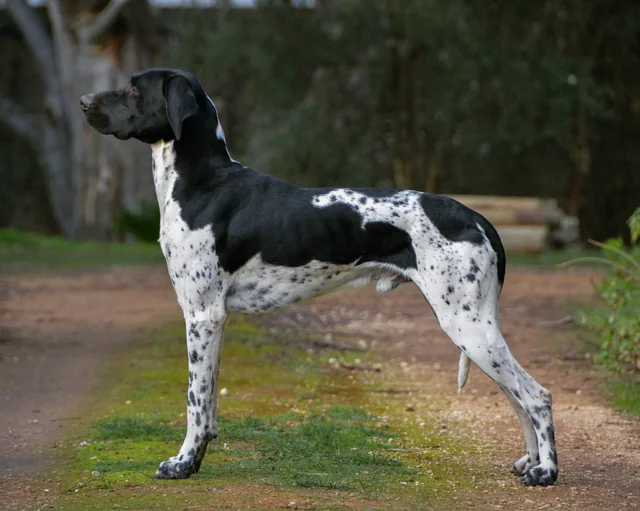
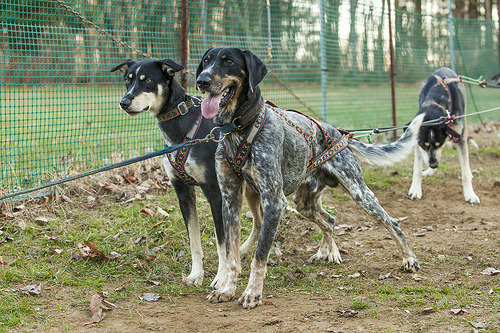
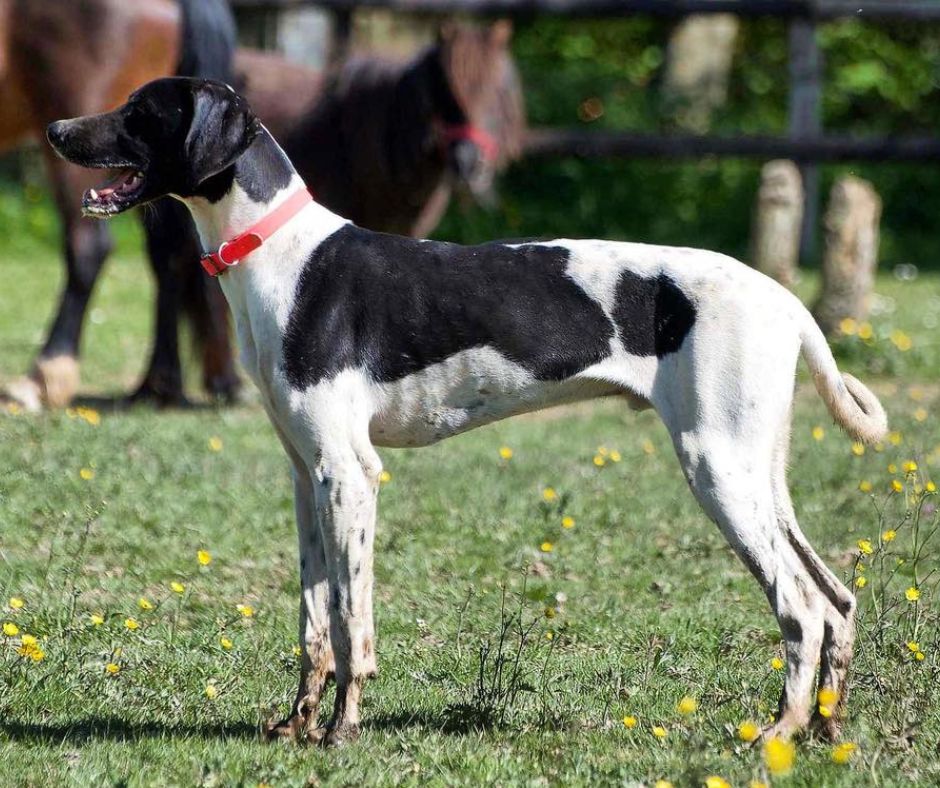
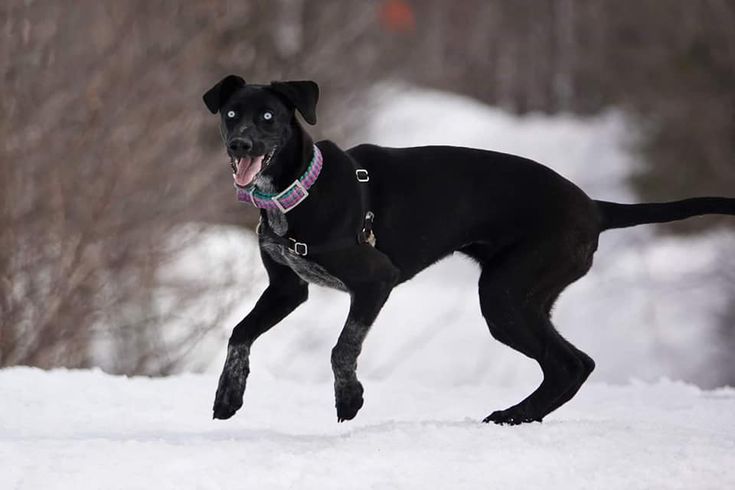
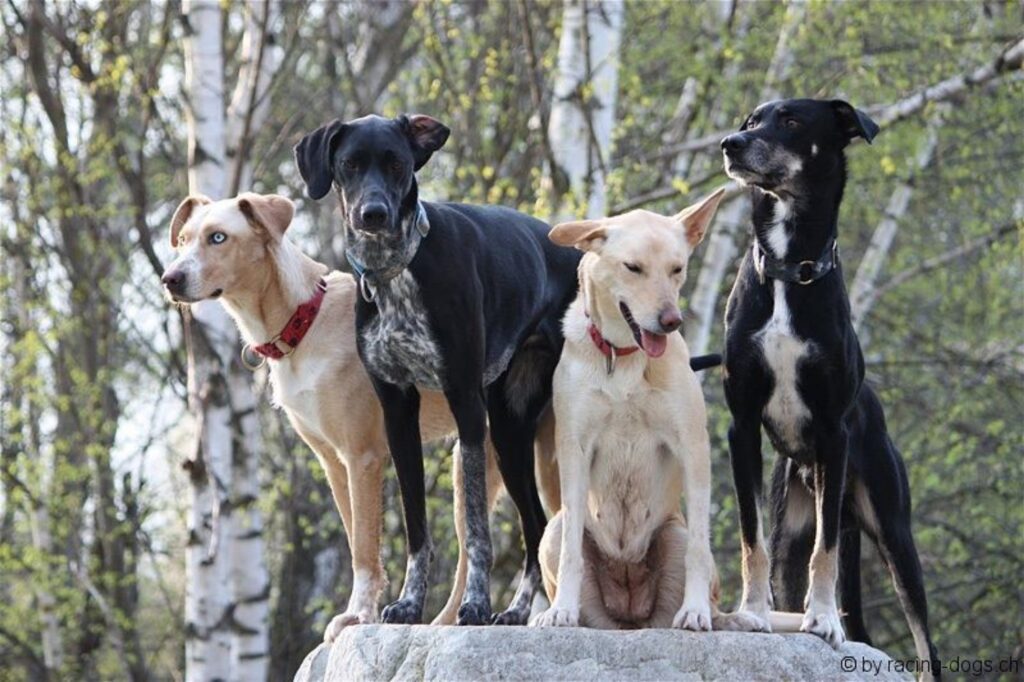
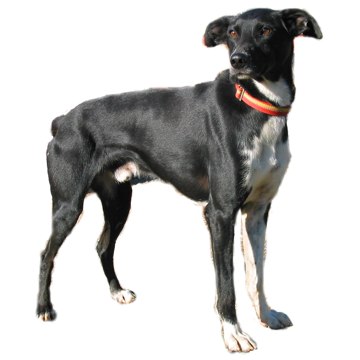
Because no written standard exists, Eurohounds vary noticeably in appearance — and that is not a breeding fault but a direct consequence of how they are selected. The general outline of an athlete is traceable in every individual: a medium-sized dog with dry musculature, long limbs and a deep chest.
On specific figures for height and weight we deliberately hold back: a type without a standard has no body to set them, and sprint and distance lines are selected on different criteria, so we do not quote a number we would be willing to sign off as "the breed norm". The guide values in the breed card at the top of the page should be read as exactly that — a guide, not a standard.
Points of the exterior
Coat: usually short, but denser than a pure pointer's. Coat type is one of the main selection criteria, because it sets the narrow comfort window: the dog must be able to run in frost without a jacket, yet not overheat when the temperature climbs a little above freezing. Unlike heavy-coated breeds such as the Himalayan Shepherd Dog, Eurohounds need a jacket when standing still in hard frost — they hold their heat by moving.
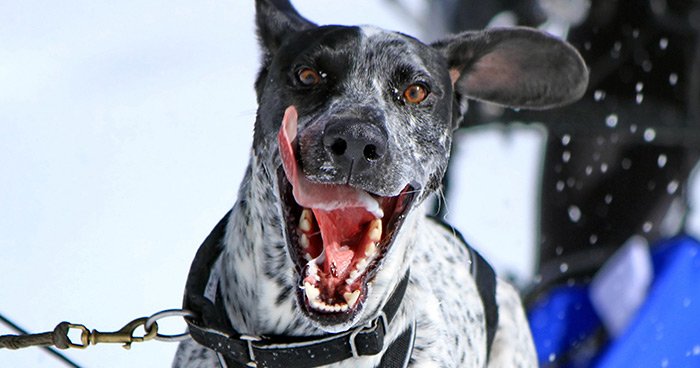
Ears: often semi-erect or dropped — a gundog legacy that tells a Eurohound from a husky at a glance. In kennel practice ear shape has long served as a rough visual indicator of the share of pointer blood, though no precision should be expected from such an estimate.
Colour: the most typical is black with white blazes and patches, but since nobody selects for colour, practically any variant inherited from the ancestors turns up.
Feet: strong and tightly knuckled, adapted to running on snow, but more vulnerable to ice than the feet of aboriginal northern breeds. This is one of the few points of care that Eurohound owners describe as mandatory rather than desirable.
Temperament and Working Ability
The Eurohound is a workaholic. Its temperament can be described in three words: energy, focus, desire. From the gundogs it inherited orientation towards people; from the husky, the pack instinct and a love of harness.
It is worth noting that "work ethic" in this sport is not an advertising word but a trait that is genuinely measured. In the 2010 study mentioned above it was one of three phenotypes scored in every dog alongside speed and endurance, and it was through work ethic that a statistical association with breed contributions was found. When a musher says a dog "has a head on it", he is describing a trait a laboratory knows how to count.
An individual signature of movement
Recent biomechanical work has added an unexpected detail. An analysis of more than 20,000 strides in a ten-dog sprint team (Seleb, Bhamla, Integrative and Comparative Biology, 2026) showed that each dog has its own reproducible "gait states" between which it switches regularly. A companion study (Ding, Seleb, Huson, Bhamla, Gan, Journal of the Royal Society Interface, 2026) described the mechanics: a dog in harness moves between rotary and transverse gallop within a handful of strides, barely altering either speed or stride duration, and controls that transition by changing the stiffness of the swing limb. The practical conclusion for an owner is simple: a team is not a set of identical engines — every dog has its own movement signature, and a change in that signature is often noticeable before any lameness is.
Social interaction
At home they are often affectionate and companionable. They are less inclined to wander off on their own than huskies and take better to training. The need for movement, however, remains critical. If a Eurohound does not run, it dismantles the flat. This is neither revenge nor a "bad character" — it is the physiological need to discharge accumulated energy that was deliberately selected into it over generations.
Their in-group communication is notably well developed. Watching a group of Eurohounds in a kennel run, you can pick out a complex hierarchy and active interaction that in some ways recalls the behaviour of a species such as the African Wild Dog: constant movement, play and a clear distribution of roles during joint action — in this case, running.
Pros and Cons of the Breed
Advantages (Pros)
Speed and pace: among the best working dogs for sprint disciplines on snow and on dryland.
Human orientation: they learn directional commands ("gee", "haw", "on by") more easily than pure-bred huskies.
A wider genetic base: in the Alaskan sled dog population, observed heterozygosity is 15% higher and inbreeding at least five times lower than in registered breeds (Huson et al., 2010). This lowers the risk of recessive disease — provided the parents do not carry the same variant — and has no effect on polygenic, anatomical or load-related problems.
Short coat: less dirt and odour in the house, though moulting does not go anywhere.
Sociability: they get on well with other dogs — a consequence of pack work in harness.
Challenges (Cons)
Need for exercise: fifteen minutes of walking is nothing. They need to run for kilometres. Without work they fall into destructive behaviour.
Unpredictability within a litter: without a standard and a stud book you cannot know in advance what coat, temperament and heat tolerance a particular puppy will grow into.
Prey drive: the gundog inheritance can provoke a chase after cats, hares or birds on an off-lead walk.
Not guard dogs: not aggressive towards people and will not defend the house.
A narrow thermal window: in hard frost they cannot live outdoors around the clock without an insulated kennel or access indoors, and in mild weather they need a cooling protocol of their own.
Vocalisation: they can be noisy, especially before a start or while waiting to be fed.
Care and Management
Keeping a Eurohound differs substantially from keeping an ordinary house dog. This is a professional athlete, and the approach has to match.
How much energy this actually takes out of the body
The most accurate available measurements were made by the doubly labelled water method. In a study of nine Alaskan sled dogs on a 490-kilometre race lasting about 70 hours at temperatures from −35 to −10 °C, total energy expenditure was 47,100 ± 5,900 kJ per day (4,400 ± 400 kJ per kg of metabolic mass), while metabolisable energy intake from food was 44,600 kJ per day (Hinchcliff et al., American Journal of Veterinary Research, 1997). That is roughly 11 thousand kilocalories a day — and it is the upper limit of what has been documented, obtained during distance work in extreme cold. A sprint dog on a 5–10-kilometre course does not need anything like that; the figure is worth knowing as the scale of the phenomenon, not as a feeding norm.
The ration
In racing rations for sled dogs, fat traditionally supplies about 60% of calories — this figure appears as a description of ordinary practice in a study of vitamin E and exertional rhabdomyolysis at the Iditarod (Piercy et al., Neuromuscular Disorders, 2001). What that shift achieves was shown by an experiment on working dogs (Gal et al., PLoS ONE, 2021): an ultra-low-carbohydrate ration (1% of metabolisable energy from carbohydrate, 63% from fat, 37% from protein) against a high-carbohydrate one (52% / 25% / 23%) produced higher locomotor activity — area under the curve 104,122 ± 6,045 against 80,904 ± 4,950 arbitrary units over 96 hours, P < 0.001.
Period
What changes in the work
What to go by
Off-season
Minimal load; the task is not to put on surplus
Condition control; the ration of an ordinary active dog
Building form (8–12 weeks)
Gradual increase in distance and volume
In 10–12-week conditioning programmes, lean mass rose by about 7% and fat mass fell by 3.5% (Thornton et al., 2021); resting heart rate over the same period fell by 21% (Thornton et al., 2020)
Peak season
Maximum energy expenditure and a need for fast recovery
A high share of fat in calories — about 60% in racing practice (Piercy et al., 2001); split meals and snacks immediately after work
Water is a separate topic, and an underrated one
Dogs do not sweat, and this creates the false impression that their fluid losses are small. The measurements say otherwise: during those same 490-kilometre races, water turnover in working dogs was 190 ± 19 ml per kilogram of body mass per day (Hinchcliff et al., Journal of Applied Physiology, 1997), while a study of multi-day work found daily water turnover reaching 45% of total body water (Stephens-Brown, Davis, Journal of Veterinary Internal Medicine, 2018; 16 Alaskan Huskies, 222 km over two days). Hence the practice of "baited water" — adding meat broth or mince to the water before work: on an adrenaline high a dog will often refuse plain water.
Electrolyte losses are not zero either, though they take a different route: in sled dogs during 12 weeks of conditioning, salivary sodium, chloride and magnesium concentrations rose in proportion to mileage, and the authors suggest that replacing these minerals may help against exertional imbalance (Templeman et al., Physiological Reports, 2020).
Foot care and equipment
A Eurohound's feet are more delicate than those of aboriginal breeds. Using wax-based balms before every outing on snow is regarded as a mandatory part of preparation. Booties are likewise used often — especially on abrasive snow or ice, to avoid cuts and pad wear.
As for harnesses, Eurohounds are usually put in X-back or the more modern short Euro-short types, which suit their anatomy better — a longer back and a deeper chest — and do not restrict the hind legs at the gallop.
Daily management of overheating
For dryland this is not a seasonal topic but part of the protocol for every session: shade and water at the finish, cooling immediately after work rather than "when we get there", and a cool, ventilated car before the dog is loaded. The canicross data above show why these details are not cosmetic.
NutritionHealth and risks
The Genetic Cocktail: Anatomy of Success
The classic first-generation formula the mushers themselves use is 50% Alaskan Husky and 50% pointing dog, most often the German Shorthaired Pointer and less often the English Pointer. In subsequent breeding the proportions drift according to the discipline, and there is no external arbiter to say "this is still a Eurohound and that one no longer is".
Sprint lines: a higher share of pointer blood. Explosive, with shorter coats and longer limbs.
Distance lines: they retain more husky heritage — a better coat and the ability to hold a pace over long races.
Sighthound influence: for extreme speed, Greyhound blood is sometimes added. The dog becomes faster but less resistant to hard frost and more demanding about the trail surface.
DNA studies make it possible to check how far this kitchen arithmetic holds up. In a 2012 paper (Huson et al., Mammalian Genome), admixture mapping in the genome of the Alaskan sled dog identified differentiated contributions from four unadmixed breeds: the Alaskan Malamute, the Siberian Husky, the German Shorthaired Pointer and the Borzoi. Principal component analysis across 115,000 single nucleotide polymorphisms separated the sprint and distance populations cleanly into two distinct genetic groups. Linkage disequilibrium blocks proved longer in distance dogs than in sprint dogs (7.5–10 kb against 2.5–3.75 kb) — a technical way of saying that the sprint lines were the ones outcrossed more widely and more recently.
And now the result that advertising copy finds most awkward. In the 2010 study the researchers scored three working traits in every dog: speed, endurance and work ethic. The Alaskan sled dog signal in the extreme sprint group was 14% higher, and the pointer contribution 5.5% higher, than in the rest. But when faster dogs were compared with slower ones, the increase in breed contribution in the faster dogs came not from the pointer but from the Saluki and the Anatolian Shepherd — 3% each. The authors put it plainly: the Pointer, mixed into sprint dogs for years precisely for the sake of speed, was not found to positively affect speed performance. For comparison: in distance dogs with elite endurance the Malamute and Siberian Husky signals were 11% higher, while the Anatolian Shepherd gave +6% in distance dogs with a high work ethic.
This does not mean the Shorthaired Pointer is redundant in the cross. It means that what works is the whole dog, not the arithmetic of "add pointer, get speed". The cross produces a different type: dry anatomy, orientation towards people, a different coat and a different heat-dissipation profile — and it is that combination that wins sprints, not a single "speed gene", which does not exist in that form.
Two further findings from the same group are worth knowing for anyone who keeps such a dog. First, a single nucleotide polymorphism in the angiotensin-converting enzyme gene (ACE) significantly distinguishes sprint dogs from distance dogs (Huson et al., Journal of Heredity, 2011; P = 2.38 × 10⁻⁵) — sprint and distance have diverged down to the level of individual genes. Second, comparing elite and poorly performing dogs yielded a single region significantly associated with heat tolerance, containing seven polymorphisms in the myosin heavy chain 9 gene (MYH9), two of which correspond to conserved promoter and enhancer regions of the human orthologue. Heat tolerance in these dogs is a measurable heritable trait, not merely "a short coat".
Feature
Alaskan Husky
German Shorthaired Pointer
Eurohound (cross)
Registry status
Not registered as a breed
Recognised breed with a standard
Not registered
Basis of selection
Result on the trail
Standard plus field work
Result on the trail
What it brings to the cross
Endurance, will to pull, coat
Biddability, human orientation, dry anatomy
A combination of both
Trace in the sled dog genome (Huson, 2012)
The base of the population
One of four documented contributions
Derived from both
Discipline profile
Distance and sprint
Hunting; historically pulka and skijoring
Sprint, skijoring, dryland
Health: What Is Really Known About These Dogs
Frequently Asked Questions · 7
Is the Eurohound a breed?
In the registry sense, no: there is no written standard, no closed stud book, no FCI recognition, and none is envisaged. In the population sense it is derived from the Alaskan sled dog, which geneticists describe as a distinct, identifiable population. Put simply: the papers are missing, the biological definition is there.
Can a Eurohound live in a flat?
Yes, but on one condition: that you do the sport. If you run canicross or ride regularly with the dog, a Eurohound will be an excellent flatmate — indoors they often behave calmly and sleep on the sofa. Without sport the flat will turn into ruins, and that is predictable rather than unfortunate.
Is a crossbred healthier than a purebred dog?
The precise answer is this: a wider genetic base lowers the risk of recessive disease when the parents do not carry the same broken variant. It does not touch polygenic traits, the anatomical consequences of build, or load-related injuries; and both the Alaskan sled dog population and the German Shorthaired Pointer carry documented hereditary variants for which DNA tests exist. The right question to a breeder is therefore not about "the health of the breed" but about the specific tests the parents passed.
How long do Eurohounds live?
The reference span quoted for this type of dog is 12–15 years. What influences it is known more precisely than the span itself: the state of the joints and tendons of the forelimbs, cardiac monitoring, weight in the off-season and discipline in recovery after exertion.
Can you hunt with a Eurohound?
Although the blood of hunting dogs runs in their veins, selection was not for finding game but for running in traction. They may react to game, but they are unlikely to point or to retrieve properly. Their passion is running forward, not searching in the bushes.
How do they differ from Greysters?
The main difference is in the composition: a Greyster has no husky. It is a Norwegian cross of the Greyhound with the German Shorthaired Pointer, and genetic estimates give roughly 75% shorthaired pointer to 25% greyhound. Greysters are most often seen on dryland — they tolerate heat well, which makes them popular at continental European starts; the typical working distance is 5–8 km. The Eurohound, by contrast, retains the northern component, and with it the will to pull and better frost resistance.
Why does a Eurohound have "strange" blood results?
Because the reference ranges were not built on sporting dogs. In sled dogs the thyroid hormones are naturally lower, the heart is larger, and NT-proBNP can exceed the upper reference limit after work. Before any blood is taken, warn the vet that this is a working sporting dog and say when it last worked at full effort.
Breed Video
FAQ
Is the Eurohound a breed?
In the registry sense, no. It is a sporting cross of the Alaskan Husky with a pointing dog (most often the German Shorthaired Pointer), with no written standard and no stud book. At the same time the Alaskan sled dog itself is described by geneticists as a distinct, genetically identifiable population.
Is a crossbred healthier than a purebred dog?
A wider genetic base lowers the risk of recessive disease when the parents carry different variants. It does not extend to polygenic traits, anatomy or load-related injuries. Both Alaskan sled dogs and the German Shorthaired Pointer have documented hereditary variants with DNA tests available — ask the breeder what exactly was tested in the parents.
Is the Eurohound suitable as a pet?
Only for very active people who genuinely do canicross, bikejoring or skijoring. At home such a dog often behaves calmly, but only after work; without sport it quickly becomes destructive.
Why is the Eurohound bred from the pointer?
The pointer gives biddability, human orientation and dry anatomy; the husky, endurance and the will to pull. Notably, in the 2010 genetic analysis it was precisely the pointer contribution that showed no positive effect on speed: in sprint it is a complex of traits that works, not a single ancestor.
How does the Eurohound differ from the Greyster?
The Greyster has no husky: it is a Norwegian cross of the Greyhound with the German Shorthaired Pointer, estimated genetically at roughly 75% shorthaired pointer and 25% greyhound. The Eurohound retains the northern component, and with it the will to pull and better frost resistance.
Why does a Eurohound have “strange” blood results?
The reference ranges were not built on sporting dogs. In sled dogs thyroid hormones are naturally lower, the heart is larger, and NT-proBNP can exceed the upper reference limit after exertion. Warn the vet that this is a working sporting dog and say when it last worked at full effort.
How do I protect a Eurohound from overheating?
Cool it immediately after the finish, not after the drive home: in a canicross study, in almost a quarter of cases body temperature kept rising for the first five minutes after stopping, while immersion in cold water (0.1–15 °C) proved effective and safe.