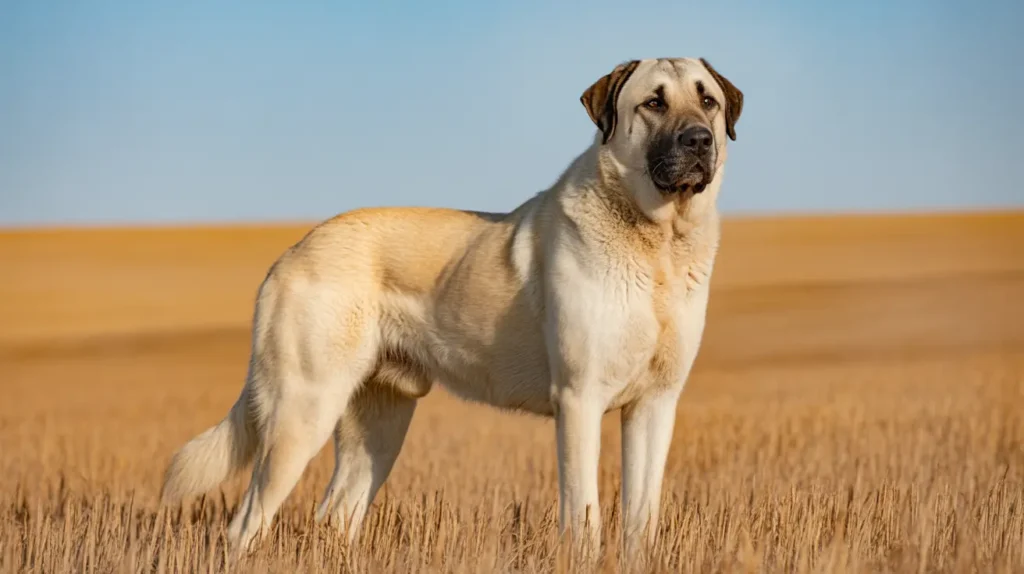
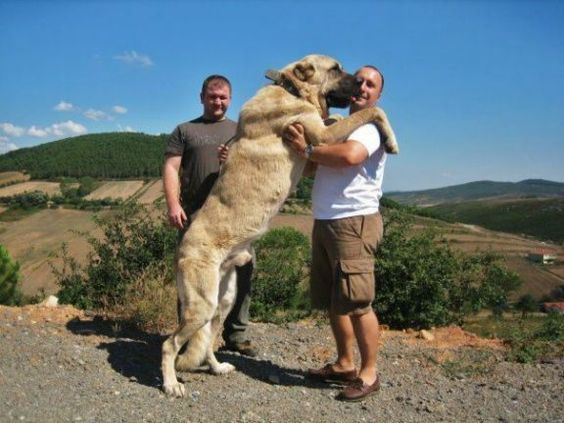
A giant Turkish flock guardian: powerful, calm, fearless and boundlessly devoted to its charges. The Kangal is a legendary livestock guardian able to stop a wolf or a bear; at home it is even-tempered and gentle with the family, but its strength and independence call for experience and space.
Apartment · not suitableKidsCats · with caveatsOther dogs · with caveatsBeginners · not suitable
The Kangal Shepherd Dog is an official Turkish breed and represents a true national treasure of the country. Breed enthusiasts argue strongly for its seperate identity from the Anatolian Shepherd, emphasising the unique genetic purity of the lineage from the Sivas province. These purebred dogs have not been mixed with other breeds for centuries, thereby preserving their primal qualities. Incredible physical power, bordering on phenomenal endurance, and innate courage led to the use of Kangals for guarding flocks against the most dangerous predators. The freedom-loving Kangal will zealously guard its entrusted territory, but will never tolerate a chain or confined indoor living. Its warm double coat allows it to endure the bitter, freezing winters of the Anatolian plateau. Representatives of the breed are relatively low-maintenance but require a firm hand and persistent training. Learn more on Tvaryny.
The Kangal: A brief breed overview
The Kangal: A brief breed overview · 8
Characteristic
Indicators and Data
Country of Origin
Turkey (Kangal region, Sivas province)
Purpose
Flock guardian, watch dog
Life Span
12–15 years
Height (Males)
74–85 cm (occasionally up to 89 cm)
Height (Females)
71–79 cm
Weight (Males)
50–65 kg (some individuals up to 75 kg)
Weight (Females)
40–55 kg
Coat Type
Short to medium length, dense, with a thick undercoat
Interesting facts about the Kangal
Bite force. The Kangal possesses the strongest bite amongst all dog breeds in the world. Its jaw pressure can reach 743 PSI (pounds per square inch), which exceeds the bite force of a lion.
"Wolf killer". In Turkey, they are called "Kurtboğan", which means "the one who strangles the wolf". This is no exaggeration - an adult male is capable of handling a predator single-handedly.
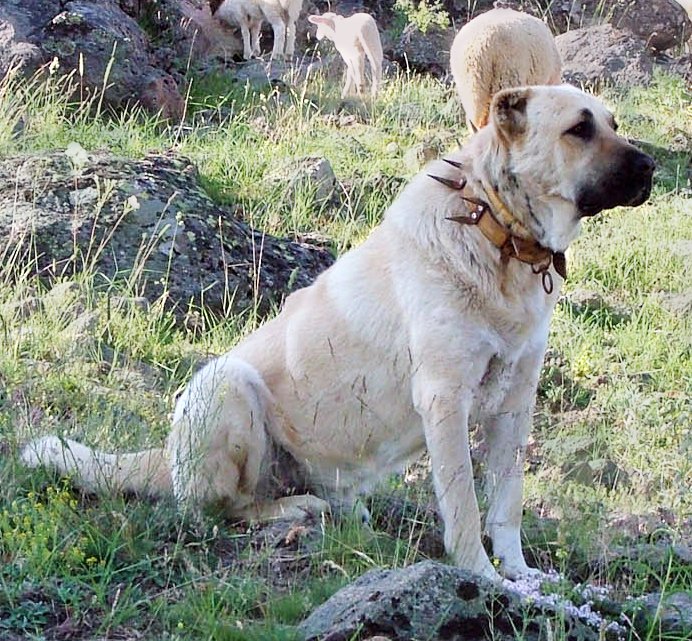
Special collar. Traditionally, massive collars with outward-facing spikes are put on Kangals. This is done not for beauty, but to protect the dog's throat in a fight with wolves.
Speed. Despite its size, the Kangal can reach speeds of up to 50–55 km/h over short distances.
History of the breed
The Kangal Karabash is a living legend of Turkey and the only breed amongst local dogs officially recognised in the country as holding the status of a state treasure. It has been declared a national heritage, and images of these giants can be found on Turkish Lira coins and postage stamps. The history of these animals is rooted in deep antiquity, dating back to the times of Babylon and Assyria, although the main centre of the breed's formation is the Sivas region in Central Turkey.
The breed's name derives from the town of Kangal, where a well-known dynasty of landowners bred these dogs for centuries to protect flocks from wolves, jackals, and even bears. Unlike many European shepherds, the Kangal developed under conditions of strict isolation. This isolated development meant that the gene pool of the Karabash contains virtually no impurities from other breeds. This is a unique case of preserving an archaic type of Molosser in the modern world.
In the 1980s, the first representatives of the breed arrived in the USA thanks to enthusiasts Nelson and Judith Nelson, marking the beginning of their journey into Western countries. However, Turkey jealously guards its heritage: the export of a purebred Kangal Karabash outside the homeland is strictly regulated and often prohibited by law without special permits. Therefore, encountering a genuine, aboriginal Kangal outside of Turkey is an exceptional event for any cynologist.
What the Kangal looks like: appearance description
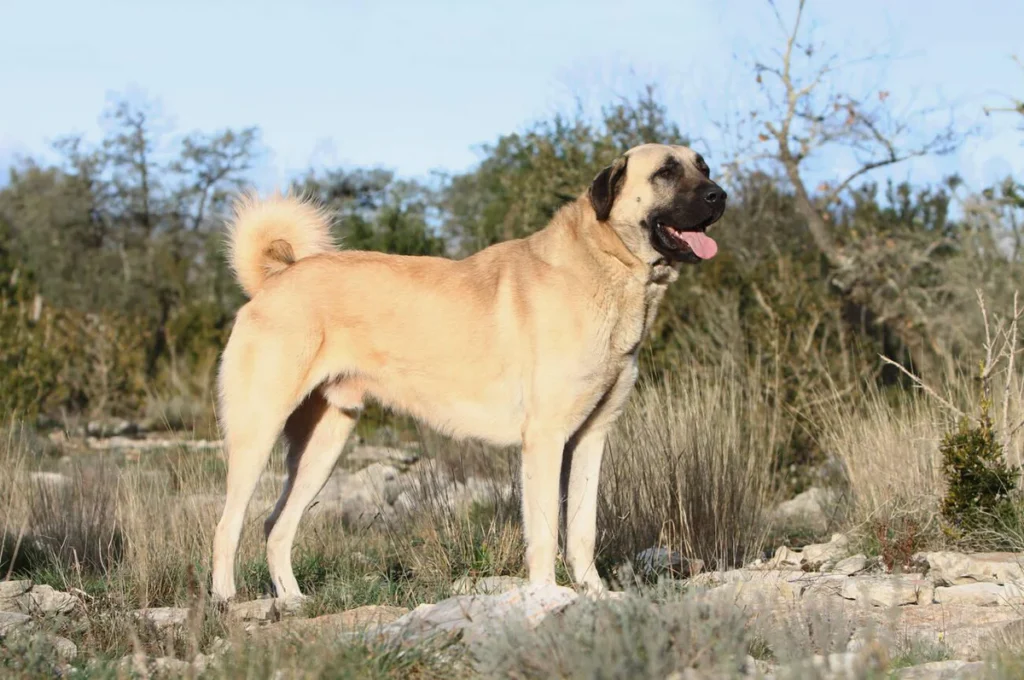
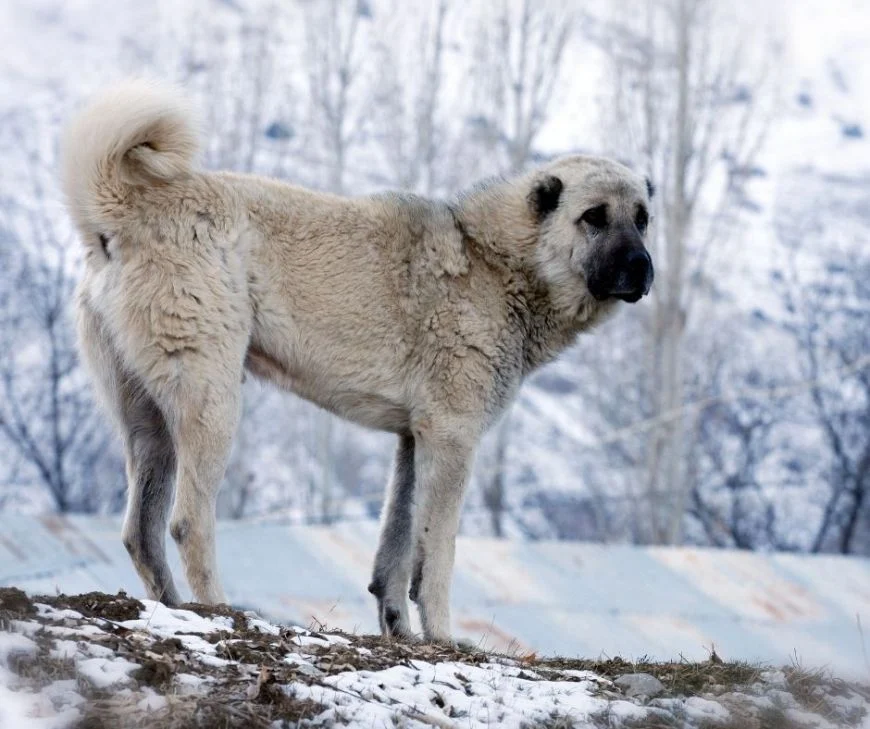
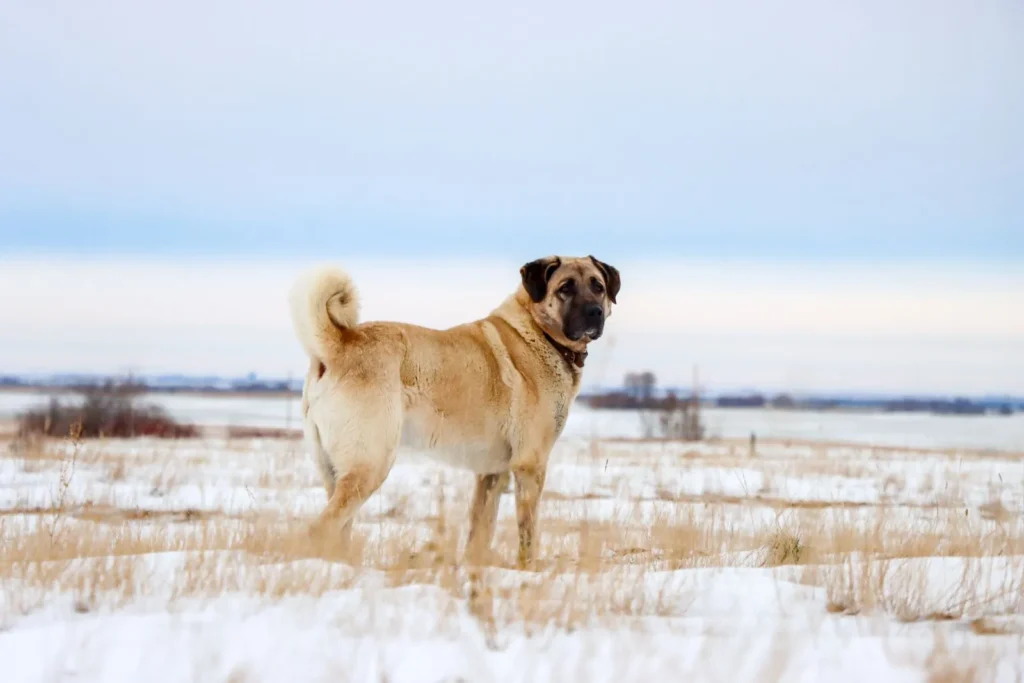
The Kangal Karabash is a mighty dog whose appearance radiates quiet strength. The breed's main calling card is the "Karabash", which translates from Turkish as "black head". The presence of a black mask on the muzzle is a mandatory sign of pure breeding.
Head and Body
The Kangal has a massive, broad head, proportional to the body, with a barely noticeable transition from forehead to muzzle. The jaws are powerful, with a scissor bite. The ears are triangular, medium-sized, with rounded tips. In a relaxed state, they hang down, lying close to the head, but when the dog is alert, they rise slightly, turning towards the source of the sound. Historically in Turkey, ears were often cropped so that a wolf could not grab them, but this practice is now banned in the UK and many European countries.
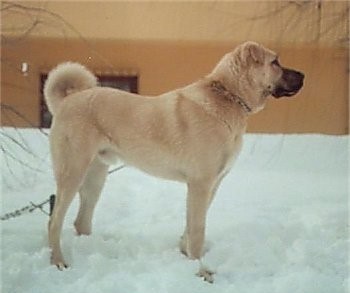
The animal's body is slightly stretched, with well-developed muscles covered by thick fur. The chest is deep, reaching down to the elbows, which provides a large lung volume for prolonged running. The dog's long, bushy tail is another indicator of mood: at rest, it is lowered and slightly curled at the tip, but when excited or in motion, it is raised high and curled into a tight circle over the back.
Coat and Colour
The colour of the short but very dense coat varies in different shades of brown: from light dun (fawn) to dark grey or tan. An important detail is that the coat has a double structure: stiff guard hair and an extremely dense undercoat, which protects the dog from both +40°C heat and -30°C frost. The robust physique of the breed reveals their physical power and stamina, whilst the coat structure makes them invulnerable to adverse weather conditions.
Dog lovers often confuse the Kangal with other Turkish breeds. For example, the snow-white Akbash dog is a completely different breeding line, although it performs similar functions. There is also confusion with the term Anatolian Shepherd Dog (Karabash), which in the West is often considered a generalised name, whereas Turkish experts insist on the uniqueness of the Kangal specifically.
Character: temperament and behaviour
Self-reliance, courage, and independence are the leading character traits of the Kangal Karabash. This is a dog with a distinct sense of its own dignity. It will not fetch a ball a hundred times or fawn over its master. The Kangal is a partner, not a servant. To ensure these qualities do not hinder the relationship with humans, a puppy should be trained from an early age, establishing a clear hierarchy.
Territorial instinct. In the Kangal, this is developed to the maximum. This makes him an ideal guard. He clearly knows the boundaries of his plot and will not let a stranger pass without the owner's permission.
Composure. Unlike many working breeds, the Kangal is not prone to unnecesary aggression or hysteria. It attacks only as a last resort when the threat is real. The dog bravely enters a fight with a wolf or jackal and can scare off a bear, but will never touch a small dog or a child if they do not pose a threat.
Attitude towards the family. The Kangal adores "its" pack (the owner's family, children, other pets) and takes them under its wing. It allows children many liberties, but leaving a huge dog alone with toddlers is still not advisable due to its sheer size.
Off-duty, it behaves peacefully and often seems like a phlegmatic lounger. But without work, it falls into depression or becomes aggressive from boredom. The Kangal Karabash needs freedom of movement, socialisation, and authority in upbringing. This is a serious dog for serious people.
Training and socialisation
A Kangal puppy must grow up alongside people and other animals - this will save the owner from trouble in the future. Early socialisation (trips to the town, meeting guests, other dogs) will contribute to discipline, which should be established firmly and consistently. The independent nature of the dog demands authority from the owner, but not cruelty. The Kangal does not tolerate physical punishment - it will only destroy trust.
The Kangal Karabash is a working breed, so it lends itself well to training, but do not expect the automatic obedience of a German Shepherd. The Kangal always thinks before executing a command. If he considers the command senseless, he may ignore it. A basic obedience course is mandatory.
It is worth mentioning that other rare shepherd dogs with complex characters exist in the world. For example, in Spain, the Can de Palleiro is used for guarding, as well as the lesser-known but interesting Can Guicho (Quisquelo). Although they are smaller than the Kangal, the principles of raising independent herders are similar - respect and consistency.
Pros and cons of the breed
Pros of the breed
Cons and difficulties
Incorruptible guard: You won't find a better protector of territory.
Not for a flat: Requires a large territory and a secure fence.
Stable psyche: Does not bark without reason, calm in the home.
Tendency to dominate: Requires an experienced owner capable of being a leader.
Low maintenance: Coat is self-cleaning, tolerates any climate well.
Heavy shedding: Twice a year it "dumps" a huge amount of fur.
Robust health: One of the healthiest breeds amongst giants.
Socialisation: Without early introduction to the world, can become dangerous to others.
Love for children: Very patient with "its" children.
Aggression towards strange dogs: May perceive other large dogs as rivals or a threat.
Coat care and housing
Living in a flat is an absolute contraindication for keeping a Kangal Karabash. Even in a private house, it will lack space and freedom if the plot is too small (less than a quarter of an acre). Kangals are kept in a spacious courtyard, enclosed by a high fence (minimum 2 metres), where the dog will inhabit and guard "its" territory. The fence must be sunk into the ground, as the Kangal loves to dig holes and may tunnel underneath.
However, having a yard does not replace walks and training outside the territory for a working breed. Physical exertion for the Kangal Karabash is no less important than nutrition and rest. The dog must categorically not be kept on a chain. From this, the proud animal becomes embittered, unmanageable, and suffers physically.
Hygiene
Its thick coat sheds very heavily seasonally (in spring and autumn). During this period, brushing becomes a daily necessity. At other times, it is enough to brush the dog once or twice a week with a special comb or furminator for large breeds. You should not bathe your pet often, as its coat has water-repellent properties and a protective layer of oil. You should regularly clean its ears (as the hanging shape promotes the accumulation of dirt) and check the coat for ticks and parasites after walks in the fields.
Nutrition
Nutrition: key recommendations
Health and risks
Health: typical diseases and prevention
Frequently Asked Questions (FAQ) · 3
Is a Kangal suitable as a first dog? No, categorically not recommended. This breed requires an experienced owner who understands the psychology of dominant dogs.
Can a Kangal be kept with other dogs? Dogs of opposite sexes usually get along well. Two male Kangals on one territory will constantly settle scores, which can lead to serious fights. With small breeds (if the Kangal grew up with them), problems usually do not arise - he simply ignores them.
How much does an adult Kangal eat? Surprisingly little for its weight. An adult dog needs approximately 1.5–2 kg of natural food or 600–800 grams of dry food per day (depending on activity).
Video about the breed
FAQ
Is the Kangal aggressive?
Not towards its family and charges — it is calm and gentle; its job is to deter predators, so it is wary of strangers. Socialisation and an experienced owner are needed.
Can the Kangal live in a flat?
No — a giant working guardian that needs space, work and territory; the city and cramped quarters do not suit it.
How does the Kangal differ from a shepherd dog?
The Kangal is not a herder but a guardian (LGD): it lives with the flock and protects it from predators rather than driving it on command.