Tvaryny ›
Dogs ›
Central Asian Shepherd Dog (Alabai)
Group 2 · molossoids · Central Asia
Central Asian Shepherd Dog (Alabai)
An ancient guardian giant of the steppes: independent, fearless, a devoted protector of flock and family. It makes decisions on its own, so it needs a very experienced owner, space and early socialisation — not for a flat and not for a novice.
Apartment · not suitableKids · with caveatsCats · with caveatsOther dogs · not suitableBeginners · not suitable
Fearless, loyal, and self-assured giants – that's precisely what Central Asian Shepherd Dogs, also known as Alabai, are. This is one of the most ancient dog breeds, with a history spanning millennia. They are not just pets, but reliable guardians and faithful companions, albeit with a very strong character. This detailed overview will help you understand the profound depth and multifaceted nature of this unique breed. Find out more on Tvaryny.
An Alabai is certainly not a dog for a novice owner. Their upbringing demands a firm hand, boundless patience, and a deep understanding of the psychology of livestock guardian dogs. They are inherently bred to protect territory and their "pack," meaning their instincts will always take precedence. For individuals entering their domain without the owner, they can be just as dangerous as they are to wild animals. However, for their own family, they are an affectionate and devoted friend.
General Information and Characteristics of the Alabai Breed
General Information and Characteristics of the Alabai Breed · 12
Breed Name
Central Asian Shepherd Dog (CASD), Alabai, Turkmen Wolfhound
Country of Origin
Territories of Central Asia (Turkmenistan, Uzbekistan, Kazakhstan, Kyrgyzstan, Tajikistan)
Time of Breed Origin
Over 4000 years
Type
Guard Dog, Herding Dog
Lifespan
12–15 years
Height (at Withers)
Males: from 70 cm, Females: from 65 cm
Weight
Males: 50–79 kg, Females: 40–65 kg
Temperament
Calm, independent, confident, fearless, proud
Physical Exercise Needs
Moderate (requires long walks, not intensive training)
Trainability
Moderate (intelligent, but stubborn and independent)
Attitude Towards Children
Good (with proper upbringing and constant supervision)
Attitude Towards Other Animals
Can be aggressive towards other dogs, especially of the same sex
Interesting Facts About the Central Asian Shepherd Dog
In its homeland, Turkmenistan, the Alabai is a national treasure, and its export from the country is strictly controlled.
Historically, "test fights" of Alabais were conducted in Central Asia. Their goal was not to kill or injure the opponent, but to determine the strongest-willed dog. Cowardice was considered the worst fault.
Alabais have a unique attack style: unlike many dogs that grab limbs, they try to knock the opponent off their feet with a body blow and latch onto the neck or head.
In different regions, the breed has its own names and some differences in exterior. For example, in Kazakhstan, they are called "Tobet."
The history of the Central Asian Shepherd Dog isn't one of modern selective breeding. Instead, it's a tale of natural selection spanning over four millennia across the vast territories from the Caspian Sea to China. These dogs were indispensable helpers to nomadic tribes engaged in livestock farming. Their primary role was to protect flocks of sheep from predators (wolves, bears) and to guard settlements from strangers.
Harsh living conditions shaped the breed's unique characteristics. Only the strongest, most resilient, and most intelligent individuals survived, capable of making independent decisions in extreme situations. The dogs had to contend not only with predators but also with a brutal climate: scorching days, freezing nights, and drastic temperature fluctuations. They adapted to scarce food and limited water supplies.
Purposeful breed development began only in the USSR during the 20th century. These dogs started to be used for guarding military and state facilities. The first breed standard, defining its key characteristics, was approved in 1989 by the Fédération Cynologique Internationale (FCI). Even today, Alabais living in remote areas of Central Asia retain their primal traits, having changed little over thousands of years.
What a Central Asian Shepherd Dog Looks Like: Breed Standard
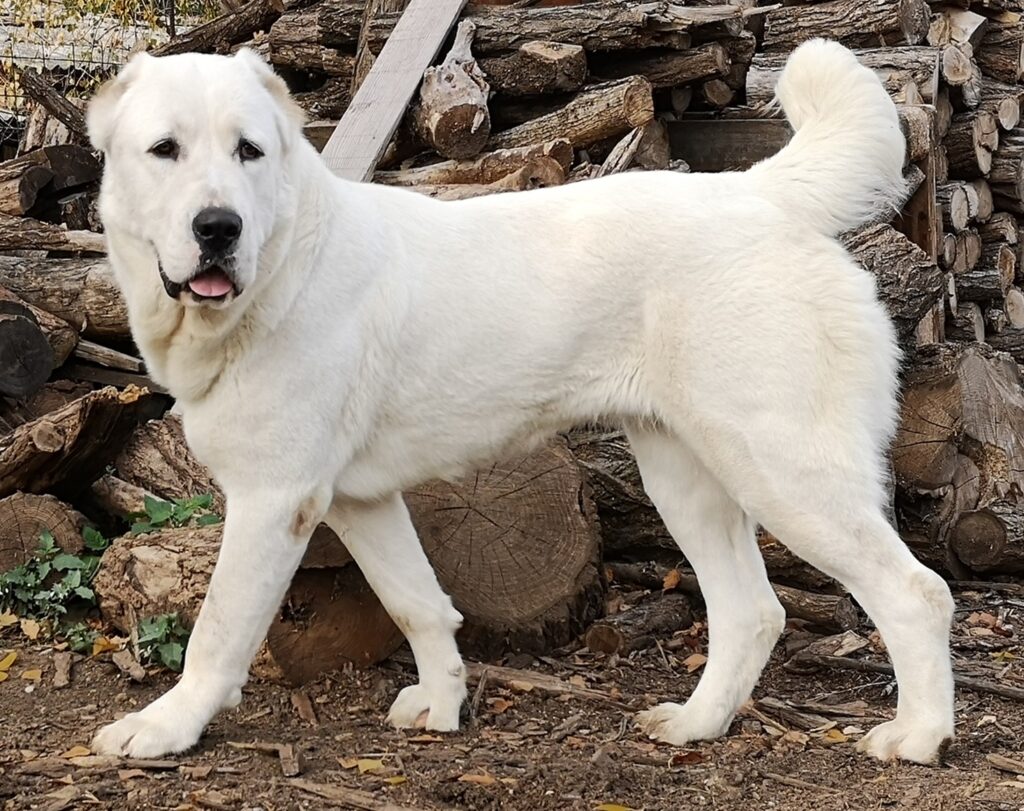
The Alabai is a large dog with a harmonious and powerful build. Its appearance exudes strength, confidence, and calmness. Every element of its exterior testifies to its purpose – to be a tireless guardian.
Head: Massive, proportionate to the body, with a broad and flat skull. The stop (transition from forehead to muzzle) is smooth. The muzzle is voluminous, blunt, not pointed.
Eyes: Small, rounded, set wide apart. Colour – from light hazel to dark brown. The gaze is confident, stern, "from under the brow."
Ears: Low-set, triangular, pendulous. Historically, ears and tails were cropped to prevent injuries in clashes with predators. In many countries today, cropping is prohibited.
Body: Powerful, with a broad and deep chest. The back is straight and strong. The neck is short, muscular, often with a pronounced dewlap (fold of skin).
Limbs: Straight, parallel, with massive bone structure and well-developed musculature. Paws are large, oval, well-knuckled.
Tail: High-set, saber-shaped, thick at the base. Carried low in repose, raised to back level or higher when excited.
Coat: Coarse, straight, with a dense undercoat. Comes in two types: short (3–5 cm) and long (7–10 cm), forming a mane on the neck and "trousers" on the hind legs.
Colour: Any colour is permissible, except for genetically blue, brown, and saddle-patterned. The most common are – white, black, grey, fawn, red, brindle, and their combinations.
Character and Temperament of the Alabai
The Alabai's character is its calling card. It is calm, balanced, and utterly fearless. These dogs are not prone to fussiness or indiscriminate barking. They conserve energy, observing the world around them and analysing situations. However, if an Alabai decides its territory or family is in danger, it will act instantly, decisively, and without warning. Its attack is formidable and effective, making it one of the best guard dogs in the world.
It's crucial to understand that the Alabai is a dog with a strongly expressed territorial instinct. It considers its own all the territory it can control. Towards strangers, it will always be distrustful and wary. At the same time, for members of its family ("pack"), it is an affectionate and patient giant. They generally get along well with children, perceiving them as objects of protection, but due to their size and strength, any interaction with a child must occur under strict adult supervision.
Independence and a propensity for independent decision-making are another key trait. Unlike working breeds that wait for a command, an Alabai will first assess the situation itself. This characteristic makes training more challenging but simultaneously proves its high intelligence. Its character can be compared to other large guardian breeds, such as the Caucasian Shepherd Dog, but the Alabai is considered more balanced and less "explosive."
Pros and Cons of the Central Asian Shepherd Dog Breed
Pros and Cons of the Central Asian Shepherd Dog Breed · 7
Pros (+)
Cons (-)
Exceptional guarding qualities
Categorically unsuitable for apartment living
Balanced and stable character
Requires an experienced and strong-willed owner
High intelligence and ability for independent decisions
Stubbornness and independence in training
Loyalty to family and patience with children (under supervision)
Tendency to dominate and test owner's authority
Unpretentious regarding living conditions and diet
Can be aggressive towards other dogs and animals
Robust health and endurance
Requires early and prolonged socialisation
Simple coat care (doesn't require frequent washing)
Sheds heavily seasonally
Training and Socialisation
Training a Central Asian Shepherd Dog is the most crucial aspect of its ownership. Without proper upbringing, this dog can become uncontrollable and dangerous to others. The main rule: the owner must be the undisputed leader for the Alabai, the "pack alpha." This can be achieved not through physical force, but through confidence, consistency, and calmness.
Early Socialisation: From puppyhood, an Alabai needs to be introduced to various people, sounds, places, and other (calm, importantly) dogs. This will help them react appropriately to new situations in the future.
Establishing Hierarchy: The dog must clearly know its place. It eats after people, doesn't sleep on the owner's bed, and enters doors last. This isn't cruelty, but clear "pack rules" for the dog to understand.
Consistency: Prohibitions must be constant. If something isn't allowed today, it's not allowed tomorrow either. All family members must adhere to the same rules.
Learning Through Respect: Alabais react poorly to shouting and physical punishment. They respect calm strength and fairness. Training should be based on positive reinforcement and clear commands. Their stubbornness is akin to that shown by a Rottweiler, so patience is key.
Professional Help: It is highly recommended to complete a general obedience course and a "Dog in the City" course under the guidance of an experienced cynologist who is familiar with the peculiarities of large guardian breeds.
Remember, an Alabai will always try to test your authority, especially during adolescence (9–18 months). Your task is to calmly and confidently reaffirm your leadership position.
Care and Maintenance of the Alabai
The ideal environment for keeping a Central Asian Shepherd Dog is a private house with a large, securely fenced area. The fence must be high and strong, as an Alabai will consider everything it sees as its property and may attempt to expand its "dominions."
Keeping them in a flat is highly undesirable. These dogs need fresh air and space. The confinement of apartment living can negatively impact their psyche and health. They require long (1–2 hours per day) walks at a calm pace, preferably in natural surroundings, rather than active ball games.
Caring for an Alabai is relatively straightforward:
Coat: Requires regular brushing (1–2 times a week) with a stiff brush. During seasonal shedding (spring and autumn), the procedure should be done daily to remove the large amount of undercoat.
Washing: Alabais should be bathed infrequently, only when absolutely necessary (1–2 times a year). Their coat has self-cleaning properties.
Ears and Eyes: Regularly check for dirt and inflammation. Clean as needed.
Claws: If the dog walks a lot on hard surfaces, its claws will wear down naturally. Otherwise, they need to be trimmed 1–2 times a month.
Nutrition
Nutrition: What to Feed a Central Asian Shepherd Dog
Health and risks
Health and Typical Diseases of Alabais
Frequently Asked Questions About the Breed (FAQ) · 6
Question · 6
Question
Answer
Is the Alabai suitable for a novice owner?
Definitely not. This breed requires experience, knowledge of dog psychology, a strong character, and a willingness to dedicate a lot of time to training.
How do Alabais get along with children?
With proper upbringing and early socialisation, an Alabai will be a patient and caring guardian for the children of its family. However, never leave a small child alone with such a large dog.
Can an Alabai be kept in a flat?
Highly unrecommended. This is a dog for outdoor keeping in a spacious, well-fenced area. A flat is like a prison for them.
Do Alabais bark a lot?
No, they are not prone to indiscriminate barking. Usually, their deep, bassy bark is a warning about a stranger approaching their territory.
How does an Alabai get along with other animals?
Can be very aggressive towards unfamiliar dogs, especially of the same sex. Towards animals with which it grew up in its "pack" (cats, other dogs), it can be tolerant.
How does the Alabai differ from the Caucasian Shepherd Dog?
Although the breeds are similar in purpose, the Alabai is considered calmer, more balanced, and quieter. The Caucasian Shepherd Dog is often more "explosive," distrustful, and aggressive towards strangers.
Video About the Breed
FAQ
Can the Alabai be kept in a flat?
Absolutely not — a guardian giant that needs space and territory to protect. A flat contradicts the very nature of the breed.
Is the Alabai suited to a novice?
No — its independent character, strength and guarding instinct call for a very experienced owner, firm leadership and early socialisation.
Is the Alabai aggressive?
It is not aggressive without reason, but it resolutely defends its territory and family. The key is socialisation and the owner's control, not a chain.