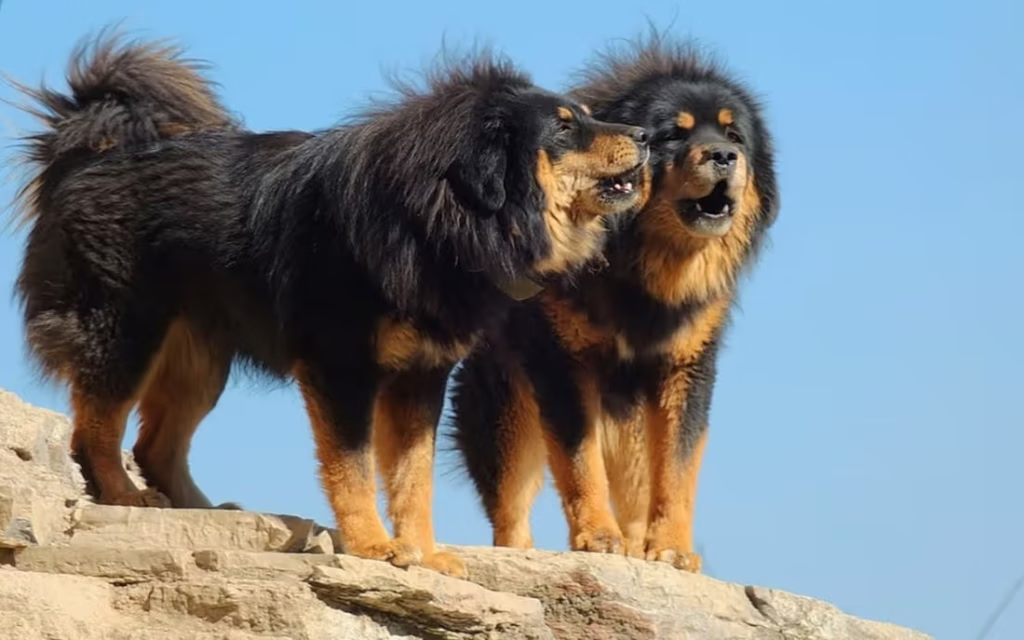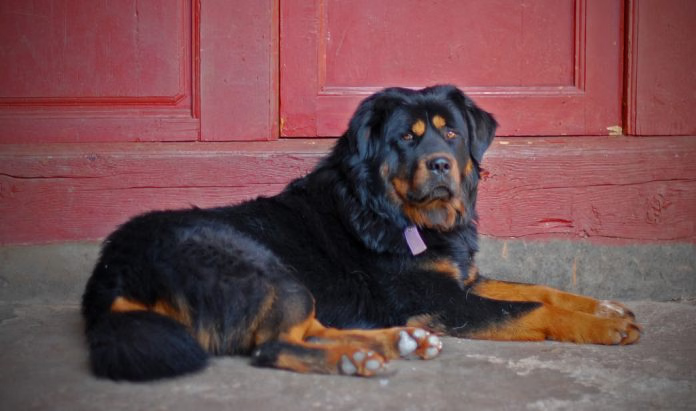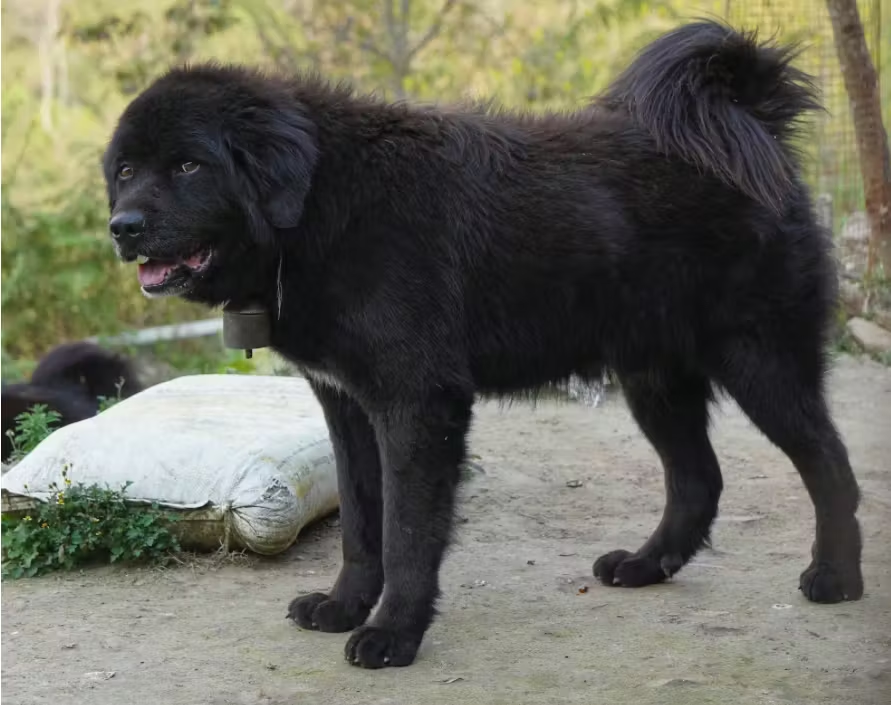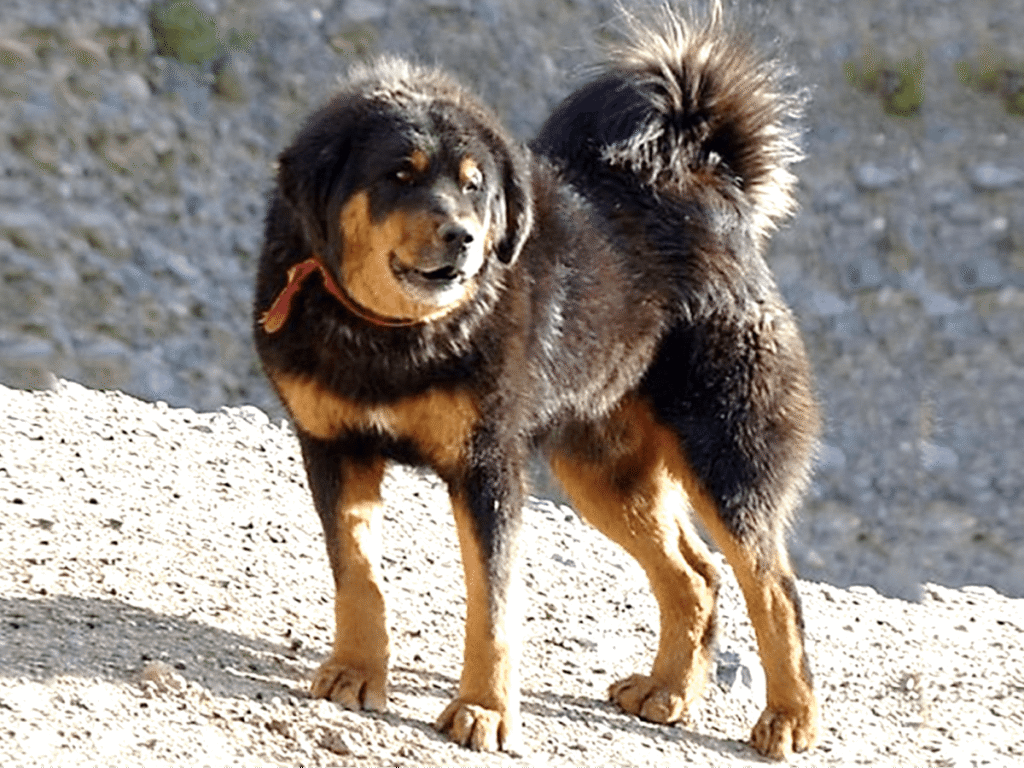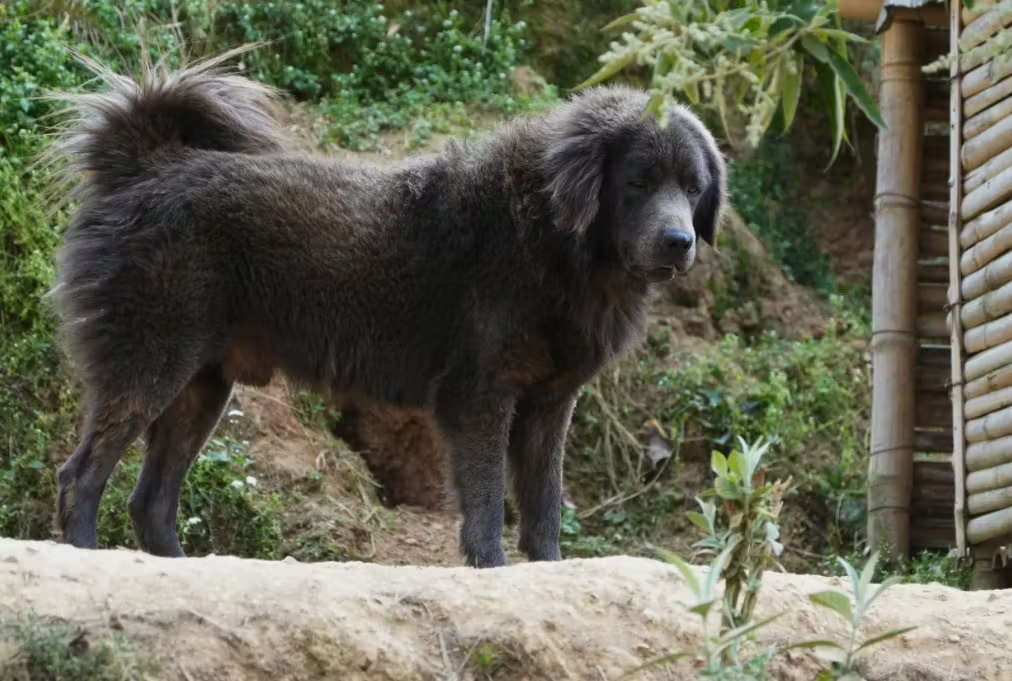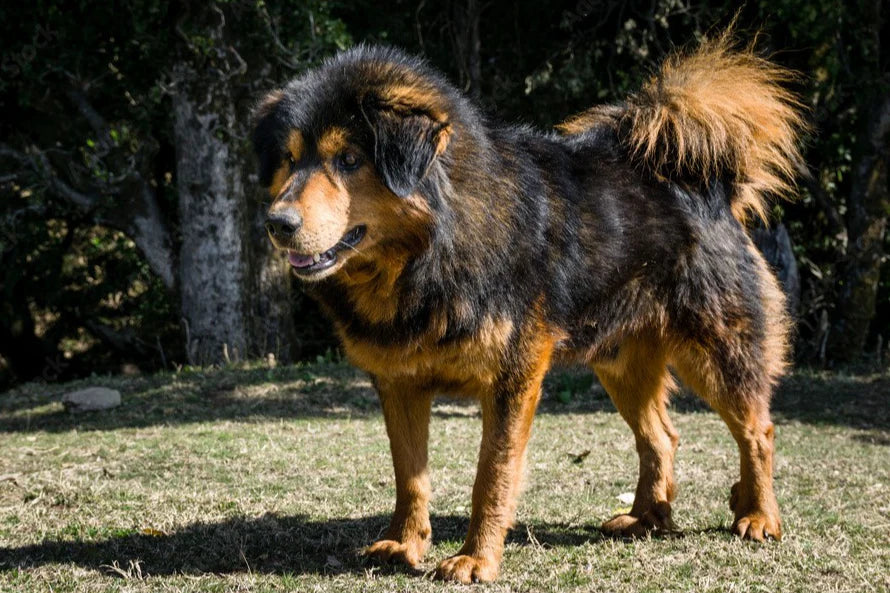
The Himalayan Sheepdog (Gaddi Kutta) is a majestic and powerful breed that has stood for centuries as an unshakeable guardian in some of the harshest conditions on our planet. These dogs are not merely shepherds, but true symbols of endurance and loyalty, shaped by the thin air and steep slopes of the Himalayas. Find out more on Tvaryny.
One caveat before we go any further. This is not a "breed" in the sense a British reader normally means the word — not in the way a Labrador Retriever or a Border Collie is a breed. It is a landrace: a living population of working dogs shaped not by breeders, judges and stud books but by the wolf, the snow leopard, the cold and the daily necessity of keeping a flock alive at three or four thousand metres. That single fact colours everything that follows. In different valleys the dog is called by different names, measured to different figures and described in different terms, and any honest article has to say so rather than paper over the cracks. What follows sets out what is genuinely known, where the sources disagree, and what owning one would actually mean for somebody living not in the Himalayas but in Britain.
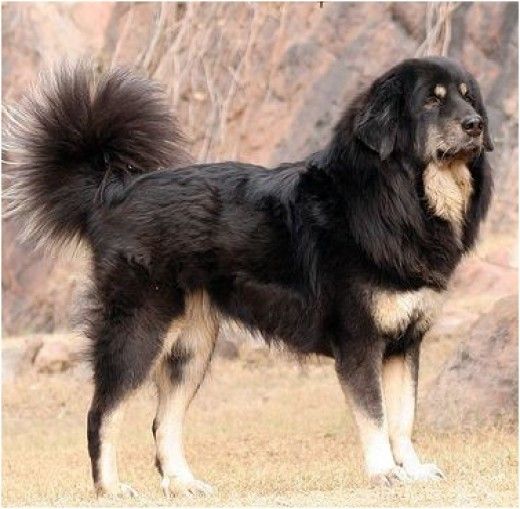
Himalayan Sheepdog: a brief breed overview
Himalayan Sheepdog: a brief breed overview · 6
| Country of origin | India, Nepal (Himalayan region) |
|---|---|
| Size | Large (51–66 cm at the withers) |
| Weight | 27–40 kg (individual specimens can be heavier) |
| Coat type | Long, coarse, with a thick undercoat |
| Living conditions | Private house with grounds only |
| Lifespan | 10–13 years |
Treat that table as a deliberately cautious summary. Further down you will find a second one with noticeably different figures, and that is not a mistake on our part: a landrace has no single standard, so every source measures whatever sample of dogs it happened to see. We have therefore set the main sources side by side so you can judge the spread for yourself.
One breed or four? Untangling the names
This is the central puzzle of the Himalayan Sheepdog, and nothing else in the article makes sense without it. Start reading around the subject and you will meet at least six names, all of them attached, in one way or another, to the same type of dog:
- Himalayan Sheepdog — the bookish, encyclopaedia name in English. It is the label under which the dog appears in breed dictionaries, and the one we use here.
- Bhotia / Bhutia / Bhote Kukur — the everyday name in the Indian state of Uttarakhand, in Nepal and across the eastern Himalayas. The root "Bhot" means Tibet and people of Tibetan descent, so in a Nepali or Garhwali mouth the word means, quite literally, "Tibetan dog".
- Gaddi Kutta / Gaddi dog — the dog of the Gaddi people of Himachal Pradesh, on the Dhauladhar and Pir Panjal ranges. Locally it is nicknamed the Gaddi Leopardhund; the English-language press prefers "Indian Panther Hound".
- Bangara (Bangara Mastiff) — a name tied to the Tehri Garhwal district. Some sources treat the Bangara as the very same dog; others insist it is a separate, heavier, more massive type, kept to guard yaks and homesteads rather than to work sheep.
- Himalayan Mastiff — a commercial name, popular with anyone selling puppies, because "mastiff" sounds weightier than "sheepdog".
- Pahadi Kutta — simply "mountain dog" in Hindi, applied to any large hill dog with no reference to type at all.
Breed dictionaries generally list Bhotia, Bangara, Gaddi Kutta and Himalayan Mastiff as synonyms for one breed. The people who actually live with these dogs are not so sure. In the hills there is a long-running argument about whether the Bhotia and the Gaddi are two varieties of one dog or two different dogs pushed towards a common shape by a common job. The case for separating them is physical enough: the Gaddi has a markedly heavier, arched neck and a pronounced, almost leonine ruff, whilst the Bhotia is lighter, finer in the muzzle and shorter-coated about the head.
In early January 2025 the bureaucracy settled part of the argument. India's ICAR-NBAGR — the National Bureau of Animal Genetic Resources, part of the Indian Council of Agricultural Research, based at Karnal — registered the Gaddi as a distinct indigenous breed under its own name. Reports give different days for the decision (the 6th or the 9th of January, and one account places it in 2024 altogether), so the precise date is best treated as unsettled. The substance, though, is not in doubt: administratively, in India, the Gaddi now exists separately from the Bhotia.
What does that mean in practice for a reader? If somebody offers you a "Himalayan Sheepdog", ask where the parents came from and what the people who worked with them called them. A Gaddi from Himachal Pradesh, a Bhotia from Uttarakhand and a Bhote Kukur from Nepal are not identical dogs, even though all three belong to the same Himalayan guardian type.
Recognition: no FCI number, and no place on the Royal Kennel Club's register
Here we have to be blunt, because this is the question that comes up most often. The Himalayan Sheepdog is not recognised by the Fédération Cynologique Internationale. It does not appear in the FCI nomenclature, it has no standard number, and it belongs to no group and no section. It is equally unrecognised by the American Kennel Club, by the United Kennel Club and — the point that matters most to a British reader — by The Royal Kennel Club, the body that has governed pedigree dogs in this country since 1873 and which took the royal prefix from King Charles III in 2023. Not one of the world's leading canine organisations holds a standard for this dog.
That is not a gap in our research, and it is not a case of "they haven't got round to it yet". It is a statement of status, and it has concrete consequences. Formal recognition requires a stable population of known ancestry, a written standard, a sponsoring breed club and a stud book that somebody actually keeps. A landrace has none of those things — and remains a landrace precisely because nobody in the hills has ever had reason to keep them.
What the Royal Kennel Club's rules actually say
The RKC does have a route for foreign breeds it has never registered before: the Imported Breed Register. Read the policy, though, and you can see the Himalayan failing at almost every hurdle. A breed proposed for that register is expected to come from a country whose national registry either holds a reciprocal agreement with the RKC or has full FCI membership, or else to have a breed club maintaining a stud book that the RKC finds acceptable; there should ideally be a meaningful number of unrelated dogs already resident in the UK; three-generation pedigrees are expected; and the breed should already be recognised in its country of origin. The Gaddi has an agricultural genetic-resource registration and a veterinary college taking measurements — it does not have a stud book with three generations behind it. The Board also reserves the right, in its absolute discretion, to refuse to recognise any proposed breed. In plain English: this dog is not going onto the Breed Register, and there is no realistic prospect of it doing so soon.
So, for anyone in Britain, the position is this. No RKC registration and no pedigree. No breed classes, no championship shows, no Crufts — there is no standard against which a judge could assess the dog and no class into which he could be entered. What is available is the Activity Register, which exists for dogs of any breeding, pedigree or not, and lets them compete in Kennel Club licensed obedience, agility, rally, working trials, flyball, heelwork to music and canicross. Whether a Himalayan guardian would want to do any of those things is another matter entirely, but the door is at least not bolted.
Two separate movements are worth keeping apart, because they are easy to conflate:
- The agricultural channel (India). The ICAR-NBAGR registration recognises the Gaddi as a national genetic resource, in the same system that registers breeds of cattle, buffalo and sheep. It is not a kennel standard, it confers no international pedigree, and it does not put the dog into anybody's stud book. What it does do is open the way to state conservation programmes. Before the Gaddi, only three dog breeds had been registered there: the Rajapalayam and the Chippiparai from Tamil Nadu and the Mudhol Hound from Karnataka. The Gaddi became the fourth — and the first from the Himalayas.
- The club channel (Nepal). Nepali sources report that in 2025 a body calling itself the International Kennel Club recognised the Bhote Kukur as a distinct breed, and that the Bhote Kukur Club of Nepal has begun drafting a standard and registering dogs. Context matters here: this is not one of the leading world federations, so the weight of that recognition should not be overstated. As a first step towards documenting a population, however, it counts for something.
The scientific base is slowly filling in as well. Since 2019, staff at the veterinary college in Palampur, Himachal Pradesh, have been carrying out phenotypic and molecular characterisation of the Gaddi; the material was submitted to NBAGR in 2022 and formed the basis of the registration. That matters more than it sounds. Somebody has finally started measuring this dog rather than merely retelling stories about him.
A pedigree of altitude: the mastiff, the wolf and the EPAS1 gene
Life at altitude is not a question of stamina but of biochemistry. The air at 4,000 metres holds roughly forty per cent less oxygen than air at sea level, and an ordinary dog does not work up there so much as endure. Molecular work over the past decade has shown how the dogs of the Tibetan Plateau solved the problem.
The key player is EPAS1, a transcription factor that switches on when oxygen runs short. Studies published in Molecular Biology and Evolution and in PeerJ established that high-altitude domestic dogs did not evolve their "altitude" variants of this gene from scratch: they acquired them by introgression from the Tibetan grey wolf — ancient hybridisation, after which the useful variant was locked in by selection. The dating puts that event somewhere around 24,000 years ago. A separate strand of work found a similar story for haemoglobin, where adaptive changes in function in high-altitude Tibetan canids arose through gene conversion and introgression rather than from new mutation.
An important caveat, and we would rather state it plainly than let it pass. That research was carried out on the Tibetan Mastiff and on Tibetan Plateau dogs generally; the Himalayan Sheepdog does not appear in it as a separate sample. We cannot claim that the Bhotia carries the same EPAS1 variants. What we can say is that he lives in the same oxygen regime, comes from the same pool of Asian molossoids and has been subject to the same selection — which makes the inference more than reasonable. It is offered here as an inference, and not as a fact about this dog.
The armoured neck, the mane and the "false eyes": anatomy as an instruction manual
The most interesting thing about this dog is that his appearance reads like a set of survival instructions. Every feature has an explanation, and nearly every one of them points at a single opponent.
- The heavy, arched neck. This is the Gaddi's signature, and researchers describe it in so many words as armour. A big cat kills by closing on the throat; a thick, short, strongly arched neck under a mass of coat denies the snow leopard that fatal hold. It is why the neck on these dogs is developed out of all proportion to the rest of the frame.
- The mane. A collar of long hair round the neck and over the shoulders, almost leonine in the Gaddi. It does two jobs at once: physical protection, and visual bulk. A dog with his hackles up in the dark looks a third bigger than he is.
- The double coat. A coarse outer coat sheds water and snow; a dense undercoat holds heat. This is not decoration, it is a thermal suit for sleeping out on bare rock below freezing.
- Drop ears. Less surface to be torn in a scuffle than an upright ear offers. The price is poorer ventilation of the ear canal — which becomes our problem in a damp British climate, not a Himalayan one.
- A deep, carrying bark. In the mountains this is a weapon that works at range: the voice rolls down the valley, warns the predator off, wakes the shepherd and brings the neighbouring dogs in. A guardian wins most of his fights without having one.
Then there are the pale spots above the eyes of black-and-tan dogs, the so-called "false eyes". Local belief holds that they let the dog keep watch even in his sleep. The rational reading is more prosaic: contrasting markings make the direction of gaze easier to read and, in the widely held view of herders, confuse an approaching predator. It should be said plainly, though — this is folklore and shepherds' observation, not the finding of any study.
A guardian, not a herder: chalk and cheese
Say "sheepdog" to a British reader and one picture appears immediately: a Border Collie flat to the ground on a Welsh hillside, eye locked on a ewe, working to a whistle. Set that picture aside. It is the wrong animal entirely. The Himalayan Sheepdog belongs to a different class of working dog — the livestock guardian — and the failure to grasp that distinction is behind most of the disappointment that new owners of guardian breeds run into.
A guardian, not a herder: chalk and cheese · 7
| Feature | Herding dog | Livestock guardian dog |
|---|---|---|
| What it does | moves the flock — gathers, sheds, drives, directs | lives inside the flock and repels the threat |
| What it runs on | a redirected hunting pattern (stalk, eye, outrun — minus the kill) | protective instinct; no predatory drive towards stock at all |
| Who is in charge | works to command, reading the handler constantly | works autonomously and makes its own decisions |
| How it is made | training and repetition of commands | early bonding with the stock from about eight weeks |
| Attitude to strangers | broadly neutral | suspicious by default |
| Peak activity | daylight, when the shepherd is working | night, when the predators come |
| Typical examples | Border Collie, German Shepherd Dog, Kelpie | Himalayan Sheepdog, Caucasian Shepherd, Central Asian Shepherd, Kangal, Maremma |
The line that matters most in that table is the one about autonomy. A guardian is not taught to guard. He is reared alongside the sheep from an age at which the predatory sequence has not yet consolidated, and he simply comes to regard the flock as family. From there he takes his own decisions: the shepherd sleeps, and the dog works out for himself whether that noise behind the rocks is worth getting up for. Thousands of years of selection on those terms have produced a dog who is used to having a view of his own — and that is a working characteristic, not a training fault.
The Himalayan does come with an interesting exception. Unlike most guardians, he is by several accounts also called on to help move stock, and here and there to hunt. The clean division of labour familiar from western Europe does not exist in the Himalayas: the dog does whatever is needed at the time. The main job, however, remains guarding — Nepali sources say outright that these dogs were traditionally bred to protect rather than to drive.
The working year: transhumance, the snow leopard and the night watch
To understand this dog's temperament, picture his working calendar. Gaddi herders practise transhumance — seasonal vertical migration. Winter is spent in the lower, milder foothills of the Shivalik range, around Kangra, Mandi and Hamirpur, picking over the stubble of harvested fields. In April and May the climb begins: thousands of sheep and goats move up through the passes of the Dhauladhar and the Pir Panjal to alpine pasture, where they graze all summer. In autumn they come back down. It is one of the oldest and most intricately organised pastoral routes anywhere in the world, and the dog walks every step of it from the first day to the last.
What is waiting for the flock up there? The snow leopard, the Himalayan wolf, the Himalayan black bear, and the common leopard at lower elevations. The Gaddi has a reputation for standing off a leopard — hence the "Indian Panther Hound" nickname. Nor is this purely folklore: a 2025 study assessing the Gaddi as a non-lethal means of deterring predators in the north-western Himalayas found these dogs to be the most effective non-lethal livestock-protection strategy available. That has a direct bearing on the snow leopard's own survival, since where the dog does his job the herder has no reason to reach for a gun.
And one further detail that any prospective owner should pin above the kettle: this is night work. Predators come in darkness, so the dog's peak of attention falls between dusk and dawn. A Himalayan Sheepdog dozes through the day, then patrols and gives tongue at every suspicious sound through the night. In the mountains that saves the flock. On a British housing estate it does something rather different to your relationship with the neighbours — a point we return to under the law, because in this country it is a legal matter as well as a social one.
Why Britain has no guardian dog of its own
Here is a question worth asking, and the answer explains a great deal about why this breed feels so foreign to British eyes. Britain is a sheep country. We have hefted flocks on the Cumbrian fells, Herdwicks and Swaledales that know their own ground without a fence in sight, Blackfaces on the Scottish hills, and a shepherding tradition rich enough to have produced the finest herding dog on earth. So why has it never produced a livestock guardian?
Because we killed the predators. The wolf was gone from England by roughly the end of the fifteenth century and from Scotland by some point in the seventeenth or eighteenth, depending on which account you prefer; the lynx and the bear had gone long before. For five hundred years the most formidable thing facing a British ewe has been a fox, a badger or somebody's loose Labrador — and against a fox you do not need forty kilos of Himalayan guardian. Take the predator away and the dog that guards the flock at night becomes redundant. What remains useful is the dog that gathers it in the morning. That is why British shepherding evolved towards the Border Collie and the whistle, and why the guardian breeds we do see here are all imports: the Pyrenean Mountain Dog, the Maremma Sheepdog, the Anatolian Shepherd Dog and the Estrela Mountain Dog, all recognised by the Royal Kennel Club and all sitting in the Pastoral Group alongside the collies whose job is the polar opposite of theirs.
The practical upshot for anybody weighing up a Himalayan Sheepdog is this: you would be importing not just a dog but an entire job description that Britain retired half a millennium ago. There is no flock in this country that needs defending from a snow leopard. That does not make the dog a bad dog. It does mean that everything he was built for will have to be replaced with something you invent for him — and inventing work for a guardian is a good deal harder than it sounds.
The Himalayan among Asia's other guardians
The quickest way to place this dog is to set him beside relatives a British reader may already have met — some of them in the show ring at Crufts, some only in print. Note in particular the recognition column, because it is the sharpest dividing line in the table:
The Himalayan among Asia's other guardians · 6
| Breed | Region | Recognition status | Size (male) | The key difference |
|---|---|---|---|---|
| Himalayan Sheepdog (Bhotia) | Himalayas: Uttarakhand, Nepal | recognised by no major registry | roughly 60–75 cm | lighter and nimbler than the mastiff; in places helps move stock as well as guard it |
| Gaddi Kutta | Himachal Pradesh, Dhauladhar | ICAR-NBAGR register, India, 2025 — as a genetic resource, not a kennel standard | 65–75 cm, about 39–45 kg | heavy arched "armour" neck and leonine mane; reputation for facing down a leopard |
| Tibetan Mastiff (Do-Khyi) | Tibetan Plateau | FCI No. 230, Group 2 (molossoid, mountain type) | markedly heavier and more massive | guarded monasteries and homesteads; heavily reshaped by show breeding in recent decades |
| Bakharwal | Jammu and Kashmir, Pir Panjal | recognised by no major registry | 61–76 cm | dog of the Gujjar-Bakarwal nomads; traditional diet almost without meat |
| Caucasian Shepherd Dog | Caucasus | FCI No. 328, Group 2 | very large, heavy | went through twentieth-century planned breeding; has stud books and show rings |
| Central Asian Shepherd Dog | Central Asia | FCI No. 335, Group 2 (definitively recognised 25.01.1989) | very large | the closest functional analogue: autonomous flock guarding in semi-desert |
The table tells the essential story. By job, the Himalayan Sheepdog is the sister of the Caucasian and the Central Asian Shepherd Dog. By status he stands quite alone: they have a standard, a number, a ring and a stud book; he has the mountains and the memory of the men who herded with him. As for the Tibetan Mastiff, with whom he is perpetually confused, the last half-century has taken the two in opposite directions — the mastiff has been shaped by demand for a spectacular exterior, whilst the Bhotia and the Gaddi are still being shaped by the wolf.
A landrace guardian in Britain: what you are actually taking on
We have written this section without varnish, because this is where things go wrong for dogs of this type. The Himalayan Sheepdog is not an exotic breed with a good backstory. He is a working tool lifted out of the environment that made him. Here is what that means in a British setting.
- Territoriality does not switch off. A guardian divides the world into his own and everybody else, and he does the dividing himself. The delivery driver, the neighbour, the man come to read the meter, the child who has nipped in after a ball — to him, all of these are incursions. The owner's job is not to talk the dog round but to manage access: doors shut, a separate room when visitors call, a sign on the gate.
- Wariness of strangers is breed-normal, not a training failure. Socialisation lowers the tension and makes reactions predictable, but it will not turn a guardian into a friendly Labrador. Anyone hoping for that conversion ends up disappointed, and the dog ends up punished for being what he is.
- Night activity. Barking at two in the morning at a cat in the shrubbery is not a foible, it is the job. On a hill farm nobody minds. In a suburb it means complaints, a visit from environmental health and a very sour street. Weigh that up before you buy, not afterwards.
- He needs something to be responsible for. A guardian has no use for agility or flyball; he needs an object of responsibility. Ground to patrol, a smallholding, stock if you have any. Without it he either sinks into apathy or invents a job of his own, and you will not care for his version.
- Poor control at distance. Thousands of years of selection for autonomy mean that a recall issued in a moment of real arousal may simply not land. Dogs of this type are not let off the lead in public places — not because they are bad dogs, but because they were not built for it.
- No support from the system whatsoever. There is no breed club, no standard, no breed register, no breed rescue to fall back on if things go wrong, no trainer who specialises in this population and no vet who has seen a hundred of them. You are on your own with the dog. That is the crucial difference between a Himalayan Sheepdog and, say, a Pyrenean Mountain Dog, behind which sit decades of British experience, an active breed club and people who will take your call.
Let us put it bluntly. In a town flat this dog would not live, he would merely exist. Taking one on in the wrong setting is making a rod for your own back — and, worse, for his. The breed suits roughly the same people who are suited by a Caucasian Shepherd Dog or a Central Asian: your own house, a serious fence, an even-tempered owner, a willingness to manage visitors for the dog's entire life, and a firm resolve not to acquire a guardian because he looks magnificent in photographs.
The British climate: it is not the cold, it is the damp
A British winter holds no terrors for this dog. Frost, wind and snow he takes better than we do; the double coat was designed for exactly that. Our climate presents him with two rather different problems instead.
The first is wet. Himalayan cold is dry cold. A British winter is mild, grey and soaking, and a dense undercoat that stays damp for weeks on end behaves quite differently from one that stays frozen: matting behind the ears and in the trousers, hot spots underneath the mats, and ear trouble in a dog whose drop ears already ventilate badly. Practical answer — dry him properly after walks rather than letting him "dry off in the utility room", get right down to the skin with the brush at least twice a week, and check those ears weekly as a matter of routine, not when he starts shaking his head.
The second is heat, and it is the one that kills. Ancestors of this dog worked through summers where the daytime temperature on the high pasture rarely climbed above the middle teens. British summers now regularly deliver spells well above thirty degrees, and for a dog carrying that undercoat a heatwave is a genuine threat to life rather than a discomfort. Walk at dawn and late in the evening; keep off hot pavements and do the five-second test with the back of your hand on the paving before you set off; deep shade across the garden all day; several water bowls in different places. And do not clip a double coat "to keep him cool" — the consensus among people who work with these coats is that clipping wrecks the insulation and exposes the skin to the sun. In short: our winter is his holiday, our July is the hazard.
The Himalayan Sheepdog and the law in Britain
Bringing one to Britain: the import route from India and Nepal
Buying in Britain: don't let anyone sell you a pup
Will the breed survive? Its status today
The picture is worrying and the sources are unanimous about it. The figure researchers give for pure Gaddi is fewer than a thousand dogs. At that level any population counts as vulnerable. For the Bhotia and the Nepali Bhote Kukur there are no reliable numbers at all, but every description converges on a single word: shrinking.
The causes have nothing to do with disease or predators, and everything to do with economics:
- The end of the nomadic way of life. Roads, schools, wage labour and government settlement programmes are gradually folding up transhumance. No flock in the mountains means no work for the dog, and therefore no reason to breed him.
- Crossbreeding. Mixing with imported breeds is diluting the gene pool. Pure dogs are becoming harder to find even in the hills, which is why sources say that a genuine Bhotia is now next to impossible to buy.
- No breeding programme. No stud books, no coordination, no records — only individual enthusiasts and the herders themselves.
- Outright losses in conflict zones. Of the related Bakharwal population in Jammu and Kashmir it is reported that numbers fell sharply from the 1990s, in part because hundreds of dogs were killed during the period of armed conflict.
What is being done? The veterinary college at Palampur breeds Gaddi puppies and passes them to herders and owners to keep the living population going. The ICAR-NBAGR registration opens the door to state genetic-resource conservation programmes. In Nepal, the Bhote Kukur club has begun documenting dogs. Whether any of it is enough remains an open question: a registration on paper and a thousand dogs in the mountains are two different things, and in the end the breed's survival depends on whether the work it was made for still exists in the Himalayas.
Interesting facts
- Locals in the Himalayas believe that these dogs can see spirits. Their "false eyes" (light patches above the eyes, often found in black and tan individuals) supposedly allow them to watch the world even when they are asleep.
- A thick "mane" often forms on the neck of adult males, which not only gives them a majestic appearance but also protects the throat from predator bites during fights.
- In India, this breed is often called "Gaddi Kutta", which is linked to the Gaddi tribe, who traditionally breed these dogs.
- The nickname "Indian Panther Hound" is not about hunting leopards but about repelling their attacks on the flock. The word "hound" here is journalistic licence rather than a description of function.
- The Gaddi became the first Himalayan and only the fourth dog breed of any kind to be registered by India's ICAR-NBAGR. Before it came the Rajapalayam, the Chippiparai and the Mudhol Hound — all three from the south of the country.
- A 2025 study rated the Gaddi the most effective non-lethal means of protecting livestock in the north-western Himalayas. Put another way, a good dog saves not only sheep but snow leopards, because where the flock comes through intact the herder has no cause for revenge.
- The names "Bhotia" and "Bhote Kukur" come from "Bhot", the old word for Tibet in Nepal and northern India. The locals were pointing at these dogs' Tibetan roots long before anyone sequenced a genome.
- Britain has recognised roughly two hundred and twenty breeds, in seven groups, since the Kennel Club began registering dogs in 1873 — and this is one of a great many working landraces around the world that has never been among them. Recognition follows paperwork, not merit.
In summary: who the Himalayan Sheepdog suits
The Himalayan Sheepdog is not a breed in the ordinary sense but a living working tradition, kept afloat by a few thousand mountain herders. He has no standard, no FCI number and no stud book; his names contradict one another; his measurements vary by twenty centimetres depending on who did the measuring. What he has instead is something a good many titled breeds have lost — a function that natural selection never allowed to soften, and a job for which, in the mountains, he answers with his life.
In Britain he is a dog for a house of your own with a serious fence, for an even-tempered person with real experience of large guardian breeds, for somebody prepared to manage visitors for the next twelve years and not expecting friendliness towards every passer-by. He is not a dog for a suburban semi, not a dog for a first-time owner, and not a dog to take on because the photographs are magnificent. If that description fits you, a Himalayan guardian will be as dependable a partner as you will ever have. If it does not, far better to admit as much now than on the day a forty-kilo dog decides the postman has crossed a line.